

 Italian Futurism is remembered primarily for its manifestos, paintings, sculpture, typography and provocative public performances. Yet its artists also recognized that cinema—the newest visual medium of their time—could become a laboratory for movement, speed, distortion and unexpected combinations of images.
Between the first experiments associated with Futurist ideas around 1911 and the movement’s declining cinematic activity after the First World War, Italian artists proposed a radically unconventional approach to film. Their surviving production was extremely limited, however, and their historical importance rests as much on what they imagined as on what they actually placed on screen.
This experimental chapter developed alongside the commercial successes described in Italia Mia’s guide to the Golden Age of Italian cinema. While Italian studios were attracting international audiences with historical epics and melodramas, the Futurists wanted to free cinema from conventional storytelling altogether.
From Futurism to the Moving Image
Filippo Tommaso Marinetti publicly launched Futurism with his 1909 manifesto. The movement rejected reverence for the past and celebrated modern cities, machines, electricity, speed, conflict and technological transformation.
Cinema appeared ideally suited to these ideas. It had no centuries-old academic tradition, and filmmakers could manipulate time, movement and scale in ways that painting and theatre could not. Yet the Futurists believed that most commercial films merely photographed traditional theatrical stories.
They wanted cinema to become an autonomous art rather than “theatre without words.”
The starting date of 1911 requires some explanation. A fully organized Futurist cinema did not yet exist that year. The date instead refers to early experiments in movement, photography and color that helped prepare the movement’s cinematic theories.
Anton Giulio Bragaglia began developing what he called photodynamism around 1911. Instead of freezing a single instant, his photographs traced the continuous movement of a body through space. The results transformed gestures into blurred paths, curves and overlapping forms. Although photodynamism was photography rather than cinema, it shared Futurism’s desire to represent motion as an experience rather than a sequence of static positions.
The brothers Arnaldo Ginna and Bruno Corra also experimented with color, light and abstract movement. Accounts describe them painting directly on strips of film in an attempt to create a form of chromatic music. Those early films have not survived, so their precise appearance and projection history cannot be fully reconstructed.
These experiments are important, but they should not be treated as proof that a coherent Futurist film movement was already operating in 1911.
The 1916 Manifesto of Futurist Cinematography
Futurist cinema received its clearest definition in 1916 with the publication of La cinematografia futurista, generally translated as The Futurist Cinema or The Futurist Cinematography.
The manifesto was signed by Filippo Tommaso Marinetti, Bruno Corra, Emilio Settimelli, Arnaldo Ginna, Giacomo Balla and Remo Chiti. Earlier versions of this article incorrectly referred to “Armando Ginna”; the artist’s name was Arnaldo Ginna.
The document declared that cinema should separate itself from realistic photography, literary plots and conventional theatre. It proposed a “polyexpressive” art combining painting, sculpture, architecture, poetry, typography, music, noise and physical objects.
Among the manifesto’s ideas were:
- simultaneous presentation of different times and places;
- visual equivalents for emotions, smells, sounds and states of mind;
- animated or “humanized” objects;
- distorted representations of the human body;
- moving words, letters, numbers and typographic compositions;
- abrupt changes in proportion;
- cinematic analogies linking a character’s emotions to unrelated images;
- combinations of color, line, movement and rhythm;
- deliberately illogical or impossible events.
These proposals were more ambitious than the surviving films. The manifesto should therefore be read as a program for a possible cinema, not as a precise description of an established body of work.
Its language also reflects the troubling political culture of Futurism. Marinetti and several of his associates promoted aggressive nationalism, militarism and Italy’s involvement in the First World War. The movement’s artistic rebellion cannot be separated entirely from that ideological context.
Vita futurista: The Lost Futurist Film
The film most directly connected to the 1916 manifesto was Vita futurista, directed by Arnaldo Ginna with the participation of Marinetti, Corra, Settimelli, Balla, Chiti and other members of the movement.
Made in Florence in 1916, the film consisted of a series of short episodes rather than a conventional continuous story. Contemporary descriptions mention scenes with titles such as How a Futurist Sleeps, Futurist Morning Exercise, Futurist Breakfast, Search for Inspiration and Drama of Objects.
The performers reportedly disrupted ordinary behavior, placed familiar objects in absurd situations and contrasted the energetic Futurist with the supposedly passive “passéist.” The structure drew upon Futurist synthetic theatre, which favored brief, confrontational scenes over traditional dramatic development.
Vita futurista is now considered lost apart from a small number of surviving images and written descriptions. Consequently, detailed claims about its editing, camera effects or visual rhythm must be treated cautiously. It may have attempted some of the manifesto’s proposals, but historians cannot examine the complete film to determine how fully it realized them.
Its loss is especially significant because it prevents modern audiences from directly comparing Futurist cinema’s theoretical ambitions with its practical results.
Thaïs and Enrico Prampolini’s Extraordinary Sets
The best-known surviving film associated with Italian Futurism is Thaïs, directed by Anton Giulio Bragaglia. It is usually dated to 1917, although some film histories give 1916 as its production date.
Bragaglia was close to Futurist experimentation but was not one of the six signatories of the cinema manifesto. Thaïs should therefore be described as a film connected to Futurism rather than a perfect realization of the movement’s program.
Its story remains rooted in the melodramatic “diva film” popular in silent Italian cinema. The central character is Vera Preobrajenska, played by the performer known as Thaïs Galitzky. Vera seduces men and becomes involved in a destructive emotional triangle that ends in death, guilt and suicide.
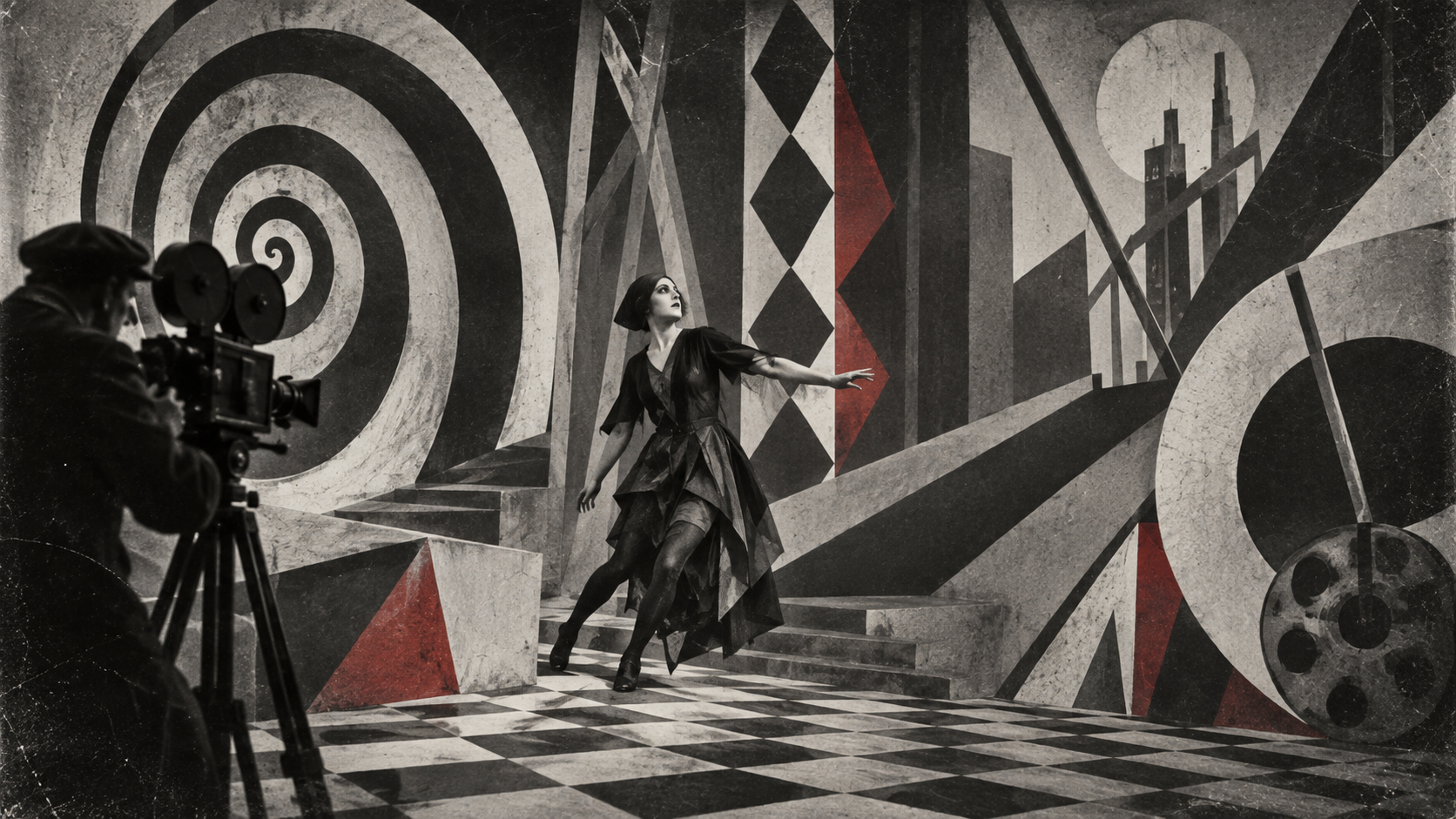
What makes the film exceptional is not its conventional plot but its increasingly oppressive visual environment. Enrico Prampolini designed stark interiors filled with spirals, diamonds, chessboard patterns, painted eyes and severe black-and-white geometries. The sets seem to confine the characters within an unstable psychological space.
As the drama progresses, the distinction between physical setting and mental condition becomes less secure. Architecture no longer serves simply as a background; it participates in the character’s emotional disintegration.
The incomplete surviving version of Thaïs is valuable evidence of the interaction between cinema, theatrical design and avant-garde visual art. Its abstract environments also invite comparison with later European experiments, including German Expressionist films such as The Cabinet of Dr. Caligari.
That comparison should not be presented as proof that Thaïs directly inspired The Cabinet of Dr. Caligari. The two works share striking anti-naturalistic qualities, but establishing a direct line of influence requires stronger documentary evidence than visual similarity alone.
Other Films and the Problem of Classification
Not every unusual Italian film made during this period was a Futurist work.
Amor pedestre, directed by Marcel Fabre in 1914, tells its story almost entirely through the feet and lower legs of its characters. Its reduction of the human body to moving fragments has often been discussed in connection with Futurist performance and visual experimentation. However, it was produced before the 1916 cinema manifesto and was not an official Futurist group production.
Filibus, directed by Mario Roncoroni in 1915, featured an airborne criminal mastermind, advanced machinery and playful changes of identity. Its fascination with technology and modern mobility can appear compatible with Futurist themes, but it was a commercial adventure serial rather than a Futurist manifesto film.
Distinguishing between official Futurist works, films made by artists close to the movement and commercial films sharing similar imagery makes this history more accurate. Futurism was part of a wider early-cinema culture already experimenting with trick photography, accelerated movement, fantasy, machines and fragmented bodies.
Why So Little Futurist Cinema Survives
Italian Futurist cinema produced far fewer films than its energetic manifestos might suggest. The movement lacked a stable production system comparable to Italy’s major studios, and many Futurists worked more extensively in literature, painting, photography, theatre and performance.
The First World War disrupted artistic and industrial activity, while early nitrate film stock was highly fragile and flammable. Poor archival preservation caused the disappearance of a substantial part of silent cinema—not only Futurist productions.
There was also a gap between theory and practice. The manifesto imagined a cinema capable of dismantling and reconstructing the visible world, but filmmaking required equipment, financing, laboratories, performers and distribution. Provocative ideas were easier to publish than to realize.
After the war, the Italian film industry entered the severe difficulties examined in The Great Crisis of Italian Cinema, 1919–1929. Futurist activity continued in other arts, but its first concentrated encounter with cinema had largely ended.
The Real Legacy of Futurist Cinema
The importance of Italian Futurist cinema should not be measured by the number of surviving films. Its most durable contribution was conceptual: it argued that cinema could transform reality rather than merely record it.
The Futurists proposed moving typography, simultaneous actions, animated objects, visualized emotions, shifts of scale and combinations of multiple art forms. Similar strategies later appeared throughout international experimental cinema, animation and graphic filmmaking.
However, resemblance does not automatically establish direct influence. There is insufficient evidence to claim that Futurist cinema directly shaped Federico Fellini, Jean-Luc Godard, David Lynch, computer-generated imagery or the modern music video. Those assertions exaggerate a complex history involving many separate movements, technologies and artists.
A more defensible conclusion is that the 1916 manifesto anticipated questions that later avant-garde filmmakers would explore independently or through broader European modernism: Could film abandon linear narrative? Could editing reproduce thought? Could objects become performers? Could words and abstract forms move across the screen? Could cinema combine all the arts?
The Futurists did not invent every technique they advocated, nor did they consistently transform their proposals into finished films. Their contribution was to recognize cinema’s capacity for radical visual experimentation at a remarkably early stage.
That combination of visionary theory, incomplete realization and extensive loss makes Futurist cinema one of the most fascinating—and most easily overstated—chapters in the history of Italian cinema.
Further Reading
Readers interested in the original manifestos can find English translations in Film Manifestos and Global Cinema Cultures, edited by Scott MacKenzie.
External Sources
Treccani – The Historical Avant-Gardes and Cinema
Treccani Encyclopedia of Cinema – Futurism
University of California Press – The Futurist Cinema
The Futurist Archive – La cinematografia futurista
The Metropolitan Museum of Art – Anton Giulio Bragaglia and Photodynamism