

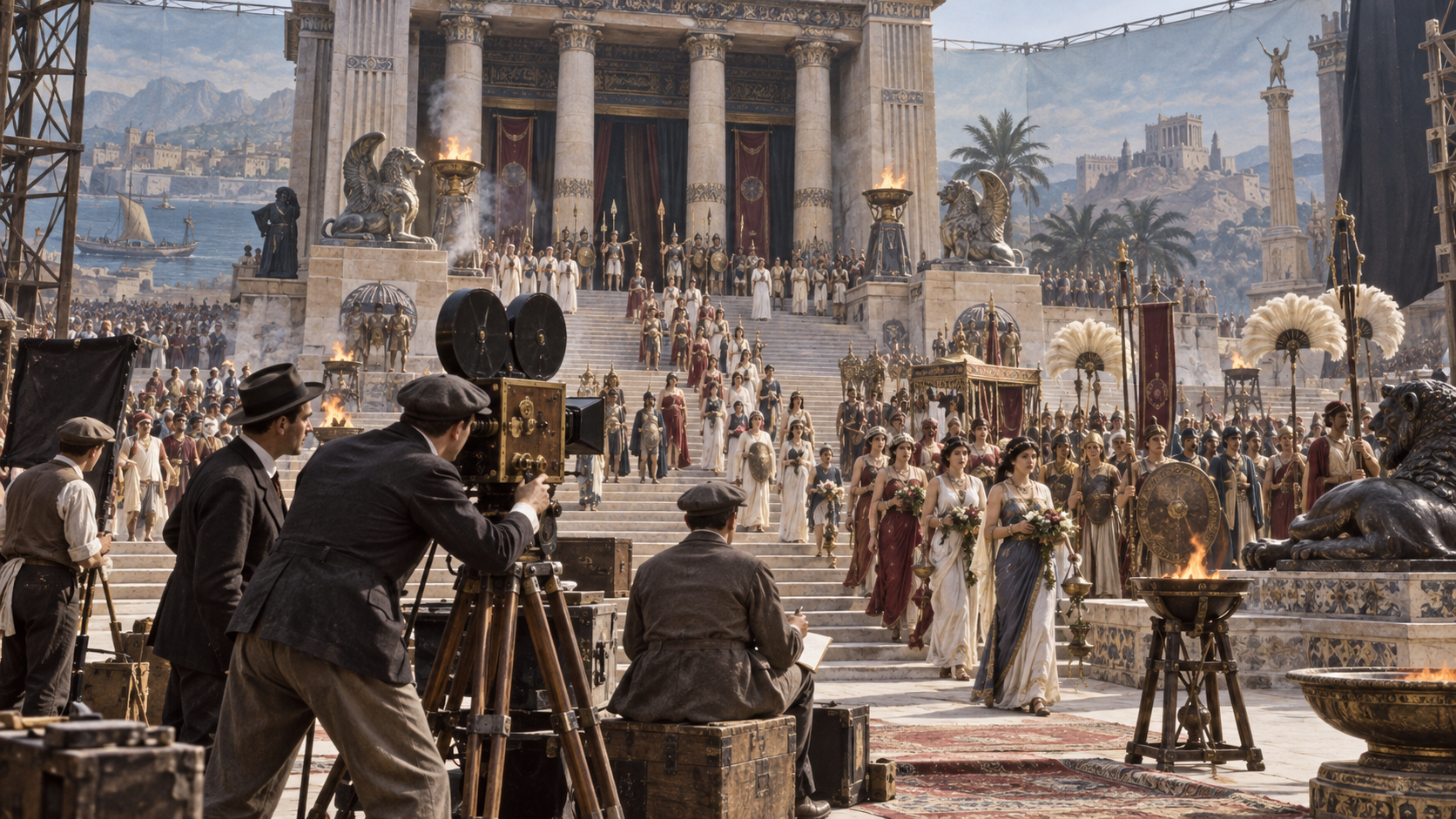
 Between 1910 and the outbreak of the First World War, Italy became one of the most ambitious and internationally successful filmmaking countries in the world. Italian studios transformed the young medium through historical epics, literary adaptations, elaborate sets and increasingly long narratives.
This brief but extraordinary period is often described as the first Golden Age of Italian cinema. Its defining genre was the kolossal: a large-scale spectacle that recreated ancient civilizations, biblical stories and famous episodes from history. The movement reached its artistic and technical summit with Giovanni Pastrone’s Cabiria in 1914.
These films did more than entertain audiences. They helped establish the feature-length film, showed that cinema could compete with theatre and opera, and influenced how filmmakers around the world approached historical spectacle.
Why Italian Cinema Flourished
By the beginning of the 1910s, Italy had developed several important centres of film production. Turin was home to companies such as Ambrosio Film and Itala Film, while Cines operated from Rome and Milano Films became an important force in Milan.
These companies were no longer producing only brief scenes or one-reel stories. They were building permanent studios, employing actors and technicians, developing international distribution networks and experimenting with longer films.
Italy possessed several advantages. Its ancient monuments, artistic heritage and association with Roman history gave its productions an immediate visual identity. Historical subjects were also easy to export because audiences in different countries already knew stories about Nero, Pompeii, Hannibal, early Christianity and the Roman Empire.
The Italian industry used that cultural inheritance to distinguish itself from French, Danish and American competitors. Instead of attempting to imitate foreign films, Italian producers presented their country as the natural home of monumental historical cinema.
This development followed the pioneering experiments described in our guide to the beginning of the Italian film industry.
What Was the Italian Kolossal?
The Italian word kolossal, deliberately spelled with a “k,” became associated with films distinguished by immense sets, large casts, expensive costumes and stories drawn from antiquity, religion or national literature.
The rise of the kolossal was not simply a matter of making everything bigger. It reflected a fundamental change in the status of cinema.
Early films were often presented as short attractions within a varied entertainment program. The Italian epics helped turn filmgoing into a major cultural event. Longer running times, reserved seating, specially composed music, prestigious theatres and extensive advertising encouraged audiences to treat cinema as something comparable to an important theatrical or operatic production.
The genre also offered filmmakers opportunities to experiment with crowd movement, depth of staging, lighting, special effects and relationships between actors and monumental architecture. These experiments prepared the way for the increasingly sophisticated visual language of feature filmmaking.
L’Inferno and the Prestige of Italian Literature
One of the period’s early landmarks was L’Inferno, released by Milano Films in 1911. Inspired by the first part of Dante Alighieri’s Divine Comedy, the film was directed by Francesco Bertolini, Adolfo Padovan and Giuseppe de Liguoro.
Its succession of elaborate tableaux recreated some of Dante’s most memorable visions, including the circles of Hell, condemned souls, mythological creatures and encounters with famous historical figures. The filmmakers drew heavily upon Gustave Doré’s celebrated illustrations of Dante’s poem.
L’Inferno demonstrated that a substantial film based on a canonical literary work could attract both popular and educated audiences. It also showed how Italian cinema could use the country’s literary heritage to gain cultural prestige and international recognition.
From Troy to Ancient Rome
Giovanni Pastrone and Luigi Romano Borgnetto’s La caduta di Troia (The Fall of Troy), produced by Itala Film in 1911, was another important step toward the fully developed historical epic.
The film condensed the story of Troy into a series of carefully arranged scenes involving palace interiors, armies, the wooden horse and the destruction of the city. Although its camera remained largely fixed, the scale of the sets and the organization of action within the frame pointed toward the greater ambitions of Cabiria.
Historical productions multiplied rapidly. Roman emperors, Christian martyrs, mythological heroes and doomed ancient cities provided filmmakers with subjects that combined education, melodrama and spectacle.
Quo Vadis? Becomes an International Event
Enrico Guazzoni’s Quo Vadis?, produced by Cines and released in 1913, was one of the greatest international successes of early Italian cinema.
Adapted from Henryk Sienkiewicz’s novel, the film follows the Roman soldier Marcus Vinicius, his love for the Christian woman Lygia and the persecution of Christians during the reign of Nero. Guazzoni staged the story through monumental sets, large crowd scenes, lavish costumes and dramatic episodes involving imperial Rome.
The scale and length of Quo Vadis? allowed it to be marketed as a special attraction rather than an ordinary film. Its international distribution demonstrated that audiences would pay premium prices and remain in a theatre for an extended historical production.
For this reason, Quo Vadis? is frequently discussed as an early predecessor of the modern blockbuster. It established a commercial model in which spectacle, advertising, prestigious source material and event-style exhibition reinforced one another.
The previous ItaliaMia version dated the film to 1912. The accepted release year is 1913.
The Battle of Pompeii
The popularity of ancient-world stories was so intense that two Italian companies released competing adaptations of Edward Bulwer-Lytton’s novel The Last Days of Pompeii in 1913.
Ambrosio Film produced Gli ultimi giorni di Pompei, directed by Eleuterio Rodolfi, although Mario Caserini has also sometimes been associated with the production. Pasquali Film released a separate adaptation titled Jone, ovvero Gli ultimi giorni di Pompei, directed by Giovanni Enrico Vidali.
This competition reveals how commercially valuable the kolossal had become. Pompeii offered everything the genre required: romance, religious conflict, monumental architecture, crowds, disaster and the eruption of Vesuvius.
The films also illustrate an important feature of the period. Historical authenticity was less important than creating a convincing visual world capable of overwhelming the spectator. Ancient history provided the setting, but melodrama gave these productions their emotional appeal.
Cabiria: The Summit of the Italian Kolossal
The achievements of the period converged in Giovanni Pastrone’s Cabiria, produced by Itala Film and released in 1914.
Set during the Second Punic War, the film follows a Sicilian girl separated from her family after an eruption of Mount Etna. Kidnapped and taken to Carthage, Cabiria is selected for sacrifice in the temple of Moloch before being rescued by the Roman Fulvio Axilla and his powerful companion Maciste.
The personal story unfolds against an immense historical background that includes Hannibal’s crossing of the Alps, the conflict between Rome and Carthage, the campaigns of Scipio and Archimedes’ defence of Syracuse.
Pastrone combined intimate melodrama with battles, ceremonies, palaces, temples and vast crowd scenes. Rather than presenting history as a disconnected series of tableaux, he connected several characters and parallel lines of action across a long narrative.
Sets, Special Effects and the Moving Camera
Cabiria was remarkable for the physical depth of its sets. Actors could move through large, three-dimensional environments instead of performing only in front of painted backdrops.
The temple of Moloch became the film’s most famous image. Its enormous idol, flames and lines of victims transformed a religious ritual into a terrifying cinematic spectacle. Segundo de Chomón, one of early cinema’s most accomplished specialists, contributed to the production’s photography and special effects.
Pastrone also employed controlled camera movements often described as carrelli, or tracking shots. Moving cameras were not invented by Cabiria, but Pastrone used them with unusual purpose and consistency. The camera could advance into a scene, reveal spatial relationships or guide attention through a complex set.
This combination of camera movement, deep staging, lighting and architectural scale gave the film a visual fluidity that distinguished it from many earlier historical productions.
Gabriele D’Annunzio and the Film’s Cultural Prestige
The celebrated writer Gabriele D’Annunzio received prominent billing in the publicity for Cabiria. Giovanni Pastrone devised the story and screenplay, while D’Annunzio contributed the elevated language of the intertitles and supplied or refined character names.
Associating the production with one of Italy’s most famous literary figures was also a brilliant marketing decision. D’Annunzio’s name helped present Cabiria as a prestigious work of national art rather than merely a popular entertainment.
The original presentation further strengthened that impression. Major screenings used orchestral and choral accompaniment. Ildebrando Pizzetti composed the Sinfonia del fuoco for the temple sequence, while Manlio Mazza prepared the remainder of the musical accompaniment.
The film premiered in Turin and Milan on April 18, 1914. Its combination of film, literature, music and theatrical spectacle made it one of the most ambitious cultural events of the silent era.
Maciste: From Supporting Character to Italian Icon
Cabiria also introduced Maciste, played by Bartolomeo Pagano. In the film, Maciste is the immensely strong companion of Fulvio Axilla, but his physical presence and heroic personality made him one of the production’s most memorable characters.
Pagano subsequently returned as Maciste in a long series of films. The character moved beyond the ancient world and appeared in adventures set in different periods and environments.
Maciste became one of early cinema’s first recurring action heroes and helped create an Italian tradition of muscular screen heroes that would later reappear in the peplum, or sword-and-sandal films, of the 1950s and 1960s.
Did Cabiria Influence Hollywood?
Cabiria circulated internationally and became an important reference point for filmmakers interested in feature-length spectacle. Its scale, monumental settings and integration of historical events with personal drama anticipated later epics produced in Europe and the United States.
The film is often said to have influenced D. W. Griffith’s Intolerance of 1916. The comparison is reasonable, particularly because both productions use enormous sets, large crowds and historical spectacle. However, claims of a simple, directly documented line of influence should be treated cautiously.
What can be stated confidently is that Cabiria helped establish a model of epic filmmaking that became part of an international cinematic language. Italian filmmakers had shown that a motion picture could sustain a complex story over several hours and compete with the scale of opera, theatre and historical painting.
Beyond the Historical Epic
The Italian cinema of this period was not limited to ancient spectacles. Comedies, crime stories, melodramas and films centred on charismatic actresses also attracted large audiences.
The emerging diva film placed emotionally intense female performances at the centre of stories about desire, social position, betrayal and sacrifice. Actresses such as Lyda Borelli and Francesca Bertini would become internationally recognized screen personalities.
Nino Martoglio’s Sperduti nel buio (Lost in Darkness, 1914) offered a striking contrast to the grand historical epic through its portrayal of poverty and social division in Naples. Later critics sometimes described it as a distant anticipation of Neorealism. Because the film is lost, however, such comparisons depend largely on contemporary accounts and surviving documentation and should not be presented as an uncontested direct connection.
The End of a Brief Golden Age
The outbreak of the First World War interrupted the conditions that had supported Italy’s cinematic expansion. Production costs increased, international distribution became more difficult and foreign competitors—especially the rapidly consolidating American industry—grew stronger.
Italian studios continued making important films after 1914, but the momentum of the early kolossal could not be maintained indefinitely. Structural weaknesses, fragmented production and changing international markets eventually contributed to the great crisis of Italian cinema between 1919 and 1929.
Nevertheless, the films produced between 1910 and 1914 permanently changed the possibilities of the medium. L’Inferno, Quo Vadis? and especially Cabiria demonstrated that cinema could reconstruct entire worlds, combine popular entertainment with cultural prestige and carry Italian creativity to international audiences.
Within the broader history of Italian cinema, this first Golden Age deserves recognition not simply for the size of its productions, but for the filmmakers’ determination to transform a new invention into an ambitious narrative art.
Further Reading
For a scholarly introduction to the studios, genres, performers and international circulation of the period, see Italian Silent Cinema: A Reader, available through Amazon.com.
External Sources
Museo Nazionale del Cinema – Cabiria and Italian silent-film restoration
Cineteca di Bologna – Cabiria: credits, restoration and historical notes
British Film Institute – Cabiria among the great silent epics
European Film Gateway – Silent-era films from the Museo Nazionale del Cinema