

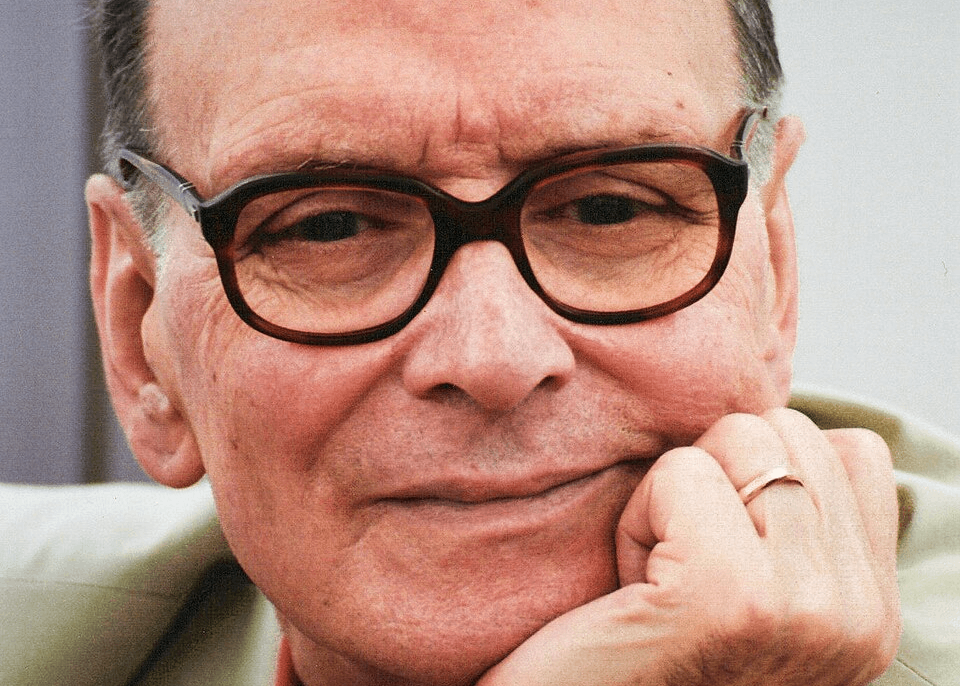
 Ennio Morricone transformed film music into a form of storytelling as expressive as dialogue or photography. Through unforgettable melodies, unusual instruments, human voices, whistles, bells, electric guitars and moments of carefully controlled silence, he created music that could reveal what a character feared, desired or remembered before a single word was spoken.
Although he remains inseparable from the Westerns of Sergio Leone, Morricone’s career was far broader. He composed for political dramas, thrillers, comedies, horror films, historical epics and intimate stories of love and memory. He also arranged some of the most inventive Italian popular songs of the 1960s and wrote more than one hundred concert works independent of cinema.
Across a career spanning nearly six decades, Morricone composed more than four hundred original scores for film and television. His music reached audiences who may never have known the titles of the films but immediately recognized the lonely whistle from The Good, the Bad and the Ugly, the soaring oboe melody from The Mission or the nostalgic themes of Cinema Paradiso.
Early Life in Rome
Ennio Morricone was born in Rome on November 10, 1928. His father, Mario, was a professional trumpet player who performed in orchestras and introduced his son to the practical realities of a musician’s life.
Morricone began writing music while still a child and entered Rome’s Conservatorio di Santa Cecilia, where he studied trumpet, choral music, instrumentation and composition. His most influential teacher was the distinguished Italian composer Goffredo Petrassi, who gave him a rigorous foundation in harmony, counterpoint and modern composition.
The discipline of the conservatory remained essential to Morricone throughout his life. Even his most experimental film scores were carefully constructed. Sounds that seemed spontaneous—a cracking whip, a ringing bell, a coyote-like cry or a fragment played on electric guitar—were usually integrated into precisely organized musical patterns.
After completing his studies, Morricone worked as a trumpeter in Roman orchestras and wrote music for radio, theater and other performers. These early jobs gave him experience in moving rapidly between classical music, jazz, entertainment and commercial recording.
Arranger for Italian Popular Music
Before becoming internationally famous as a film composer, Morricone was one of Italy’s most imaginative arrangers of popular music.
During the late 1950s and 1960s, he worked extensively with RCA Italiana, arranging recordings for artists including Mina, Gianni Morandi, Gino Paoli, Edoardo Vianello and Rita Pavone. He also collaborated with international performers such as Paul Anka and Chet Baker.
Morricone approached a pop song as a miniature dramatic work. Instead of merely adding strings or a conventional orchestral accompaniment, he might introduce unusual percussion, unexpected changes of rhythm, fragments of spoken sound or instrumental combinations borrowed from contemporary classical music.
One of the finest examples is Mina’s “Se telefonando,” composed by Morricone with lyrics by Maurizio Costanzo and Ghigo De Chiara. The song develops from a compact melodic idea that is repeatedly transformed by changes in harmony, orchestration and intensity. It remains one of the landmarks of Italian popular music.
This commercial work was not separate from Morricone’s later film career. It taught him how to create a memorable identity within a few seconds—a vital skill for a composer working with images.
Experimental Music and Il Gruppo
At the same time that Morricone was arranging popular songs, he was involved in Rome’s avant-garde music scene.
He became a member of the Gruppo di Improvvisazione Nuova Consonanza, often called simply Il Gruppo. The ensemble explored free improvisation, extended instrumental techniques, electronic effects, noise and unconventional methods of producing sound.
This experimental background helps explain why Morricone’s film scores sounded unlike traditional Hollywood music. He understood how a noise could become a musical event and how familiar instruments could be made strange. He was equally comfortable writing a beautiful melody for strings or building tension from repeated notes, dissonant clusters, breathing, metallic impacts and distorted voices.
Morricone never considered experimentation and accessibility to be opposites. His most popular scores frequently combine a simple, emotionally direct melody with daring textures beneath it.
From Il federale to a New Language for Film
Morricone’s first major credited film score was for Luciano Salce’s Il federale, released in 1961. More assignments followed quickly as directors recognized his ability to give each film a distinct musical identity.
His decisive breakthrough came through his collaboration with Sergio Leone. The two men had attended the same primary school in Rome but became creative partners as adults.
Their first film together was A Fistful of Dollars in 1964. Because the production did not have the resources of a major American studio, Morricone turned limitation into invention. Instead of relying entirely on a large symphonic orchestra, he used whistling, bells, whips, gunshot-like effects, choral cries and electric guitar.
The result did more than accompany Leone’s images. It created an entirely new musical vocabulary for the Italian Western.
Read more about the film in ItaliaMia’s feature on A Fistful of Dollars.
Sergio Leone and the Dollars Trilogy
Morricone continued his collaboration with Leone on For a Few Dollars More and The Good, the Bad and the Ugly. Together, the three films became known as the Dollars Trilogy and established both artists internationally.
For For a Few Dollars More, Morricone used the melody of a chiming pocket watch as part of the story. The sound is not simply background music: it controls the timing of the final confrontation and connects the characters through a shared memory.
In The Good, the Bad and the Ugly, the famous two-note main theme resembles the howl of a coyote. Different instrumental colors identify the film’s three central characters, while “The Ecstasy of Gold” builds from a repeating piano figure into an overwhelming combination of orchestra, percussion and Edda Dell’Orso’s wordless soprano.
Leone sometimes asked Morricone to compose important themes before filming. The director could then play the music during production, allowing camera movement, acting and editing to develop in relation to the score. Their collaboration made music part of a film’s conception rather than something added only after the images had been completed.
Once Upon a Time in the West
Once Upon a Time in the West, released in 1968, represents one of the highest achievements of the Leone–Morricone partnership.
Morricone created distinct musical identities for the principal characters. Jill McBain receives a sweeping, almost operatic theme sung by Edda Dell’Orso. The mysterious Harmonica is represented by a tense, breath-driven harmonica phrase connected to his traumatic past. The ruthless Frank is accompanied by music that combines menace with unexpected grandeur.
The score demonstrates Morricone’s ability to communicate information gradually. The meaning of the harmonica motif changes as the story reveals the connection between Harmonica and Frank. Music becomes memory, identity and destiny.
Morricone later reunited with Leone for Duck, You Sucker! and Once Upon a Time in America. The latter score is among his most melancholy, using pan flute, strings and the song “Amapola” to evoke friendship, betrayal and the unreliability of memory.
Explore the genre more fully in ItaliaMia’s history of the spaghetti Western.
Beyond the Western
The enormous popularity of the Leone films occasionally obscured the extraordinary range of Morricone’s work.
He scored The Battle of Algiers, Gillo Pontecorvo’s influential account of the Algerian struggle for independence. The music combines military rhythm, tension and lament while avoiding the emotional simplifications of a conventional action score.
For Elio Petri, Morricone composed unsettling and darkly satirical music for Investigation of a Citizen Above Suspicion and The Working Class Goes to Heaven. These scores echo the absurdity, corruption and psychological instability examined by the films.
His work with Pier Paolo Pasolini included The Hawks and the Sparrows, Theorem, The Decameron and Salò, or the 120 Days of Sodom. Each demanded a different musical response, from playful irony to sacred intensity and deliberate discomfort.
Morricone also wrote for Bernardo Bertolucci’s Before the Revolution and 1900, Marco Bellocchio’s Fists in the Pocket, and several thrillers directed by Dario Argento. In films such as The Bird with the Crystal Plumage, The Cat o’ Nine Tails and Four Flies on Grey Velvet, whispered voices, childlike melodies and dissonant sounds create an atmosphere that is simultaneously seductive and disturbing.
This diversity places Morricone at the center of the history of Italian cinema, not merely within one popular genre.
International Films and Hollywood Directors
Morricone remained based in Rome even as his reputation became international. He never needed to relocate permanently to Hollywood to work with major American and European directors.
For Terrence Malick’s Days of Heaven, he wrote luminous music that complements the film’s images of fields, changing skies and fragile human lives. The score received Morricone’s first Academy Award nomination.
John Carpenter’s The Thing required something entirely different. Its ominous electronic pulse is deliberately restrained, creating a sense of isolation and approaching danger. The score is a striking example of Morricone adapting his voice to the aesthetic of another filmmaker without losing his own identity.
Other important international scores include Roman Polanski’s Frantic, Brian De Palma’s The Untouchables and Casualties of War, Barry Levinson’s Bugsy, Wolfgang Petersen’s In the Line of Fire, Mike Nichols’s Wolf and Warren Beatty’s Bulworth.
For The Untouchables, Morricone combined heroic orchestral writing with nervous rhythms and sinister themes. The recording earned him a Grammy Award.
The Mission and “Gabriel’s Oboe”
Roland Joffé’s The Mission inspired one of Morricone’s most celebrated scores.
The film follows Jesuit missionaries and Indigenous communities in eighteenth-century South America. Morricone combined three musical worlds: European church music, Indigenous-inspired rhythm and the orchestral language of cinema.
“Gabriel’s Oboe” represents communication through music. When Father Gabriel plays his oboe, the instrument becomes an attempt to cross barriers of language and fear. The theme’s apparent simplicity conceals careful harmonic movement and orchestral balance.
The choral “On Earth as It Is in Heaven” brings the score’s musical elements together, while “The Falls” gives the landscape a sense of spiritual scale. Rather than treating the cultures in the story as unrelated musical categories, Morricone allows their sounds to meet, conflict and eventually coexist.
The Mission received an Academy Award nomination and became one of the most frequently performed works in Morricone’s concert repertoire.
Giuseppe Tornatore and the Music of Memory
Morricone formed another important creative partnership with Sicilian director Giuseppe Tornatore.
Their best-known collaboration, Cinema Paradiso, is a tribute to moviegoing, childhood and the passage of time. Morricone’s principal theme captures the tenderness and sadness of remembering a world that can never be recovered. His son Andrea Morricone composed the film’s famous love theme, making the soundtrack a family collaboration.
Morricone and Tornatore continued working together on Everybody’s Fine, The Legend of 1900, Malèna, The Unknown Woman, Baarìa, The Best Offer and The Correspondence.
These scores reveal a more intimate side of Morricone’s art. Instead of the theatrical confrontations associated with Leone, Tornatore’s films often called for music about memory, longing, absence and emotional connections that survive across time.
After Morricone’s death, Tornatore directed Ennio, an extensive documentary constructed from interviews with the composer and testimonies from filmmakers and musicians. It offers one of the most accessible introductions to Morricone’s personality, methods and creative struggles.
How Morricone Composed for Film
Morricone rejected the idea that film music should merely duplicate what the audience could already see. If a scene was visibly tragic, he did not automatically write conventionally sad music. He searched for an underlying tension, a memory, an irony or a point of view that the image alone did not express.
Several characteristics recur throughout his work:
Memorable melodic cells
Many Morricone themes begin with only a few notes. He repeats and transforms them through changes of harmony, rhythm, instrumentation and register.
The human voice as an instrument
Solo voices, choirs, whispers, cries and wordless singing often carry emotion without using conventional lyrics. The performances of soprano Edda Dell’Orso became especially important to his sound.
Unconventional instruments
Whistles, Jew’s harp, harmonica, electric guitar, bells, ticking watches, typewriters and found sounds could become central parts of a score.
Contrapuntal writing
Morricone frequently layered independent musical lines rather than building everything around a single melody. His conservatory training allowed complex structures to sound immediate and natural.
Music as narrative
A Morricone theme may identify a character, reveal a hidden relationship or return with a different meaning after the audience has learned more about the story.
These methods explain why his music often remains compelling away from the films. The pieces work as independent listening experiences while retaining the dramatic worlds for which they were written.
Concert Music and Partenope
Morricone preferred the expression “absolute music” for compositions written independently of film. Throughout his career he created chamber works, concertos, cantatas, choral pieces and music for solo instruments and orchestra.
Among these works are Frammenti di Eros, Ut, Voci dal silenzio and the cantata Per i bambini morti di mafia. They reveal his continuing engagement with experimental technique, spirituality, civic memory and the possibilities of the human voice.
His only opera, Partenope: Musica per la sirena di Napoli, was completed in the 1990s. The work draws upon the mythological siren associated with the foundation of Naples. After remaining unperformed for almost three decades, it received its first fully staged production at Naples’s Teatro di San Carlo in December 2025.
The posthumous premiere helped renew attention to a side of Morricone’s career that had often been overshadowed by his film scores.
The Hateful Eight and the Long-Awaited Oscar
Quentin Tarantino had used previously recorded Morricone music in several films before asking the composer to create an original score for The Hateful Eight.
Morricone did not attempt to reproduce the heroic or playful language of his Leone Westerns. Instead, he created a dark, claustrophobic score suited to a story of suspicion, isolation and concealed identities. Some musical material originated in ideas written during the period of The Thing, but the finished score developed its own cold and threatening character.
In 2016, at the age of 87, Morricone received the Academy Award for Best Original Score for The Hateful Eight. It was his first competitive Oscar after previous nominations for Days of Heaven, The Mission, The Untouchables, Bugsy and Malèna.
The award followed the Honorary Oscar he had received in 2007 for his contributions to film music. Clint Eastwood, whose screen presence had become inseparable from Morricone’s Western themes, presented the honorary award and translated part of the composer’s acceptance speech from Italian.
Awards and International Recognition
Morricone’s honors included two Academy Awards—one honorary and one competitive—three Golden Globes, a Grammy Award for The Untouchables, multiple BAFTA Awards, numerous David di Donatello and Nastro d’Argento awards, and the Golden Lion for Lifetime Achievement at the Venice Film Festival.
He received the Polar Music Prize and a star on the Hollywood Walk of Fame. Italy also honored him with the rank of Knight Grand Cross of the Order of Merit of the Italian Republic.
The significance of these awards lies not simply in their number. They reflect the unusual breadth of Morricone’s appeal. He was admired by experimental composers, classical musicians, filmmakers, rock bands and listeners who encountered his music through records, concerts or popular culture.
Marriage, Family and Private Life
In 1956, Morricone married Maria Travia, who remained his companion throughout the rest of his life. They had four children: Marco, Alessandra, Andrea and Giovanni.
Maria was an essential presence in Morricone’s personal and creative life, and she contributed texts to some of his vocal compositions. Morricone dedicated his Oscar for The Hateful Eight to her.
Despite his international fame, he remained deeply attached to Rome and to an ordered daily routine. He generally composed at a desk using pencil and manuscript paper rather than depending primarily on a piano or electronic equipment.
His son Andrea became a composer and conductor, while Giovanni pursued work as a filmmaker and screenwriter.
Death and Farewell
Ennio Morricone died in Rome on July 6, 2020, at the age of 91, following complications caused by a fall.
He prepared his own farewell announcement, explaining that he wanted a private funeral and did not wish to disturb others. The message expressed gratitude to friends and collaborators, but its most personal words were reserved for Maria, the woman with whom he had shared more than six decades of marriage.
His death produced tributes from filmmakers, orchestras, musicians and audiences throughout the world. Yet Morricone’s music had already achieved something beyond commemoration: it had become part of the collective language of cinema.
Ennio Morricone’s Influence and Legacy
Morricone changed expectations about what a film score could do. He demonstrated that music could be melodic without being predictable, experimental without becoming inaccessible and emotionally powerful without merely instructing the audience what to feel.
His influence extends far beyond cinema. Metallica has long used “The Ecstasy of Gold” to introduce its concerts. Rock, electronic and hip-hop artists have sampled or reinterpreted his music, while composers including Hans Zimmer have acknowledged his importance.
Directors continue to use Morricone recordings to give new films a sense of grandeur, danger, irony or nostalgia. Concert halls regularly present programs devoted to his work, and new arrangements introduce his melodies to younger audiences.
His compositions endure because they contain strong musical ideas rather than depending entirely on the images they accompanied. A Morricone theme can summon an empty landscape, a lost love, a childhood cinema or an approaching threat within seconds.
He did not simply write music for movies. He showed that the sound of a film could become one of the central ways in which that film is remembered.
Essential Ennio Morricone Scores
Listeners beginning their exploration of Morricone should seek out:
- A Fistful of Dollars
- For a Few Dollars More
- The Good, the Bad and the Ugly
- The Battle of Algiers
- Once Upon a Time in the West
- Investigation of a Citizen Above Suspicion
- Duck, You Sucker!
- Days of Heaven
- The Thing
- Once Upon a Time in America
- The Mission
- The Untouchables
- Cinema Paradiso
- The Legend of 1900
- Malèna
- The Hateful Eight
You can browse Ennio Morricone soundtrack collections on Amazon.com, find books about Morricone and his music, or look for Giuseppe Tornatore’s documentary Ennio: The Maestro.
Frequently Asked Questions
When and where was Ennio Morricone born?
Ennio Morricone was born in Rome, Italy, on November 10, 1928.
How many film scores did Ennio Morricone compose?
He composed more than four hundred original scores for cinema and television, in addition to more than one hundred concert works.
What is Ennio Morricone’s most famous music?
His most widely recognized works include the main theme and “The Ecstasy of Gold” from The Good, the Bad and the Ugly, “Gabriel’s Oboe” from The Mission, the theme from Cinema Paradiso and the score of Once Upon a Time in the West.
Did Ennio Morricone win an Oscar?
Yes. He received an Honorary Academy Award in 2007 and won the competitive Academy Award for Best Original Score for The Hateful Eight in 2016.
Who was Ennio Morricone’s most important collaborator?
Morricone worked with hundreds of filmmakers, but his collaboration with Sergio Leone was especially influential. Together they transformed the sound of the Western and changed the relationship between music and moving images.
External Sources
Ennio Morricone biography — Treccani
Ennio Morricone’s 2007 Honorary Award — Academy of Motion Picture Arts and Sciences
The Hateful Eight at the 2016 Academy Awards
Ennio Morricone’s Grammy Awards and nominations — Recording Academy
Ennio Morricone — Golden Globes
Partenope — Teatro di San Carlo