

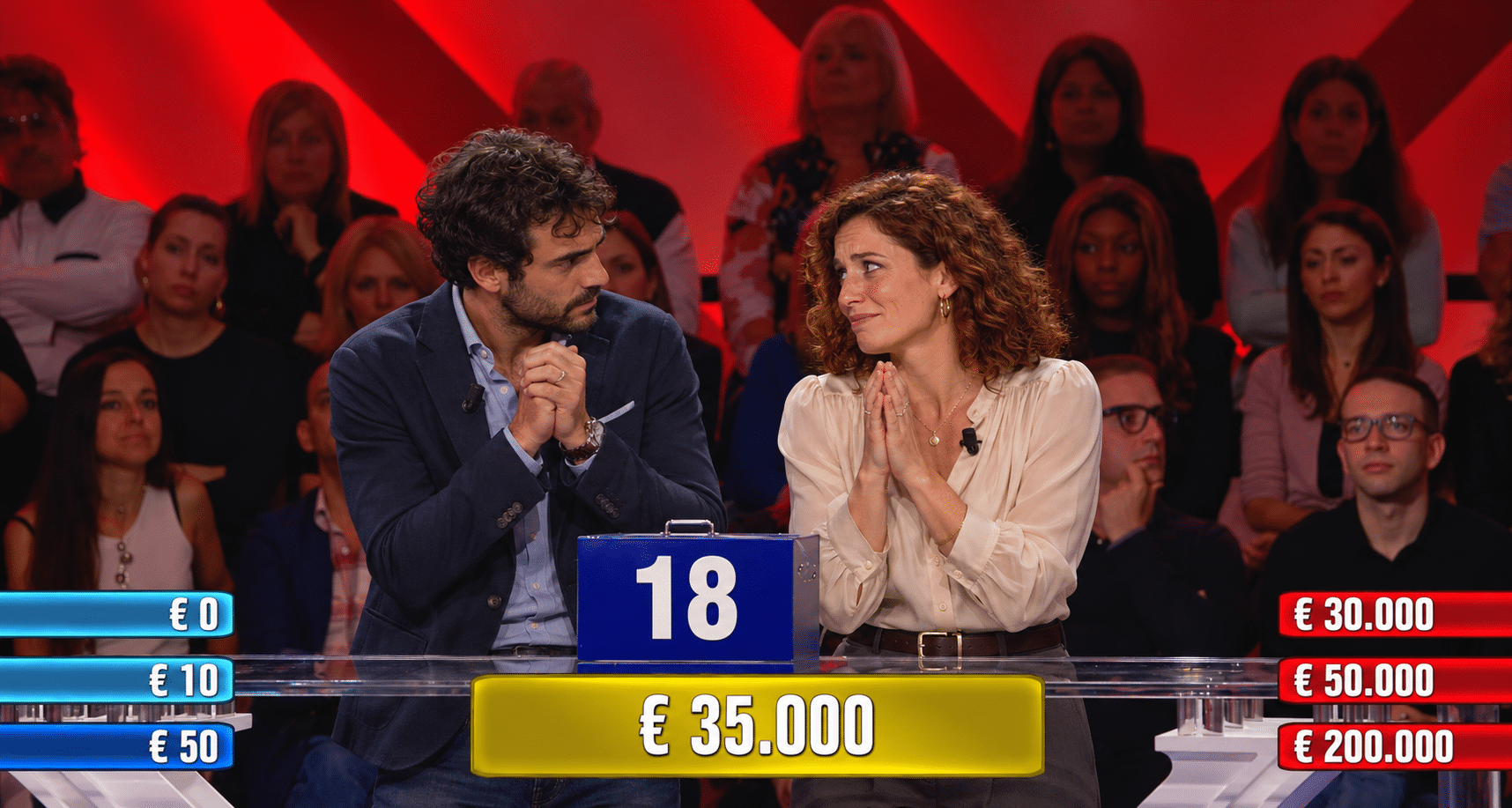
“Take the offer.” “Open one more.” “Don’t change that parcel.”
Affari Tuoi invites these arguments almost immediately. A contestant sits beside someone close to them, a sealed parcel stands between hope and disappointment, and a telephone call turns a possible fortune into a concrete offer.
You do not need to answer questions about history or recognize an obscure Italian expression. You need to decide whether an unknown prize is worth more to you than the amount being offered to give it up.
That simple choice makes Affari Tuoi, Italy’s version of Deal or No Deal, unusually easy to follow—and surprisingly difficult to agree about.
Our guide to Italian game shows introduces the wider television landscape. This article explains the parcels, the Dottore and the decisions that turn a game of chance into a shared evening conversation.
Information checked November 12, 2026. Current-season details were checked against the producer’s 2026–27 regulations and official program pages. The decision examples below are invented illustrations, not accounts of actual contestants.
What Is Affari Tuoi?
The title can mean “your affairs” or “your business,” with a useful suggestion of deals and bargaining.
RaiPlay identifies Stefano De Martino as the current host and describes a game involving 20 contestants, one for each Italian region, with a top ordinary parcel prize of €300,000.
The basic setup is immediately recognizable to viewers familiar with Deal or No Deal. One player has a sealed container; other containers are opened; offers interrupt the process. What gives the Italian version its character is the combination of parcels, regional representatives and a presenter who relays the Dottore’s telephone proposals.
The 2026–27 season launched on September 6, with the producer announcing a regular 20:35 slot on Rai 1 and a new Milan studio. Check the daily schedule for changes.
The Parcels: Why Opening a Small Prize Is Good News
The parcels are called pacchi; the contestant playing the main game is the pacchista.
The player keeps a parcel closed while choosing other parcels to open. Each revealed amount is removed from the board and becomes unavailable as an ordinary parcel prize.
This reverses the instinct of someone watching for the first time. Revealing a tiny amount is good news: a disappointing possibility has disappeared. Revealing a large amount is bad news because that valuable prize has been eliminated.
Imagine the board still contains €100, €500, €20,000 and €100,000. If an opened parcel reveals €100,000, the player has not won it. That amount has just left the game.
The board therefore tells you what remains possible, not what the contestant has already earned.
What do the regions add?
The regional labels give the numbers a human setting. A parcel is associated with someone from Tuscany, Sicily, Veneto or another part of Italy, rather than being an anonymous object.
For an international viewer, this is also a gentle introduction to Italy’s geography. You hear region names repeatedly, attached to real voices and personalities.
A region’s identity does not make its parcel more valuable. Neither does a number that happens to match a birthday. Those associations can make the experience meaningful to the player without supplying information about the hidden prize.
The Three Decisions at the Heart of the Show
The recurring choices are straightforward:
| Choice | Meaning |
|---|---|
| Accept an offer | Give up the parcel’s hidden prize in exchange for the agreed amount. |
| Reject an offer | Continue with the uncertainty of the game. |
| Accept a cambio | Exchange the held parcel for another unopened one when that option is offered. |
The show can present these choices through additional devices, including covered cards associated with an offer or a swap. The package may change; the underlying tension remains the same.
Accepting an offer settles the prize decision. Further openings can show what might have happened, but they do not turn a previously accepted offer into a different award.
That distinction is essential when watching the final reveal. The contestant may discover that they surrendered a fortune—or escaped with much more than their parcel contained.
Who Is the Dottore?
The Dottore is the game’s off-camera negotiating figure, performing the role international audiences associate with the Banker. The presenter receives his telephone calls and conveys his proposals.
The current regulations state that the notary assigns the ordinary parcel prizes secretly and communicates the assignments to the Dottore after play begins.
That knowledge makes the phone call intriguing. Is the offer intended to tempt someone away from a valuable parcel? Is it meant to persuade them to keep a poor one? The viewer can interpret the proposal, but its size alone does not prove what is inside.
A useful way to watch is to separate what the rules establish from what the conversation suggests. The Dottore has a role within the game. A pause, joke or sudden increase in an offer is not a reliable code that lets the audience decode the parcel.
The important exception: Pacco Nero
The Pacco Nero, or Black Parcel, carries a separately drawn value. Under the regulations, that amount is hidden even from the Dottore until revealed.
It is therefore wrong to assume that the Black Parcel means zero, or that the Dottore always knows every amount involved.
When it remains unresolved, it adds uncertainty to the board. Any calculation that treats it as a known fixed amount is missing part of the situation.
Should the Contestant Take the Offer?
There is no answer that fits every board and every person.
An offer can look modest compared with the largest remaining prize and still be substantial compared with the less fortunate outcomes. The contestant must consider the whole range, not just the number they hope to win.
The following examples use ordinary known-value parcels only. They set aside special prizes, hidden-value parcels and any additional information conveyed by the negotiation.
Example 1: certainty has a value
Suppose two ordinary prizes remain: €1 and €100,000. The offer is €35,000.
Assuming the two remaining parcels are equally likely to contain either amount, the average prize is:
(€1 + €100,000) ÷ 2 = €50,000.50
The offer is below that average. It does not follow that accepting it is foolish.
The average describes repeated equivalent games. This contestant faces one outcome: a very small prize or a much larger one. They will not receive €50,000.50 by continuing.
Someone who places a high value on securing €35,000 may reasonably stop. Another person may accept the risk of ending with €1. Their disagreement can reflect different priorities rather than different arithmetic.
Example 2: the largest number can dominate attention
Now imagine four equally likely ordinary prizes remain:
€1 — €100 — €500 — €100,000
Their average is €25,150.25. Suppose the offer is €20,000.
The €100,000 prize makes the board exciting. Yet three of the four possible parcel outcomes are €500 or less.
One viewer sees an offer below the average and wants to continue. Another sees three disappointing outcomes and wants to protect the €20,000.
Both are responding to real features of the example. The first is concentrating on the average; the second on the distribution of outcomes.
The average is a useful reference point, not a complete decision rule.
Example 3: a bad result does not prove a bad decision
A contestant accepts €30,000 and later discovers that the parcel held €100,000.
It is tempting to call the decision a mistake. But before the reveal, the contestant did not know that result.
Reverse the ending: the same player accepts the same offer, and the parcel contains €1. The decision suddenly looks excellent, even though the information available at the moment of choice was identical.
Judge the choice using what was known when it was made. The reveal changes the story; it does not retroactively change the earlier information.
Should You Change Your Parcel?
The cambio produces some of the strongest reactions because it makes the player responsible for surrendering one particular object and choosing another.
Keeping the original parcel can feel loyal. Changing it can feel decisive. Neither feeling establishes its value.
Under a simple model in which unopened parcels are randomly assigned and there is no useful additional information, exchanging one for another does not automatically improve the chance of holding the larger prize.
This is also not automatically the classic Monty Hall problem. In that puzzle, the host’s knowledge and compulsory method of revealing a losing option create a specific probability structure. A swap offer in Affari Tuoi should not be given the same mathematical advantage without checking the actual information and selection process.
For viewers, the most revealing question is often: Why do I want the player to change?
If the answer is a lucky number, a feeling that the original parcel is “due” to disappoint, or an urge to do something after several bad openings, that is an emotional preference rather than new evidence.
The Partner Beside the Player
The pacchista plays with a partner from their family or personal circle. Under the current rules, the pacchista has the final say if the pair disagree.
This arrangement gives the decision an extra dimension. The person beside the player may share the hopes attached to the money while having a different tolerance for uncertainty.
One may be thinking about the largest prize. The other may already be imagining what the current offer could make possible.
Their discussion is part of the attraction because it resembles a recognizable conversation: how much uncertainty should two people accept when both care about the result?
At home, viewers have a comfortable advantage. They can recommend taking a risk without experiencing the consequences.
What Is Regione Fortunata?
Regione Fortunata, the Lucky Region, is an alternative final introduced in the revived format.
The player gives up the remaining parcel prizes to try to identify a region selected in advance. The first successful guess wins €100,000. After an incorrect first attempt, the field is reduced to ten regions for a second chance worth €50,000; another incorrect answer wins nothing.
It is an alternative route, not a bonus automatically added to the parcel prize.
Watch the presenter’s explanation of when the option is available. Its appeal depends partly on how attractive—or disappointing—the remaining ordinary game has become.
What Else Can Change Between Editions?
Affari Tuoi keeps its central offer-or-continue decision while changing supporting features.
The published 2026–27 rules also include a Superpremio Opel car opportunity, triggered by finding three qualifying low-value parcels within the first four openings and then making a successful choice between two concealed options.
These additions explain why an old episode, a special broadcast and the current season may not look identical. For a first viewing, concentrate on the remaining parcels and the offer. Follow the explanation on screen when a separate prize or special mechanism appears.
The ordinary monetary prizes are paid in gettoni d’oro, gold tokens. The displayed amounts should not be treated as identical to a net cash payment.
A Short History of the Italian Version
The producer dates the first Italian episode to October 13, 2003.
Presenters across the show’s history have included Paolo Bonolis, Pupo, Antonella Clerici, Max Giusti, Flavio Insinna and Amadeus. Carlo Conti has hosted prime-time specials. Stefano De Martino took over the regular show in September 2024.
The format has room for different presenting styles because the rules leave space for conversation. The presenter can reassure a nervous player, tease the Dottore and give the audience time to consider the same choice.
For more background, explore our guide to Italian TV personalities and their shows.
Watching Affari Tuoi as an Italian Learner
Affari Tuoi is an approachable starting point because the board and the opened parcels provide visual context.
You may miss a joke and still understand that a large prize has disappeared. Repeated offers also make numbers easier to recognize in context.
| Italian expression | Meaning in the game |
|---|---|
| Pacco / pacchi | Parcel / parcels |
| Offerta | Offer |
| Accetto | I accept |
| Rifiuto | I refuse |
| Cambio | Swap |
| Tengo il mio pacco | I’m keeping my parcel |
| Andiamo avanti | Let’s continue |
| Quanto offre? | How much is he offering? |
Before the contestant answers, pause and make your own decision aloud: Accetto l’offerta or Tengo il mio pacco. Then add a reason.
If you prefer a program that challenges vocabulary and word associations directly, try our L’Eredità and La Ghigliottina guide.
Playing Affari Tuoi at Home
Clementoni produces an Affari Tuoi board game, model 16882, with 20 plastic parcels and an age recommendation of 8+.
It offers a way to experience the suspense with friends or family. Check the contents of the edition before buying: a boxed game does not necessarily include every feature of the current television season.
Affiliate disclosure: As an Amazon Associate, Italia Mia earns from qualifying purchases.
Search Amazon.it for Clementoni Affari Tuoi 16882
This is a product-search link. Check the edition, language, seller and current delivery availability on Amazon.
You can also make watching into a simple household game without buying anything. Write down “accept,” “continue” or “swap” before the contestant decides, together with one sentence explaining why. Compare your reasoning after the reveal.
The aim is to notice how you make decisions, rather than rewrite your earlier prediction to match the result.
Where to Watch
Use the official Affari Tuoi page on RaiPlay for available episodes and program information.
For current installments, choose the 2026–27 season. Live schedules can change, and an accessible program page does not guarantee that every video can be watched outside Italy.
A full episode is the best introduction. Short clips often deliver the dramatic reveal while omitting the earlier openings that made the decision difficult.
Why the Argument Continues After the Parcel Opens
Affari Tuoi gives the audience two different questions to answer.
The first is what the player should do with the information available. The second is how they feel about what happened afterwards.
Those questions are easy to confuse. A cautious choice can miss a fortune; a risky choice can succeed. Neither outcome makes uncertainty disappear from the moment when the decision had to be made.
That is why the show can remain absorbing even when everyone understands the rules. The sealed parcel contains one prize, but the offer means something different to each person watching.
External Links
- RaiPlay: Affari Tuoi
- RaiPlay: 2026–27 episodes
- Endemol Shine Italy: program history and current regulation link
- Endemol Shine Italy: 2026–27 regulations and participation conditions
- Endemol Shine Italy: September 2026 season announcement
- Rai: 2025–26 rules, background on offers, swaps and Pacco Nero
- Rai: earlier regulations explaining Regione Fortunata
- Clementoni: Affari Tuoi, model 16882