
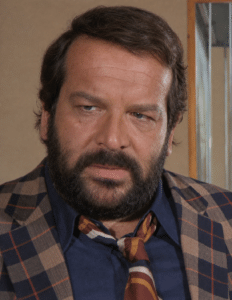
 Before audiences knew his beard, his impatient stare and his apparently effortless knockout punch, Bud Spencer had already made Italian sporting history. Competing under his birth name, Carlo Pedersoli, he broke a national swimming barrier and represented Italy at two Olympic Games. Cinema gave him a second, remarkably different public life.
His screen partnership with Terence Hill made him an international star, but the familiar image of the good-hearted giant tells only part of the story. Spencer’s career connects competitive sport, the changing fortunes of the Italian western, physical comedy and a substantial body of work beyond the famous double act.
Carlo Pedersoli: A Childhood Between Naples and Rome
Carlo Pedersoli was born in Naples on October 31, 1929. He began swimming as a child, and his family subsequently moved to Rome. During his youth, another family move took him to Brazil, giving him experience of life beyond Italy well before his films reached international audiences.
He began university studies in chemistry and later turned to law, but swimming became the arena in which he first established himself. His early adulthood did not follow a simple route toward acting: study, sport, employment and periods in South America all preceded his breakthrough in westerns.
That background helps explain why “former swimmer turned actor” feels like an inadequate description. By the time he became Bud Spencer, Pedersoli had already experienced several different kinds of working life.
The Swimming Champion Before the Movie Star
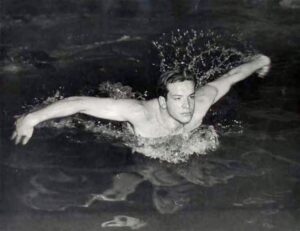 In 1950, Pedersoli became the first Italian swimmer to complete the 100 metres freestyle in under one minute, recording 59.5 seconds at Salsomaggiore. The achievement placed him in Italian sporting history long before his first major film success.
His competitive record included seven individual Italian titles and four relay titles. He also represented Italy at the Helsinki Olympics in 1952 and the Melbourne Olympics in 1956. Although he did not win an Olympic medal, qualifying for two successive Games demonstrated the seriousness of his sporting career.
Swimming was only part of his success in the water. Pedersoli also played water polo and won gold with Italy at the 1955 Mediterranean Games in Barcelona. The distinction matters: his Olympic appearances were in swimming, while that Mediterranean gold came in water polo.
These achievements make his later screen persona particularly interesting. The lumbering, reluctant fighter was a comic creation performed by someone whose earlier career had demanded coordination, strength and competitive discipline.
How Carlo Pedersoli Became Bud Spencer
Pedersoli had appeared in films before his breakthrough, but Giuseppe Colizzi’s Dio perdona… io no! (God Forgives… I Don’t!, 1967) established the partnership that would transform his career.
His co-star was Mario Girotti, who became known internationally as Terence Hill. Both adopted English-sounding stage names for the international market. Pedersoli combined a reference to Budweiser beer with the surname of Spencer Tracy, an actor he admired.
Hill’s own account adds a revealing detail. As a teenager, he had admired Pedersoli at their swimming club in Rome, but they had not become personally acquainted. Both also appeared in Hannibal, without working together on the same shooting days. Their partnership finally began on Colizzi’s western set in Spain.
Further collaborations followed with Ace High in 1968 and Boot Hill in 1969. The combination was already promising: Hill’s quickness and lightness played against Spencer’s imposing stillness.
The Trinity Films and a Different Kind of Western
They Call Me Trinity (Lo chiamavano Trinità…, 1970), directed by Enzo Barboni under the name E. B. Clucher, gave their partnership its defining comic setting. Trinity Is Still My Name (…continuavano a chiamarlo Trinità, 1971) followed.
The pleasure of these films lies partly in their refusal to hurry. Meals, irritated looks and arguments between the two leads can matter as much as the next confrontation. Hill’s Trinity seems capable of causing trouble while barely moving; Spencer’s Bambino looks as though he would prefer everyone to leave him alone.
Their contrasting rhythms make the eventual action funnier. Spencer does not need to match Hill’s agility. A pause, a glare and one decisive movement can complete the joke.
These comedies belong within the broader development of the spaghetti western, its directors and essential films. They show how flexible the genre had become: the same frontier imagery that supported revenge stories could also accommodate broad popular comedy.
Why Bud Spencer and Terence Hill Worked Together
Their partnership offered an immediately readable contrast. Hill was mobile, mischievous and often responsible for drawing his companion into trouble. Spencer appeared solid, suspicious and increasingly exasperated. Neither needed a long explanation for audiences to understand the relationship.
The fight scenes often function as elaborate visual jokes. An opponent approaches with confidence, discovers his mistake and collapses while Spencer barely changes expression. Repetition becomes part of the pleasure: viewers anticipate the familiar gesture and enjoy the variation.
This emphasis on movement, expression and timing helps explain the films’ appeal across languages. Dialogue contributes to the comedy, but much of the relationship remains clear without it.
Their work also moved beyond westerns. Films such as Watch Out, We’re Mad! (1974), Crime Busters (1977) and Odds and Evens (1978) placed the pair in contemporary comic adventures. The setting could change because the central attraction was their contrasting personalities.
Piedone and a Career Beyond Terence Hill
Spencer also developed a substantial screen identity outside the partnership. In Piedone lo sbirro (1973), directed by Steno, he played Inspector Rizzo, a Naples policeman whose imposing presence and unconventional methods became the foundation of a series.
Piedone gives Spencer more space to carry a story himself. His authority is physical, but the appeal of the character depends just as much on warmth and a protective attitude. Naples provides a different atmosphere from the imaginary frontier of the Trinity films.
Other solo vehicles included Lo chiamavano Bulldozer and Bomber. These films invite a different appreciation of his comic presence: without Hill’s constant provocation, Spencer can become the centre around which the supporting characters move.
His filmography also contains unexpected departures. He appeared in Dario Argento’s Four Flies on Grey Velvet and later worked with Ermanno Olmi in Singing Behind Screens. Those credits are useful reminders that the familiar public image never entirely defined the actor’s choices.
Family Life and Later Work
In 1960, Pedersoli married Maria Amato, daughter of film producer Giuseppe Amato. They had three children: Giuseppe, Cristiana and Diamante. Before his major acting breakthrough, he also worked as a songwriter for RCA and in audiovisual production.
Television became an important part of his later career, including Big Man and Extralarge. He and Hill reunited for Troublemakers (Botte di Natale, 1994), directed by Hill. The reunion returned them to a western setting, with the pleasure of recognition now part of the experience.
In 2010, Spencer and Hill received special David di Donatello awards, recognizing their contribution to Italian cinema. Spencer died in Rome on June 27, 2016, aged 86.
Five Films for Discovering Bud Spencer
For a first introduction, these films show several sides of his screen appeal:
- They Call Me Trinity (1970). Start with the western comedy that makes the contrast between Spencer and Hill especially clear. Watch how much of Spencer’s performance happens in the pauses.
- Trinity Is Still My Name (1971). Follow it with the sequel to see the partnership develop within a familiar comic world.
- Piedone lo sbirro (1973). Move to Naples and discover Spencer as a leading character outside the Hill partnership.
- Watch Out, We’re Mad! (1974). A lively introduction to the duo’s contemporary comedy, with the same visual chemistry transferred out of the western setting.
- Crime Busters (1977). Another accessible example of how their contrasting temperaments could sustain a different kind of adventure.
A Legacy Built on Strength and Comic Restraint
Spencer’s size was immediately noticeable, but size alone cannot explain a lasting comic performance. His greater asset was knowing how little he sometimes needed to do. A look of disbelief, a moment of silence or a carefully delayed reaction could make a scene work before the first punch was thrown.
There is a satisfying connection between the two careers. The young Carlo Pedersoli measured success in seconds; the actor Bud Spencer understood the value of timing. One made him a significant figure in Italian sport. The other made him a familiar and much-loved presence in popular cinema.
External Links
- Bud Spencer’s official website: Carlo Pedersoli biography
- Bud Spencer’s official website: acting career
- Terence Hill’s account of their partnership
- CONI: Carlo Pedersoli’s swimming and water-polo achievements
- Filmitalia: Bud Spencer filmography