
Part of Unexpected Italy: Stories from My Recent Travels
 Cristian and I went to Umbria by car, which is still the best way to understand how the region fits together. Perugia, Gubbio and Assisi look close on a map, and they are close enough for a short journey, but the roads between them are part of the experience. They cross cultivated valleys, wooded hills and long stretches where a town appears above the landscape well before you reach it.
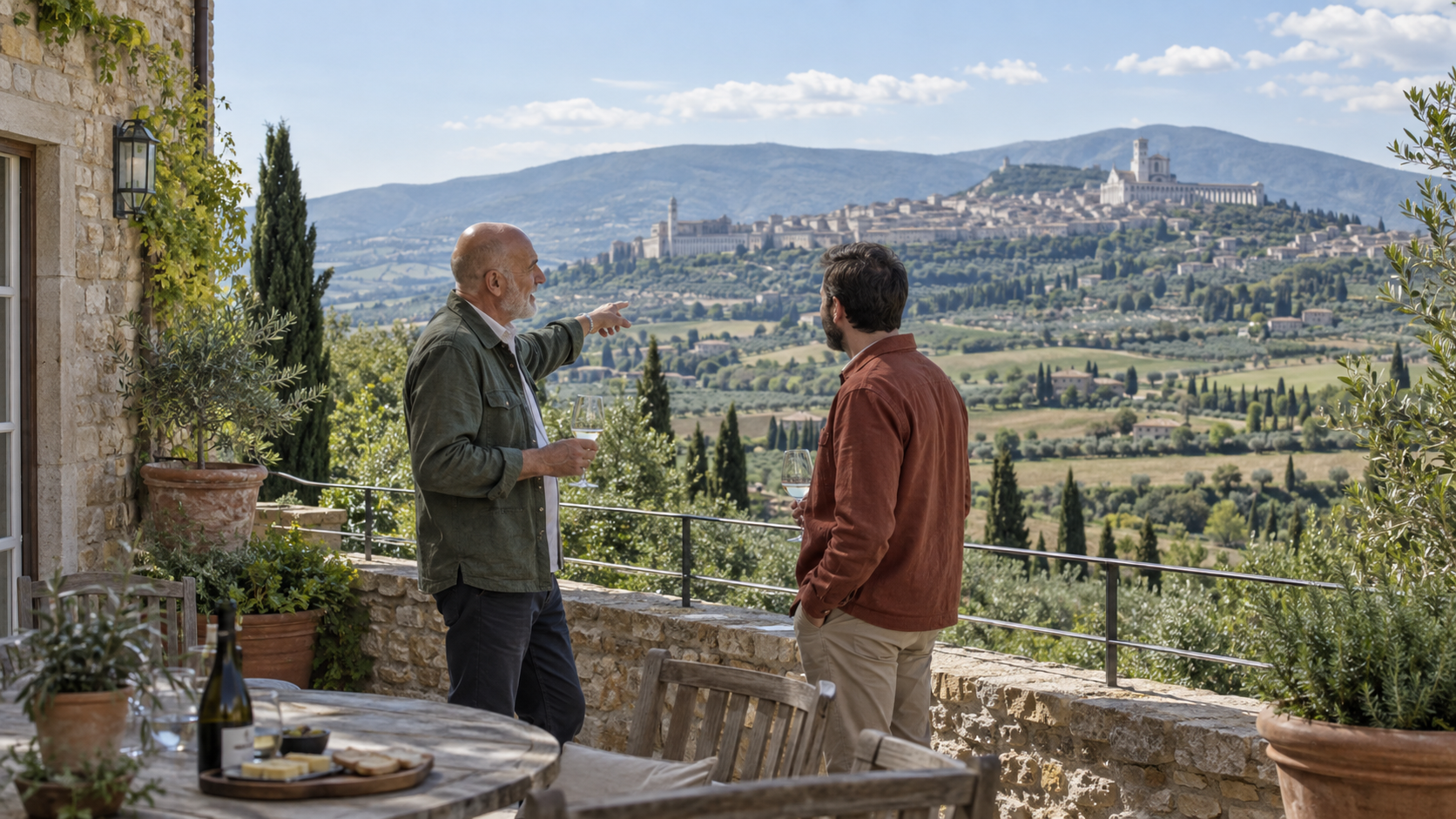
We stayed at UNICA Assisi agri-charming house, in the countryside below Assisi. From there, the city was not simply another destination on the following day’s itinerary. It was present in the distance, raised above the plain and visible from the property. That view gave the trip a fixed point even while we moved between different places.
There was no dramatic event at the center of this journey. What made it memorable was the arrangement of ordinary things: driving with a friend, staying outside the city walls, having dinner with friends near Perugia, and then spending the next day in two towns that could hardly be confused with one another. Gubbio felt severe and vertical; Assisi was more open, luminous and crowded with meanings that went far beyond religion.
Arriving in Umbria by Car
We left northern Tuscany and drove toward Umbria without treating the journey as a race to the hotel. The landscape changed gradually. The mountains and hard stone of our part of Tuscany gave way to a broader, softer countryside, although Umbria is never as gentle as travel advertising sometimes makes it appear. Its hills are cultivated, but they are also steep. Its historic towns are beautiful, but many were built in defensive positions that still require effort from anyone approaching them.
Traveling by car gave us the freedom to move at our own pace. It also made the geography clearer. Perugia occupies its long hilltop; Assisi rests against Monte Subasio; Gubbio rises at the foot of Monte Ingino. These are not towns placed randomly among attractive scenery. Each one has a physical relationship with the land around it.
Cristian and I have traveled together enough to avoid filling every hour with plans. One of us would notice a road, a view or a building, and we could stop or change direction without turning it into a major decision. In a region with no coastline and fewer large urban interruptions, that flexibility matters.
For a broader introduction to the region, Italia Mia’s Travel section includes more ideas for exploring Italy beyond the usual city-to-city itinerary.
Our Stay at UNICA Assisi
We chose UNICA Assisi agri-charming house, a small countryside property near Assisi rather than a conventional hotel in the historic center. The decision made practical sense because we had a car, but it also changed the tone of the stay.
Assisi is one of those places that can become almost abstract when described only through Saint Francis, pilgrimage and medieval art. Seeing it from the countryside returned it to the landscape. From UNICA, the basilica and the town appeared above the plain as part of a larger view rather than as isolated monuments.
The property has a garden, a panoramic pool and an agricultural setting. We were not there to spend the entire trip beside the pool, but the open space was important after driving. A room inside the old town would have placed us immediately among stone streets, shops and visitors. Here we could arrive, park, unpack and look toward Assisi before entering it.
The view was clearest when we stopped moving. During the day, attention goes to roads, directions and the next destination. From the property, the old town remained still in the distance. Its position on the slope became easier to understand than it would have been while walking inside the walls.
This was not isolation. Santa Maria degli Angeli and the roads toward Assisi and Perugia were within easy reach. But the property created enough separation from them to make the evening feel like a real pause.
Dinner with Friends Near Perugia
Our visit to Perugia was not organized around monuments. We went to see friends, and that immediately changed the purpose of the evening. Instead of looking for a restaurant in the center or trying to complete another list of sights, we went to their home and ate on the terrace overlooking the countryside.
The terrace is the detail I remember. From it, the view extended across the Umbrian landscape rather than toward a famous building. As daylight weakened, the countryside lost its sharp divisions. Fields, trees and distant houses became larger areas of color, and then only scattered lights remained.
Dinner at someone’s home also changes the way time is used. There is no waiter waiting to clear the table and no reason to decide quickly where to go next. We ate what our friends had prepared, talked, moved between subjects and remained at the table after the practical part of the meal had ended.
It was a social evening rather than a travel experience designed for visitors, which is precisely why it belongs in the story. The best way to understand a place is not always to see more of it. Sometimes it is to spend several hours in one position while people who live there continue with their normal lives.
Perugia was nearby, with its Etruscan and medieval walls, steep streets and active center, but the city did not need to dominate the evening. Our friends and their terrace gave us another version of the Perugian landscape: residential, private and connected to the countryside beyond the city.
When Cristian and I returned to UNICA, Assisi was still visible in a different form. The daylight view had become a pattern of lights against the dark hillside. The city had not moved, but after dinner with friends it no longer felt like the next attraction waiting to be visited.
The Road to Gubbio
The next day we drove to Gubbio. The route from the Assisi area crosses a part of Umbria that rewards attention. It is easy to think of the drive only in terms of distance, but the movement through the countryside prepares you for the town.
Gubbio has a harder profile than Assisi. Approaching it, the mass of medieval buildings appears pressed against Monte Ingino. Once inside the historic center, the streets rise sharply, the stone is gray and the scale changes quickly from narrow passages to the open space of Piazza Grande.
We walked rather than trying to move the car from one point to another. This is the sensible way to experience Gubbio, although its slopes make comfortable shoes more than a routine travel recommendation. The effort of climbing is part of the town’s structure.
Piazza Grande is one of the places where Gubbio’s engineering and civic ambition become visible at the same time. The large suspended square creates a terrace over the lower town, while the Palazzo dei Consoli rises above it with an authority that still feels deliberate. It is not picturesque in a soft or decorative way. The architecture is disciplined and imposing.
From the square, the view opened over roofs and the valley beyond. Cristian and I stopped there long enough to see how the town had been built in levels. From below, Gubbio can appear compact. From above, its relationship with the mountain and plain becomes clearer.
Gubbio is also associated with the Ceri, the enormous wooden structures carried through the town during the Festa dei Ceri on May 15. We were not there to witness the festival, and it would have been false to write as though we had experienced it. But references to the Ceri are present throughout the town, and they reveal how strongly Gubbio’s civic identity is tied to Saint Ubaldo and to a tradition that belongs to residents before it belongs to tourists.
We continued through the old streets without trying to see every church and palace. Gubbio does not need to be consumed quickly. Its strongest impression comes from the consistency of the stone, the steepness of the streets and the way the mountain remains close even in the center.
From Gubbio Back to Assisi
After Gubbio, we returned toward Assisi. Visiting the two towns on the same day made their differences more visible.
Assisi is also built on a slope, but it receives the visitor differently. The local pink stone changes with the light, and the town opens repeatedly toward the Umbrian plain. Gubbio seemed to draw our attention upward toward Monte Ingino; Assisi directed it outward.
We entered the historic center and walked through streets that were busier than those of Gubbio. Assisi receives pilgrims, organized groups, students, art travelers and people who may have very different relationships with Saint Francis. That mixture can make the town feel crowded, but it also gives it a purpose unlike that of an ordinary preserved hill town.
The Basilica of Saint Francis is unavoidable, both physically and historically. Its two churches, the Sacro Convento and the great supporting structures occupy the edge of the town with a scale that is difficult to understand from photographs. Inside, the fresco cycles connect religion, art and political history; outside, the view returns immediately to the valley.
We did not reduce Assisi to the basilica. We continued through Piazza del Comune, where the Roman Temple of Minerva survives behind a later church façade, and along the streets toward the Basilica of Santa Chiara. Layers of Roman, medieval and modern life coexist within a town often presented as though it belonged to a single century and a single saint.
What interested me most was the contrast between seeing Assisi from UNICA and walking inside it. From the countryside, it appeared complete and almost silent. Within the walls, it was made of slopes, separate buildings, voices, shop windows, religious groups and residents going about their day. Both impressions were true, but neither was sufficient alone.
Three Places, Three Different Versions of Umbria
In a short trip, Perugia, Gubbio and Assisi can easily become three names on an itinerary. Our journey did not feel that way because each place served a different purpose.
Perugia was connected to friendship and a private dinner overlooking the countryside. We did not need to prove we had visited it by listing monuments. The evening mattered because of the people who live there.
Gubbio was the most physically demanding and architecturally severe of the three. Its steep streets and civic buildings created an impression of strength rather than charm.
Assisi occupied both ends of the trip. We first saw it at a distance from our accommodation and later entered it on foot. That movement—from landscape to street level—made it more complex than the familiar image of the basilica on the hillside.
Cristian and I returned to the car with no single event that could be called the climax of the journey. The trip had worked because of its balance: private time with friends, public historic spaces, driving through open country and staying where the view connected all of it.
Practical Notes for This Umbria Route
A car is the simplest way to reproduce this type of journey. It allows you to stay in the countryside, visit friends outside the historic centers and travel between Assisi and Gubbio without arranging the day around limited connections. Parking inside or close to the old towns can be restricted, so use the signed public parking areas and continue on foot.
Gubbio and Assisi both involve slopes, stone paving and long periods of walking. Comfortable shoes are essential. In Assisi, check access rules and opening hours for religious sites; services and special events can change visitor access. In Gubbio, allow more time than the map suggests because the steep streets slow the pace.
UNICA Assisi was the property where we stayed. Its official website provides current information and direct contact details. I could not verify a dedicated Trip.com page for the property, but travelers comparing other accommodation in the area can check hotels in Assisi through Trip.com.
Readers planning a longer regional journey can also browse Umbria travel guides on Amazon.com.
Some links in this article are affiliate links. Italia Mia may earn a commission if you make a booking or purchase, at no additional cost to you.
What Remained After the Trip
The lasting image was not a monument. It was the countryside seen from two different terraces: first from our accommodation below Assisi and then from our friends’ home near Perugia.
The historic towns gave the journey its structure, but those quieter views gave it proportion. They reminded me that Perugia, Gubbio and Assisi are not isolated objects preserved for visitors. They remain connected by roads, farms, homes, friendships and the ordinary movement of people across the region.
That is what traveling through Umbria by car made clear. The towns were important, but the space between them—and the people waiting at the end of one of those roads—was equally part of the journey.
External Sources
- UNICA Assisi official website
- Official Assisi tourism website
- Umbria Tourism: Gubbio
- Umbria Tourism: Perugia
- Umbria Tourism itinerary from Assisi to Gubbio