I visited the island of Motia with my friend Salvatore, who was also my guide. Our excursion brought together the archaeological site and its museum: a chance to look at what the excavations have revealed, then follow the island’s history through the objects recovered from its soil.
Motia, also known as Motya or Mozia, lies in the Stagnone lagoon near Marsala, in western Sicily. The ancient settlement occupies the island of San Pantaleo. Its setting makes it an appealing excursion, but the archaeology deserves time of its own.
For this chapter of Unexpected Italy: Stories from My Recent Travels, I want to bring the excavations and museum together. The most interesting questions connect them: what stood here, how people used it, and how much can we really know from what survives?
An Island Connected to the Mediterranean
Motia’s position helped make it a trading centre linking the eastern and western Mediterranean. Today, visitors reach the island by a short boat crossing from the lagoon’s mainland shore. In antiquity, it also had a road connection towards Birgi, traces of which can still be visible in shallow water.
That connection is worth keeping in mind. An island can look isolated on a map while being closely involved in the movement of people and goods. At Motia, the relationship between land and water is part of the history you have come to understand.
I would begin a visit with the island map and a little orientation. Locate the gates, the sanctuary areas and the museum before setting off. That makes it easier to connect individual remains with the larger settlement, especially where buildings survive only in fragments.
What to Look for Among the Excavations
The archaeological route includes stretches of defensive walls, the North and South Gates, the sanctuary known as Cappiddazzu, the archaic necropolis and the sacred enclosure called the Tophet. Together, these places introduce different aspects of the city: defence, worship and the treatment of its dead.
It is tempting to move quickly from one named monument to another. I would suggest choosing a few places for closer attention. Ask where an entrance was, which walls belong together, and what evidence supports the explanation on a sign or in a guidebook.
My excursion was with Salvatore as both friend and guide. For anyone planning a similar visit, this is a good destination for an informed local guide, particularly if archaeological plans are unfamiliar. Before booking, ask whether the visit covers both the outdoor remains and the museum, and how much walking it involves.
The Basin That Changed Its Meaning
One of Motia’s most revealing archaeological stories concerns the rectangular basin traditionally called the Kothon. Long interpreted as a harbour, it has been reassessed through research led by Lorenzo Nigro of Sapienza University of Rome.
The excavations identified a freshwater-fed basin within a religious complex, rather than a dock connected to the sea. Temples, altars and other finds supported its interpretation as a sacred pool. The study, published in 2022, also examined astronomical alignments within the sanctuary.
This is the unexpected detail I would draw attention to when planning a visit. The structure itself has not changed, but its meaning has. A visitor using an older description might imagine boats where researchers now reconstruct religious activity.
The Sapienza explanation of the sacred pool is useful reading before you go. It shows why archaeology depends on testing explanations against new evidence. At Motia, excavation has recovered buildings and objects while also changing the questions asked about them.
Visiting the Giuseppe Whitaker Museum
Our excursion also included the Giuseppe Whitaker Museum on the island. I would make room for it in any itinerary, rather than leave it to whatever time remains before the return boat.
A site museum gives you a different scale of attention. Outdoors, you are trying to understand a settlement. Indoors, you can concentrate on an object, its material, its date and the circumstances in which it was found.
When reading the labels, look for the findspot as well as the object’s name. That small piece of information can connect a display to the areas outside. It is also worth distinguishing an object’s place of manufacture from the place where archaeologists recovered it. Those two locations can tell very different stories.
The Youth of Motia and an Unanswered Question
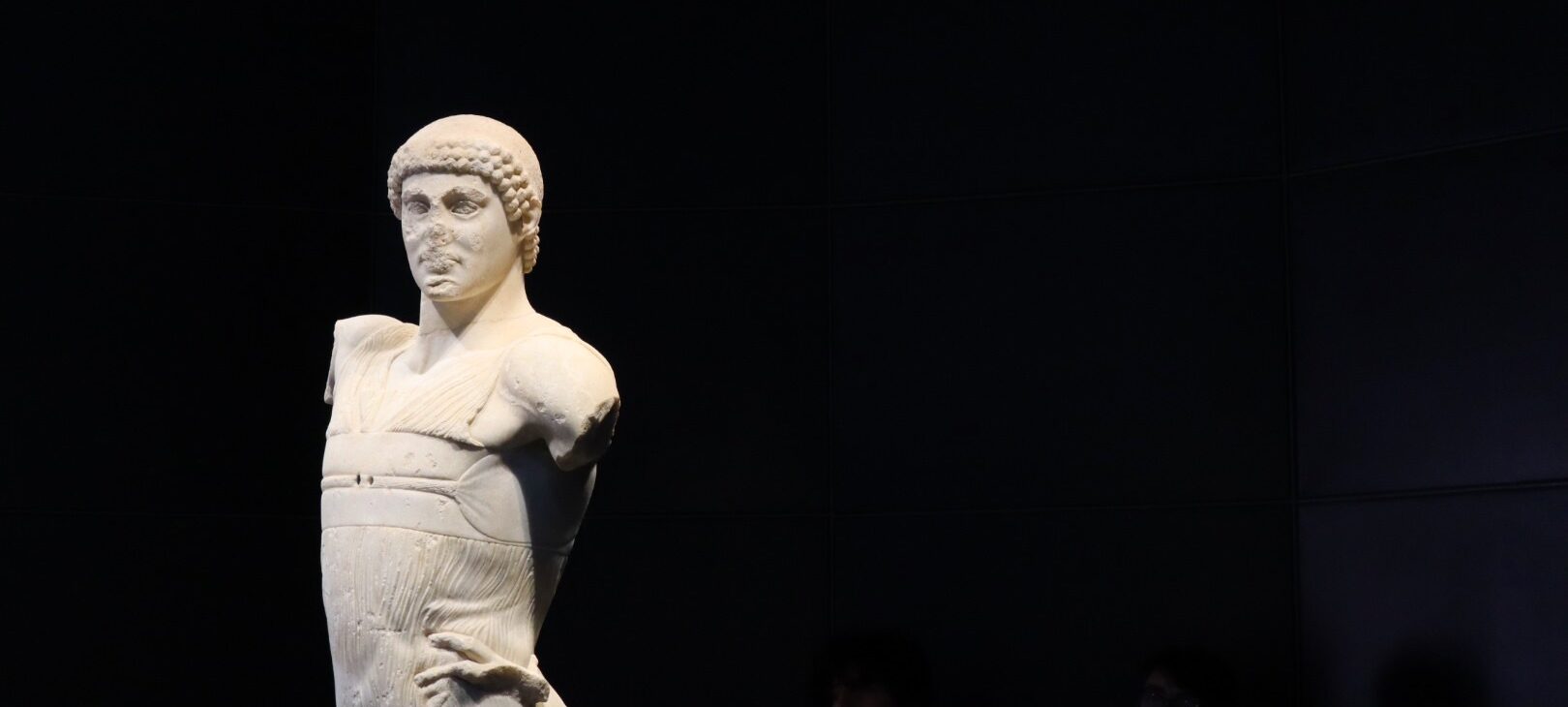
The museum’s best-known sculpture is the Youth of Motia, or Giovinetto di Mozia, often called the Motya Charioteer. Discovered in 1979 near a sanctuary and a pottery workshop, it is an exceptional marble figure whose identity has prompted considerable scholarly debate.
The Getty dates the work to around 470–460 BC and identifies it as Sicilian Greek. Its long garment follows the form of the body beneath, with closely worked folds that demonstrate the sculptor’s skill. The surviving figure gives visitors plenty to examine even without a settled explanation of whom it represents.
“Charioteer” is a familiar name, but it should not be mistaken for a certain identification. Scholars have discussed several possibilities, including athletic, heroic and divine identities. How the sculpture came to Motia is another question; the suggestion that it arrived as war booty is an interpretation, not an established biography of the object.
Give yourself time to look before reading every theory. Study the garment, posture and surviving details, then return to the explanation. The uncertainty is part of the sculpture’s interest: a major discovery can leave important questions open.
Planning Time for the Island and Museum
I would reserve at least half a day for the excursion, including the crossing and time at the landing stage. The Whitaker Foundation describes about two hours as a minimum for the island and museum; a longer allowance leaves room for a guided visit and unhurried stops.
Check the official visitor and ticket information before travelling. Island and museum admission does not include the boat fare. At the time of checking, the museum also listed a daily closure from 2 p.m. to 3 p.m., which matters when arranging your route.
Wear comfortable walking shoes, bring water and sun protection, and confirm the return crossing before starting your walk. If you have mobility requirements, contact the foundation and boat operator beforehand to discuss both boarding and the routes you want to follow.
Book Your Motia Stay and Experiences
For an overnight base, I would consider Marsala, especially if you want to combine Motia with more time in this part of western Sicily. Compare the location of each property with your transport plans; staying in town and staying near the lagoon offer different conveniences.
You can browse Marsala accommodation on Trip.com. This is a standard, non-affiliate destination link. For the excursion itself, use the Whitaker Foundation’s official booking page and arrange the boat crossing separately.
When choosing a guided experience, check explicitly that landing on Motia and visiting the museum are included. For the archaeological excursion described here, both belong in the plan.
External Links
- Whitaker Foundation: official visitor information and tickets
- Visit Sicily: Mozia and the Stagnone setting — useful for the location and route; its harbour description reflects the older interpretation of the Kothon.
- Sapienza University of Rome: the reinterpretation of the Kothon as a sacred pool
- Getty: the Youth of Motia and the debate about its identity
- Getty: Sicilian Greek art and the Motya Charioteer