
10 Iconic Italian Brands That Changed the World of Design
Italy’s reputation for style extends far beyond fashion. From the coffee maker sitting on an Italian kitchen stove to a sculptural lamp illuminating a contemporary living room, Italian companies have repeatedly transformed practical objects into expressions of culture, personality and creativity.
The phrase Made in Italy has become an international symbol of quality, but the success of Italian brands involves much more than where an object is manufactured. Italian design traditionally brings together craftsmanship, engineering, artistic experimentation, functionality and an instinctive appreciation of beauty.
Few countries have been as successful at making the objects of everyday life desirable.
A coffee maker becomes a design icon. A refrigerator becomes the centerpiece of a kitchen. A plastic chair enters a museum collection. A lamp becomes a sculpture. A glass vase becomes collectible art. A pair of shoes becomes an international symbol of glamour.
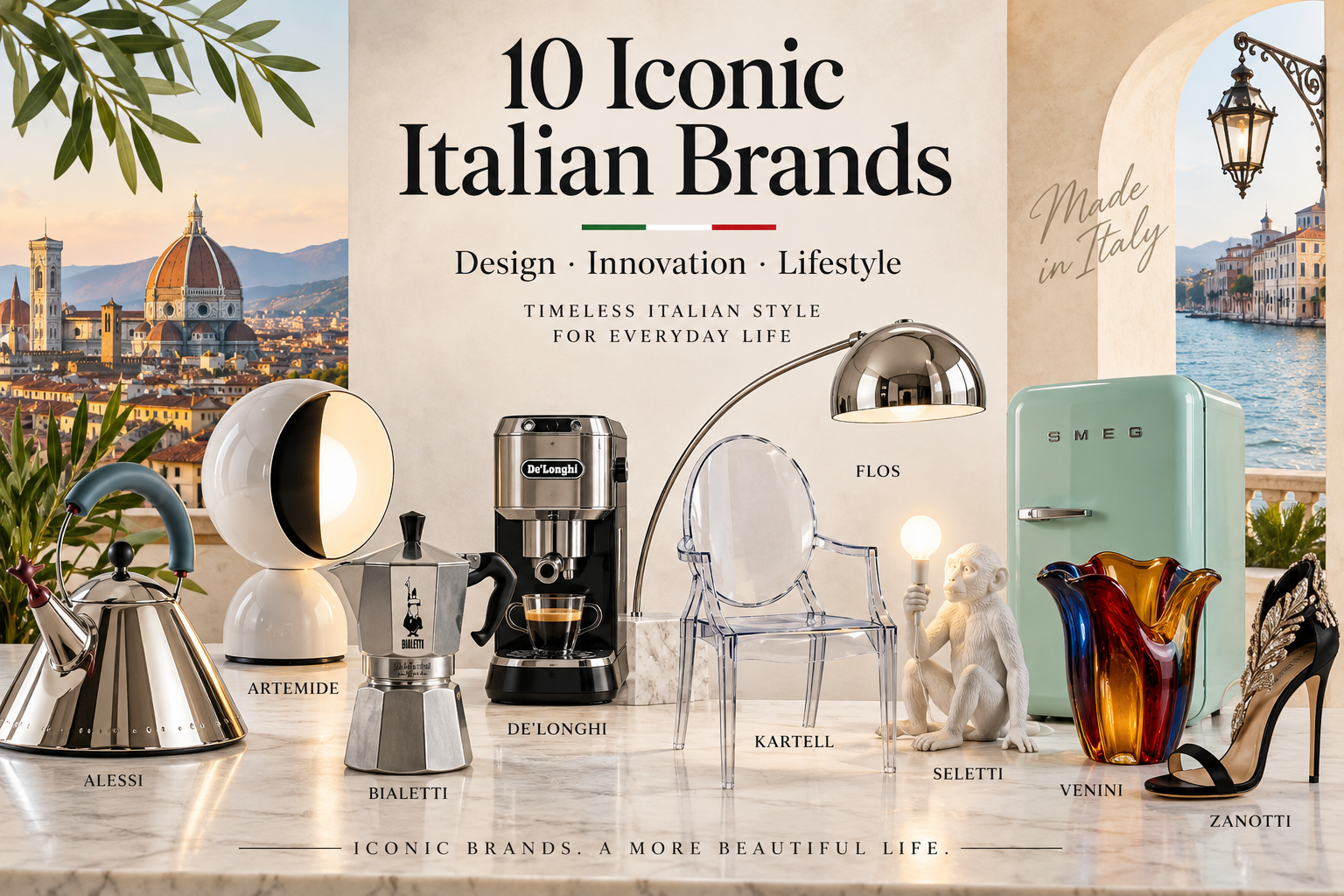
Ten companies illustrate this extraordinary range particularly well: Alessi, Artemide, Bialetti, De’Longhi, Flos, Kartell, Seletti, Smeg, Venini and Giuseppe Zanotti.
Each represents a different aspect of Italian creativity.
Alessi: Turning Everyday Objects Into Design
Founded in Piedmont in 1921, Alessi began as a metalworking workshop producing household objects. Over the following century, it developed into one of the world’s most recognizable names in industrial and household design.
Alessi’s great achievement was recognizing that even the most ordinary kitchen utensil could become an object of creativity.
Instead of simply producing kettles, corkscrews, coffee makers and citrus squeezers, Alessi invited internationally important designers and architects to reinterpret them.
The company’s collaborators have included Philippe Starck, Michael Graves, Ettore Sottsass, Alessandro Mendini, Richard Sapper and Michele De Lucchi.
The results include some of the most recognizable objects in modern design.
Philippe Starck’s Juicy Salif turned a citrus squeezer into a futuristic sculpture. Michael Graves’ famous 9093 kettle, with its colorful bird-shaped whistle, transformed a kitchen appliance into a playful piece of postmodern design. Alessandro Mendini’s Anna G. corkscrew gave an ordinary kitchen tool a human personality.
Alessi describes itself as a “Dream Factory,” an appropriate expression for a company that consistently occupies the territory between industrial production and art.
Discover Alessi
Read our complete guide to the company, its designers and its most famous products:
Alessi: Italian Design History and 10 Best Products to Buy
Artemide: The Art and Science of Light
Founded in Milan in 1960 by Ernesto Gismondi and Sergio Mazza, Artemide became one of the world’s most influential lighting manufacturers.
Its philosophy is summarized by the expression “The Human Light.”
For Artemide, a lamp is not merely a decorative object. Light affects concentration, comfort, mood and the way people experience architectural spaces.
This philosophy produced several masterpieces of twentieth-century design.
Vico Magistretti’s Eclisse, Richard Sapper’s Tizio and Michele De Lucchi and Giancarlo Fassina’s Tolomeo are now classics.
Eclisse uses a rotating inner shade to allow the user to change the amount and character of the light. Tizio uses an ingenious counterbalanced structure that allows the lamp to be repositioned easily. Tolomeo combines exposed engineering with elegant proportions and exceptional functionality.
These objects demonstrate one of the central principles of Italian industrial design: engineering itself can become beautiful.
Discover Artemide
Explore Artemide’s history and ten of its most important lamps:
Artemide Lighting: History, Iconic Lamps and 10 Designs to Buy
Bialetti: The Coffee Maker That Became an Italian Symbol
Few objects are more closely associated with everyday Italian life than the Bialetti Moka Express.
Alfonso Bialetti established his company in Piedmont in 1919. The introduction of the Moka Express in the 1930s eventually transformed the way millions of Italians prepared coffee at home.
Its octagonal aluminum body is immediately recognizable.
But the importance of the Moka goes far beyond its appearance.
Before the widespread adoption of domestic espresso machines, the Moka allowed families to prepare strong Italian-style coffee inexpensively and conveniently at home.
It became part of the rhythm of Italian life.
Generations of Italians have grown up with the familiar sound and aroma of a Moka finishing its coffee on the stove.
Bialetti also created one of Italy’s most recognizable advertising characters: L’Omino con i Baffi, the little man with the mustache.
Today, the Moka Express is simultaneously a practical kitchen appliance, an industrial-design classic and a symbol of Italian coffee culture.
Discover Bialetti
Read the complete history and explore Bialetti’s most famous coffee products:
Bialetti: Italian Coffee History and 10 Best Products to Buy
De’Longhi: Italian Technology for the Modern Home
De’Longhi demonstrates another side of Italian design: the combination of engineering, technology and domestic lifestyle.
The company’s industrial roots date to the early twentieth century, while De’Longhi developed into a major consumer-appliance brand during the 1970s.
Products such as its portable heaters, Pinguino air conditioners and Sfornatutto ovens helped establish the company’s international reputation.
Coffee, however, eventually became central to the De’Longhi identity.
The company now produces everything from compact manual espresso machines to sophisticated bean-to-cup systems capable of preparing espresso, cappuccino, latte macchiato and numerous other drinks.
De’Longhi’s success illustrates how a traditional Italian ritual can be combined with modern technology.
Coffee may be ancient, but the equipment used to prepare it continues to evolve.
Discover De’Longhi
For the company’s history, coffee machines and most interesting appliances, visit our complete De’Longhi guide in the Italia Mia Italian Shopping section.
Flos: When a Lamp Becomes a Work of Art
Founded in 1962, Flos helped transform lighting into one of the most exciting areas of modern Italian design.
Its collaborations with Achille and Pier Giacomo Castiglioni produced objects that remain astonishingly contemporary more than sixty years later.
The most famous is undoubtedly Arco.
The lamp consists of a substantial Carrara marble base supporting a long curved stainless-steel stem and suspended reflector.
Its design solved a practical problem: how could a table or seating area be illuminated from above without installing a ceiling fixture?
The Castiglioni brothers answered the question by essentially creating a portable streetlamp for the home.
Other Flos classics include Taccia, Snoopy and Parentesi.
These lamps demonstrate that lighting can be simultaneously architectural, sculptural and functional.
Discover Flos
Explore the company’s extraordinary contribution to modern lighting:
FLOS: The Art of Italian Lighting
Kartell: Making Plastic Beautiful
When Giulio Castelli founded Kartell in 1949, plastic was generally regarded as a practical industrial material rather than a medium for sophisticated furniture.
Kartell helped change that perception.
Working with leading architects and designers, the company explored what could be achieved through molding, transparency, color and mass production.
Anna Castelli Ferrieri’s Componibili storage units became one of the company’s enduring classics.
Decades later, Philippe Starck’s transparent Louis Ghost chair provided another demonstration of Kartell’s ability to exploit the aesthetic possibilities of modern plastics.
Kartell showed that inexpensive industrial materials could be used to create objects worthy of the world’s most sophisticated interiors.
The company’s influence can now be seen throughout contemporary furniture design.
Discover Kartell
Read our dedicated Kartell guide on Italia Mia to discover the company’s history, designers, furniture and most recognizable products.
Seletti: Italian Design With Humor
Italian design is not always restrained, minimalist or serious.
Seletti proves it.
Founded in 1964 in Cicognara, Mantua, the company has developed an unmistakable identity based on experimentation, pop culture, irony and humor.
Seletti lamps can resemble animals. Tableware can combine traditional imagery with surreal or provocative elements. Decorative objects frequently blur the distinction between commercial product and contemporary art.
The result is very different from the restrained modernism associated with some other Italian manufacturers.
And that is precisely the point.
Seletti’s products are designed to attract attention and provoke reactions.
They demonstrate that a home does not have to be decorated according to rigid rules. An unexpected object can give an interior personality.
Discover Seletti
Visit our dedicated Seletti Italian design guide to explore its most imaginative lamps, furniture and decorative objects.
Smeg: Making the Kitchen Beautiful
A refrigerator is fundamentally a machine.
Smeg turned it into a design statement.
Founded in Guastalla, Emilia-Romagna, in 1948, Smeg grew from an appliance manufacturer into one of the most recognizable Italian brands in the world.
Its name originally came from Smalterie Metallurgiche Emiliane Guastalla, reflecting the company’s industrial origins.
Smeg became particularly famous internationally for its colorful retro-inspired refrigerators.
Their rounded corners, chrome details and strong colors evoke the visual language of the 1950s while concealing modern refrigeration technology inside.
The same philosophy eventually spread across mixers, kettles, toasters, coffee machines and other small appliances.
A Smeg appliance is therefore often purchased for two reasons: what it does and how it makes a kitchen look.
Discover Smeg
Explore our complete Smeg guide on Italia Mia, including the company’s history and our selection of its most distinctive appliances.
Venini: Murano Glass as Modern Art
Among the companies in this guide, Venini occupies a unique position.
Its products are not simply manufactured objects. Many are examples of one of Italy’s oldest and most sophisticated craft traditions: Murano glassmaking.
Venini was established on Murano in 1921 and became famous for combining traditional Venetian glassmaking techniques with modern art and design.
Its collaborators have included Carlo Scarpa, Gio Ponti and Fulvio Bianconi.
The famous Fazzoletto vase is an excellent example. Its flowing form gives solid glass the visual appearance of fabric moving through the air.
Venini’s master glassmakers have experimented continuously with color, texture, layering and traditional techniques.
As a result, historical Venini pieces are highly sought after by collectors, while contemporary production continues the company’s relationship between craftsmanship and modern design.
Discover Venini
For collectors and buyers, read our dedicated Venini guide on Italia Mia, where we examine the company and its most important glass creations.
You may also want to read our broader Murano Glass Guide, including advice on famous foundries, authenticity and identifying reproductions.
Giuseppe Zanotti: Italian Shoemaking Meets Glamour
The final company takes us from interiors to fashion.
Giuseppe Zanotti built his reputation by combining the traditional craftsmanship of Italian shoemaking with an unmistakably glamorous aesthetic.
The designer comes from San Mauro Pascoli in Emilia-Romagna, an area with a long tradition of high-quality footwear manufacturing.
His namesake collection emerged internationally during the 1990s and quickly attracted attention for dramatic heels, metallic elements, crystals and jewelry-inspired decoration.
Zanotti later expanded beyond women’s evening shoes into sneakers, men’s footwear, handbags, accessories and other luxury products.
His work represents a different interpretation of Made in Italy.
Where Bialetti emphasizes democratic functionality and Artemide emphasizes engineering, Zanotti emphasizes craftsmanship, luxury and visual impact.
Discover Giuseppe Zanotti
Read our dedicated guide to the designer, his history and his shoes:
From there, readers can explore the current Giuseppe Zanotti collections through Italia Mia’s shopping links.
What These Ten Italian Brands Have in Common
At first glance, these companies could hardly be more different.
A Bialetti Moka is an inexpensive kitchen tool. A Venini vase may be a valuable collectible. Smeg manufactures refrigerators. Flos and Artemide produce lighting. Kartell makes furniture. Zanotti creates luxury footwear.
Yet several ideas connect them.
Design Is Part of the Product
For these companies, design is not something applied after the engineering has been completed.
Form, proportion, color, materials and tactile qualities are fundamental parts of the product itself.
Collaboration Matters
Alessi, Artemide, Flos, Kartell and Venini in particular built much of their international reputation through collaborations with important architects, artists and industrial designers.
This relationship between manufacturer and designer is one of the foundations of modern Italian design.
Tradition and Innovation Can Coexist
Venini preserves ancient Murano glassmaking knowledge while collaborating with modern designers.
De’Longhi applies contemporary technology to Italy’s traditional coffee culture.
Smeg combines modern appliances with retro-inspired aesthetics.
Zanotti combines specialist Italian shoemaking with contemporary fashion.
The past becomes a foundation for innovation rather than an obstacle to it.
Ten Brands, Ten Expressions of Italy
There is no single definition of Italian design.
Alessi is playful and intellectual.
Artemide is technological and human-centered.
Bialetti is familiar and democratic.
De’Longhi is practical and technologically sophisticated.
Flos is architectural and experimental.
Kartell is industrial and innovative.
Seletti is humorous and provocative.
Smeg is colorful and nostalgic.
Venini is artistic and artisanal.
Giuseppe Zanotti is glamorous and luxurious.
Together, they provide a remarkable portrait of Italian creativity.
Explore Italian Design and Shopping
Readers interested in purchasing products from these companies can now explore each brand through Italia Mia rather than navigating directly to individual retailers.
Start with the Italia Mia Italian Shopping Directory, where you can browse our selected Italian brands and shopping resources.
You can also explore our Ultimate Guide to Iconic Italian Brands and discover how these companies fit into the wider history of Italian industrial design.
For museum-quality design, see Italian Design Selected at MoMA in New York.
Quick Guide to the 10 Brands
| Brand | Founded | Specialty | Iconic Products |
|---|---|---|---|
| Alessi | 1921 | Household design | 9093 Kettle, Juicy Salif, Anna G. |
| Artemide | 1960 | Lighting | Eclisse, Tizio, Tolomeo |
| Bialetti | 1919 | Coffee | Moka Express |
| De’Longhi | Consumer brand from 1974 | Appliances | Espresso machines, Pinguino |
| Flos | 1962 | Lighting | Arco, Taccia, Parentesi |
| Kartell | 1949 | Furniture | Componibili, Louis Ghost |
| Seletti | 1964 | Home design | Artistic lighting and accessories |
| Smeg | 1948 | Appliances | FAB refrigerators, small appliances |
| Venini | 1921 | Murano glass | Fazzoletto and art glass |
| Giuseppe Zanotti | Namesake collection launched 1994 | Luxury footwear | Jewel heels, sneakers |
The Enduring Power of Made in Italy
The greatest Italian brands succeed because they understand something fundamental: usefulness and beauty are not opposites.
A coffee maker can become a national symbol.
A lamp can become a museum object.
A plastic chair can become a design classic.
A refrigerator can become the centerpiece of a kitchen.
A glass vase can become art.
A shoe can become a recognizable expression of Italian glamour.
These companies do more than manufacture products. They give everyday objects identity.
That is ultimately what connects Alessi, Artemide, Bialetti, De’Longhi, Flos, Kartell, Seletti, Smeg, Venini and Giuseppe Zanotti.
Each has taken something functional and made it memorable.
And that ability to bring together craftsmanship, industry, innovation and beauty remains one of the most compelling definitions of Made in Italy.
Related Italia Mia Guides
- Alessi: Italian Design History and 10 Best Products to Buy
- Artemide Lighting: History, Iconic Lamps and 10 Designs to Buy
- Bialetti: Italian Coffee History and 10 Best Products to Buy
- FLOS: The Art of Italian Lighting
- The World of Giuseppe Zanotti
- Murano Glass Guide
- Italian Design Selected at MoMA
- Italian Shopping Directory