Some of us thought the painting might cost €500. I thought €5,000 was more likely. Then we found out the asking price: €40,000.
So much for our collective expertise.
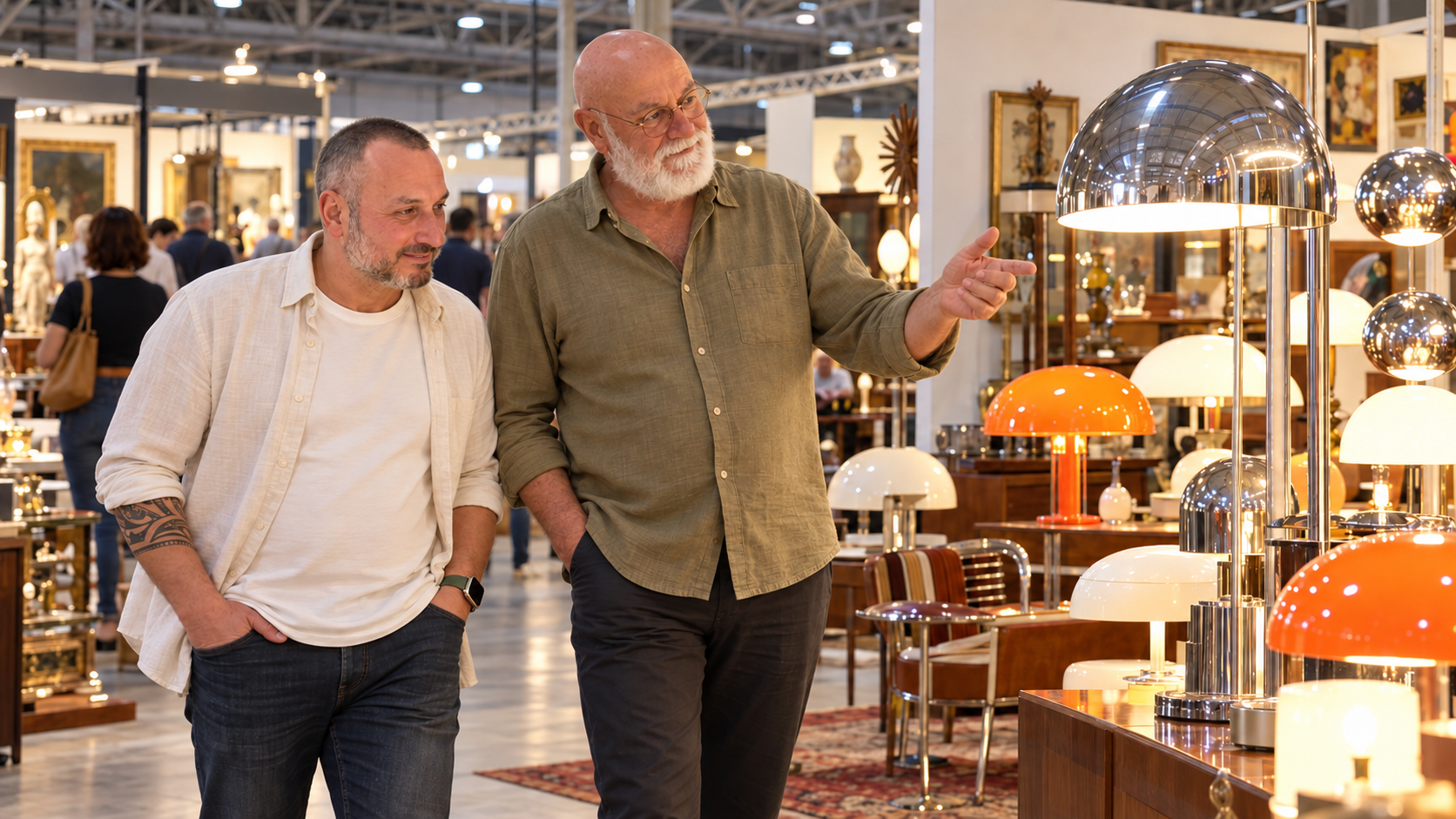
That was one of the memorable moments of my visit to Mercanteinfiera in Parma, an enormous fair for anyone interested in antiques, vintage objects, art, and design. Another involved a Space Age-style floor lamp, an asking price of €800, and a bargaining battle that ended at €600.
Between those two objects, I found plenty to explain the attraction of the place. You can admire something completely beyond your budget, misjudge a painting by several thousand euros, and still find an object you cannot resist.
This visit belongs in my Unexpected Italy: Stories from My Recent Travels series because the surprise was waiting inside a stand. In my case, it came with a lampshade and a negotiable price.
Why Mercanteinfiera Is Worth the Trip
For a lover of vintage and antiques, the attraction is straightforward: the chance to see a huge variety of objects together, compare them, and find something you would never have thought to search for online.
Mercanteinfiera takes place at Fiere di Parma, with editions in spring and autumn. Its scope includes antiques, twentieth-century design, art, vintage fashion, jewelry, and collectibles. The organizers describe a gathering of more than a thousand dealers, which gives you some idea of the scale.
This is a fair that deserves time. A hurried circuit will show you plenty of merchandise, but the interesting part begins when you stop looking at whole stands and start looking at individual objects.
An unfamiliar piece can send you into a conversation about its age, maker, materials, or previous life. Two apparently similar objects can carry very different prices. Sometimes the difference becomes clear when a dealer explains it. Sometimes it calls for more research.
You do not need to be a serious collector to enjoy that process. Curiosity is enough to get you started. A budget becomes useful shortly afterward.
What to See: Give Yourself Permission to Browse
I would approach Mercanteinfiera with a few interests in mind and enough flexibility to be distracted.
If you like interiors, concentrate on furniture and lighting. Look at proportions, construction, and details that photographs tend to flatten. A chair needs to work as a chair. A floor lamp needs to make sense in a room, both switched on and switched off.
If smaller objects are your preference, look through ceramics, glass, jewelry, and decorative pieces. These can be more manageable purchases, particularly if you are traveling, although small certainly does not always mean inexpensive.
Paintings deserve time even when you have no intention of buying. Our €40,000 discovery made that point rather effectively.
The fair also presents collateral exhibitions. Check the program for your edition before arriving, because these displays can give a visit some structure beyond browsing the dealers’ stands. Subjects and participating collections change.
My advice is to make an initial circuit, note the stands that interest you, and return to a shorter list. Record the pavilion and stand number. “The place with the beautiful lamp” is not a particularly useful address at an antiques fair.
Familiar Faces from Cash or Trash
During my visit, I saw Stefano D’Onghia, Ada Egidio, and Alessandro Rosa, familiar faces to anyone who watches Cash or Trash – Chi offre di più?
There is a distinction worth making: Stefano and Ada are among the program’s dealers, while Alessandro Rosa is the expert who evaluates the objects and explains their background before the bidding. The show is presented by Paolo Conticini on NOVE.
Seeing people associated with the program adds another point of interest to the fair. The objects, questions, and negotiations that work so well on television belong to a much larger world of dealers and collectors.
For viewers, those recognizable faces may be a reason to look more closely. But I would also give attention to exhibitors you have never heard of. A dealer’s knowledge of a particular material, period, or maker can make a stand worth visiting regardless of television appearances.
The people I saw were part of my visit; their presence should not be treated as a guaranteed feature of every edition. Check announcements if you are hoping to attend a particular appearance.
The Space Age Lamp I Could Not Resist
My own unexpected find was a floor lamp with that unmistakable Space Age feeling associated with the 1970s.
It was inside a stand, and it caught my attention enough to turn browsing into a possible purchase. This is where an antiques fair becomes dangerous in the most ordinary sense: you find something you really want, and now you have to discuss money.
The asking price was €800.
What followed was the bargaining battle. We eventually agreed on €600: €200 below the original price, a reduction of 25 percent.
That is the satisfying arithmetic. The more important point is that I bought a lamp I could not resist at a price we could agree on.
I would describe it as a 1970s Space Age-style floor lamp rather than attach an unverified designer’s name to it. In vintage lighting, the difference between an attractive period object, a documented designer piece, and a later reproduction matters. So do alterations and replacement parts.
For anyone considering a similar purchase, ask about the wiring, switch, fittings, and any previous electrical work. Look carefully at the base, shade, and connections. An appealing shape does not tell you whether a lamp is ready for everyday use.
And measure it. A floor lamp surrounded by exhibition furniture can look quite different when you imagine it beside your own sofa.
How I Would Approach the Bargaining
My €800-to-€600 purchase illustrates that an asking price can leave room for discussion. It does not establish a standard discount for the fair.
Before negotiating, understand what you are buying. Ask about condition, age, attribution, restoration, and what is included in the price. Then decide what the object is worth to you.
A useful question is simply: “What is your best price?”
From there, make a realistic offer. There is no need to insult the object or perform a theatrical dismissal of its value. A clear offer gives the seller something concrete to consider.
Also settle the practical details. Does the agreed amount include packing? Can the piece be collected later? Is delivery available, and what does it cost?
Most importantly, keep your attention on the final amount. A large reduction does not automatically make something a good purchase. You are paying for the object, not buying the pleasure of having negotiated a discount.
The Painting We Valued at €500—or €5,000
The painting produced a different kind of price discussion.
It had a futuristic character, and we debated what it might cost. Some of us thought €500. My estimate was €5,000, which already put me comfortably above the others.
Then came the actual asking price: a mere €40,000.
Even my estimate was only one-eighth of that figure.
The episode deserves a place in the story because it captures how uncertain casual judgments can be. Looking at a painting and liking it is one thing. Understanding its market position is another.
Without the artist’s name, provenance, condition, and supporting documentation, our guesses were exactly that: guesses. Equally, an asking price is what a seller hopes to receive; it is not evidence of a completed sale at that amount.
I would not attach the painting to the historical Futurist movement without confirming the artist and attribution. “Futuristic” can describe an impression. “Futurist” can make a specific art-historical claim.
What I can confirm is that none of us won the valuation contest.
In the end we found out that the artist was Giulio D’Anna, Sicilian Futurist and first italian ‘aeropittore’ (aerial painter ).
What to Buy—and What to Leave Behind
For me, the strongest reason to buy is that an object appeals to you, fits your life, and has a condition and price you understand.
These are the questions I would take around the fair:
| Object | What makes it worth considering | When to pause or walk away |
|---|---|---|
| Vintage lighting | A shape you love, sound construction, and clear information about electrical condition | Unexplained alterations, damaged fittings, or uncertain repair costs |
| Chairs and small furniture | Useful proportions, stable joints, and a finish you can assess | Structural damage or restoration costs that overwhelm the purchase |
| Glass and ceramics | Good condition and a credible explanation of maker and age | Hidden chips, repaired cracks, or unsupported attribution |
| Paintings and prints | An artist or image you want to live with, supported by appropriate documentation | Pressure to buy before you can investigate authorship or condition |
| Jewelry and watches | Clear material descriptions, condition details, and documentation appropriate to the price | Vague claims about authenticity, replacement parts, or servicing |
| Decorative collectibles | Personal appeal and a price you are comfortable paying | Buying only because someone promises future appreciation |
Be particularly careful with phrases such as “in the style of,” “attributed to,” and “probably.” They express different levels of certainty. Ask the dealer to explain the wording and record important claims on the receipt.
Mercanteinfiera also advertises an expert consultation service offering verbal opinions on matters including authenticity, origin, period, and technique. Check its availability and scope for your visit; a verbal opinion should not be confused with written certification.
The purchase I would most readily avoid is the one made under pressure. If important questions remain unanswered, leave yourself time to think.
Planning a Visit to Mercanteinfiera
The venue is Fiere di Parma, Viale delle Esposizioni 393A, outside the historic center. Plan the journey to the exhibition grounds separately from your sightseeing in Parma. Use the official directions page for transport information.
Before traveling, check the current edition’s dates, public opening hours, tickets, and exhibitor directory on the Mercanteinfiera website. Avoid relying on an old event listing.
I would allow a substantial part of the day, wear comfortable shoes, and bring measurements for any space I might be buying for. Photographs of your room can also help you judge whether an object belongs there.
For bulky purchases, agree on collection or shipping before paying. Keep the dealer’s contact details and a receipt describing the item.
If you want to turn the visit into a weekend, Parma offers plenty beyond the exhibition halls. The cathedral, Baptistery, Palazzo della Pilotta, and Teatro Regio provide reasons to spend time in the city, alongside its celebrated food traditions. The official Parma tourism website is useful for planning that part of the trip.
For more ideas beyond conventional sightseeing, browse Italia Mia’s Things to Do in Italy.
My visit gave me a €600 lamp and a memorable reminder of the limits of my ability to price paintings. That seems a respectable result for a day among antiques.
Book Your Parma Stay and Experiences
For a visit combining the fair with sightseeing and dinner in Parma, consider staying in the historic center or near the railway station. Check the journey to Fiere di Parma before choosing, particularly if you expect to carry purchases.
You can compare accommodation through Expedia’s Parma hotel listings. This is a direct, non-affiliate destination link.
Use Parma’s official tourism website to check city visits and experiences that fit your dates.
External Links
- Mercanteinfiera: official fair website and edition information
- Getting to Fiere di Parma
- Mercanteinfiera expert consultation services
- Alessandro Rosa: official NOVE profile
- Parma Welcome: official visitor information