 I made a day trip to Lecce to visit its cathedral, see the city, and taste its local specialties. Those three aims gave the day a simple focus: architecture, a walk through the historic centre, and time for the food of Salento.
Lecce is often called the Florence of the South. The name promises a city rich in art, but it can also set up the wrong expectation. Florence is closely associated with the Renaissance; Lecce’s best-known architectural language is Baroque. Its churches and palaces deserve attention on their own terms.
This visit belongs to my Unexpected Italy: Stories from My Recent Travels series. It is also a useful example of how to approach a city when you have one day: choose a few important places, leave room between them, and make lunch part of the visit.
The Florence of the South, with a Salento identity
Lecce sits in the Salento peninsula, in southern Puglia. Its historic centre brings together Roman remains and elaborate churches, with local stone giving many buildings their distinctive pale colour.
The comparison with Florence is a useful introduction, rather than a description of everything you will find. Here, the details to look for are carved façades, ornamental balconies, church portals, and the relationship between buildings and small public spaces.
I would keep the day centred on the old town. Trying to combine Lecce’s monuments with a beach excursion leaves less time for both. A city walk with a proper lunch is already a worthwhile outing.
There is no need to enter every church. Choose the cathedral as an anchor, add Santa Croce if time allows, and pay attention to the streets connecting them. That gives the architecture some context instead of turning the day into a sequence of interiors.
Piazza del Duomo and the cathedral
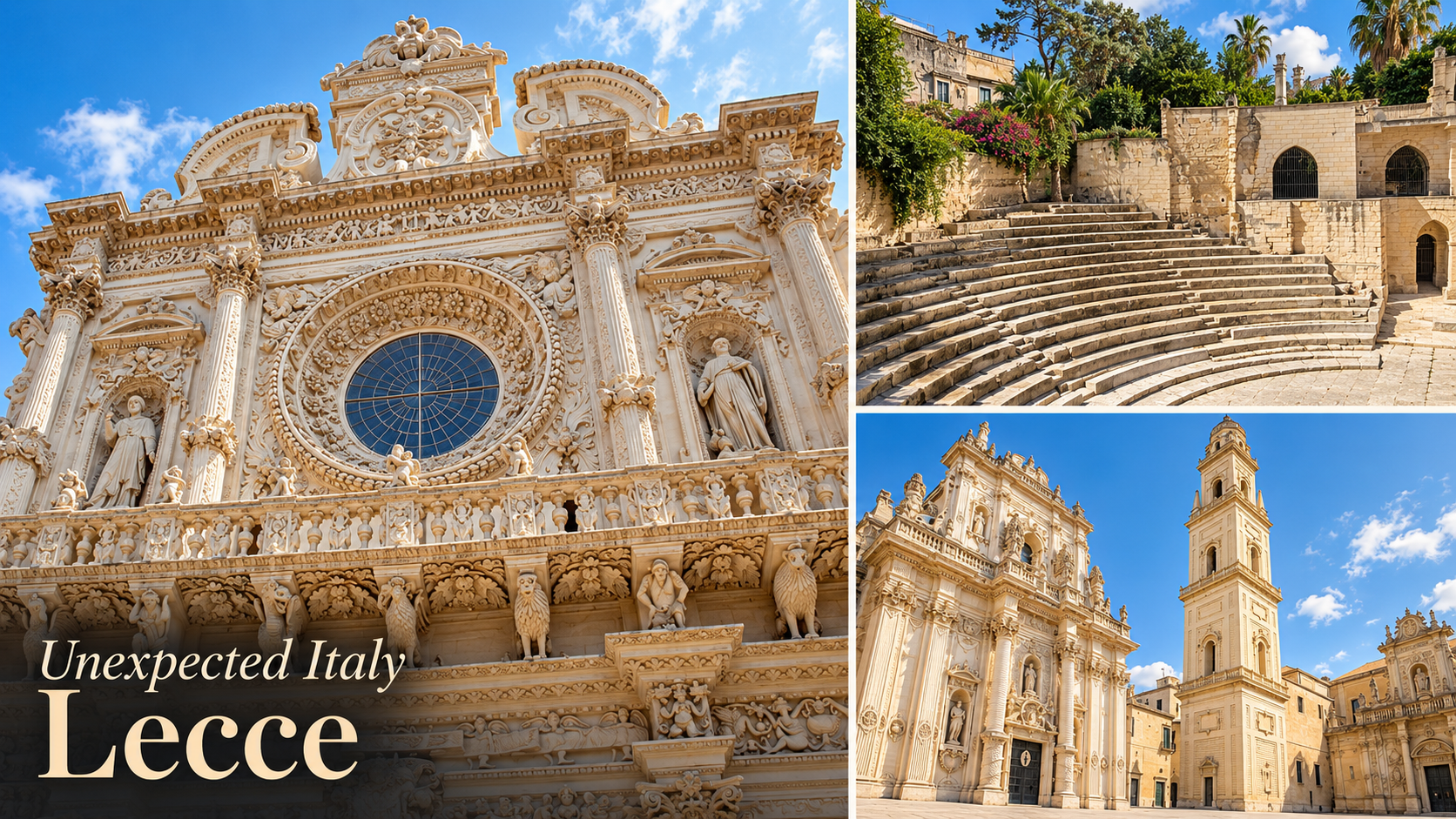
The cathedral was central to my visit. Dedicated to the Assumption of the Virgin Mary, it stands in Piazza del Duomo alongside the bell tower, the bishop’s palace, and the former seminary.
This is a place to consider as a whole. Before entering the church, allow time for the square and the way its buildings frame the cathedral. The setting is part of the visit, rather than simply an approach to the entrance.
One architectural detail is especially useful to know: the richly decorated façade facing visitors arriving in the square is the cathedral’s side façade. The principal façade occupies a less immediately prominent position. Knowing this changes how you read the building.
Inside, look for the decorated wooden ceiling and the altar dedicated to Sant’Oronzo, Lecce’s patron saint. These features connect the cathedral’s art with the city’s religious history.
For visitors interested in a different architectural mood, the crypt offers another reason to linger. Its rows of columns and lighter stone contrast with the ornament of the upper church. Include it if your chosen ticket and the day’s access arrangements allow.
The official LeccEcclesiae website is the place to check church tickets and visitor information. Consult it before planning several paid interiors, and allow for religious services when organising the day.
Walking through the old town
After giving the cathedral its own time, a walk through the centre provides a change of pace. Corso Vittorio Emanuele II is a useful thread through the old town, with the Church of Sant’Irene among the landmarks along the way.
For a first visit, I recommend alternating major sights with short stretches of ordinary streets. A doorway or balcony is easier to appreciate when you are not constantly checking the next attraction.
Piazza Sant’Oronzo introduces another part of Lecce’s history. The Roman amphitheatre places the ancient city within the present-day centre. It helps explain why a guide to Lecce should include more than its Baroque buildings.
A square, an archaeological site, and a church each require a different kind of attention. Leave enough time to stand back and understand the space before moving on. That is more useful than adding another stop simply because it is nearby.
Santa Croce and the art of looking closely
The Basilica of Santa Croce, on Via Umberto I beside the former Celestine convent, is a natural addition to a cathedral-focused day.
Its façade rewards close attention. The rose window, carved figures, and dense ornament offer plenty to examine before you decide whether to enter. Start with the overall arrangement, then choose a few details rather than trying to identify every carving.
Santa Croce also helps make the phrase “Lecce Baroque” concrete. It shows how decoration can become the main subject of a building’s exterior.
For a short visit, I would give priority to the cathedral and Santa Croce rather than rush through a longer list of churches. Each deserves enough time to be understood as an individual building.
An unexpected stop: the Roman theatre
For an additional stop beyond the principal squares, I recommend the Roman theatre near the MUST, Lecce’s historical museum.
This is a separate monument from the amphitheatre in Piazza Sant’Oronzo. Visit Lecce places it among the narrow streets near Piazzetta Vittorio Emanuele II and Piazzetta Giuseppe Pellegrino.
It is a useful choice for this series because it broadens the picture of the city. A day organised around the cathedral and Baroque architecture can also make room for the older Roman settlement.
Treat it as a suggested addition to your route, and check access before planning an interior visit. If the day is already full, there is no need to force another museum into the schedule.
What to taste in Lecce
Tasting local specialties was part of my trip. For readers planning their own visit, the following foods provide a good introduction without requiring an elaborate restaurant itinerary.
Pasticciotto is the obvious sweet starting point: shortcrust pastry filled with pastry cream, traditionally enjoyed warm. Ask what has recently come from the oven. It makes a convenient pastry stop during a morning walk.
For something savoury, look for a rustico leccese. This puff-pastry snack commonly contains béchamel, tomato, and mozzarella. It suits a short break, although a hot filling deserves a little patience.
Caffè leccese, also called coffee alla salentina, combines coffee, ice, and almond milk. The almond component adds sweetness, so consider tasting it before adding sugar.
At lunch, ciceri e tria is worth looking for. The dish combines chickpeas with pasta, some boiled and some fried. That mixture gives a traditional combination of inexpensive ingredients an appealing difference in texture.
Another option is fave e cicorie: broad-bean purée served with chicory and olive oil. These dishes show why a visit to Salento should leave space for vegetables, legumes, and regional home cooking.
Choose according to appetite and the menu. A pastry, a savoury snack, and lunch need not become an obligation to sample everything in one day.
A practical plan for one day in Lecce
I would build a first visit around a few flexible stages:
- Begin with Piazza del Duomo and the cathedral.
- Walk through the historic centre towards Piazza Sant’Oronzo.
- Leave time for a local lunch.
- Visit Santa Croce, then add the Roman theatre if access and energy allow.
- Keep a final pause for coffee or a pastry before departing.
This is a suggested itinerary, rather than a reconstruction of every step of my trip. Adjust it to opening times and your arrival point.
If arriving by car, check parking and restricted traffic zones before entering the centre. If travelling by train, check the return service before committing to a late meal. Comfortable shoes and a realistic number of interiors will make the day easier.
My trip had a straightforward purpose: the cathedral, the city, and its specialties. For another visitor, those same priorities offer a satisfying introduction to Lecce without demanding an exhaustive tour.
Book Your Lecce Stay and Experiences
For a longer visit, I would look for accommodation in or near the historic centre, keeping the main sights within walking reach. If travelling by car, confirm parking arrangements directly with the property.
You can compare hotels in Lecce on Expedia. This is a standard destination link.
For church visits, use LeccEcclesiae’s official information and ticket service. A guided walk can also be useful if you want more background on the buildings; check the exact itinerary and included admissions before booking.
External Links
- Italia.it: Lecce’s history and Baroque heritage
- LeccEcclesiae: Lecce Cathedral
- Visit Lecce: First-day walking itinerary
- Visit Lecce: Roman theatre
- Visit Lecce: Local food itinerary