
Part of Unexpected Italy: Stories from My Recent Travels
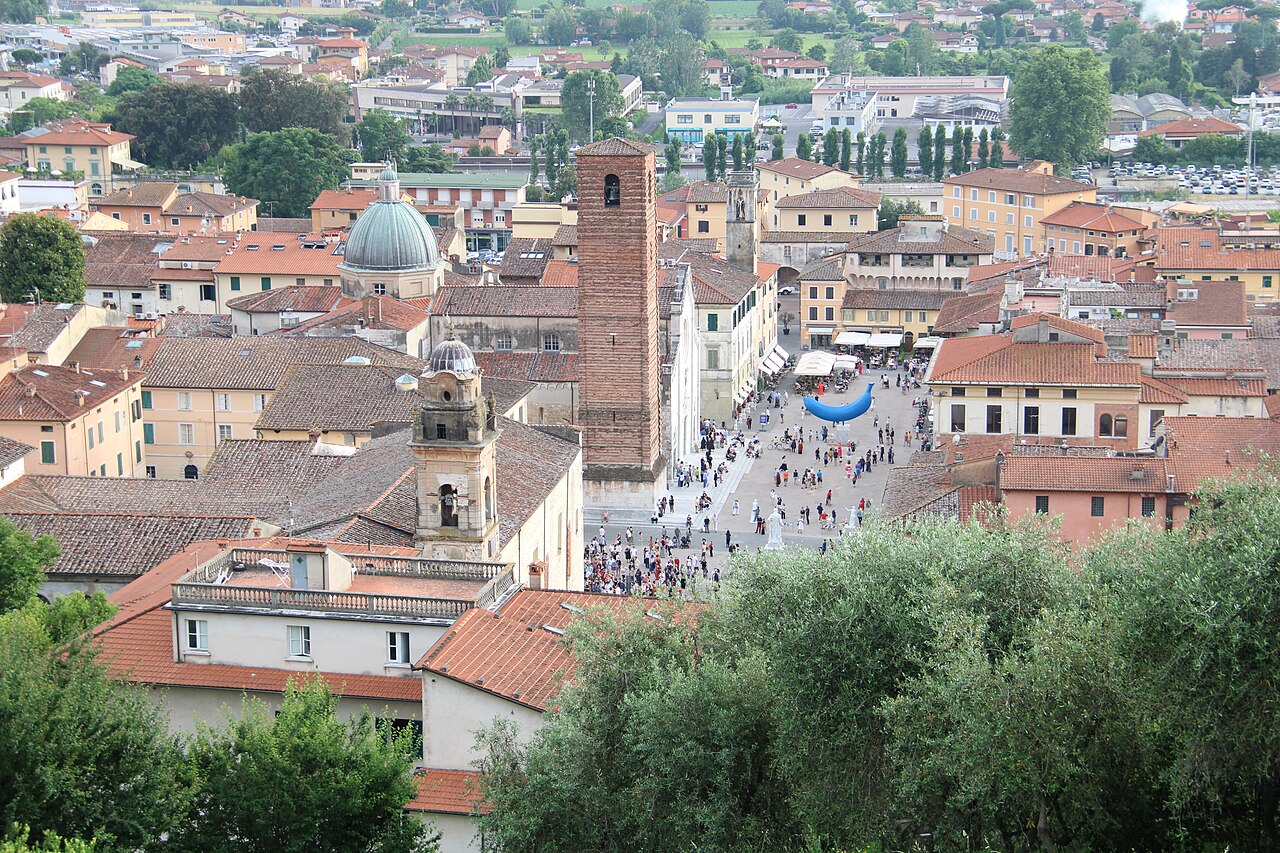 A square shaped by artists
I left Marina di Carrara on my bicycle with a modest plan: follow the coast south, turn inland at Marina di Pietrasanta, have an aperitivo in town, and ride home. It was the kind of outing that looks simple when described in one sentence. The pleasure lies in giving it the afternoon.
From Marina di Carrara, the route carries you through Cinquale and Forte dei Marmi before reaching Marina di Pietrasanta. The sea stays nearby, though the ride is as much about the life beside it: beach entrances, people crossing with towels under their arms, bicycles moving at several incompatible speeds. I had no intention of setting a record. I wanted to arrive in Pietrasanta with enough energy to enjoy it, then still have to get myself home.
Turning away from the sea
At Marina di Pietrasanta I turned inland toward the historic center, following the direction of Viale Apua. That change gives the ride its shape. For much of the outward journey, the coast provides an easy line to follow. Then the destination becomes a town with streets and a square, rather than another stretch of beach. Viale Apua is the principal connection between the marina and Pietrasanta’s center. COMUNI Versiliatoday.it
I paid more attention at crossings and junctions than I had on the seafront. A coastal ride can encourage you to settle into a rhythm; entering a town asks you to look up again. By the time I found a place for the bike and continued on foot, I was ready for a drink and a slower look around.
Aperitivo before the art
I stopped for an aperitivo before going to Piazza Duomo. I like that order. After a ride, sitting down for a while makes the town feel less like a point on a route and more like somewhere I chose to spend time.
There is also a practical advantage to stopping first: I become a more patient visitor. I can sit, watch people arrive and leave, and resist the urge to hurry through the streets because the bicycle is waiting. Italia Mia’s guide to the Italian aperitivo explains the custom for visitors. On this trip, it served the straightforward purpose of giving me a pause between the ride and the walk.
Then I headed for Piazza Duomo.
I came to Piazza Duomo to see the recent works on display, but Pietrasanta’s connection with sculpture goes far beyond any one exhibition. Artists have come here for generations to work with its marble workshops, bronze foundries, and skilled craftspeople. Some made Pietrasanta a home; others returned to its studios to turn an idea into a finished work. That distinction matters: the town has been both a place to live and a place to make art. Residenze Atena
Fernando Botero and Igor Mitoraj became closely identified with Pietrasanta. Henry Moore was among the international artists drawn here in the 1960s. Kan Yasuda, Pietro Cascella, Piero Consagra, Niki de Saint Phalle, Arnaldo and Giò Pomodoro, and Giuliano Vangi are also part of its artistic story. Their connections were different, but together they help explain why sculpture feels so present in the town. The municipality records works and collaborations associated with these artists through its workshops, sculpture park, and Museo dei Bozzetti. Residenze Atena
With that history in mind, I took another circuit of the square. I stepped back from one of the newly displayed works, then approached it from the side. From one position it seemed to belong to the buildings behind it; from another it changed the whole view. Pietrasanta lets you do that without entering a gallery. You can arrive for an aperitivo, walk into Piazza Duomo, and find yourself spending longer with a sculpture than you expected.
The sketch in the wind
As I stood near one of the works, a loose sheet of paper slid across the paving toward my shoes. I caught it before it could travel farther. It was a pencil sketch of the square, with quick lines for the buildings and a much more careful rendering of the sculpture I had just been studying.
Its owner came after it, carrying a small folder and looking relieved that I had stopped it. I handed the drawing back. We looked at the paper, then at the sculpture, from the same spot.
The surprising part was how different the two views were. I had been concentrating on the artwork’s outline against the square. The sketch paid attention to the open space around it. Once I saw that, I noticed the gap between the sculpture and the Duomo, and the way people kept crossing through it. The drawing had caught something I had walked past.
We didn’t need a long conversation. The artist put the sheet safely inside the folder, and I went back to looking. A minute later I moved to the other side of the square to see whether I could find that same view. I could. I stayed there longer than I had intended.
One more walk before the return
From Piazza Duomo, I took another turn through the center instead of heading straight back to the bicycle. I passed the area around the Sant’Agostino complex, home to the Museo dei Bozzetti. The museum’s collection of sculptors’ models gives useful context to a town where finished works can appear in the streets and squares. It deserves a visit of its own; this time, my visit was an outdoor one. Comune di Pietrasanta
I returned to the piazza once more before leaving. I wanted to look at the artworks without trying to name a favorite or extract a lesson from them. The sketch had simply given me another way to stand in the square. That was enough.
If you make this ride yourself, allow time for that second look. Pietrasanta is close enough to the coast to work as an afternoon destination, but it rewards a stop longer than a quick drink and a photograph. Lock the bike, walk a few streets, and see what is on display. You can always choose how much farther to go once you are there.
Back to Marina di Carrara
I collected the bicycle and rode back toward Marina di Pietrasanta. At the coast, I turned north for the return through Forte dei Marmi and Cinquale to Marina di Carrara. The route was familiar by then, and I appreciated having the sea to follow again.
I had set out for a ride, an aperitivo, and a look at Pietrasanta’s art. I got all three. The loose sketch added a small interruption that made me spend a few more minutes in the square and see it from somewhere else. By the time I reached home, that was the detail I wanted to remember.
This story is part of Unexpected Italy: Stories from My Recent Travels.
Book Your Pietrasanta Stay and Experiences
You can make the ride a day trip, or stay in Pietrasanta and give its galleries and nearby coast more time. Compare Pietrasanta hotels on Trip.com for a stay in or near town. For a separate art and history outing elsewhere in Tuscany, Weekend in Italy lists a guided Pisa and Lucca excursion departing from Florence; it is not part of this cycling route.
Affiliate disclosure: Italia Mia may earn a commission from qualifying bookings made through its partner links, at no additional cost to you. The links above are destination and product pages; affiliate tracking has not been verified for them.
External Links
- Comune di Pietrasanta: Museo dei Bozzetti
- Comune di Pietrasanta: exhibitions and museum information
- Comune di Pietrasanta: the 2026 Gustavo Vélez exhibition across town