
A biography can make a familiar name less predictable. Leonardo becomes more than the painter of the Mona Lisa; Garibaldi becomes more than a red shirt and a monument. Following a life from one decision to the next reveals the people, institutions, opportunities, and mistakes behind a reputation.
These ten books range from Renaissance Florence to twentieth-century Turin. They include artists and patrons, a diplomat, a revolutionary, a dictator, an educator, an industrialist, and a writer. They also invite different kinds of reading. Some explain how a person worked; others examine how a public image was built. A strong biography opens those questions rather than settling every argument about its subject.
Artists and patrons
1. Leonardo da Vinci — Walter Isaacson
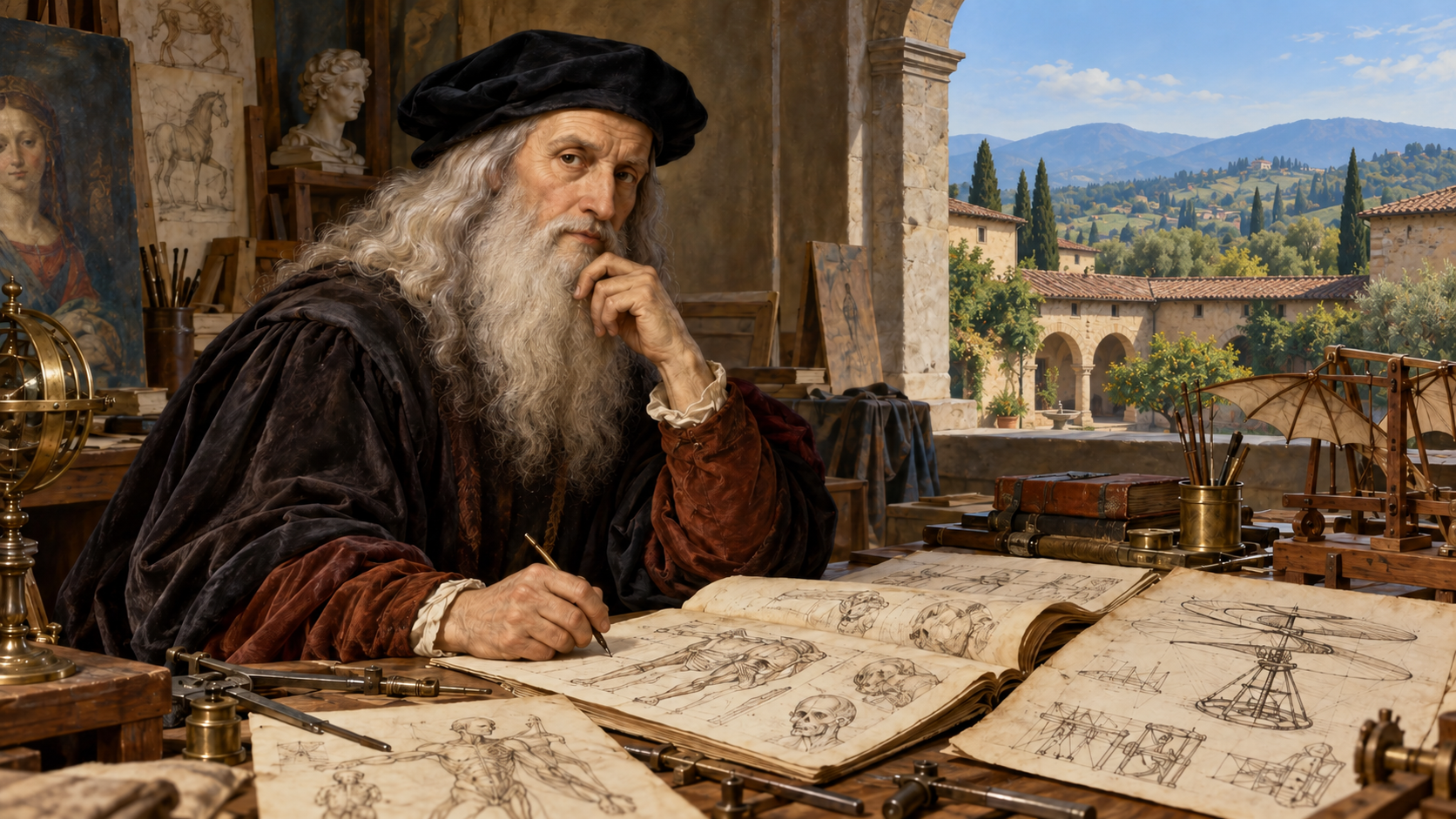
Leonardo da Vinci by Walter Isaacson follows a mind that rarely stayed inside the boundaries of a single profession. Leonardo painted, drew, studied anatomy, investigated water and flight, designed machines, and filled notebooks with observations and questions. Isaacson uses those notebooks to connect the celebrated paintings with the habits of attention behind them.
The pleasure of the book lies partly in watching Leonardo look. His interest in a face, a muscle, or the movement of water could lead him from careful observation to an ambitious artistic idea. Isaacson also has to reckon with the gap between Leonardo’s plans and what he completed. That makes this a good choice for readers interested in the working life behind a masterpiece, including its experiments and unfinished projects.
2. Michelangelo — William E. Wallace
The David and the Sistine Chapel ceiling can make Michelangelo seem impossibly remote. In Michelangelo: The Artist, the Man and His Times by William E. Wallace, the artist has patrons to satisfy, commissions to negotiate, family obligations to manage, and several demanding forms of work to master. Wallace’s attention to documentary evidence helps bring those pressures into view.
Michelangelo’s long career gives the biography its range. A reader who knows him principally as a sculptor can follow his work in painting and architecture too. Wallace shows why the circumstances around a commission matter: a work of art took shape through a relationship with a patron, a place, a budget, and a set of expectations. Read this for a fuller sense of the person who had to make the work.
3. Caravaggio — Andrew Graham-Dixon
Caravaggio’s violent life has sometimes threatened to become the only story told about him. Caravaggio: A Life Sacred and Profane by Andrew Graham-Dixon gives that turbulence its place while repeatedly returning the reader to the paintings. Graham-Dixon pays close attention to the people Caravaggio depicted and the extraordinary immediacy he brought to religious scenes.
This is the book to choose if you want biography and art criticism together. Its account of Caravaggio’s movements and conflicts is compelling, but its readings of the pictures ask a more lasting question: what made viewers feel that these scenes were happening before their eyes? You may finish the book wanting to stand in front of the paintings and test those readings for yourself.
4. Lorenzo de’ Medici — Miles J. Unger
Lorenzo de’ Medici appears so often as a patron of Renaissance art that his political life can fade into the background. Magnifico: The Brilliant Life and Violent Times of Lorenzo de’ Medici by Miles J. Unger puts Florence’s cultural achievements beside its rivalries and dangers. The title’s “violent times” matter: patronage and politics were closely connected in the world Lorenzo inhabited.
Unger is especially useful for readers who want to understand what it meant to hold influence in a city that prized republican forms while powerful families competed within them. Lorenzo’s support for culture was part of a much larger public life. For a broader view of the works and cities around him, continue with Italia Mia’s guide to the Italian Renaissance.
Politics and public life
5. Niccolò Machiavelli — Miles J. Unger
Few writers have had their names turned into an adjective as thoroughly as Machiavelli. Machiavelli: A Biography by Miles J. Unger returns him to Florence’s unsettled politics and to his work as a diplomat. The Prince becomes more revealing when read alongside the political reversals, violence, and frustration that shaped the writer’s experience.
A biography cannot tell readers which interpretation of Machiavelli to accept, and Unger’s portrait is itself an interpretation. It can, however, make the questions sharper. Was Machiavelli describing power, advising its holders, or trying to understand how a vulnerable state might survive? Readers interested in political thought will find more here than the familiar shorthand of ruthless ambition.
6. Giuseppe Garibaldi — Lucy Riall
Garibaldi: Invention of a Hero by Lucy Riall asks two questions at once: what did Garibaldi do, and how did so many people come to see him as a hero? Riall traces the role of writers, artists, performers, and publishers in building his image, while taking seriously the public enthusiasm that image attracted.
That approach makes the book valuable well beyond the history of Italian unification. Garibaldi’s fame crossed borders, and his image became part of the story of his political influence. Riall gives readers a way to think about the relationship between a real life and a legend without assuming that one simply cancels out the other.
7. Benito Mussolini — R. J. B. Bosworth
A biography of Mussolini requires clear attention to the damage done by Fascism. Mussolini by R. J. B. Bosworth examines the dictator within the political world and society in which he operated. Bosworth’s study considers his actions and failures without treating him as an inexplicable figure outside history.
That historical approach helps readers ask how power was gained, exercised, and sustained. It also makes room to consider the people and institutions around Mussolini, rather than allowing the dictator’s personality to stand in for an entire regime. This is a substantial choice for anyone prepared to examine a dark chapter of Italian history closely.
Modern lives
8. Enzo Ferrari — Brock Yates
The Ferrari name suggests speed, design, and a carefully cultivated sense of excellence. Enzo Ferrari by Brock Yates turns from that public identity to the man who built it. Yates follows the ambitions, relationships, and competitive pressures behind the racing team and automobile company.
You need not be a motorsport specialist to find the story interesting. Ferrari had to work with drivers, engineers, business partners, and rivals, and his decisions affected people as well as machines. Readers drawn to Italian industry will find a biography about leadership and the costs of an exacting vision. Readers drawn to racing will see more of the human organization behind the cars.
9. Maria Montessori — Rita Kramer
Maria Montessori’s name is familiar even to people who know little about her life. Maria Montessori: A Biography by Rita Kramer follows the physician and educator through the social and intellectual climate in which she developed her ideas. First published in 1976, it remains a useful account of the person behind a method now practiced far beyond Italy.
Montessori’s story is more interesting than a simple account of classroom materials. It involves questions about children’s independence, an adult’s role in learning, and how an educational idea changes as it spreads. Kramer’s biography is particularly rewarding if you want to meet Montessori before considering what later schools have made of her work.
10. Primo Levi — Ian Thomson
Primo Levi wrote with exceptional clarity about his deportation to Auschwitz and the difficult return that followed. Yet those books, essential as they are, do not contain the whole of his life. Primo Levi: A Life by Ian Thomson considers Levi as a survivor, a chemist, a writer, and a person with relationships and interests beyond any single work. Thomson drew on extensive research and interviews for his portrait.
The biography may also encourage readers to seek out more of Levi’s own writing, including The Periodic Table. His scientific training and literary work were both part of how he observed the world. Read Thomson for the breadth of a life; read Levi alongside him to encounter the voice that no biography can replace.
Where to begin
Choose according to the question that interests you most. For the making of art, start with Leonardo, Michelangelo, or Caravaggio. For the relationship between a public figure and a public image, try Garibaldi or Ferrari. For ideas that traveled far beyond one person’s lifetime, turn to Machiavelli or Montessori. Levi offers a particularly moving example of why a writer should be known through both a life and a body of work.
These ten biographies do not form a single story of Italy. Their subjects lived in different centuries and exercised very different kinds of power. Read together, though, they show how much more there is to a famous name once you ask who worked beside that person, what choices were available, and how later generations chose to remember them.
As an Amazon Associate, Italia Mia may earn from qualifying purchases.
External Sources
Washington University on Wallace’s Michelangelo biography
Yale University Press on Riall’s Garibaldi biography
Simon & Schuster on Unger’s Machiavelli biography
Simon & Schuster on Isaacson’s Leonardo biography
Bloomsbury on Bosworth’s Mussolini biography
Ian Thomson on Primo Levi: A Life