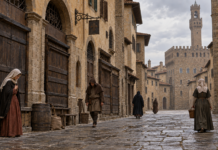

 The Italian Renaissance was far more than an artistic movement. It was a period of experimentation, rediscovery and intellectual ambition that transformed painting, sculpture, architecture, literature, science and political thought.
Beginning in the prosperous cities of central and northern Italy, the Renaissance gradually changed how Europeans understood nature, antiquity and humanity’s place in the world. Artists studied anatomy and perspective. Architects returned to classical proportion. Scholars recovered Greek and Roman texts. Wealthy families, merchants, guilds and popes used art to communicate faith, prestige and political power.
Florence is commonly described as the birthplace of the Renaissance, but the movement never belonged to a single city. Rome, Venice, Milan, Mantua, Ferrara, Urbino and Naples all developed distinctive Renaissance cultures. Together, these competing courts and republics created one of the most influential periods in world history.
What Was the Italian Renaissance?
The word “Renaissance” means “rebirth.” It describes the renewed interest in the literature, philosophy, architecture and visual culture of ancient Greece and Rome that emerged in Italy toward the end of the Middle Ages.
This was not a simple return to the ancient world. Renaissance thinkers adapted classical ideas to the political, religious and social realities of their own time. Christian belief remained central, and many of the greatest paintings and sculptures were created for churches, monasteries and papal buildings.
What changed was the way artists and intellectuals approached their subjects. Greater attention was given to observation, individual experience, physical reality and the dignity of human beings.
Renaissance art became increasingly recognizable through:
- Realistic human figures and expressions
- Convincing space created through linear perspective
- Careful observation of anatomy and movement
- Renewed use of classical columns, arches and domes
- Greater recognition of the individual artist
- Portraits of merchants, rulers and other secular patrons
- Religious scenes presented in believable human settings
- Interest in mythology, history, philosophy and nature
The Renaissance was part of the much longer history explored in Italian Art Movements and Periods. Understanding it as one chapter within that broader chronology helps explain both its medieval origins and its transition into Mannerism and Baroque art.
When Did the Italian Renaissance Begin?
There is no universally accepted starting date. Historical periods rarely begin in a single year, and the Renaissance developed gradually.
Many historians identify a Proto-Renaissance in the late 13th and 14th centuries. During this period, artists such as Giotto began to give human figures a new sense of weight, emotion and physical presence. Petrarch, meanwhile, encouraged the study of classical literature and helped shape the intellectual movement later known as humanism.
The Renaissance is commonly divided into four overlapping phases:
Proto-Renaissance: approximately 1300–1400
Giotto, Pietro and Ambrogio Lorenzetti and other artists moved beyond some of the more formal conventions of medieval art. Their figures occupied believable spaces and displayed recognizable emotions.
Early Renaissance: approximately 1400–1490
Florence became the principal laboratory of innovation. Brunelleschi investigated mathematical perspective and classical architecture, Donatello transformed sculpture, and Masaccio brought monumentality and spatial coherence to painting.
High Renaissance: approximately 1490–1527
Leonardo da Vinci, Michelangelo and Raphael created works that appeared to unite technical mastery, ideal proportion and emotional power. Rome became a major center under ambitious Renaissance popes, while Venice developed its own extraordinarily rich tradition of color and atmosphere.
Mannerism: approximately 1520–1600
Artists including Pontormo, Parmigianino and Bronzino moved away from the balanced harmony associated with the High Renaissance. Their elongated figures, unusual colors and complex compositions created a more artificial and intellectually sophisticated style.
The phases overlap because artists did not stop working when one historical label supposedly ended. Regional differences also meant that Renaissance ideas appeared at different times in different parts of Italy.
Why Did the Renaissance Begin in Italy?
Several conditions made the Italian peninsula particularly favorable to cultural innovation.
The presence of the ancient world
Roman buildings, sculptures, inscriptions and ruins were visible throughout Italy. Artists and architects could study classical remains directly rather than knowing antiquity only through manuscripts.
Wealthy commercial cities
Florence, Venice, Genoa and Milan benefited from banking, manufacturing and international trade. Wealthy families and civic institutions invested in churches, palaces, monuments and public art.
Political competition
Italy was divided into republics, duchies, kingdoms and papal territories. Rulers competed for prestige by employing leading artists, architects and scholars. A magnificent cathedral, palace or public square could demonstrate the power of an entire city.
Patronage
Art required money, materials and access to important spaces. Patrons commissioned works for devotion, commemoration, diplomacy and personal reputation.
The Medici became the most famous patrons in Florence, but they were not alone. The Sforza supported culture in Milan, the Gonzaga in Mantua, the Este in Ferrara and the Montefeltro in Urbino. Popes transformed Rome through some of the largest artistic commissions of the period.
Humanism
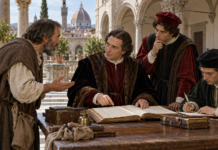
Renaissance humanists studied grammar, rhetoric, poetry, history and moral philosophy through classical texts. They believed education could develop human abilities and contribute to civic life.
Humanism was not necessarily opposed to Christianity. Many scholars regarded classical learning and Christian belief as compatible, even when that combination generated debate.
Florence: The Birthplace of Renaissance Innovation
Florence played an exceptional role in the Early Renaissance. Its banking wealth, guild system, republican traditions and powerful families created intense competition for artistic prestige.
A celebrated turning point came with the 1401 competition for new bronze doors for the Baptistery of San Giovanni. Lorenzo Ghiberti won the commission, but the competition also involved Filippo Brunelleschi, who later revolutionized Renaissance architecture.
Brunelleschi’s dome for Florence Cathedral remains one of the period’s greatest engineering achievements. Its scale and construction demonstrated that contemporary architects could equal—and perhaps surpass—the builders of antiquity.
Florence was also the city of:
- Masaccio, whose frescoes gave figures remarkable physical presence
- Donatello, who revived and transformed classical sculptural forms
- Fra Angelico, who combined spiritual intensity with Renaissance space
- Filippo Lippi, known for graceful and emotionally accessible figures
- Sandro Botticelli, creator of Primavera and The Birth of Venus
- Leonardo da Vinci, whose curiosity extended across art, science and engineering
- Michelangelo, whose early career was shaped by the city and Medici patronage
Anyone exploring the Renaissance in person should treat Florence as an open-air museum. The cathedral complex, Palazzo Vecchio, Santa Maria Novella, Santa Croce and the churches of the Oltrarno reveal different aspects of the city’s history.
The Uffizi Gallery contains major works by Botticelli, Leonardo, Raphael, Michelangelo and Titian. Advance reservations are strongly advisable, particularly during the busiest travel periods.
Reserve Uffizi Gallery admission through Weekend in Italy
Affiliate disclosure: Italia Mia may receive a commission from qualifying reservations made through selected links, without increasing the price paid by the reader.
The Medici and the Power of Patronage
The Medici family became wealthy through banking and gradually turned financial influence into political power. Their support of artists, architects, scholars and religious institutions helped shape Florence’s visual identity.
Cosimo de’ Medici supported intellectual and artistic projects while exercising influence behind the institutions of the Florentine Republic. His grandson Lorenzo de’ Medici, known as Lorenzo the Magnificent, became closely associated with the cultivated world of late-15th-century Florence.
Medici patronage was not simply generosity. Art strengthened family prestige, expressed political alliances and contributed to the public image of Florence. Chapels, palaces, sculptures and paintings could all carry messages about legitimacy, devotion and authority.
The family’s influence eventually extended beyond Tuscany. Two Medici became popes—Leo X and Clement VII—while Catherine de’ Medici and Marie de’ Medici became queens of France.
Leonardo da Vinci: Art Joined with Observation
Leonardo da Vinci embodied the Renaissance ideal of curiosity crossing conventional boundaries. He studied painting, anatomy, engineering, water, flight, botany, optics and the movement of the human body.
His paintings are celebrated not only for their technique but also for their psychological ambiguity. In works such as the Mona Lisa and The Last Supper, gestures, expressions and spatial relationships create a complex emotional experience.
Leonardo’s notebooks reveal that art and science were not separate activities for him. Drawing was a method of investigation. By recording muscles, machines, plants and water currents, he attempted to understand the structures beneath visible appearances.
Visitors can encounter Leonardo’s legacy in several Italian cities:
- Florence, where he trained and developed as an artist
- Milan, home of The Last Supper
- Turin, which preserves important drawings
- Venice, where the Gallerie dell’Accademia holds the exceptionally fragile Vitruvian Man, displayed only under restricted conditions
Michelangelo: The Human Body as Monument
Michelangelo Buonarroti considered himself primarily a sculptor, even though he also transformed painting and architecture.
His David, created from a block of marble that other sculptors had found difficult to use, became a symbol of Florence. Unlike earlier versions of the biblical hero, Michelangelo represented David before the battle—alert, tense and prepared to act.
In Rome, Michelangelo created the Pietà, painted the ceiling and altar wall of the Sistine Chapel, worked on the tomb of Pope Julius II and redesigned parts of St. Peter’s Basilica.
His figures combine detailed anatomical knowledge with deliberate exaggeration. Muscles, gestures and poses communicate spiritual conflict as well as physical strength. The scale of his vision made the human body appear capable of carrying the emotional weight of biblical history.
To experience Michelangelo in context, visitors should see the Accademia and Medici Chapels in Florence, followed by the Vatican Museums and St. Peter’s Basilica in Rome.
Raphael: Harmony and Intellectual Order
Raphael achieved an extraordinary reputation during his short life. His paintings are characterized by compositional clarity, graceful figures and an ability to organize complicated subjects into harmonious scenes.
After working in Umbria and Florence, Raphael moved to Rome in 1508. Pope Julius II commissioned him to decorate rooms in the Apostolic Palace now known as the Raphael Rooms.
The most famous fresco, The School of Athens, presents ancient philosophers within a monumental classical setting. Plato and Aristotle occupy the center, while mathematics, geometry, astronomy and philosophical debate unfold around them.
The work captures an essential Renaissance ambition: bringing classical learning into conversation with the culture and beliefs of contemporary Italy.
The official Vatican Museums describe the Room of the Segnatura as containing Raphael’s most famous frescoes and as marking the beginning of the High Renaissance. The rooms were decorated by Raphael and his workshop between 1508 and 1524.
Botticelli and the Poetry of Florentine Painting
Sandro Botticelli created some of the most immediately recognizable images of Renaissance Italy.
The Birth of Venus presents the goddess arriving on the shore, while Primavera brings together mythological figures in an enigmatic garden. Their meanings continue to inspire debate, but both works reflect the sophisticated intellectual environment of Medici Florence.
Botticelli also produced deeply religious paintings. His career demonstrates why it is misleading to separate Renaissance classicism completely from Christian devotion. Mythology, philosophy, poetry and faith could coexist within the work of one artist.
Both The Birth of Venus and Primavera can be seen at the Uffizi Gallery.
Donatello and the Renaissance in Sculpture
Donatello helped redefine European sculpture. He worked in marble, bronze, wood and terracotta, creating figures with unprecedented individuality and emotional force.
His bronze David revived the tradition of the freestanding nude and offered a strikingly different interpretation from Michelangelo’s later monumental figure. Donatello’s Saint George, Mary Magdalene and equestrian monument to Gattamelata demonstrate his remarkable range.
He also used a shallow-relief technique known as schiacciato, producing an illusion of atmospheric depth through extremely subtle changes in the surface.
Important works by Donatello can be found in Florence’s Bargello National Museum, the Museo dell’Opera del Duomo and the Basilica of San Lorenzo, as well as in Padua.
Brunelleschi and the Reinvention of Architecture
Filippo Brunelleschi looked to Roman buildings for principles of proportion, engineering and structural clarity. His architecture replaced much Gothic complexity with measured geometric relationships.
His best-known achievement is the dome of Florence Cathedral, built without the traditional full wooden centering that a project of its enormous size would ordinarily have required.
Brunelleschi also influenced architectural space through works such as:
- The Ospedale degli Innocenti
- The Old Sacristy of San Lorenzo
- The Pazzi Chapel
- The churches of San Lorenzo and Santo Spirito
Renaissance architecture did not merely copy ancient Rome. Architects studied classical models and adapted them to churches, palaces and civic buildings serving contemporary Italian society.
Rome and the High Renaissance
During the early 16th century, Rome became the most ambitious artistic center in Europe. Popes Julius II and Leo X recruited outstanding artists to glorify the Church and reshape the city.
Bramante developed plans for the rebuilding of St. Peter’s Basilica. Michelangelo painted the Sistine Chapel ceiling. Raphael decorated the papal apartments. Ancient sculptures were collected, studied and displayed.
The concentration of money, authority, antiquities and artistic talent made papal Rome the center of the High Renaissance.
The Sack of Rome in 1527 disrupted this extraordinary environment. Artists dispersed, political conditions changed, and the balanced ideals associated with the High Renaissance gave way increasingly to Mannerism.
For practical information about the collections, see Italia Mia’s guide to the Vatican Museums in Rome.
Venice and the Renaissance of Color
Venetian Renaissance painting developed differently from the art of Florence and Rome.
Florentine artists were often associated with drawing, structure and the intellectual construction of form. Venetian painters became particularly admired for color, light, atmosphere and the sensuous qualities of oil paint.
Giovanni Bellini helped establish the Venetian tradition. Giorgione introduced poetic ambiguity, while Titian developed a rich and expressive handling of color that influenced European painting for generations.
Tintoretto brought intense movement and dramatic lighting to large religious compositions. Paolo Veronese became famous for magnificent architectural settings, luxurious fabrics and grand groups of figures.
Venice’s Renaissance heritage can be experienced in the Gallerie dell’Accademia, the Doge’s Palace, Santa Maria Gloriosa dei Frari, San Giorgio Maggiore and numerous smaller churches.
Milan: Leonardo and the Sforza Court
Under the Sforza family, Milan became a major Renaissance court. Leonardo spent some of his most productive years there, working as a painter, engineer, designer and organizer of court spectacles.
His Last Supper, painted in the refectory of Santa Maria delle Grazie, is among the defining works of the Renaissance. Rather than presenting the apostles as a static group, Leonardo captured the moment after Christ announces that one of them will betray him. The figures respond through gestures, expressions and tightly organized groups.
Milan also preserves Renaissance architecture and art at the Castello Sforzesco, Pinacoteca di Brera and Basilica of Santa Maria presso San Satiro.
Mantua, Ferrara and Urbino: The Renaissance Courts
The Renaissance was shaped not only by famous republics and papal commissions but also by smaller courts.
Mantua
The Gonzaga family attracted artists and intellectuals to Mantua. Andrea Mantegna’s Camera degli Sposi in the Palazzo Ducale transformed a room through illusionistic painting. Later, Giulio Romano created the extraordinary Palazzo Te.
Ferrara
The Este court cultivated literature, music and visual art. Cosmè Tura, Francesco del Cossa and Ercole de’ Roberti developed a distinctive Ferrarese style characterized by sculptural forms, unusual colors and expressive tension.
Urbino
Federico da Montefeltro turned Urbino into one of Italy’s most refined courts. The Palazzo Ducale combined elegance, learning and political symbolism. Urbino was also Raphael’s birthplace and an important center for ideas about the ideal courtier.
These cities make it possible to experience the Renaissance with fewer crowds than visitors generally encounter in Florence, Rome or Venice.
Naples and the Renaissance in Southern Italy
Naples occupied a major political and cultural position under the Aragonese dynasty. Its court maintained connections with artists and intellectuals from other parts of Italy, Spain and the wider Mediterranean.
The triumphal arch of Castel Nuovo reflects the influence of classical Roman monuments. Artists such as Francesco Laurana and Antonello da Messina contributed to a southern Renaissance shaped by international exchange.
Antonello was particularly important in combining Italian attention to form and space with techniques associated with Netherlandish oil painting.
Including Naples in the story corrects the common misconception that the Renaissance was exclusively a northern or central Italian phenomenon.
Women of the Italian Renaissance
Traditional accounts have often concentrated on male artists and patrons, but women participated in Renaissance culture as rulers, writers, collectors and artists.
Isabella d’Este, Marchioness of Mantua, became one of the period’s most influential patrons and collectors. She commissioned works, exchanged ideas with artists and created spaces designed to express her intellectual identity.
Sofonisba Anguissola achieved international recognition as a portraitist and later worked at the Spanish court. Properzia de’ Rossi became known as a sculptor in Bologna, while poet Vittoria Colonna participated in important literary and religious networks and maintained a close friendship with Michelangelo.
Women faced restrictions on training, professional independence and access to commissions. Their achievements are therefore especially significant—and essential to a complete account of Renaissance culture.
Beyond Painting: Literature, Science and Political Thought
The Renaissance cannot be understood through art alone.
Dante, Petrarch and Boccaccio helped establish the prestige of literature written in the Italian vernacular. Petrarch’s engagement with classical texts also became fundamental to humanism.
Niccolò Machiavelli examined power and government with an unsentimental realism in The Prince. Baldassare Castiglione described the qualities expected of an ideal courtier, while Ludovico Ariosto created a Renaissance literary masterpiece in Orlando Furioso.
Scientific investigation was also changing. Greater attention to observation affected anatomy, cartography, engineering and the representation of the natural world. Printed books allowed texts and images to circulate more widely, accelerating the exchange of knowledge.
The period did not produce modern science in a single leap. Nevertheless, it encouraged habits of observation, comparison and questioning that would have lasting consequences.
Where to See Renaissance Masterpieces in Italy
A Renaissance-focused journey could include the following essential destinations:
Florence
Visit the Uffizi Gallery, Accademia Gallery, Bargello, Palazzo Vecchio, Museo dell’Opera del Duomo, San Lorenzo, Santa Croce, Santa Maria Novella and the Brancacci Chapel.
Rome and Vatican City
See the Sistine Chapel, Raphael Rooms, Vatican Pinacoteca, St. Peter’s Basilica, Villa Farnesina and Renaissance churches and palaces throughout the historic center.
Venice
Explore the Gallerie dell’Accademia, Doge’s Palace, Frari Basilica, Scuola Grande di San Rocco and churches containing works by Bellini, Titian, Tintoretto and Veronese.
Milan
Reserve admission to Leonardo’s Last Supper, then visit the Castello Sforzesco, Pinacoteca di Brera and Santa Maria presso San Satiro.
Mantua
Tour the Palazzo Ducale and Palazzo Te, with particular attention to Mantegna and Giulio Romano.
Urbino
Visit the Palazzo Ducale and Galleria Nazionale delle Marche, then explore the historic center associated with Raphael.
Ferrara
See Palazzo Schifanoia, the cathedral, Castello Estense and the city’s Renaissance urban expansion.
For a wider cultural itinerary, consult Italy’s Art Cities and Top Museums in Italy.
Planning an Italian Renaissance Journey
A first Renaissance itinerary could combine Florence, Rome and Venice over approximately ten days:
- Four nights in Florence
- Three nights in Rome
- Three nights in Venice
Travel between these cities is straightforward by high-speed train. Museum reservations should be made before the trip, particularly for the Uffizi, Accademia, Vatican Museums and Leonardo’s Last Supper.
Travelers with more time could add Milan, Mantua, Ferrara or Urbino. Mantua and Ferrara are particularly rewarding for visitors interested in court culture, while Urbino offers one of the most coherent surviving Renaissance urban environments.
Compare hotels in Italy through Trip.com
Recommended Books About the Italian Renaissance
The Civilization of the Renaissance in Italy by Jacob Burckhardt
A landmark interpretation of Renaissance politics, society and culture. Some conclusions reflect the period in which it was written, but the book remains important to the history of Renaissance scholarship.
The Lives of the Artists by Giorgio Vasari
Vasari’s biographies shaped the traditional story of Renaissance art. His accounts are colorful and influential, although they should not always be treated as impartial historical records.
The Italian Renaissance by J.H. Plumb
An accessible introduction to the personalities, institutions and cultural forces that shaped Renaissance Italy.
Leonardo da Vinci by Walter Isaacson
A readable biography connecting Leonardo’s paintings, notebooks, scientific observations and relentless curiosity.
As an Amazon Associate, Italia Mia earns from qualifying purchases.
Why the Italian Renaissance Still Matters
The Renaissance changed the position of the artist in society. Painters, sculptors and architects increasingly emerged as recognizable individuals with personal reputations rather than anonymous craftspeople.
It also changed the appearance of cities. Domes, palaces, public squares, chapels and frescoes communicated ideas about order, faith, civic identity and political authority.
Most importantly, the Renaissance demonstrated that the past could be studied without simply being imitated. Italian artists and thinkers looked back to antiquity while producing something distinctly new.
Its legacy remains visible in museums and monuments, but it also survives in modern ideas about creativity, education, individual achievement and the relationship between art and observation.
To walk through Florence, Rome, Venice, Milan, Mantua or Urbino is therefore to encounter more than a collection of beautiful objects. It is to enter a historical conversation about what human beings can understand, imagine and create.
External Sources
- Uffizi Galleries: Official website
- Vatican Museums: Raphael’s Rooms
- Vatican Museums: The School of Athens
- Vatican Museums: 15th- and 16th-Century Art Department
- National Gallery, London: Introduction to Raphael