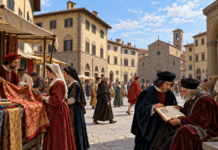
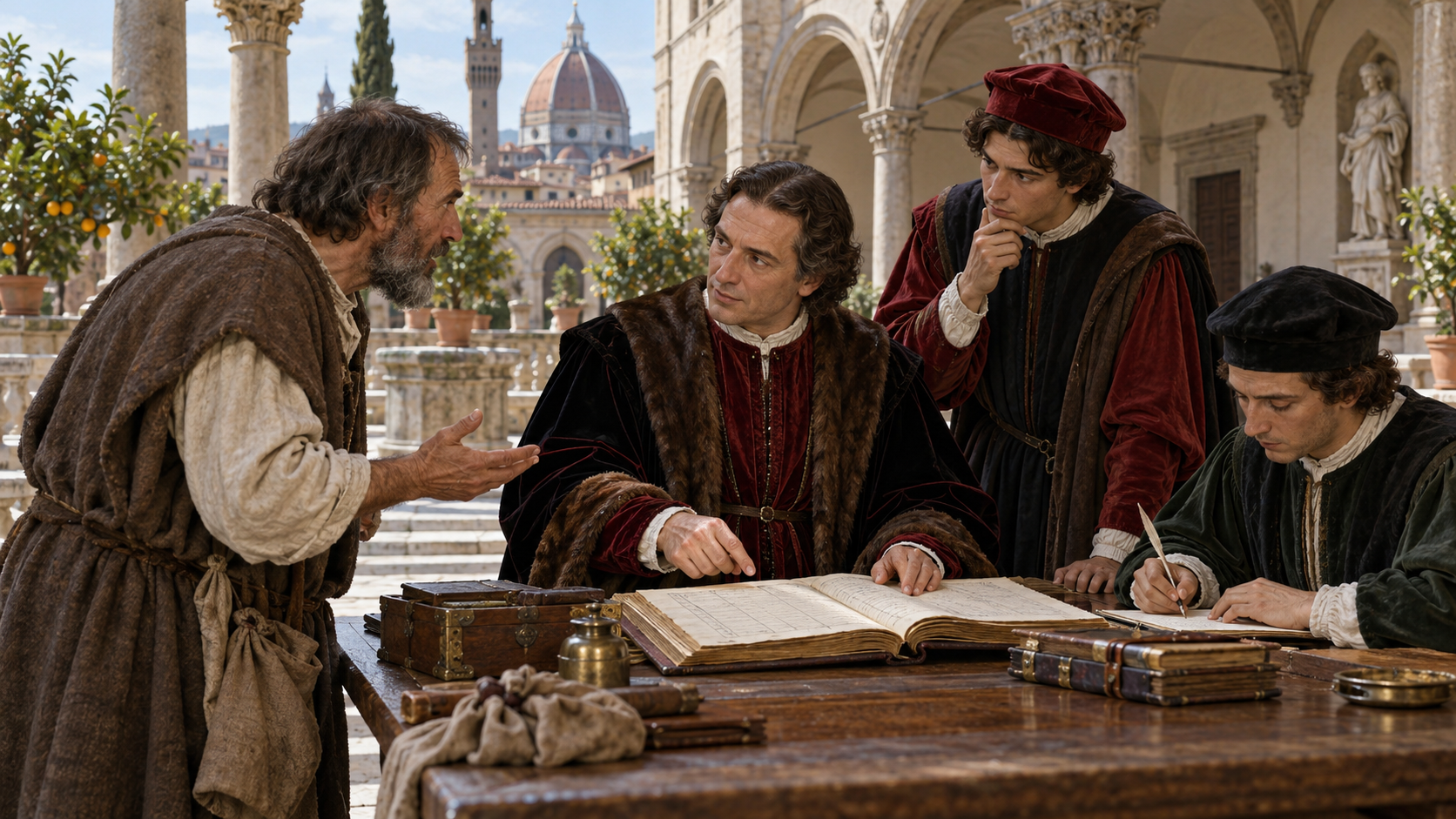
 Florence had councils, public offices, and a proud tradition of republican government. Yet for much of the fifteenth century, its most influential political decisions depended on one family.
The Medici did not initially rule as kings or dukes. Their authority grew through banking, personal obligations, control over appointments, and alliances inside and outside the city. They understood that power could operate through institutions while leaving those institutions standing.
Walk from Palazzo Medici Riccardi to Palazzo Vecchio today, and that political tension becomes visible. One building was the home of a banking family; the other was the seat of civic government. The struggle over Florence concerned how far the household could control the republic.
Our broader guide to Renaissance Italy explores the period’s society and cultural changes. Here, the focus is the practical business of power: who could hold office, who owed whom a favor, and what happened when Florentines challenged Medici dominance.
Disclosure: This article contains affiliate links. Italia Mia may earn a commission from qualifying purchases or bookings at no additional cost to you. As an Amazon Associate, Italia Mia earns from qualifying purchases.
A Republic with Unequal Access to Power
To understand the Medici, start with the government they inherited.
Florence’s political traditions had developed through the conflicts and commercial growth described in Medieval Italy and the Rise of the City-States. Guild membership, citizenship, wealth, and family connections all influenced participation.
The republic was not a modern democracy. Women had no formal political rights, and many working people and residents of Florence’s subject territories were excluded from its governing institutions.
At the center stood the Signoria, consisting of eight priors and the Gonfaloniere of Justice. These officials usually served for only two months. Frequent rotation was intended to prevent individuals from turning temporary office into permanent authority.
Many appointments involved drawing names from bags containing eligible candidates. However, eligibility itself depended on screening. A random drawing could offer little independence if powerful people controlled whose names entered the bags.
That distinction became crucial to Medici government.
Banking Created More Than Wealth
Giovanni di Bicci de’ Medici established the Medici bank in 1397. Under his successors, its operations connected Florence with commercial and political centers elsewhere in Europe.
The bank handled deposits, commercial payments, exchange transactions, and dealings with the papal administration. Its structure included partnerships and branches rather than a single institution operating exactly like a modern bank.
Financial relationships also created political opportunities. A merchant seeking credit, a partner looking for business, or an influential client needing assistance might develop a continuing relationship with the family.
Such connections did not automatically produce obedience. Other Florentine families were wealthy, and Medici clients had interests of their own. Nevertheless, banking gave the family information, contacts, and resources that could support a wider political network. Its papal business was especially valuable, although access to that business changed with the politics of successive pontificates.
For readers interested in this financial background, Tim Parks’s Medici Money: Banking, Metaphysics, and Art in Fifteenth-Century Florence offers an accessible account of the relationship between banking, religion, and cultural spending. Readers shopping in Italy can also find La fortuna dei Medici, its Italian translation.
Cosimo’s Breakthrough: Control the Appointments
Cosimo de’ Medici, known as Cosimo the Elder, inherited wealth and an extensive network. He also faced powerful opponents, particularly the circle associated with Rinaldo degli Albizzi.
In 1433, his enemies secured his exile. Their victory proved temporary. The following year, a favorable change in Florence’s officeholders allowed Cosimo’s supporters to reverse his sentence.
He returned in October 1434.
The lesson was clear: controlling the city required more than winning one confrontation. It required influencing the officials who would govern after the current officials left office.
Cosimo’s allies used extraordinary commissions, known as balìe, to reorganize political participation. Opponents were exiled or excluded, while the lists of eligible officeholders were reconstructed.
Officials called accoppiatori became important in managing appointments. Their role helped the Medici influence who entered government despite the republic’s continuing language of rotation and selection.
This was a gradual and sometimes unstable process. Cosimo had to maintain a coalition, and the machinery did not always operate smoothly. His achievement was to make that coalition increasingly effective without immediately replacing the republic with a hereditary principality.
Patronage Made Influence Personal
Political patronage extended well beyond paying for paintings.
It could involve helping someone obtain an appointment, supporting a petition, recommending a relative, or introducing a business partner. Each act could strengthen a relationship that mattered in a later dispute.
The family’s influence therefore reached through many households. Allies gained opportunities and protection; the Medici gained supporters capable of acting within public institutions.
This also explains why Medici power required constant attention. A disappointed ally could become an opponent. A favor granted to one household might offend another.
Artistic and religious patronage added a public dimension to these relationships. Buildings, chapels, and prestigious commissions displayed wealth while presenting the family as useful to Florence.
At Palazzo Medici Riccardi, Benozzo Gozzoli’s Magi Chapel brings sacred imagery together with a richly dressed procession that includes Medici figures and associates. It is a revealing setting for considering how devotion, family identity, and social prestige could share the same space.
The palace’s official website describes separate private and guest access to the chapel—an architectural reminder that even an intimate religious room could serve the family’s public relationships.
These commissions could express sincere faith and artistic interest as well as political ambition. Their value to the family lay partly in making its prominence visible, memorable, and respectable.
Lorenzo’s Alliances Reached Beyond Florence
After Cosimo died in 1464, his son Piero maintained the family’s position. Lorenzo de’ Medici became its leading political figure after Piero’s death in 1469.
Lorenzo’s authority depended on domestic relationships, but Florence could not be governed through domestic politics alone.
The city operated among competing powers: Milan, Venice, the papacy, Naples, and other Italian states. An external alliance could strengthen a Florentine government; an external enemy could encourage its opponents.
Marriage also connected households across political boundaries. Lorenzo’s marriage to Clarice Orsini linked him to a prominent Roman aristocratic family, extending the Medici’s relationships beyond Florence’s merchant elite.
However, alliances were never permanent guarantees. A pope could be a valuable partner in one dispute and a dangerous adversary in another. Commercial competition, territorial ambitions, and family interests often overlapped.
The Pazzi Conspiracy Exposed the Risks
On 26 April 1478, conspirators attacked Lorenzo and his brother Giuliano during Mass in Florence’s cathedral.
Giuliano was killed. Lorenzo survived.
The Pazzi conspiracy involved a rival banking family and other opponents of Medici power. It also developed within a wider conflict involving Pope Sixtus IV and interests connected to his nephew Girolamo Riario.
The plot’s failure brought violent reprisals. Yet surviving the attack did not make Lorenzo secure: Florence subsequently faced war against the papacy and Naples.
Lorenzo traveled to Naples in late 1479 and negotiated with King Ferrante. The agreement reached in 1480 helped break the hostile alliance and end the immediate military crisis. Its terms were not an uncomplicated victory, but the journey strengthened Lorenzo’s reputation as an indispensable negotiator.
The episode shows how several forms of power intersected. A banking rivalry became a conspiracy; a conspiracy became an international conflict; diplomacy then helped preserve a family’s position at home.
Republican Opposition Had Different Goals
Medici opponents did not all want the same kind of republic.
Some leading families objected to exclusion from offices and decisions. They wanted a larger share of power within an elite political system.
Other critics placed greater emphasis on civic liberty: the principle that public institutions should remain independent of one household.
After Lorenzo’s death in 1492, his son Piero struggled to sustain the family’s position. During the French invasion of 1494, his concessions to Charles VIII helped provoke a political collapse. The Medici were expelled.
The restored republic created a Great Council, broadening participation among qualified male citizens. This remained a restricted political community, but its reformers sought to reduce the concentration of authority that had developed under the Medici.
Girolamo Savonarola became an influential voice in the new order. His preaching connected moral reform, religious renewal, and Florence’s political future. He held no position equivalent to a hereditary ruler, and republican government involved many participants beyond him.
His execution in 1498 did not immediately end the republic. That government survived until the Medici returned in 1512.
The Medici Returned—and the Republic Returned Again
The family’s restoration depended heavily on external military and political circumstances. Their subsequent position was strengthened by Giovanni de’ Medici’s election as Pope Leo X in 1513.
Another family member, Giulio de’ Medici, became Pope Clement VII in 1523.
These papacies gave the family extraordinary influence, but they also bound Florence more closely to conflicts beyond Tuscany.
In 1527, the Medici were expelled again. Florence established another republic, which resisted the forces seeking to restore them during the siege of 1529–1530.
The city’s defeat marked a decisive change. Alessandro de’ Medici became Duke of Florence in 1532, creating a formally hereditary regime.
Fifteenth-century dominance through republican institutions had given way to a different political structure.
From Banking Family to Ducal Dynasty
After Alessandro’s assassination in 1537, Cosimo I de’ Medici became duke. He belonged to another branch of the family and should not be confused with Cosimo the Elder.
His government developed a more centralized state and a court culture suited to hereditary rule.
The contrast matters. Cosimo the Elder had cultivated the standing of a powerful citizen within a republic. Cosimo I governed as a prince.
The family’s banking fortunes and political fortunes also followed different paths. Financial problems had weakened the earlier bank, yet Medici authority survived and eventually took new forms. Papal connections, military support, and dynastic alliances could sustain power even when the original commercial foundation had diminished.
Florence’s history therefore cannot be explained by wealth alone. Money helped build the network, but institutions and alliances determined how that network could govern.
Where to See This History in Florence
A visit becomes more revealing when each building is connected to a political question.
Palazzo Medici Riccardi is the best starting point for the fifteenth-century family. Its courtyard, rooms, and Magi Chapel invite a question: how could a private household advertise exceptional status while remaining part of a republic?
Palazzo Vecchio represents the authority of civic government. Later, Cosimo I appropriated it as a ducal residence, making the former republican headquarters part of the dynasty’s own presentation of power.
San Lorenzo and the Medici Chapels reveal the family’s investment in worship, burial, and remembrance. However, the chapels contain work from different periods. The later monumental complex should not be treated as an unchanged survival of Lorenzo’s Florence.
If you want to explore these places, browse Florence museum tickets and visits through Weekend in Italy. Look for the Medici Chapels and other relevant options, and compare the listed inclusions and total price with official museum information before booking.
Allow space between visits to notice the city outside the monuments. Medici politics worked through neighborhoods, shops, family connections, and everyday requests as well as through grand rooms.
Selected Books for a Closer Look
Choose a book according to the question that interests you most:
- Banking and patronage: Tim Parks’s Medici Money connects financial practices with religion and cultural spending.
- The wider family story: Paul Strathern’s The Medici: Power, Money, and Ambition in the Italian Renaissance follows the dynasty across generations.
- The machinery of government: Nicolai Rubinstein’s The Government of Florence under the Medici, 1434–1494 is a specialist study for readers interested in offices, councils, and constitutional change.
The Medici’s lasting achievement was to connect resources that other families possessed separately: money, relationships, public prestige, and access to government. Their opponents repeatedly demonstrated that those connections could break.
That makes Florence a compelling place to explore political history. Behind the familiar artworks lies a city whose residents argued, sometimes violently, over who had the right to make decisions in their name.
External Sources
- Storia di Firenze: Cosimo de’ Medici’s return to power in 1434
- Storia di Firenze: Piero de’ Medici’s expulsion in 1494
- Treccani: Lorenzo de’ Medici, Dizionario Biografico degli Italiani
- The Metropolitan Museum of Art: The Medici—Portraits and Politics
- Palazzo Medici Riccardi: The Magi Chapel