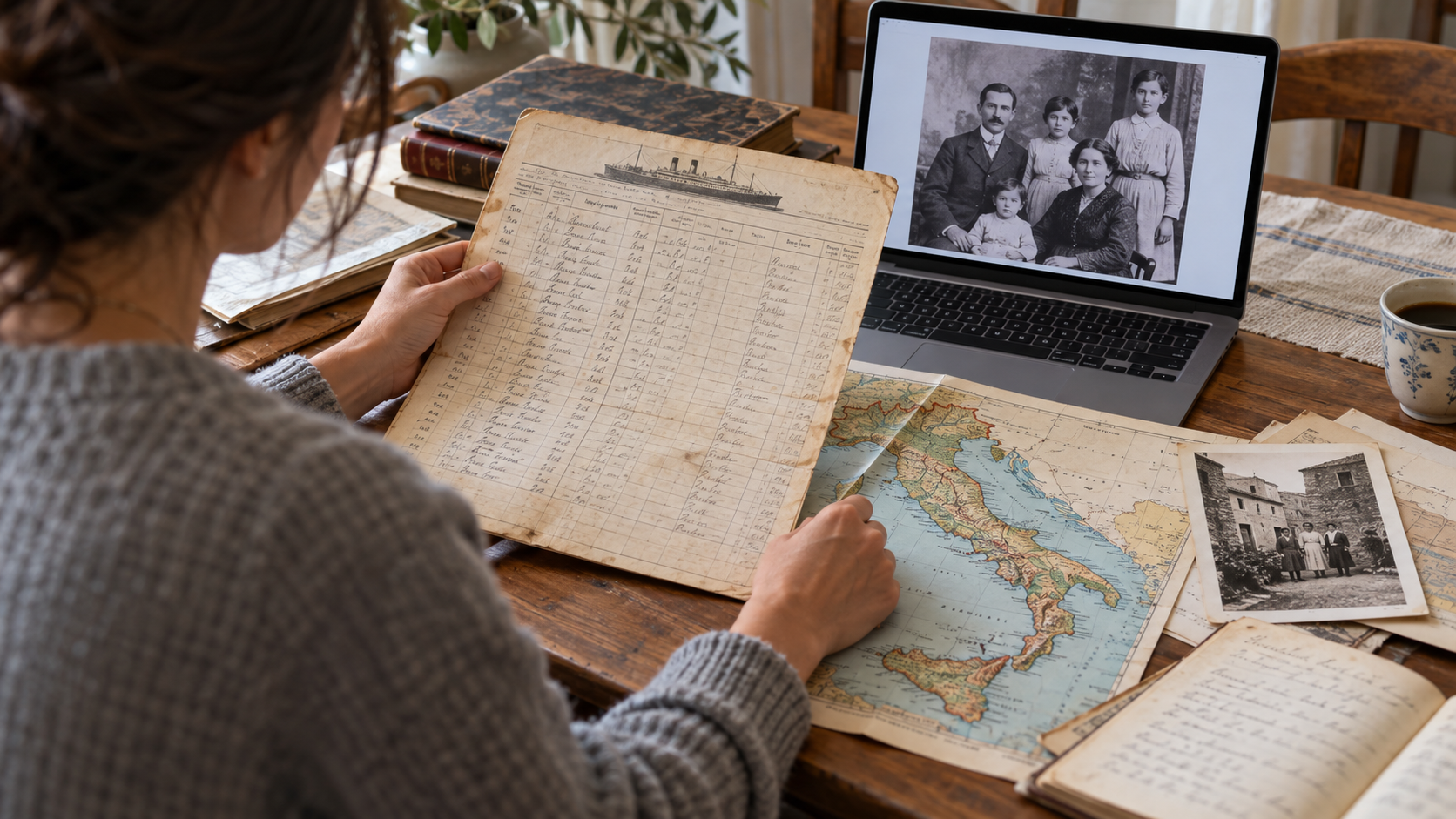
 Your grandmother said the family came from Naples. A passenger list seems to say something different. An online family tree names a village you have never heard of.
Which place should you investigate?
Finding your ancestor’s town in Italy often means working through clues left in the country where they settled. Immigration papers, marriage records, relatives’ documents, and old letters can help you identify the place where Italian research should begin.
The goal is to establish the correct comune, or municipality, for the event you want to investigate. A region or province gives you a starting area; a municipality helps you locate the relevant records.
This guide takes you through that investigation, including what to do when names are misspelled, relatives provide competing stories, or several Italian towns appear to fit.
For the broader research process, start with How to Research Your Italian Ancestors: Records, Parish Archives and Surnames.
Have you been curious to try Ancestry®? Now is the perfect time. Get started with a free trial.
This article contains affiliate links. As an Amazon Associate, Italia Mia earns from qualifying purchases.
1. Start With One Person and One Research Question
Choose one immigrant ancestor rather than trying to solve the origins of an entire family at once.
Frame a specific question: “Where was my great-grandmother born?” This is more useful than “Where is our family from?” Her birthplace, childhood home, and last Italian address may have been different.
Create a short profile containing:
- Every known version of the person’s name.
- An approximate birth date or range.
- Parents’ names, including the mother’s birth surname.
- A spouse’s name and marriage details.
- Siblings and other close relatives.
- Known addresses after immigration.
- Approximate arrival dates and occupations.
Keep uncertain information visibly uncertain. If a census suggests a birth around 1888, record “about 1888,” rather than turning an estimate into an exact date.
Separate family recollections from documented information, too. Both matter, but they play different roles in the investigation.
2. Search Family Papers for Places, Addresses, and People
Before paying for records, examine what the family already has.
Look through letters, postcards, passports, certificates, funeral notices, photographs, prayer cards, and address books. Scan both sides of documents and photographs. A return address or handwritten dedication may be more useful than the main image.
When speaking with relatives, ask concrete questions:
- Did anyone write to family in Italy?
- Was a village, parish, or nearby city ever mentioned?
- Did your ancestor return to Italy?
- Which relatives arrived together?
- Who kept the old documents?
- Was the family connected with a hometown association?
Record unfamiliar place names exactly as you hear or read them. Do not immediately replace a strange spelling with the nearest familiar Italian city.
A remembered name might refer to a village, a neighborhood, a parish, or a larger administrative area. At this stage, preserve the clue.
3. Find the Original Immigration Record
A passenger-list search result can be useful, but the original image usually deserves a closer look.
Depending on the date and form, United States passenger records may identify birthplace, last residence, occupation, and relatives at the destination. These details can distinguish people who share a name. The information available varies between records.
When you locate a likely entry:
- Read the column headings.
- Confirm the passenger’s age and other identifying details.
- Inspect the whole entry and any continuation page.
- Note companions and named relatives.
- Save the image and its archival reference.
Birthplace and last residence answer different questions. A person could have been born in one municipality, worked in another, and sailed from a third.
Likewise, a ship leaving Naples does not establish that every passenger came from Naples.
If the first arrival provides little detail, search for later journeys. A return visit may have produced a more informative record.
For United States research, the National Archives’ immigration overview explains the available holdings. Its port-of-entry directory helps you look beyond New York.
For Canadian arrivals, Library and Archives Canada’s passenger-list guide covers records from 1865 to 1935. For other destinations, begin with the relevant national or regional archive.
4. Follow Naturalization and Local Records
If immigration records do not identify the town, move through the documents created after arrival.
For a United States ancestor, investigate declarations of intention and petitions for naturalization, rather than stopping at a citizenship index. The National Archives explains that records may be held by federal repositories, state or local custodians, or USCIS, depending on the court and period.
Other useful leads include marriage applications, church marriage entries, death certificates, obituaries, and cemetery records. Consider military registrations and employment or association records when available.
Use these sources as a search sequence, not a promise that every document will name an Italian town.
Also ask who supplied the information. An ancestor’s own statement deserves attention, but it can still contain an error. A death certificate completed decades later by someone who never visited Italy may preserve only a broad family recollection.
Write down the exact wording, the date, and the informant when identified. That makes later comparisons much easier.
5. Search Spelling Variations Without Losing the Person
Names can change between languages and across records. Indexers can also misread handwriting.
Try variations systematically:
- Search Italian and adopted given names.
- Try surnames with and without spaces or apostrophes.
- Broaden the estimated birth year.
- Remove an uncertain birthplace filter.
- Search by a spouse, sibling, or child.
- Use wildcards where the database supports them.
For example, a search for D’Angelo may need a second attempt as Dangelo. Giuseppe may appear as Joseph in an English-language record. However, neither variation proves that two entries describe the same person.
Compare the surrounding evidence: relatives, addresses, age, occupation, and migration history.
For married women, search both the birth surname and married surname where appropriate. Do not assume every country or record system followed the same naming practice.
If a town name is difficult to read, compare its letters with other words written by the same clerk. Keep a transcription such as “possibly…” until additional evidence supports it.
6. Investigate Siblings, Cousins, and Traveling Companions
When your ancestor’s records stop helping, investigate the people around them.
A sibling’s marriage record might name a birthplace more precisely. A cousin’s passenger list might preserve a clearer spelling. A traveling companion may name the same relative or destination address.
Make a small table of associated people:
| Person | Connection | Detail worth investigating |
|---|---|---|
| Brother or sister | Shared family background | Birthplace and parents |
| Cousin | Possible connection to the same locality | Relatives and addresses |
| Traveling companion | Shared journey | Last residence and destination |
| Marriage witness | Social or family connection | Whether other records explain the relationship |
| Person named at destination | Immigration contact | Address and stated relationship |
Treat these connections as leads. Siblings can be born in different towns, and a traveling companion may have met your ancestor shortly before departure.
The strongest result comes when several details connect the associated person to your ancestor and then point toward a specific locality.
7. Work Out What Each Place Name Means
Before deciding that two records conflict, identify the type of place each one describes.
| Term | Meaning | Research implication |
|---|---|---|
| Comune | Municipality | A key location for civil registration research |
| Frazione | Named locality within a municipality | Records may be cataloged under the parent comune |
| Provincia | Province | Narrows the area but usually does not identify one town |
| Regione | Region | A broad geographical starting point |
| Parrocchia | Parish | Relevant to church registers |
| Port of departure | Where the journey began by ship | Does not establish birthplace |
Family references to “Naples” or “Palermo” may mean the city, a wider area, or the place associated with departure. Let the record’s heading and context guide your interpretation.
Check historical geography as well. Municipal names, boundaries, and administrative affiliations can change. An older record may use a name that differs from a modern map.
Use municipal websites, archive catalogs, and historical maps to investigate a candidate locality. Search both the historical name and the current name where appropriate.
Surname-distribution maps can suggest areas to investigate, but they cannot identify your ancestor’s birthplace by themselves.
8. Resolve Conflicting Places With an Evidence Table
Avoid choosing the place that appears most often without examining how the information originated. Several online trees may repeat the same unsupported claim.
Instead, compare each record.
The following is a fictional example illustrating the method:
| Source | Place recorded | What it establishes or suggests |
|---|---|---|
| Family recollection | “Naples” | A broad clue requiring clarification |
| Passenger list, departure field | Napoli | Port of departure |
| Passenger list, residence field | Caserta | Reported last residence |
| Naturalization petition, birthplace field | A specific municipality | A candidate birthplace |
| Italian birth record | The same municipality, with matching parents | Strong evidence connecting the person to that place |
These entries need not contradict one another.
When records really do give competing birthplaces, ask:
- Do they certainly describe the same person?
- Was the information supplied firsthand?
- Was the place transcribed correctly?
- Could one name be a hamlet within the other municipality?
- Does either candidate produce records matching the family?
Write a short explanation of your conclusion and any unresolved problem. A clear research note is more useful than silently deleting the inconvenient evidence.
9. Test the Candidate Town Against Italian Records
Once you have a plausible municipality, search for an Italian record that connects the locality to your ancestor.
The Portale Antenati, run by Italy’s Ministry of Culture, provides access to digitized historical records preserved by participating State Archives. Its archive browser helps you explore the available holdings.
Search by name where an index exists. If that produces nothing, investigate the available registers for the locality and period. The portal distinguishes registers with indexed names; a failed name search should not be treated as proof that the person is absent from the underlying records.
FamilySearch’s Italian research resources provide another starting point for identifying collections and learning how to use civil records.
Look beyond a matching name. Compare parents, dates, spouse, and any later annotations. A record for someone with the same name and approximate age may belong to another family.
For help with this stage, see How to Find Birth, Marriage and Death Records in Italy. If church records are needed, continue with Italian Parish Records: How to Find Baptisms, Marriages and Burials.
10. Make a Focused Request When Online Research Runs Out
Before contacting an office, check which institution holds the relevant records and what request procedure it publishes.
Prepare a concise inquiry giving the person’s name, approximate date, event sought, known parents, and the evidence pointing to that municipality or parish.
Ask about a specific record or a limited date range. “Please research everyone with this surname” is difficult for an office to answer.
Keep a research log showing the collection, years, and indexes already searched. Distinguish between:
- A record searched for but not found.
- A year missing from the collection.
- A register that exists but is not online.
- An image that you could not access or read.
Those are different obstacles, and each suggests a different next step.
Genealogy Guides to Keep Beside Your Research
A reference book can help you understand unfamiliar documents and organize the next stage of your search.
Two options are:
- The Family Tree Italian Genealogy Guide: How to Find Your Ancestors in Italy, by Melanie D. Holtz. The Italian Genealogical Society of America recommends it for beginner and intermediate research. Find the guide on Amazon.
- Italian Genealogical Records, by Trafford R. Cole. This reference includes reproduced records, translations, and explanations of Italian civil, church, and other sources. Find the book on Amazon.
These links open title searches so you can compare editions and sellers. Older guides remain useful for understanding documents, but check current archive websites for access instructions and contact details.
From a Documented Town to a Meaningful Visit
Once the evidence supports your conclusion, save the original records, source references, and a short explanation of how you identified the town.
Then you can begin planning a visit around documented connections: a parish, a neighborhood, an address, or the places where relatives worked.
Italia Mia’s Ancestry Travel in Italy: How to Visit the Town Your Italian Family Came From explains how to turn that research into a practical trip.
Finding the town gives your family story a location you can investigate—and, perhaps, a street you can finally walk.
External Sources
- National Archives: Passenger Arrival Records
- National Archives: Naturalization Records
- Library and Archives Canada: Passenger Lists, 1865–1935
- Portale Antenati
- FamilySearch: Italian Research Help
- Italian Genealogical Society of America: Research Books