 Italian parish records can take your family history beyond the dates available in civil registration. A baptism may identify an ancestor’s parents. A church marriage can reveal another parish to investigate. A burial entry may help distinguish between two people with the same name.
Then there are the household registers known as stato delle anime. These can bring several generations into view on the same page, showing who lived together and how members of a parish community were connected.
Finding these documents requires more than searching a surname. You need to identify the right parish, establish where its historical records are preserved, and learn to recognize the language used by the record keeper.
If you are beginning your research, start with Italia Mia’s How to Research Your Italian Ancestors. This guide builds on that approach, focusing on Italian church records and the practical steps needed to find and interpret them.
What Are Italian Parish Records?
Parish records are documents created by a local church community. For most researchers tracing Catholic Italian ancestors, the principal sources are baptismal registers, marriage registers and registers of deaths or burials.
You may also encounter confirmation registers, marriage banns, supporting marriage files and household lists.
These documents record religious events and parish life. They therefore differ from the government records known as stato civile. A baptism entry records a baptism; it does not automatically give the child’s birth date. Likewise, a church wedding and a civil marriage may have occurred on different dates.
Use both sets of records when possible. Italia Mia’s guide to Italian civil birth, marriage and death records explains how to research the municipal side of your family history.
This article concentrates on Catholic records. If your ancestors belonged to another religious community, identify that community’s own record-keeping institutions before applying the same search strategy.
How Far Back Do Italian Church Records Go?
There is no starting date that applies to every Italian parish.
The Council of Trent, which concluded in 1563, helped establish and regulate the keeping of baptismal and marriage registers. Some communities preserved earlier records, while others have surviving series that begin much later.
The Roman Ritual of 1614 provided further instructions for parish record keeping, including deaths and household registers. However, an instruction to maintain a register does not mean that the original volume survives today.
For any parish, ask three separate questions: when did recording begin, which years survive, and which volumes are accessible?
A gap between two registers may represent lost documents rather than a family’s departure from the town. Always establish the coverage before drawing conclusions from an unsuccessful search.
Find the Historical Parish Before Searching
Knowing the ancestral comune, or municipality, is the starting point. The next task is identifying the parish that served the family when the event occurred.
One municipality may contain several parishes. A rural village, or frazione, may have its own church, while another settlement may historically have belonged to a parish in a neighboring community.
Begin with the most precise location you can establish. A street, farm, neighborhood or village name can be more useful than the municipality alone.
Check existing family documents for references to:
- A parish or church name.
- A village, district or rural settlement.
- The priest who performed a ceremony.
- A marriage celebrated outside the family’s usual residence.
- A birthplace different from the recorded residence.
Do not assume that the nearest church today held responsibility for the family centuries ago. Ask whether the parish existed during the period you need, whether its boundaries changed, and whether an older parish served the locality.
If the answer remains unclear, send the diocesan archive a focused question about the village and date range. Identifying the correct institution can save many hours of searching the wrong registers.
Parish Archives and Diocesan Archives: Where to Look
An archivio parrocchiale preserves records belonging to a parish. Historical volumes may remain there, but some collections have been transferred to another parish or a diocesan archive.
An archivio storico diocesano preserves historical material associated with a diocese. Its holdings can include records of the bishop and diocesan offices, together with deposited parish collections. Holdings differ, so a diocesan archive should not be assumed to possess every parish register in its territory.
Use BeWeB’s archival resources to look for descriptions of ecclesiastical archives and their collections. An inventory can identify surviving record types, dates and the institution holding them. An online description does not necessarily include digital images.
Before arranging a visit, confirm the repository, consultation rules and appointment requirements. Ask whether photographs or reproductions are permitted.
If the parish no longer exists independently, ask where its archive went. The building’s present status does not tell you where its historical records are kept.
Baptismal Registers: Finding Children and Parents
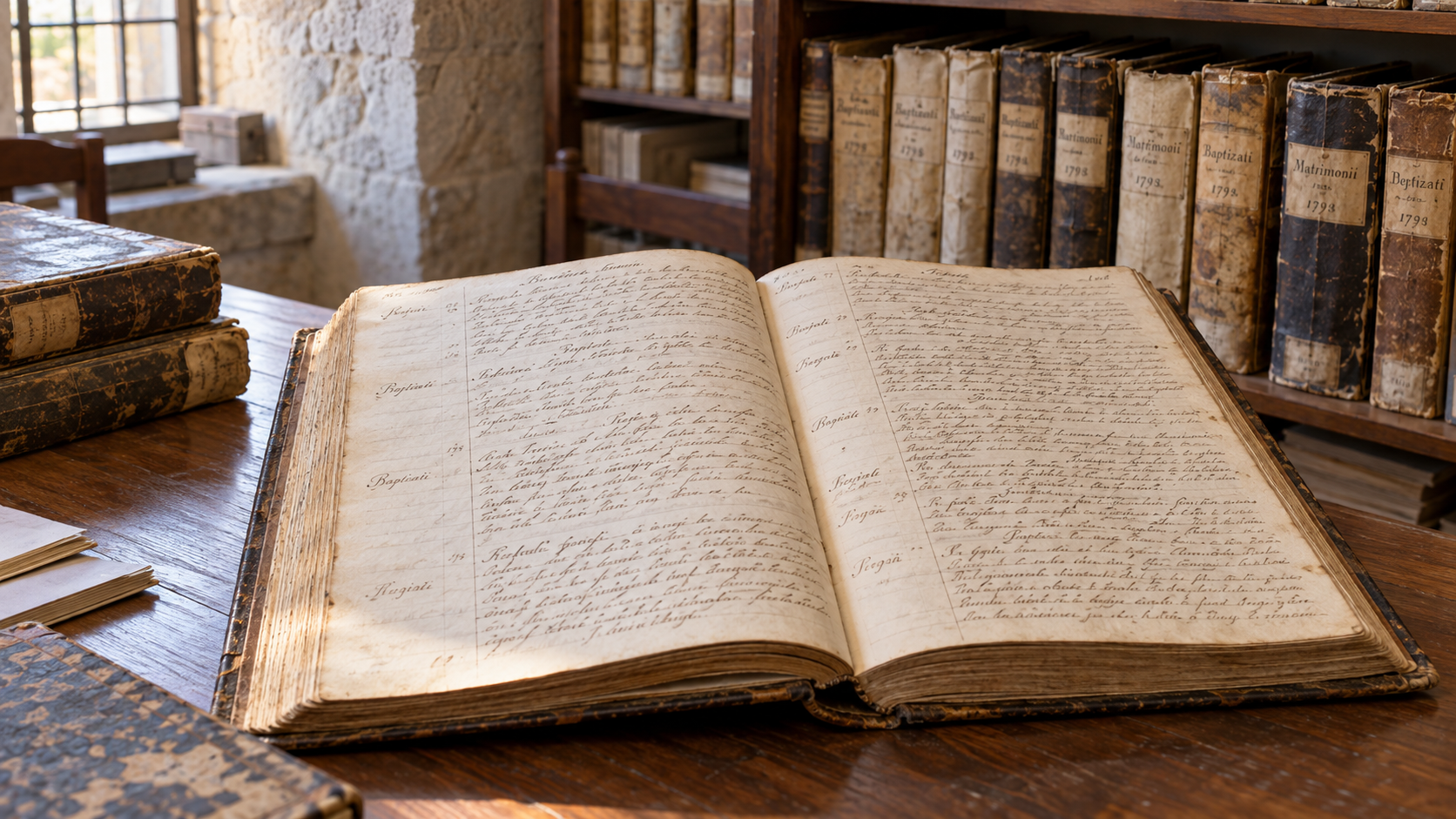
Baptismal registers may be called registri dei battesimi or libri dei battezzati. A Latin heading might read liber baptizatorum.
An entry generally identifies the baptized child, the baptism date, parents, godparents and the priest. Depending on the period and the detail recorded, it may also provide the birth date, residence or other information.
Keep the baptism date separate from the birth date. If the entry gives only the former, record the birth date as unknown until another source establishes it.
Read the complete entry, including marginal notes. Later annotations may point to another event in the person’s life.
Copy godparents’ names as well. They offer people to investigate, although their presence alone does not prove a family relationship.
For a difficult surname, compare several entries written by the same priest. Seeing how the writer formed letters elsewhere can help you separate a spelling variation from a transcription mistake.
Church Marriage Records: Connecting Two Families
A church marriage register may be titled registro dei matrimoni or liber matrimoniorum.
Entries can identify the spouses, ceremony date, parents, places of origin and witnesses. They may also mention marriage banns, permissions or dispensations. The amount of information varies.
Distinguish the wedding date from the dates on which banns were announced. Banns show that a marriage was intended; the marriage entry records the ceremony.
Look for references to another parish or diocese. These may provide the next location to search for a spouse’s baptism.
Ask whether supporting church marriage papers survive. Their titles vary and can include pratiche matrimoniali or processetti matrimoniali. Do not confuse them with similarly named civil marriage attachments.
A reference to a dispensation deserves further investigation, especially if it concerns kinship. However, do not build a family connection from a brief phrase alone. Locate the supporting documentation when available and check how the relationship was described.
Burial and Death Registers: Reading the Dates Carefully
Church death registers may be called registri dei morti, registri dei defunti or liber defunctorum.
Depending on the entry, they may record the deceased person’s name, age, marital status, death or burial date, burial place and religious rites.
Read the wording before deciding which date appears. Obiit indicates that a person died; sepultus or sepulta indicates burial. The two events need separate entries in your research notes when both dates are supplied.
Use a recorded age as a clue to a birth year. For example, someone described as 70 in 1810 might have been born around 1740, but that calculation remains approximate.
Compare the proposed identity with baptisms, marriages and household records. A matching name and estimated age may still belong to another person in the same community.
A burial location can also suggest another collection to investigate, but it does not guarantee that a marked grave survives.
Stato delle Anime: A View of the Household
The stato delle anime, often appearing in the plural as stati delle anime, is one of the most useful sources in Italian parish research. Its Latin name is status animarum.
These registers list parishioners by household and record religious information. They were commonly compiled or updated annually, often around the Easter blessing of homes.
Depending on the register, entries may include names, ages, relationships, residence and sacramental participation. Some also identify occupations or other household details.
A household is not necessarily a group of blood relatives. Servants and other people sharing the home may appear alongside the family. Read relationship labels rather than assigning kinship from the order of names.
Compare surviving years to investigate changes. A child appearing in one register and disappearing from another prompts a search for further evidence; absence alone does not establish a death or migration.
These registers can be particularly helpful when several families share a surname. The combination of household members, ages and residence may separate one family group from another.
Useful Latin Terms in Italian Parish Records
You do not need to master Latin before beginning, but a small vocabulary helps you recognize the structure of an entry.
Word endings change according to grammar. The same name or relationship may therefore appear in several forms.
| Latin term | Meaning or research clue |
|---|---|
| baptizatus / baptizata | Baptized |
| natus / nata | Born |
| filius / filia | Son / daughter |
| filius legitimus / filia legitima | Son / daughter described as born within marriage |
| pater / mater | Father / mother |
| patrinus / matrina | Godfather / godmother |
| conjuges | Spouses |
| uxor | Wife |
| viduus / vidua | Widower / widow |
| testes | Witnesses |
| quondam | The late; often indicates a deceased person |
| obiit | Died |
| sepultus / sepulta | Buried |
| annorum | Of years; commonly introduces an age |
| mensis | Of the month |
Names may also appear in Latin forms. Giovanni can become Joannes or Ioannes, Giuseppe Josephus, and Lorenzo Laurentius. Grammatical endings may alter them further.
Preserve the original wording in your transcription, then add an interpretation separately. Do not silently replace an uncertain name with the spelling you expected.
Historic terms concerning parentage reflect the record keeper’s language. Explain them neutrally and avoid treating them as modern judgments about the people recorded.
For further help, use FamilySearch’s Latin handwriting lessons.
Search Online, Then Browse the Original Registers
The FamilySearch Catalog is a useful place to look for Italian church collections.
Search by locality and examine the descriptions of relevant church records. Check the parish, record types and dates before opening a volume.
Some collections have searchable indexes. Others require browsing images. A failed name search therefore does not establish that an ancestor is absent from the records.
When browsing, try this sequence:
- Confirm that you have the correct parish and record type.
- Check the dates covered by the volume.
- Look for an internal index.
- Locate the relevant year or approximate period.
- Read the original entry and its margins.
- Save the reference needed to find it again.
FamilySearch image access varies by collection. Some images are available remotely; others have restrictions that may require access through a FamilySearch center, an affiliate library or another provider. Follow the message shown for the particular collection rather than assuming that all Italian records have the same access conditions.
How to Request a Parish Record
A useful request gives the recipient enough information to identify one event.
Include the ancestor’s full name, approximate date, locality, parents or spouse if known, and the type of record sought. Explain that your purpose is family-history research.
Write in Italian when possible. Keep the initial request short and ask whether the relevant register survives.
For a baptism search, you could write:
Gentile Responsabile dell’Archivio, sto svolgendo una ricerca sulla storia della mia famiglia. Cerco l’atto di battesimo di [nome e cognome], nato/a presumibilmente tra [anno] e [anno] a [località], figlio/a di [nomi dei genitori, se conosciuti].
Potreste indicarmi se conservate il registro relativo a questo periodo e se è possibile richiedere una riproduzione digitale dell’atto? In caso contrario, sarei grato/a per un’indicazione dell’archivio competente. Vi prego inoltre di comunicarmi eventuali costi e modalità della richiesta.
Ringrazio per l’attenzione e porgo cordiali saluti.
Replace every bracketed item before sending. If the date is uncertain, explain how you estimated it.
Ask about research and reproduction charges before commissioning work. If you need a formally issued certificate, say so at the outset: a photograph for family research and an official certificate are different requests.
Allow time for a reply. A parish may have limited staff, and historical research may require referral to another institution.
What to Do When You Cannot Find the Record
Before widening the search, review what you have actually checked.
Was the register complete for the relevant years? Did you browse the images or rely only on an index? Were you searching the parish of residence, birthplace or marriage?
Next, investigate the most likely alternatives:
- Another parish serving the same village or neighborhood.
- An older parish that existed before a later division.
- The spouse’s parish for a marriage.
- Another repository holding transferred volumes.
- A sibling’s baptism or marriage.
- Supporting marriage papers containing an extract of an earlier record.
Keep a log of unsuccessful searches. “No baptism found in this parish’s surviving register for 1790–1795” is useful evidence. “No record exists” is a much broader conclusion that the search may not support.
If you encounter an unfamiliar place name, preserve it exactly and investigate it before choosing the next archive.
Build a Documented Family History
For every discovery, record the parish, repository, register title, date range, page or folio, and entry number when available. For online images, save a stable link or image identifier and the date consulted.
Keep the full image where permitted. A cropped name removes context that may later help with interpretation.
Separate three things in your notes: what the document says, what you think it means, and what remains uncertain.
That discipline matters when names repeat, ages conflict or handwriting is unclear. A promising entry becomes a reliable family connection only when its details fit the wider evidence.
Italian parish records offer more than a route to earlier generations. They can reveal the households, witnesses, places and relationships that shaped an ancestor’s life. Begin with a precise location, follow the records carefully, and let each verified discovery guide the next search.
External Sources
- BeWeB — Ecclesiastical Archival Resources
- BeWeB — Baptismal Registers
- BeWeB — Marriage Registers
- BeWeB — Stato delle Anime
- FamilySearch — Catalog
- FamilySearch — Historical Record Image Restrictions
- FamilySearch — Latin Handwriting and Genealogical Vocabulary