

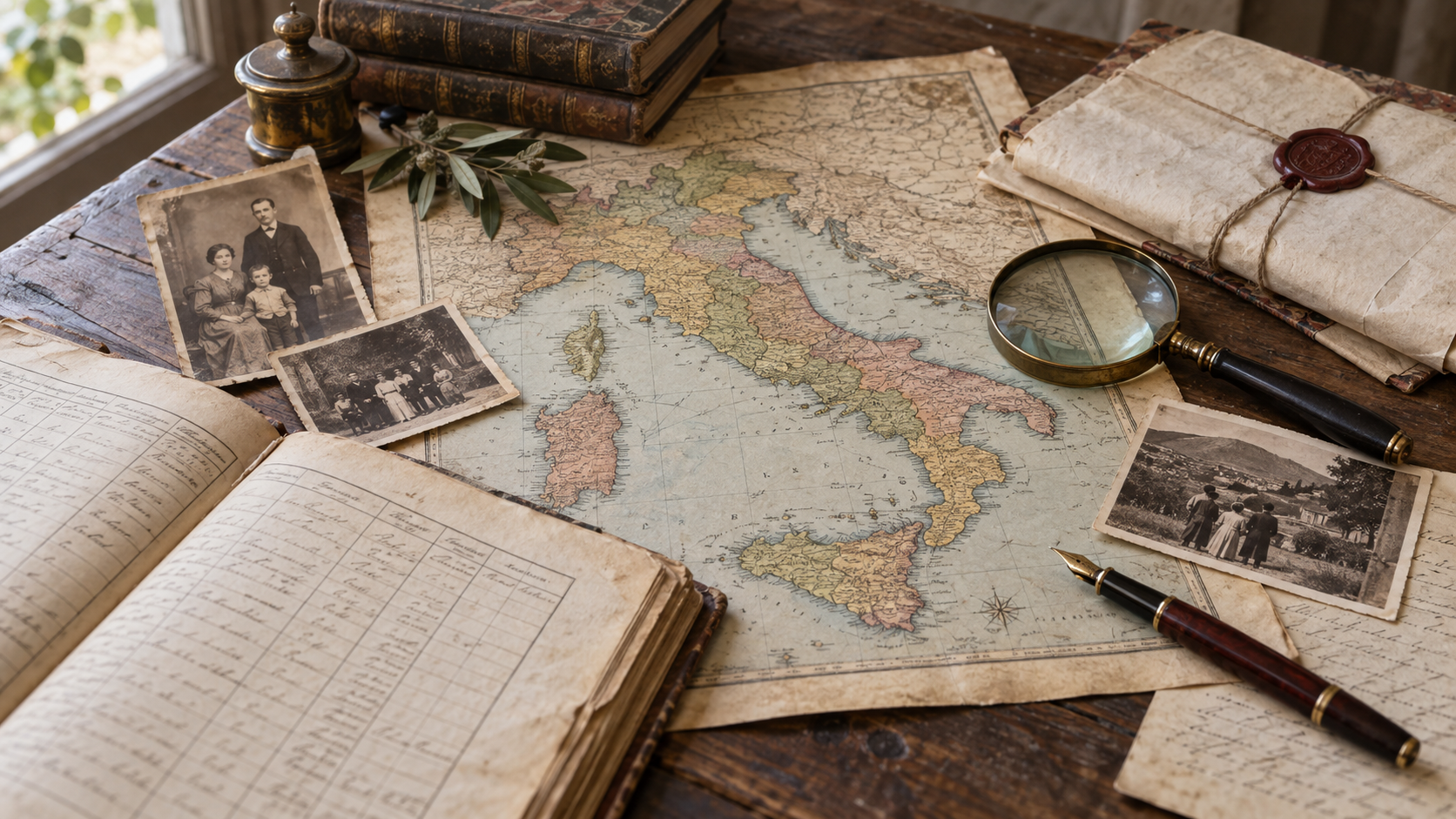
 An Italian surname can contain a fragment of family history. It may point to an ancestor’s occupation, hometown, physical appearance, father’s name or social circumstances. For millions of Italian Americans, understanding a surname is often the first step toward identifying the town or region their ancestors left behind.
However, surnames should be treated as clues rather than definitive proof. The same surname may have developed independently in different parts of Italy, while migration, dialects and clerical errors frequently changed its spelling. A name associated with Sicily today, for example, might have originated elsewhere generations earlier.
If you are beginning a family-history project, Italia Mia’s guide to tracing your Italian genealogy explains how to find birth, marriage, death and immigration records.
How Italian Surnames Developed
During much of the Middle Ages, a single personal name was sufficient in small communities. As towns grew and populations became more mobile, people needed additional names to distinguish one Giovanni, Antonio or Maria from another.
A person might be identified by a parent, occupation, hometown or memorable characteristic. Giovanni, the son of Pietro, could become Giovanni di Pietro. Marco, the village blacksmith, might be called Marco Ferraro. Someone arriving from Rome could be known as Romano.
These descriptions gradually became hereditary family names. The process did not happen everywhere at the same time. Wealthy urban families often used stable surnames earlier, while hereditary surnames appeared later in some rural communities.
Church baptism, marriage and burial registers helped stabilize surnames, although spelling continued to vary. The priest or civil official normally wrote the name as he heard it, sometimes recording different versions of the same surname within one family.
Patronymic Surnames: Identifying the Father or Ancestor
Many Italian surnames developed from the first name of a father or another male ancestor. These are called patronymic surnames.
The prefixes Di, De, Del, D’ and occasionally Da can indicate descent or a family connection:
Di Giovanni — descendant or son of Giovanni
De Luca — connected with Luca
Di Pietro — son or descendant of Pietro
D’Angelo — descendant of Angelo
De Simone — connected with Simone
De Santis — associated with Sante, Santo or the saints
The absence of a space does not necessarily change the meaning. De Luca, Deluca and DiLuca may represent different ways of recording a related surname, especially after a family emigrated.
Some surnames developed directly from first names without a prefix. Examples include Martini, Paoli, Giorgi, Antonelli, Tommasini and Bernardini. Their endings may indicate a family group, a descendant or a diminutive form.
Surnames Based on Occupations
An ancestor’s trade could become the identifying name of the entire family. Some occupational surnames remain immediately recognizable:
Ferrari, Ferraro and Fabbri — connected with ironworking or blacksmithing
Barbieri — barbers
Sartori — tailors
Molinari — millers
Pastore — shepherd
Pescatore — fisherman
Fornari — bakers or people working with ovens
Muratori — builders or bricklayers
Calzolari — shoemakers
Carbonari — charcoal makers
Ferrari is now internationally associated with automobiles, but the surname existed centuries before the company. It belongs to the same broad occupational family as Ferraro and Fabbri.
Regional vocabulary produced different surnames for similar occupations. A trade name used in Veneto might not be identical to the equivalent name in Sicily or Tuscany.
Surnames Derived from Places
Geographical surnames can be especially useful to genealogists because they may indicate where an ancestor once lived or originated.
Romano — a person associated with Rome
Lombardi — someone from Lombardy
Napolitano — a person from Naples
Genovese — someone from Genoa
Pugliese — a person from Puglia
Calabrese — someone from Calabria
Siciliano — a person from Sicily
Toscano — someone from Tuscany
Sardo — a person from Sardinia
Montanari — people from the mountains
Della Valle — connected with a valley
A geographical surname does not always mean that the family still lives in that location. In fact, such a name may have been given after an individual moved elsewhere. A man called Genovese in Sicily may have received the name precisely because he or his family came from Genoa.
Explore Italia Mia’s guide to the regions of Italy when comparing a surname with historical towns, provinces and regional migration patterns.
Surnames Based on Appearance or Personality
Physical characteristics, personality traits and nicknames produced many familiar Italian surnames:
Rossi or Rosso — traditionally associated with red hair, a reddish complexion or the color red
Bianchi or Bianco — connected with the color white, pale hair or complexion
Ricci — curly-haired
Grasso — large or stout
Basso — short
Longo or Lungo — tall or long
Gentile — gentle, courteous or noble
Mancini — traditionally associated with someone who was left-handed
Testa — head, possibly referring to a physical feature or nickname
These meanings should not be interpreted literally for every modern bearer. A medieval nickname may have been affectionate, ironic or based on a temporary characteristic. After it became hereditary, it no longer described each member of the family.
Religious and Devotional Surnames
Religion influenced Italian personal names and surnames for centuries. Examples include Santoro, Santi, De Santis, Di Dio, Croce, Rosario, Natale and Pasquale.
Some referred to saints or Christian devotion. Others may have been associated with the date of a child’s birth. Natale, for example, can be connected with Christmas, while Pasquale is associated with Easter.
Religious surnames can have several possible origins, so parish registers and civil documents are needed before drawing conclusions about a particular family.
Foundling Surnames and a Necessary Caution
Certain Italian surnames are historically associated with abandoned children, foundling hospitals or charitable institutions. Esposito is the best-known example, particularly in and around Naples. Its meaning is connected with a child who had been “exposed” or placed in institutional care.
Other names sometimes connected with foundlings include Innocenti, Trovato, Proietti and Degli Esposti. Their histories differ by city and institution.
It is important not to assume that every person carrying one of these surnames descends from a foundling. Surnames spread through marriage, migration, unrelated family lines and ordinary demographic growth. Only documentary research can establish an individual family’s history.
What Surname Endings May Reveal
The ending of a surname can offer a regional or linguistic clue, but it is never a perfect map.
Surnames ending in -i, such as Rossi, Bianchi, Ricci and Martini, are common across northern and central Italy. The plural ending often came to represent an entire household or family group.
Names ending in -o, including Russo, Greco, Romano and Bruno, are found throughout Italy but are particularly common in many southern regions.
Endings such as -ini, -etti, -ello, -ello and -ucci may have originated as diminutive or affectionate forms. Antonelli, Paoletti, Rossini and Bertolucci are examples of how a personal name or nickname could develop into a family name.
Sardinian surnames frequently preserve distinctive endings and forms, including -u, -as and -is. Carta, Sanna, Piras, Melis and Manca are strongly associated with Sardinia, although migration has carried them throughout Italy and abroad.
In Sicily, surnames such as Lo Monaco, La Rosa, Messina, Catalano and Greco reflect a combination of occupations, places, personal descriptions and the island’s complex linguistic history.
The most reliable regional clue is not the ending alone, but the concentration of the surname in specific municipalities combined with birth and marriage records.
Why Italian Surnames Have Different Spellings
A single family surname may appear in several forms:
De Angelis, DeAngelis and D’Angelis
De Luca, Deluca and Di Luca
Lo Presti and Lopresti
D’Andrea and Dandrea
Giordano and Jordano
Before standardized documents, spelling depended heavily on the person recording the name. Italian dialects also affected pronunciation, while emigrants sometimes encountered officials unfamiliar with Italian spelling.
A surname may have been shortened, joined together or adapted after immigration. Contrary to a popular story, American immigration officials did not routinely invent new names at Ellis Island. Passenger names had generally been recorded at the European port of departure. Changes were more likely to occur later through schools, employment, naturalization documents or the family’s own decision to simplify its name.
When researching an ancestor, search every plausible spelling and do not discard a record because one letter is different.
Common Italian Surnames and Their Possible Meanings
Lists vary according to the database and period studied, but these names are frequently found among Italy’s most widespread surnames:
Rossi — associated with red coloring or a nickname
Russo — a southern form related to rosso, although individual origins may differ
Ferrari — connected with blacksmiths or ironworkers
Esposito — historically associated with foundlings, especially in Naples
Bianchi — connected with the color white or a physical characteristic
Romano — someone originating from or associated with Rome
Colombo — connected with the Italian word for dove; the name has several possible historical uses
Ricci — curly-haired
Marino — associated with the sea or the personal name Marino
Greco — someone believed to be Greek or to have connections with Greek lands
A dictionary meaning is only the beginning. To learn what a surname means in your own family, you must determine where its earliest documented bearers lived.
How to Research Your Italian Surname
Begin with relatives and documents already in your possession. Record complete names, maiden names, approximate dates, occupations and places of birth. The single most useful discovery is usually the ancestral Italian comune, or municipality.
Then follow these steps:
- Search passenger lists, naturalization files, marriage certificates and death records in the country of immigration.
- Note every version of the surname, including differences in spacing and punctuation.
- Identify the ancestor’s town, not merely the region or province.
- Search Italian civil records for births, marriages and deaths.
- Use parish registers when civil records do not reach the period you need.
- Compare parents, spouses, occupations and addresses before deciding that two similar records concern the same person.
- Work backward one generation at a time.
Italy’s official Ancestors Portal provides digitized civil records from participating State Archives. Records can be explored by archive or, where indexing is available, searched by name.
FamilySearch also offers surname information, historical documents and free family-tree tools. Automated surname descriptions are useful starting points, but they should always be checked against original records.
Can a Surname Prove Italian Citizenship?
A surname by itself cannot prove eligibility for Italian citizenship. It may help identify an Italian ancestor, but citizenship applications require official documents establishing the relationship between each generation.
Birth, marriage, death and naturalization records are much more important than the apparent meaning or nationality of the surname. A person with a clearly Italian name may not qualify, while someone whose surname no longer sounds Italian may have a documentable Italian line.
A Surname Is a Clue, Not the Entire Story
Italian surnames preserve traces of medieval occupations, ancient towns, dialects, physical descriptions, religious traditions and family relationships. They can suggest where to begin, but they rarely provide a complete answer on their own.
The real story emerges when a surname is connected with a specific person, place and document. That combination can transform a familiar family name into a journey through Italian regional history and the larger story of Italians around the world.
External Sources
Portale Antenati — Official Italian Ancestors Portal
Portale Antenati — Explore the Italian State Archives
FamilySearch — Surname Origins and Meanings