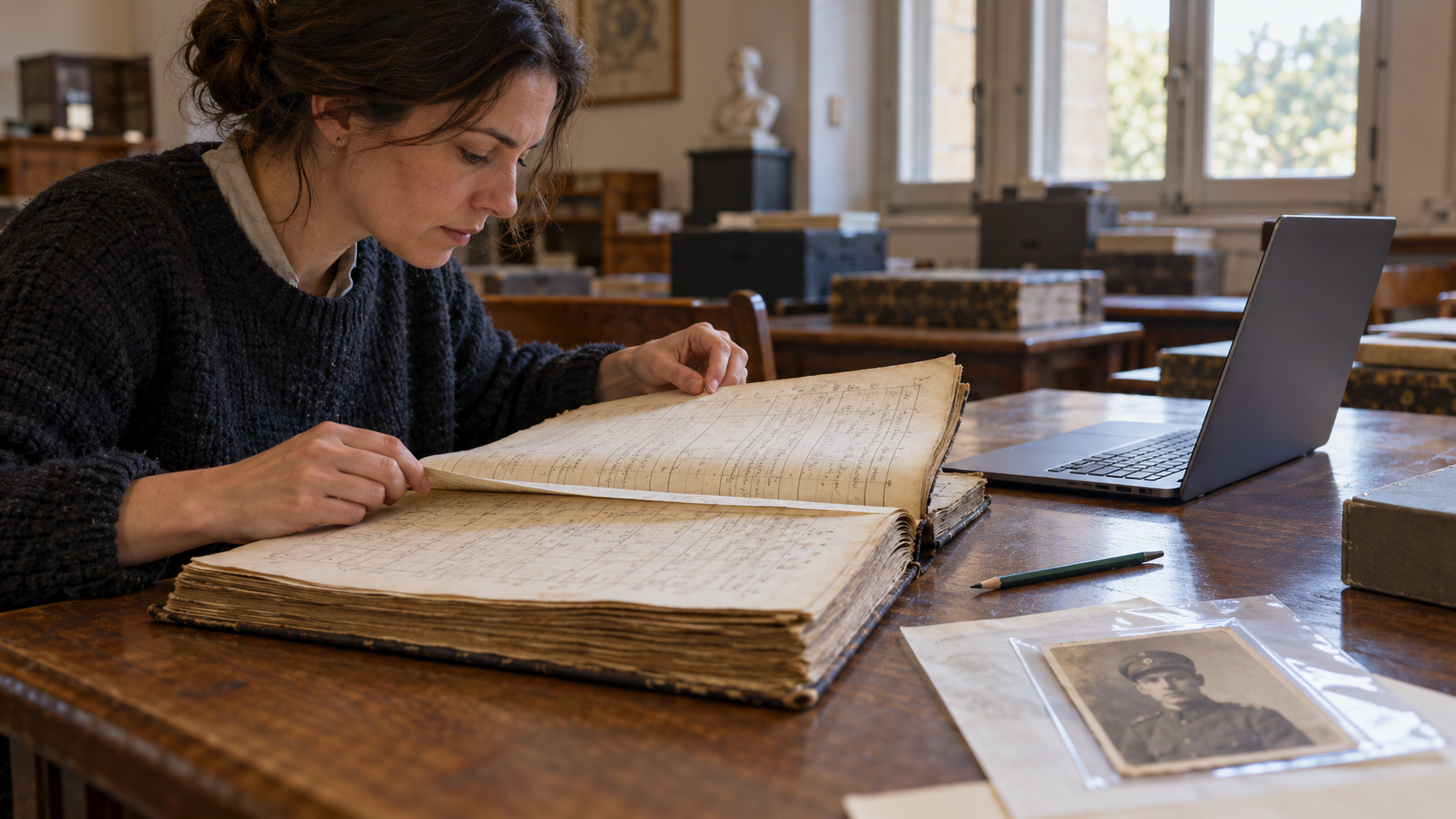
 A faded photograph of a young man in uniform can raise questions that birth and marriage certificates cannot answer. Where did he serve? Was he called up during a war? What was his occupation before he entered the army?
Italian military records can help families investigate these questions. They may also reveal details that feel surprisingly personal: an ancestor’s height, eye color, education, trade, and the names of his parents.
The starting point is understanding the difference between conscription records, which document the recruitment process, and service records, which describe a military career. Appearing on a conscription list does not, by itself, prove that someone served.
This guide focuses on the historical records most families encounter when researching male ancestors: liste di leva, ruoli matricolari, and fogli matricolari. For the broader research process, begin with How to Research Your Italian Ancestors.
This article contains affiliate links. As an Amazon Associate, Italia Mia earns from qualifying purchases.
Understanding the Main Italian Military Records
Military research becomes easier once you recognize the names used in archive inventories.
| Italian term | What it means | Why it matters |
|---|---|---|
| Liste di leva | Conscription lists | Identify men considered for recruitment and may record the outcome of their examination |
| Liste di estrazione | Lists associated with the recruitment lottery | Help trace recruitment decisions in periods when the lottery system operated |
| Rubriche matricolari | Alphabetical indexes to military rolls | Help you find the identifying number needed to locate a record |
| Ruoli matricolari | Military service rolls | Summarize enlistment and subsequent service |
| Fogli matricolari | Individual military record sheets | Provide an individual account of identity and service |
| Fascicoli matricolari | Military personnel files | May contain supporting documentation beyond the summarized record |
These records serve different purposes. A conscription list may explain why a man did not enter service, while a military roll may record assignments, promotions, or discharge. The personnel file and the summarized service record may also be held separately.
What Can You Discover About an Ancestor?
The contents depend on the period, collection, and individual record.
Historical military rolls can include physical descriptions, occupation, literacy, enlistment details, military units, campaigns, promotions, decorations, disciplinary entries, and discharge information.
For example, the State Archive of L’Aquila describes records containing height, hair and eye characteristics, profession, literacy, unit, enlistment date, and participation in military campaigns. These details can add considerable depth to a family history.
Use the information to answer specific questions. Does the occupation agree with a marriage record? Does the date of enlistment fit the family’s migration timeline? Are the parents the same people named in the birth certificate?
A matching name alone is insufficient. Compare several identifying details before adding the record to your family tree.
Begin with a Name, Birth Year, and Town
Before searching an archive, collect:
- Your ancestor’s full name, including spelling variations.
- Date of birth, or the narrowest reliable estimate.
- Municipality of birth.
- Parents’ names, if known.
- Residence during adolescence.
- Any known military branch, unit, rank, or service number.
The distinction between birthplace and residence is particularly important.
The State Archive of Milan explains that its military research depends on knowing the municipality where the person lived when he reached 17, rather than simply where he was born. A family move could therefore send your search toward a different jurisdiction. Check the guidance for the particular archive and period you are investigating.
If you know only “Sicily,” “Naples,” or another broad location, first work through Finding Your Ancestor’s Town in Italy.
A birth record can help confirm identity before you approach the military collections. See Italian Civil Records: How to Find Birth, Marriage and Death Records in Italy.
Search by Birth Class, Not Just the Year of a War
Archive inventories frequently organize military records by classe, usually referring to the birth cohort.
If your ancestor was born in 1895 and served during the First World War, begin by investigating the relevant 1895 class rather than assuming that his record will be filed under 1915.
However, filing is not always straightforward. The State Archive of Perugia notes that volunteers and men whose recruitment was deferred may appear in a different class. Its guidance recommends extending an unsuccessful search to the three preceding and three following years.
Treat that as a practical follow-up strategy, guided by the archive’s own arrangement, rather than a reason to search every nearby register immediately.
Record the exact class shown in the index. Do not silently replace it with the birth year if the two differ.
Find the Archive That Holds the Records
For historical army conscription and service records, investigate the relevant Archivio di Stato, or State Archive.
Start with its website and look for headings such as:
- Patrimonio archivistico — archival holdings.
- Guida alle ricerche — research guidance.
- Ufficio di leva — conscription office.
- Distretto militare — military district.
- Banche dati — databases.
- Ricerche per corrispondenza — research by correspondence.
Check both the geographical coverage and the surviving years. Different series in the same archive may cover very different periods.
Ravenna offers a useful example: its published description lists conscription records for men born between 1880 and 1917, but military rolls from the former Ravenna district for 1866–1870. Finding the right archive therefore does not guarantee that it holds every record type for your ancestor’s lifetime.
For older searches, establish which administration governed the locality at the time. Avoid assuming that modern provincial boundaries describe every historical collection.
What Can You Search Online?
There is no single online search that should be treated as a complete inventory of every Italian military record.
Use the Portale Antenati to identify participating archives and investigate their holdings. Then follow the individual archive’s research tools and digital collections.
Distinguish between three things:
- A description confirming that records exist.
- An index naming people in those records.
- Digital images of the records themselves.
An online index may provide the reference needed to request a document without displaying the document.
Perugia, for example, publishes alphabetical military indexes for specified classes. Its instructions explain that researchers should provide the name, class, matriculation number, and category where applicable when requesting the corresponding record.
Other archives offer different tools. Piacenza provides a searchable database drawn from military indexes for classes 1842–1877. Vicenza describes a database linking personal information to images of military sheets, including a complete reproduction of its 1899 series. These are local resources with defined coverage.
Read Conscription Decisions Carefully
Some of the most important information may be a short annotation beside the name.
| Term | General meaning | Research implication |
|---|---|---|
| Riformato | Found unfit for military service | Look closely at the examination decision |
| Rivedibile | Required later reassessment | Follow subsequent examinations or recruitment entries |
| Renitente | Recorded as failing to appear for the required recruitment process | Investigate the surrounding circumstances |
| Arruolato | Enrolled or enlisted | Continue toward the service documentation |
These terms describe administrative decisions. Read the entire entry and any later annotations before drawing conclusions.
In particular, renitente should not automatically be translated as “deserter.” Failure to appear for recruitment and desertion after entering service are different situations. The Milan archive’s historical guide distinguishes recruitment decisions from later service events.
If your ancestor emigrated, compare the military dates with passenger lists and other migration evidence. A family story may explain a notation, but it should not replace documentary confirmation.
How to Request a Military Record
A focused request gives an archive something it can realistically investigate.
Check its current instructions before writing. Research services, required identification, charges, and reproduction procedures vary. Do not assume that a search by correspondence will be free.
The State Archive of Barletta-Andria-Trani, for example, publishes requirements for narrowly defined requests, identification, and payment procedures. Its military-record instructions also specify the personal details needed to locate a record. Follow the rules of the institution you actually contact.
You can adapt this Italian request:
Oggetto: Richiesta di ricerca documentazione militare – [Nome e cognome], nato nel [anno]
Gentili responsabili,
sto svolgendo una ricerca genealogica sul mio antenato:
Nome e cognome: [nome completo]
Data e luogo di nascita: [data e comune]
Genitori: [nomi, se conosciuti]
Comune di residenza all’epoca della leva: [se conosciuto]
Classe, distretto e numero di matricola: [se conosciuti]
Vorrei sapere se presso il vostro Istituto è conservata la relativa documentazione nelle liste di leva e nei ruoli o fogli matricolari.
Se disponibile, desidererei ricevere una riproduzione digitale completa del documento, comprese eventuali pagine successive e annotazioni.
Vi chiedo cortesemente di indicarmi la procedura da seguire e gli eventuali costi prima di procedere.
Ringrazio per l’attenzione e porgo cordiali saluti.
[Nome e cognome]
Replace the placeholders and remove fields you cannot complete. Include an archive reference if you have already located an index entry.
Officers, Sailors, and Other Service Branches
The usual army-district search will not cover every military career.
Milan’s guidance identifies its main historical district documentation as concerning enlisted soldiers and noncommissioned officers, with separate routes for officers. For other branches or records still held by military authorities, consult the Ministry of Defence’s current military documentation guidance. It provides separate instructions for the Army, Navy, Air Force, and Carabinieri.
Some State Archives also preserve naval material. Venice, for example, describes liste di mare and naval military rolls covering specified years and classes. Consequently, a sailor’s record may require both local archival research and branch-specific guidance.
Investigating Wartime Service, Death, or Disappearance
If family accounts say an ancestor died or disappeared during a world war, consult the Ministry of Defence’s databases of the war dead and missing. The official page links to separate First and Second World War resources.
Compare any result with the person’s birth details and military documentation. Do not identify a casualty solely through a shared surname.
Once you have a unit and dates, you can also investigate that unit’s history. Keep the distinction between individual evidence and historical context clear: a regimental account describes the unit, but does not automatically establish everything one soldier experienced.
In your family history, separate documented facts, family recollections, and questions that remain unresolved.
What If You Cannot Find the Record?
An unsuccessful search is a reason to review the research route.
Ask whether:
- You searched the correct residence and military district.
- The birth year is reliable.
- The name appears under another spelling.
- The relevant register survives.
- The online resource covers the required class.
- You searched only an index rather than the underlying records.
- The ancestor served in another branch.
- A recruitment decision explains the absence of later service entries.
Keep a log of the collections and years checked. “No matching name in this index” is a more useful conclusion than “no military record exists.”
Return to civil records when identity remains uncertain. Italian Parish Records can also help resolve family relationships or conflicting dates.
Useful Books for Italian Military and Family Research
Two English-language references can support this work.
Italian Genealogical Records, by Trafford R. Cole
This guide covers civil, church, notarial, and military records, with reproduced documents and explanations. It is especially relevant when you want to understand the records themselves. Find Italian Genealogical Records on Amazon.
The Family Tree Italian Genealogy Guide, by Melanie D. Holtz
This broader guide covers tracing an immigrant ancestor, identifying the hometown, researching records, and communicating with archives. It also includes genealogical vocabulary and sample letters. Find The Family Tree Italian Genealogy Guide on Amazon.
These links open Amazon title searches so you can compare editions and sellers. Use older books for record interpretation, while checking archive websites for current access procedures.
Preserve the Evidence Behind the Story
When you obtain a record, save the complete image and its archival reference: institution, collection, class, volume or file, matriculation number, and page where available.
Then create a transcription and a separate translation. Mark uncertain words instead of guessing.
Even a brief service entry can connect a face in a photograph with an occupation, a place, and a dated event. Preserving the source allows the next generation to understand how that connection was established.
External Sources
- Archivio di Stato di Milano: Military District Sources
- Archivio di Stato di Perugia: Military District Sources
- Archivio di Stato di Barletta-Andria-Trani: Research by Correspondence
- Archivio di Stato di Piacenza: Military Databases
- Archivio di Stato di Vicenza: Databases
- Portale Antenati
- Italian Ministry of Defence: Military Record Requests
- Italian Ministry of Defence: War Dead and Missing Databases