
 Editorial note: This is an imagined interview, not a historical transcript. All questions, answers and scene details are original fiction informed by Marco Polo’s biography and travel account. The dialogue should not be quoted as his actual words.
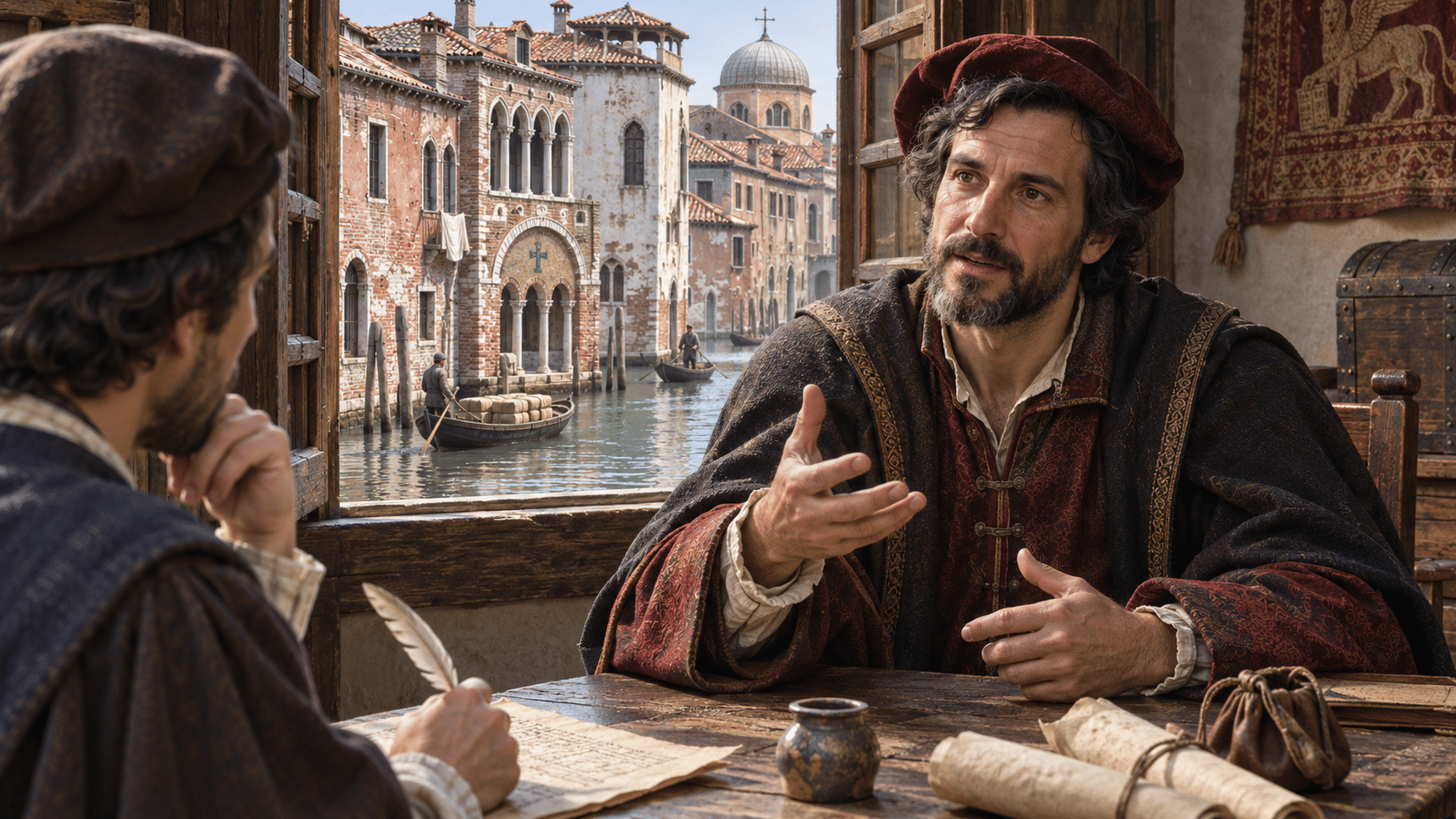
Venice, in our imagined encounter, is settling into evening. Water knocks against a landing below the window. Somewhere outside, a boatman calls to someone we cannot see.
Across the table sits a man whom we have learned to picture forever in motion: crossing deserts, entering unfamiliar cities, standing before an emperor. Tonight, however, Marco Polo is at home.
There is no magnificent map spread before him. No convenient line connects Venice to the court of Kublai Khan. There is only the distance between a journey and the telling of it.
Born in 1254, Polo departed for Asia with his father Niccolò and uncle Maffeo in 1271. He returned to Venice in 1295. His account, produced with Rustichello of Pisa during imprisonment in Genoa and commonly known in Italy as Il Milione, would give generations of readers an extraordinary description of Asian lands and societies. The circumstances of his capture and the precise nature of some of his activities remain uncertain.
Our conversation begins with the young man who left, before turning to the storyteller who came home.
Leaving Venice
Italia Mia: When you left Venice, did you imagine that people would still be discussing your journey centuries later?
Marco Polo: I had enough difficulty imagining the next part of the road.
You look backward and see a life arranged into events. A departure, an emperor, a return, a book. Living it was less orderly. There were decisions to make without knowing what would follow them.
My father and uncle had experience. I had their company and a young man’s belief that endurance was something he would discover when he needed it.
Your family were merchants. Was the journey about curiosity or business?
You make them sound like separate occupations.
A merchant asks what a place produces, what its people need, which roads are open and whom he can trust. Those questions can lead him into matters that have little to do with the price of cloth.
How is a city governed? Why does this money circulate here? Which language will get an answer?
Curiosity is useful when your living depends on understanding a place. It becomes dangerous when you believe understanding it will be easy.
What did Venice teach you before you left?
To look at what arrives.
A ship brings goods, certainly. It also brings news, rumors, unfamiliar words and explanations for why a cargo is late.
In a port, distant events have consequences you can touch. A conflict elsewhere changes the price of something on your own quay. A decision made by someone you will never meet delays a man you are waiting for.
You learn that your city does not end at its waterfront.
The Road Beyond Familiar Things
We often imagine your journey as a great adventure. What does that description leave out?
The waiting.
People enjoy hearing that you crossed a difficult country. They are less interested in the days spent discovering whether you could cross it at all.
An animal is unfit to continue. Someone has advice that contradicts what you heard yesterday. A route that was possible last season may not be possible now.
Then there is the ordinary work of keeping yourself fed, rested and sufficiently healthy to move again. Adventure is a comfortable word when spoken beside a fire.
Were you afraid?
Of course.
Fear can make you attentive. It can also make you foolish. You must learn which kind you are experiencing.
I would be suspicious of a traveler who claimed never to have been afraid. Either he understood very little of his circumstances, or he has improved himself considerably in the telling.
How do you begin to understand a place where almost everything is unfamiliar?
First, you need someone who can explain what you are looking at.
Then you need to discover whether the explanation is reliable.
A traveler depends on other people more than his account may suggest. Someone names a town. Someone interprets a custom. Someone tells him why the road turns away from a river.
You should remember those people whenever you read a book with one traveler’s name on it.
At the Court of Kublai Khan
Polo’s account places him in the service of Kublai Khan, the Mongol ruler of Yuan China. His precise responsibilities are difficult to establish independently, so confident descriptions of a particular official title should be treated cautiously.
What would you want a reader to understand about entering the Khan’s world?
That it was already occupied with its own affairs.
A visitor can imagine himself important because everything is new to him. But the people around him have business to conduct whether he understands it or not.
Officials receive instructions. Traders negotiate. Servants know where things belong. You arrive with your astonishment, and the place continues working.
That is a useful correction to a young man’s opinion of himself.
Your book pays considerable attention to wealth and authority. Were you impressed by power?
Power makes itself visible in ways a traveler cannot easily ignore.
There are buildings and ceremonies, but there are also roads, messengers, supplies and commands that reach places far from the person giving them.
If you want to describe a ruler’s strength, you must look beyond what he wears. Ask how quickly his orders travel. Ask who carries them out.
Does admiration make a traveler less critical?
It can.
So can hostility. A man determined to dislike everything before he arrives will misunderstand as readily as a man determined to admire it.
The difficulty is to keep looking after you have formed your first opinion.
Historical perspective: The imagined answers here explore themes in Polo’s account; they do not establish his private attitudes. His descriptions should also be read critically for their treatment of imperial authority and the people living under it.
Paper Money and Everyday Marvels
Among the memorable subjects in The Travels are paper currency, the imperial messenger system and coal described as black stones burned for fuel. These passages show the book’s interest in the practical workings of society alongside its accounts of rulers and riches.
Which deserves more attention: a splendid palace or an unfamiliar way of paying for dinner?
The second might tell you something the first does not.
A palace announces that someone possesses wealth. Money shows you how people exchange it.
If a material you would not ordinarily consider valuable can purchase goods, then you must ask what gives it that power. Whose authority stands behind it? Where will people accept it?
That is worth describing carefully.
Your readers might expect jewels and treasure. Instead, you also give them fuel, roads and administration.
Jewels do not explain how a city gets through the winter.
A traveler who notices only costly things will have a very incomplete account. Watch what people burn, what they carry, how supplies arrive.
You begin to understand a place when you become interested in what its inhabitants consider ordinary.
Is that the greatest reward of travel: discovering a different ordinary?
It is one reward.
At home, you can pass the same activity every morning without thinking about it. Elsewhere, you have to ask what is happening.
The useful thing would be to bring that habit home. To look again at a familiar street and realize how much you have never troubled to understand.
The Traveler and the Storyteller
Your account is associated with Rustichello of Pisa. How should we imagine the relationship between experience and writing?
A journey does not arrive already shaped like a book.
You remember a place, then another place interrupts it. A question makes you recall something you had not thought important. An explanation needs another explanation before a listener can follow it.
The person helping you tell the story has work to do.
And the traveler has a responsibility as well: he must resist the temptation to become more impressive every time he speaks.
Readers have questioned parts of your account. Should they?
A reader should ask questions.
If you say that something happened, it is reasonable to ask how you know. Were you present? Did someone tell you? Was that person in a position to know?
The difficulty begins when a reader decides that everything unfamiliar must be impossible. But belief without questions is not much better.
Did you see everything described in your book?
A traveler hears about places beyond his own road.
In a trading city, information arrives with people who have come from somewhere else. You can learn something useful without having stood in the place yourself.
But the distinction matters. What I saw and what I was told are different kinds of knowledge. A careful reader should keep them separate.
Historical perspective: Polo’s text contains both descriptions presented as personal experience and reports about places he did not visit. It also survives through a complicated manuscript tradition. It should not be treated as a modern, uniformly verified travel diary.
Coming Home
After so long away, what would returning to Venice feel like?
You expect recognition to happen immediately.
A familiar sound may give it to you. Then a conversation reminds you how much time has passed.
Other people have continued living. They have their own events to recount, their own losses and disagreements. Your absence may occupy a much larger place in your life than in theirs.
That can be difficult to accept.
Would you feel disappointed if someone did not want to hear about your travels?
I would like to tell you I would receive it with perfect grace.
But a man who has spent years collecting things to say may not immediately recognize when his listener has heard enough.
Perhaps returning requires learning that a conversation is not another expedition under your command.
What do you miss when you are far from home?
Small things are often the most persistent.
Not the whole city at once. A way of speaking. The ease of understanding a joke without someone explaining it. Knowing where a passage leads.
There is a kind of rest in familiarity that you do not appreciate until you have spent a long time without it.
Questions for a Modern Traveler
Today, people can cross in hours distances that once demanded months. What would you ask them?
What do they do with the time they have gained?
I would welcome an easier journey. There is no special wisdom in discomfort by itself.
But arriving quickly does not mean understanding quickly. You still need attention. You still need someone to explain what you have misunderstood.
What mistake should a traveler try hardest to avoid?
Assuming that the first person who explains a place has explained all of it.
Ask another person. Walk farther. Notice whether what you have been told agrees with what you see.
And remember that people may have better things to do than satisfy your curiosity. You are visiting their lives.
What would you say to someone who calls you a man who discovered Asia?
I would ask what they mean by discovered.
The people living there were not waiting for me to tell them where they were.
A traveler may bring unfamiliar information to his own audience. That does not make him the beginning of the history he describes.
One final question: what makes a journey worth telling?
Something you can help another person see more clearly.
It need not always be magnificent. A small observation, honestly described, may be more useful than a grand claim.
And you should leave room for the possibility that someone who comes after you will understand it better.
Reading Marco Polo Today
Our imagined conversation ends with the sounds outside the window: water, voices, the movement of a city that has its own business to finish.
The historical Marco Polo is harder to contain than the familiar image of a solitary explorer. His story involves family enterprise, established routes, intermediaries, imperial institutions and a literary collaborator. His book offers valuable testimony, but also demands attention to the difference between observation, reported information and storytelling.
That combination makes him a rewarding subject for modern readers. We can be interested in the journey while questioning the account. We can recognize its influence without pretending that the societies it described began with a European visitor’s arrival.
For readers considering journeys of their own, Italia Mia’s Italy travel planning guides provide a practical starting point. Polo’s story suggests a question to carry alongside any itinerary: once you arrive, what will you take the time to notice?
External Links
- Le vie di Marco Polo — Biography: Biographical overview discussing the documentary evidence and uncertainties surrounding his life.
- Treccani — Marco Polo: Italian reference entry on the traveler and his account.
- Encyclopaedia Iranica — Polo, Marco: Scholarly discussion of Polo’s travels and their historical significance.
- Project Gutenberg — The Travels of Marco Polo, Volume 1: A freely accessible historical English edition with extensive editorial notes; its older commentary should be read in its period context.