
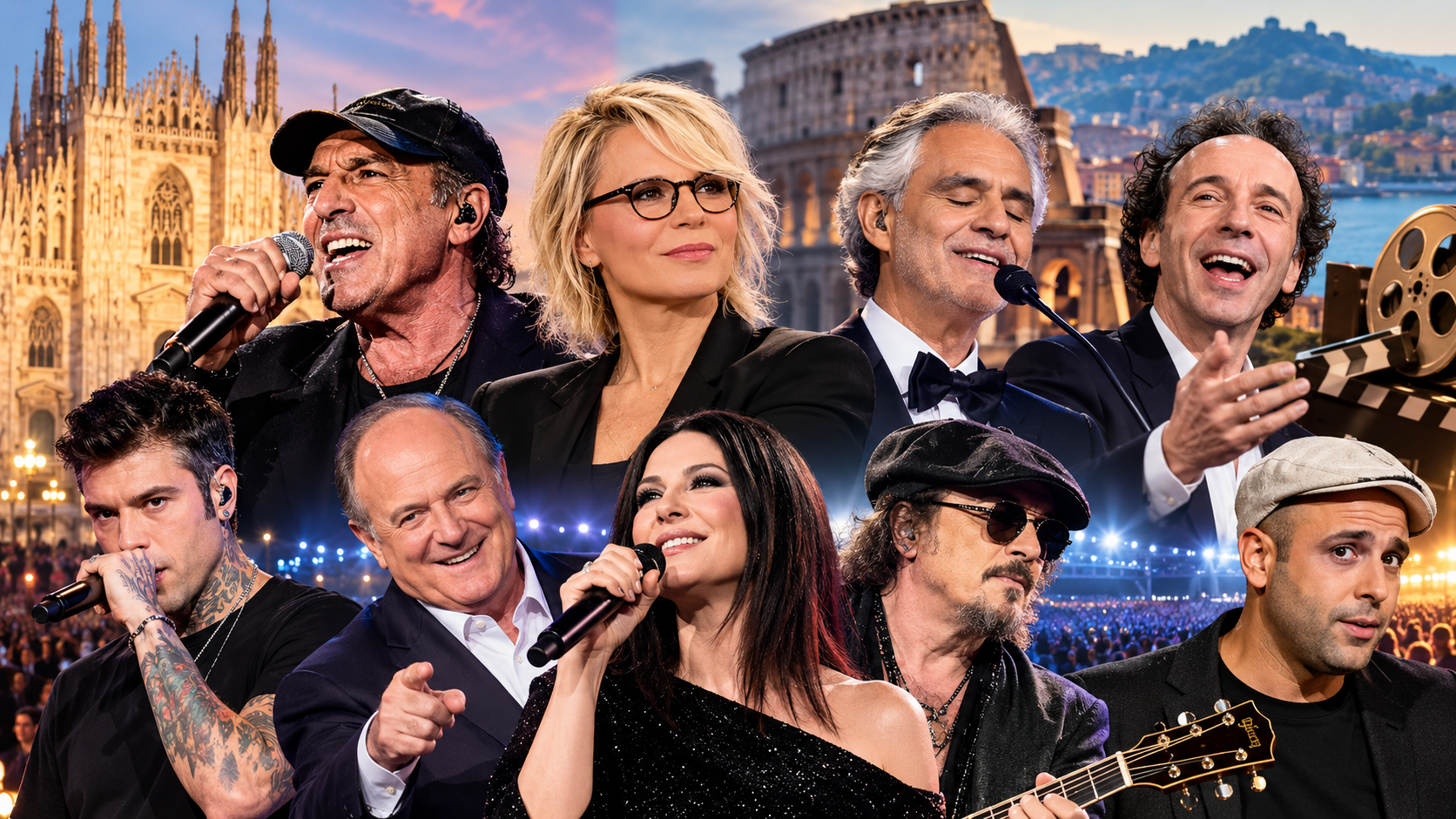
 Italy has produced internationally successful singers, Oscar-winning actors, television stars and entertainers whose careers have lasted for decades. But who are the richest Italian celebrities?
The answer is surprisingly difficult to establish.
Unlike the founders of publicly traded companies, celebrities rarely disclose their complete personal finances. Websites routinely publish supposed “net worth” figures for Italian stars, sometimes claiming fortunes of €50 million, €100 million or considerably more. In many cases, however, there is little evidence explaining how those numbers were calculated.
A more reliable picture emerges from company accounts, property holdings, music rights, production companies, record sales, concert revenues, film receipts and other documented business interests.
For that reason, this is not an exact richest-to-poorest ranking. It identifies 20 Italian entertainment figures with substantial documented commercial success and examines where their money comes from.
Maria De Filippi
Maria De Filippi has a particularly strong claim to being among the wealthiest active personalities in Italian television because she is not simply a highly paid presenter. She is also a television producer and business owner.
Her company Fascino Produzione Gestione Teatro, jointly controlled with Mediaset’s RTI, produces programs including Amici, C’è posta per te, Uomini e Donne and Tu sì que vales.
According to reporting on Fascino’s 2025 accounts, the company generated approximately €76.7 million in revenue and €8.1 million in net profit.
Those figures are not De Filippi’s personal net worth — an important distinction throughout this article — but her ownership interest makes Fascino one of the most substantial documented businesses associated with an Italian television personality.
Gerry Scotti
Gerry Scotti is one of the most interesting names in Italian television because decades of presenting have been accompanied by significant business and property investments.
Scotti has spent more than 40 years in broadcasting, becoming closely associated with some of Italy’s most successful quiz and entertainment programs.
But television fees tell only part of the story.
Recent financial reporting on his companies has placed consolidated tangible and financial assets at close to €40 million. His interests include the holding company GTI, television production through Good Time Production, property and other investments.
This does not mean Gerry Scotti personally has a €40 million net worth. It does, however, provide something more substantial than a speculative celebrity-wealth estimate: identifiable corporate assets accumulated during a very long television career.
Vasco Rossi
Few Italian performers can generate concert business on the scale of Vasco Rossi.
His company Giamaica Srl reported approximately €12.9 million in revenue for 2025 and €1.85 million in net profit.
Even more revealing is its balance sheet. Reported figures included approximately €11.9 million in land and buildings, €9.2 million in holdings in controlled companies and €6.5 million in other financial investments. Net assets reached approximately €23.6 million.
Giamaica also controls property interests in the United States.
Again, company assets are not identical to Vasco Rossi’s personal net worth. But these are much more meaningful numbers than an unsupported estimate from a celebrity-wealth website.
His extraordinary longevity is also reflected in the ItaliaMia guide to the 100 Most Famous Italian Songs, which includes his 1983 classic “Vita spericolata.”
Andrea Bocelli
Andrea Bocelli is arguably the most globally recognizable Italian singer of his generation.
His official biography reports more than 90 million records sold worldwide. His career combines classical music, pop crossover recordings, international touring and appearances at some of the world’s most prestigious events.
ItaliaMia has followed his career in Andrea Bocelli: A Voice for All Ages, while “Con te partirò” and “Vivo per lei” are included among our 100 Most Famous Italian Songs.
That worldwide market differentiates Bocelli from performers whose commercial careers are concentrated primarily in Italy.
Concerts, recordings, royalties, licensing and associated business activities have created multiple revenue streams over a career spanning more than three decades.
There is no sufficiently transparent public documentation to assign Bocelli a precise personal net worth, despite the many figures published online. What can be documented is the extraordinary international scale of his career.
Adriano Celentano
Adriano Celentano has been earning from Italian popular culture since the late 1950s.
Singer, actor, television performer, writer and producer, Celentano built a business structure around his work through Clan Celentano and related activities.
His financial strength comes from something increasingly important in the entertainment industry: ownership and control of intellectual property accumulated across more than six decades.
Recordings, publishing, film, television and investments have all contributed to his long-term financial position.
Celentano’s extraordinary career is covered in detail in Adriano Celentano: The Icon of Italian Music and Cinema.
His songs “24 mila baci,” “Il ragazzo della via Gluck” and “Azzurro” also appear in ItaliaMia’s 100 Most Famous Italian Songs.
Eros Ramazzotti
Eros Ramazzotti belongs to the relatively small group of Italian pop stars who built truly international careers.
His records have sold extensively throughout Europe and Latin America, while his tours regularly include major international arenas.
His company Radiorama provides a rare glimpse into the finances behind a major Italian music career. Although the company recorded a loss of just over €1 million in 2025, it still reported approximately €11.34 million in bank and postal deposits.
That contrast demonstrates why annual income is a poor way of measuring celebrity wealth. An established performer can have a weak financial year while still controlling substantial assets accumulated during decades of successful albums and tours.
Ramazzotti’s “Terra promessa,” “Una storia importante,” “Adesso tu,” “Se bastasse una canzone” and “Cose della vita” all appear in ItaliaMia’s 100 Most Famous Italian Songs.
Laura Pausini
Laura Pausini achieved something relatively rare for an Italian pop singer: sustained mainstream success in Italy, the rest of Europe and the Spanish-speaking world.
Her career includes Grammy and Latin Grammy recognition, international touring, television appearances and recordings in multiple languages.
“La solitudine,” her breakthrough at Sanremo in 1993, introduced her to an international audience and remains one of the essential tracks in ItaliaMia’s 100 Most Famous Italian Songs.
For Pausini, the long-term value of recordings, publishing, performance income and international rights is more meaningful than the result of any individual financial year.
As with Bocelli, attaching an exact personal net-worth figure without complete financial information would create a false sense of precision.
Roberto Benigni
Roberto Benigni occupies an unusual position because he has earned money not only as an actor but also as a writer, director and producer.
His greatest international achievement remains Life Is Beautiful (La vita è bella), which became a worldwide phenomenon and won three Academy Awards, including Best Actor for Benigni.
ItaliaMia’s Roberto Benigni biography follows his journey from experimental theater and Italian television to international cinema.
His breakthrough abroad is also part of the story told in Cinema of Italy: The 1990s, a decade in which Italian filmmaking regained considerable international visibility.
Together with his wife, actress Nicoletta Braschi, Benigni has also operated through Melampo Cinematografica.
That distinction matters. Benigni is not simply an actor receiving a fee from someone else’s production. Acting, writing, directing, producing and film rights can create multiple sources of long-term value.
Checco Zalone
Luca Medici — universally known as Checco Zalone — has become one of the most commercially successful figures in the history of Italian cinema.
His films have repeatedly dominated the domestic box office.
Cado dalle Nubi, Che bella giornata, Sole a catinelle, Quo Vado? and Tolo Tolo were enormous commercial successes, but Buen Camino pushed his record even further.
As detailed in ItaliaMia’s Buen Camino by Checco Zalone: The Record-Breaking Italian Box Office Phenomenon, the film exceeded €68.8 million in Italy in its first 24 days and overtook Avatar to become the highest-grossing film ever released in Italian cinemas.
Box-office revenue does not, of course, go directly into an actor’s bank account. Cinemas, distributors, producers, taxes and other participants all receive shares.
Nevertheless, Zalone’s combination of acting, writing, music and business participation makes him much more than a highly paid performer.
Readers interested in the broader industry can explore ItaliaMia’s Italian Cinema section.
Fedez
Fedez represents a newer model of Italian celebrity wealth.
Music is only one component of a broader commercial operation involving companies, marketing, media, podcasts, entertainment and investments.
In 2025, three active companies associated with his business activities reportedly generated combined revenues of approximately €11.8 million and profits of around €2.5 million.
His business interests have changed considerably over the years, making simplistic estimates of his personal net worth particularly unreliable.
What is clear is that Fedez has transformed celebrity into a corporate operation extending substantially beyond recording royalties.
Ultimo
Nicolò Moriconi, better known as Ultimo, demonstrates how quickly the economics of Italian music can change.
Ultimo Entertainment recorded €10.06 million in revenue in 2025 and approximately €3.33 million in profit.
Those are remarkable numbers for an artist whose professional career is much shorter than those of Vasco Rossi, Celentano or Ramazzotti.
Ultimo therefore illustrates an important distinction in this article: accumulated wealth and current earning power are not the same thing.
A veteran performer may own decades of investments and intellectual property, while a younger star may currently be generating greater annual profits.
Renato Zero
Renato Zero’s longevity makes him another particularly interesting case.
His company Tattica generated approximately €17.86 million in revenue during 2024, a record year supported by music rights and an extensive concert tour.
That figure represented company revenue, not Zero’s personal earnings, but it demonstrates the continuing commercial strength of an artist whose career began in the 1960s.
The following year was quieter without the same touring activity, illustrating how dramatically live performances can affect annual music-company accounts.
For the full story of his career, friendships, stage persona and extraordinary relationship with his audience, read ItaliaMia’s Renato Zero: The Singer Who Turned Difference into an Italian Institution.
Paolo Bonolis
Paolo Bonolis has spent decades at the top of Italian commercial television, presenting programs including Ciao Darwin and Avanti un altro!
His finances are less transparent than Gerry Scotti’s, so claims about an exact personal fortune should be treated cautiously.
There is, however, documented business activity.
Bonolis owns 30% of SDL 2005, a television casting company in which Sonia Bruganelli holds 51%. Its 2024 accounts reported €4.62 million in revenue, while approximately €2.9 million remained in bank accounts.
Those company figures represent only one part of Bonolis’s long television career and should not be interpreted as his personal wealth.
Antonio Ricci
Antonio Ricci is sometimes overlooked in discussions about wealthy Italian television personalities because viewers know his programs better than they know the producer himself.
He created Striscia la notizia and has been responsible for numerous successful Italian television formats.
His importance lies in the economics of television production and intellectual property rather than celebrity appearances alone.
A successful television format can create value for years, particularly when the person behind it participates in production and rights rather than receiving only a presenter’s salary.
Reliable public information does not justify attaching a precise personal net-worth figure to Ricci, but his decades in television production make him relevant to any serious discussion of wealth in Italian entertainment.
Gianni Morandi
Gianni Morandi has been part of Italian popular entertainment since the early 1960s.
His financial importance comes primarily from longevity: recordings, concerts, film, television, Sanremo appearances and decades of royalties.
Morandi is therefore very different from a celebrity who suddenly earns several million euros from a short period of television or social-media popularity.
A reliable current personal net-worth figure is not publicly available, but more than six decades of commercially successful entertainment make him a legitimate inclusion among Italy’s financially established stars.
His work also belongs to the wider story of Italian music, where several generations of performers continue to generate audiences long after their original hits were released.
Zucchero
Adelmo Fornaciari, better known as Zucchero, built one of the most international careers in Italian popular music.
His collaborations have included major international performers, while his albums and concerts have reached audiences far beyond Italy.
Like Bocelli, Ramazzotti and Pausini, Zucchero benefits from a career whose economics include international touring and foreign royalties rather than relying exclusively on the Italian market.
“Senza una donna,” which later became a major international duet with Paul Young, is included in ItaliaMia’s 100 Most Famous Italian Songs.
No adequately documented public source provides Zucchero’s complete personal net worth, but his catalog and continuing international touring make him one of Italy’s most commercially important veteran musicians.
Tiziano Ferro
Tiziano Ferro belongs to another generation of Italian performers who successfully expanded into the international — particularly Spanish-language — market.
Record sales, publishing royalties, international releases and major tours have provided several income streams since his breakthrough in the early 2000s.
Ferro illustrates why music catalogs can be financially important long after an album’s original release. Songs continue generating revenue through streaming, radio, licensing and publishing.
His “Non me lo so spiegare” is included in ItaliaMia’s 100 Most Famous Italian Songs.
There is insufficient public documentation for a credible precise estimate of Ferro’s total personal wealth, so widely circulated online figures should be regarded as speculative.
Mina
Mina is one of the most unusual cases in Italian entertainment.
She withdrew from public performances decades ago but never stopped being commercially relevant.
Her enormous recording catalog, continuing releases and publishing and recording rights mean that her economic model differs fundamentally from performers dependent on stadium tours or television contracts.
A successful catalog can continue generating royalties through streaming, radio, physical releases, compilations and licensing decades after the original recording.
Read ItaliaMia’s Mina: Italy’s Timeless Icon of Pop and Soul for the story of her extraordinary career.
Her importance is also immediately apparent in ItaliaMia’s 100 Most Famous Italian Songs, where “Il cielo in una stanza” and “Città vuota” represent the period when Mina became one of the defining voices of Italian popular music.
Carlo Conti
Carlo Conti has been one of Rai’s most important television presenters for many years.
His work has included major entertainment programs and the Sanremo Music Festival, giving him some of the most prestigious assignments in Italian public television.
Unlike De Filippi or Scotti, however, publicly accessible information does not reveal a comparable portfolio of major corporate assets.
For that reason, it would be misleading to take reported television fees and convert them into a supposed personal fortune.
Conti belongs in this discussion primarily because of the duration and prominence of his television career rather than because we can document a specific net worth.
Sanremo’s extraordinary importance to Italian popular culture is explored throughout ItaliaMia’s Italian Music section.
Amadeus
Amadeus became one of the dominant figures in Italian television during his highly successful run as host and artistic director of the Sanremo Music Festival.
Sanremo transformed his professional position, while his subsequent move from Rai to Warner Bros. Discovery’s Nove demonstrated the commercial value attached to leading Italian television presenters.
As with Carlo Conti and Paolo Bonolis, published estimates of his personal fortune should be treated carefully unless supported by company accounts or other financial documentation.
His earnings over a long career nevertheless place him among the contemporary television personalities worth including in a broader examination of wealth in Italian entertainment.
Who Is Actually the Richest Italian Celebrity?
There is no responsible way to give a definitive answer based on publicly available information.
Maria De Filippi, Gerry Scotti and Vasco Rossi stand out because substantial corporate assets or business interests can actually be documented.
Andrea Bocelli, Laura Pausini, Eros Ramazzotti and Zucchero have another advantage: decades of international earnings extending far beyond the Italian market.
Celentano and Mina represent yet another form of wealth — extraordinarily valuable careers and catalogs accumulated over more than half a century.
Roberto Benigni adds film production and rights to his acting and directing income, while Checco Zalone has achieved a level of box-office success virtually without precedent for a contemporary Italian comedian.
Meanwhile, younger performers such as Ultimo demonstrate that current annual earnings can already compete with those of much more established stars.
Why Celebrity “Net Worth” Figures Are Often Misleading
If a website says an Italian singer is “worth €100 million,” what exactly does that mean?
Usually, it doesn’t tell you.
A person’s real net worth would require knowing the value of all assets — companies, investments, property, cash and intellectual property — and subtracting mortgages, debts and other liabilities.
Most of that information is private.
Italian company accounts can provide useful evidence, but even they have limitations. A company with €20 million in net assets does not automatically give its celebrity shareholder a €20 million personal fortune.
Likewise, a movie earning €60 million at the box office does not mean its star earned €60 million.
Record sales present the same problem. Selling tens of millions of records over a career is evidence of enormous commercial success, but the retail value of those recordings is divided among labels, distributors, publishers, writers, performers and other participants.
Wealth Versus Income
There is another reason celebrity rankings can be deceptive.
Income measures what someone earns during a particular period. Wealth measures what remains accumulated.
A singer could generate €15 million in company revenue during a major stadium tour and still have less accumulated wealth than a television personality who has invested earnings in property and companies for 40 years.
Conversely, an artist may have relatively little current income but own a valuable music catalog capable of generating royalties for decades.
This is why Celentano, Mina, Vasco Rossi and other long-established performers cannot be evaluated simply by looking at what they earned last year.
What About Pier Silvio Berlusconi?
Pier Silvio Berlusconi would change the scale of the discussion completely if he were classified simply as a television personality.
But that comparison would be misleading.
Berlusconi is primarily a media executive and major shareholder whose wealth derives largely from corporate and family holdings rather than from working as a television entertainer.
The same principle applies to other wealthy Italian media owners and entrepreneurs.
For this article, the relevant question is wealth created primarily through a career in entertainment — performing, presenting, writing, producing, recording or exploiting intellectual property.
That produces a much more meaningful comparison.
The Bottom Line
Italy’s richest entertainers reveal several very different paths to long-term wealth.
For Vasco Rossi, the stadium remains an extraordinary economic engine. For Bocelli, Pausini and Ramazzotti, international markets dramatically expanded the potential audience. For Benigni and Zalone, cinema created opportunities beyond acting fees. For De Filippi, television production became at least as important as television presentation. Gerry Scotti converted a long career into companies, financial assets and property.
And for Celentano and Mina, decades of intellectual property demonstrate something particularly important about the entertainment business: sometimes the most valuable performance is one recorded half a century ago that people are still listening to today.
That is why the richest Italian celebrity cannot reliably be identified from a single salary, concert, movie or internet “net worth” estimate.
The real money is often in what the star owns after the applause ends.
External Sources
Open — Maria De Filippi and Fascino 2025 accounts
Open — Eros Ramazzotti and Radiorama 2025 accounts
Open — Paolo Bonolis and SDL 2005 accounts
Open — Renato Zero and Tattica accounts
Corriere della Sera — Vasco Rossi, Fedez and Ultimo company results
Andrea Bocelli — Official Website
Recording Academy — Laura Pausini
Academy of Motion Picture Arts and Sciences — The Oscars