
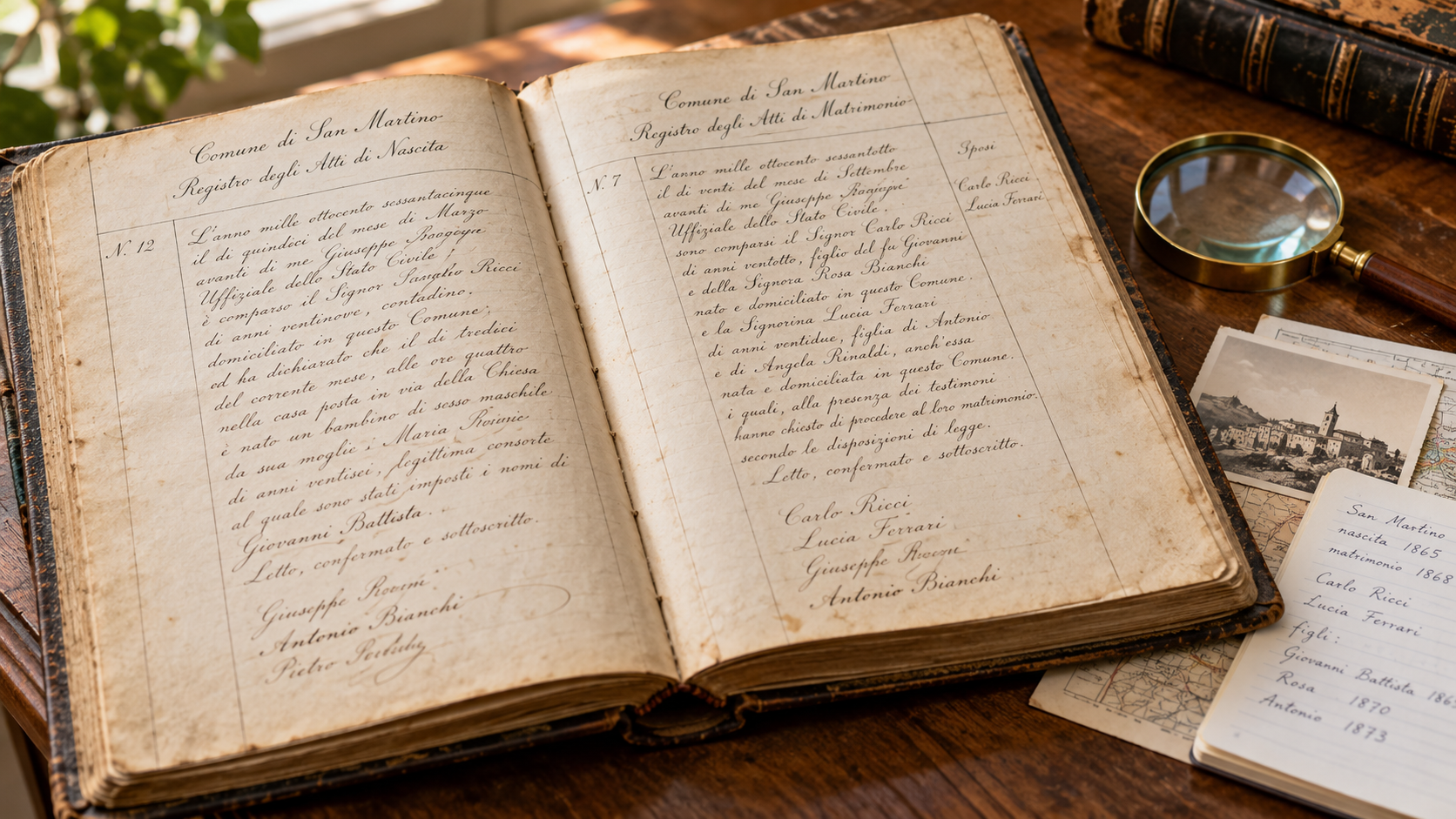
 Finding an ancestor’s Italian birth record can feel like a breakthrough—until you try to read it. The surname seems familiar, but the capital letters are elaborate, several words run together, and the date stretches across a line of handwritten Italian.
Reading old Italian handwriting for genealogy becomes easier when you separate three tasks: identifying the letters, understanding the language, and recognizing how the record is organized. You do not need to translate every sentence before extracting useful information.
This guide introduces a practical approach, with annotated examples of names, dates, abbreviations, and recurring phrases. If you are beginning your research, start with How to Research Your Italian Ancestors for the broader process of finding records and connecting generations.
About the examples: All practice passages below are constructed teaching examples, not transcriptions of identified historical documents. They illustrate wording you may encounter; spelling, abbreviations, and record formats vary by place and period.
Start with the Page, Not the Difficult Surname
Before examining individual letters, identify the town, year, record type, and language. A civil birth record and a Latin baptism entry may describe related events, but their wording and structure differ.
Keep the whole page available. A tightly cropped surname removes clues that may appear in neighboring entries, headings, or margins.
Read several records written by the same person. A clerk’s unusual capital letter may become obvious when it appears in a familiar month or place name. Start with words you can recognize, then use them to interpret uncertain ones. This approach is also central to BYU’s practical handwriting guidance.
For your working notes, separate:
- Transcription: What the document actually says.
- Translation: What those words mean in English.
- Interpretation: What the information suggests about your family.
Keeping these separate makes it easier to revisit a doubtful reading without losing track of the evidence.
Learn the Writer’s Alphabet
There is no single alphabet chart that resolves every Italian document. Individual writers formed letters differently, and the same letter can change shape at the beginning, middle, or end of a word. BYU’s paleography guidance specifically highlights this variation.
When you are uncertain, build a small reference collection from the register itself. Save examples of letters found in clearly readable words and compare them with the difficult passage.
Watch for:
| Possible confusion | What to examine |
|---|---|
| m, n, u, and i | Count the strokes and look for dots, allowing for dots placed slightly away from their letters. |
| e and c | Compare whether the writer closes the small loop elsewhere. |
| a and o | Look at the exit stroke and how the letter joins the next one. |
| Elaborate capitals | Compare several names beginning with the suspected letter. |
| Abbreviated endings | Look for a raised letter, dot, or stroke indicating omitted letters. |
These are comparison prompts, not fixed rules. A likely surname still needs to fit the visible handwriting.
For genuine handwritten examples, consult the BYU Italian alphabet charts and FamilySearch Italian handwriting resources.
Annotated Example: Reading a Name and Parentage
Consider this practice phrase:
Giuseppe Rossi, figlio del fu Antonio e di Maria Bianchi
English meaning: Giuseppe Rossi, son of the late Antonio and of Maria Bianchi.
| Part of the phrase | What it tells you |
|---|---|
| Giuseppe Rossi | The person being identified. |
| figlio | Son; figlia means daughter. |
| del fu Antonio | His father, Antonio, was deceased when this statement was recorded. |
| e di Maria Bianchi | His mother is identified as Maria Bianchi. |
In parentage formulas, fu identifies a deceased parent. It does not provide that parent’s death date. Also, fu can function as an ordinary verb elsewhere: read the whole phrase before interpreting it.
The absence of fu before Maria’s name should not, by itself, become proof that she was alive. Confirm her status with other records.
Italian civil records commonly identify married women by their birth surnames. A different surname for the mother is therefore expected; it does not indicate a different marriage or family.
Do Not Expand an Abbreviated Name Too Quickly
A form such as Ant. may suggest Antonio, but a short fragment is not sufficient evidence on its own. Check the surrounding grammar and other appearances of the name.
In a simple working transcription, you might write:
Ant[onio?]
Explain your convention: brackets contain supplied letters, and the question mark marks uncertainty. Formal transcription projects may use different conventions.
Avoid silently replacing an uncertain name with the one you hoped to find.
Annotated Example: Reading a Date Written in Words
A civil record might begin with wording like this:
L’anno milleottocentosettantadue, addì ventitré del mese di novembre…
English meaning: In the year 1872, on the twenty-third day of November…
| Written element | Reading |
|---|---|
| milleottocentosettantadue | 1872 |
| addì | On the day |
| ventitré | Twenty-three |
| del mese di novembre | Of the month of November |
Long written numbers become more manageable when divided into parts: mille + ottocento + settantadue.
A useful practice exercise is to write the expected year range in Italian before opening the register. If you are searching the 1870s, recognizing milleottocentosettanta… helps you locate the final digits.
Registration Date and Birth Date May Differ
Suppose that opening is followed later by:
…ha dichiarato che nel giorno ventidue del corrente mese è nato un bambino…
English meaning: …declared that on the twenty-second day of the current month a male child was born…
In this constructed example:
- The declaration was recorded on 23 November 1872.
- The child was born on 22 November 1872.
The opening date is therefore not automatically the birth date. Record both dates under separate labels. The same distinction matters when reading death declarations and baptism entries.
Month Abbreviations That Can Mislead You
Some historical month abbreviations combine numbers and letters:
| Abbreviation | Month | English |
|---|---|---|
| 7bre | Settembre | September |
| 8bre | Ottobre | October |
| 9bre | Novembre | November |
| Xbre | Dicembre, sometimes written decembre | December |
These forms are documented in scholarly transcription guidance. 7bre does not mean July, and 8bre does not mean August.
For example:
14 8bre 1863
Read this as 14 October 1863.
Preserve the original form in your transcription, then give the expanded date separately. This makes your reasoning visible to anyone checking the record.
Recognize Recurring Record Formulas
Learning the structure of a document saves time. Many phrases introduce predictable information, even when the handwritten details differ.
The following are useful expressions to recognize; they are not a universal template for every register.
| Italian expression | English meaning or function |
|---|---|
| avanti di me | Before me; introduces the official receiving the declaration. |
| è comparso / sono comparsi | Appeared; introduces one or more people appearing before the official. |
| ha dichiarato | Declared. |
| di anni… | Aged… |
| nato / nata a… | Born in… |
| domiciliato / domiciliata in… | Domiciled or residing in… |
| figlio / figlia di… | Son / daughter of… |
| coniuge | Spouse. |
| vedovo / vedova | Widower / widow. |
| testimoni | Witnesses. |
Use a genealogy-specific word list alongside a dictionary, particularly when a word has several ordinary meanings. FamilySearch’s Italian word list is a useful reference for record vocabulary.
Knowing these phrases helps you identify roles. The first person named in a birth record may be the official or declarant, rather than the child.
For a fuller explanation of document contents, see Italian Civil Records: How to Find Birth, Marriage and Death Records in Italy.
Annotated Example: A Death-Record Phrase
Here is another practice passage:
…è morta Maria Bianchi, di anni settanta, vedova di Antonio Rossi…
English meaning: …Maria Bianchi died, aged seventy, widow of Antonio Rossi…
| Phrase | Interpretation |
|---|---|
| è morta Maria Bianchi | Maria is the deceased person. |
| di anni settanta | Her reported age was seventy. |
| vedova di Antonio Rossi | Antonio was her husband and had died before her. |
This passage identifies a marital relationship, but it does not establish the marriage date.
An age at death can guide a birth search, but it should not automatically produce an exact birth year. The birthday may not yet have occurred that year, and the reported age may be inaccurate. Search around the estimated year and compare other evidence.
When the Register Is in Latin
Parish records may require Latin vocabulary as well as handwriting skills. A familiar Italian given name can appear in a Latin form, and its ending may change according to its role in the sentence.
Consider this constructed fragment:
…baptizavi Josephum, filium Antonii et Mariae…
English meaning: …I baptized Joseph, son of Anthony and Mary…
In an Italian family-history context, the corresponding names may be Giuseppe, Antonio, and Maria.
| Latin element | Meaning |
|---|---|
| baptizavi | I baptized. |
| Josephum | Joseph, with an ending reflecting its grammatical role. |
| filium | Son. |
| Antonii et Mariae | Of Anthony and Mary. |
Preserve the Latin wording in the transcription and record any normalized Italian names separately. Do not treat a changed grammatical ending as a different person.
FamilySearch provides Latin word-list instruction and lessons on abbreviations. For the research context, continue with Italian Parish Records: How to Find Baptisms, Marriages and Burials.
A Practical Routine for Difficult Records
Use a consistent process so that unresolved words remain visible.
- Save the source details. Record the repository, locality, register, year, act or page number, image number, and link.
- Read the full entry once. Identify people, dates, and the general structure without forcing every word.
- Transcribe the clear portions. Leave explicit gaps such as “[illegible]” where necessary.
- Compare nearby entries. Look for the same letters, names, and formulas written by the same hand.
- Translate the stable reading. Keep guesses marked.
- Check another record. A marriage entry, sibling’s birth, or later death record may resolve a name.
- Record your conclusion and its limits. Explain why a reading seems likely and what remains uncertain.
When asking someone for help, provide the whole page and a close-up, along with your tentative transcription. Say exactly which word or relationship you are trying to resolve.
If you use an automated transcription tool, treat its output as a proposed reading. Check every name, date, and relationship against the image before adding it to your family tree.
Dictionaries and Research Manuals Worth Considering
A dictionary helps with vocabulary. A research manual helps explain what a record is doing. For this task, the combination is more useful than either alone.
As an Amazon Associate, Italia Mia earns from qualifying purchases. The links below are Amazon searches; editions, formats, prices, and availability vary.
Italian Genealogical Records — Trafford R. Cole
Best suited to understanding record examples.
Italian Genealogical Records: How to Use Italian Civil, Ecclesiastical, & Other Records in Family History Research includes reproduced records with translations and explanations. It is particularly relevant when you can recognize some words but need help understanding the document as a whole.
Search Amazon.com · Search Amazon.it
Finding Italian Roots — John Philip Colletta
Best suited to the broader research process.
Finding Italian Roots: The Complete Guide for Americans is a companion for organizing research into Italian ancestry. The publisher identifies a second edition published in 2003, so use current archive websites for present-day access instructions.
Search Amazon.com · Search Amazon.it
Collins Italian Dictionary and Grammar
Best suited to everyday vocabulary and sentence structure.
This reference combines an Italian–English and English–Italian dictionary with grammar guidance. It can help you recognize verb forms and ordinary words around the genealogical details. Historical abbreviations and Latin passages still require specialist references.
Search Amazon.com · Search Amazon.it
Practice with One Register at a Time
Choose a clearly scanned page from a town you already know. Work through two or three consecutive entries, keeping a list of recurring words and uncertain letters.
Your first goal is modest: identify the main person, the event date, the parents or spouse, and any unresolved details. Return to difficult passages after reading more of the same writer’s work.
If you have not yet established the correct locality, use Finding Your Ancestor’s Town in Italy before committing hours to a register.
Progress comes from careful comparison. A surname that looked impossible on the first page may become readable after you have met the same clerk’s handwriting a dozen times.
External Links and Free Learning Resources
- BYU Italian Handwriting Tutorial — Guidance on handwriting, language, and record interpretation.
- BYU Italian Alphabet Charts — Examples of handwritten letter forms.
- FamilySearch Italian Handwriting Resources — Alphabet help and related learning resources.
- FamilySearch Italian Genealogical Word List — Vocabulary for interpreting records.
- Portale Antenati — Italian archival records for research and reading practice.