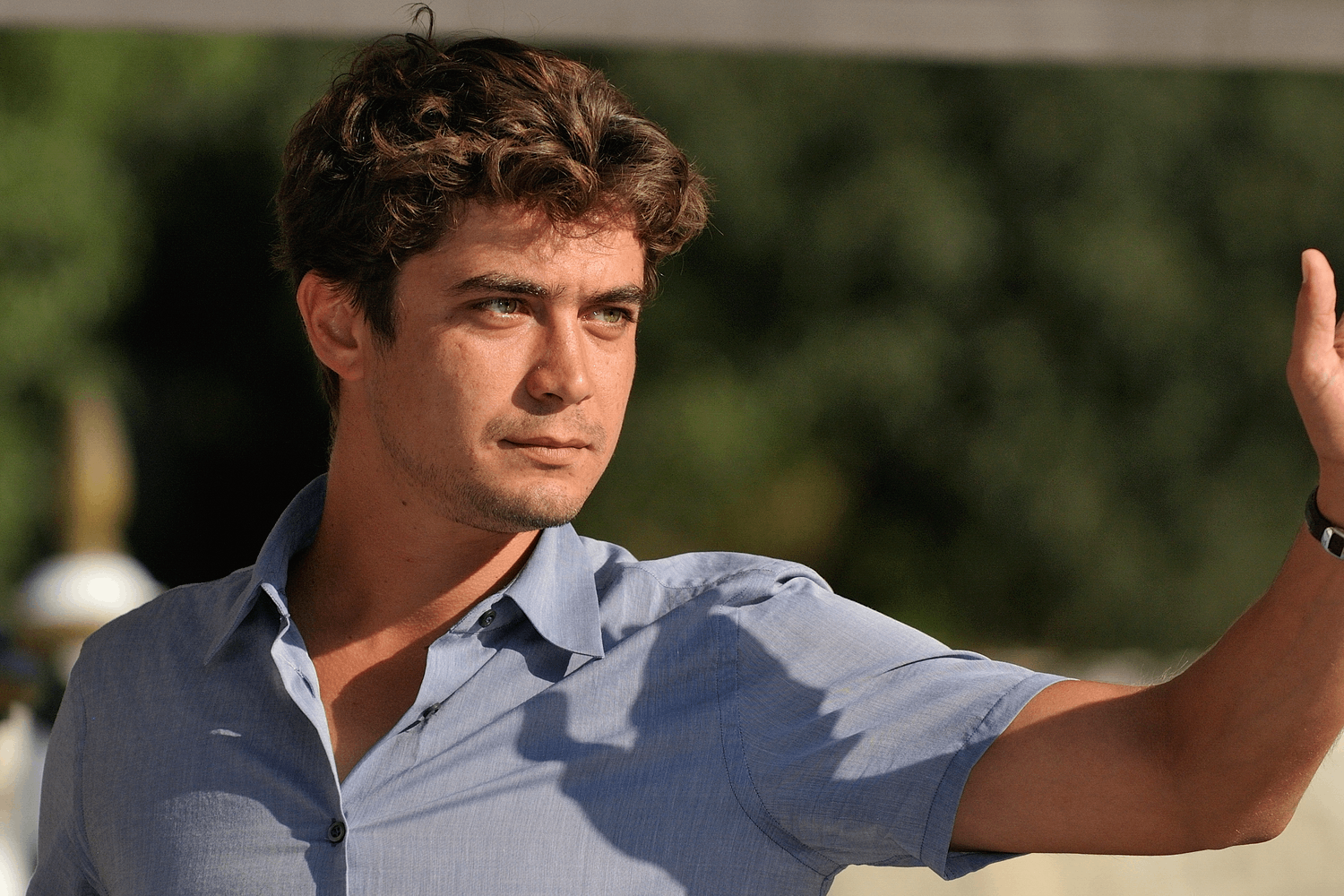
“Sexiest” is a matter of taste. Here, it means more than good looks: it includes screen presence, style, voice, confidence and the ability to make a character linger in the imagination. These Italian actors represent different ideas of masculine glamour, from the relaxed elegance of postwar cinema to the more varied appeal of today’s stars.
This is a celebration, not a ranking. For another look at contemporary performers, see Italia Mia’s Top 10 Male Actors in Italy of the 21st Century and its guide to emerging Italian actors and actresses.
Marcello Mastroianni: effortless Italian elegance
Marcello Mastroianni remains one of the defining faces of Italian cinema. In Federico Fellini’s La dolce vita (1960), he played journalist Marcello Rubini with a mixture of charm, restlessness and melancholy. The dark suit, confident stride and look of someone both inside and outside the glamorous world around him became a lasting image of Italian style.
His appeal was never just about appearance. Mastroianni could be funny, vulnerable and self-deprecating, bringing that range to films such as 8½ and A Special Day. His frequent on-screen partnership with Sophia Loren added another layer to his legend. Read more in Italia Mia’s Mastroianni biography.
Vittorio Gassman: commanding presence
Vittorio Gassman had the stature and voice of a leading man, but his magnetism also came from his intelligence and comic timing. A celebrated stage actor as well as a film star, he could project authority while making room for mischief and self-parody.
In Il sorpasso (1962), Gassman’s Bruno is an exuberant, impulsive man whose energy fills every scene. The role captures the attraction and danger of his screen persona: he is funny, bold and difficult to ignore. Gassman’s appeal came with a theatrical edge, as though every entrance deserved its own spotlight. His work also features in Italia Mia’s guide to Commedia all’Italiana.
Franco Nero: the cool western hero
Franco Nero became internationally recognizable through his work in Italian westerns. His Django, in Sergio Corbucci’s Django (1966), was a striking alternative to the polished leading man: quiet, weathered and self-possessed. The dark eyes and laconic manner did much of the talking.
Nero’s career extended well beyond westerns. He worked with Italian and international directors, appearing in films including The Mercenary, Camelot and The Pope’s Exorcist. His appeal has always depended on understatement. He rarely needed to dominate a scene; a still gaze and a measured delivery could be enough.
Giancarlo Giannini: expressive and unpredictable
Giancarlo Giannini brought a restless, expressive energy to Italian cinema. His performances could be passionate, comic, volatile or tender, often shifting between those moods within the same role. That emotional range made him compelling in Lina Wertmüller’s The Seduction of Mimi and Swept Away.
Giannini’s screen appeal is less about the silent heartthrob and more about intensity. He makes characters feel fully alive: quick to laugh, quick to argue and capable of surprising softness. His long career has moved between Italian cinema, international productions and television.
Adriano Celentano: charisma with a wink
Adriano Celentano brought a different kind of Italian star power. A successful singer before becoming a major film and television personality, he had a distinctive voice, physical comedy and mischievous confidence that made him instantly recognizable.
In comedies such as The Taming of the Scoundrel, Celentano played characters whose vanity and stubbornness were part of the joke. That self-aware quality is central to his appeal. He did not have to perform conventional sophistication; he could tease it, overturn it and still own the screen.
Michele Placido: intensity and authority
Michele Placido became widely known to television audiences as police commissioner Corrado Cattani in La piovra. The role gave him a serious, determined presence that made him one of Italian television’s memorable leading men.
Placido has also worked as a film director and appeared in a wide range of cinema. His screen appeal rests on intensity and maturity: he can suggest a man carrying difficult choices, rather than someone simply posing for admiration.
Raoul Bova: the modern romantic lead
Raoul Bova became one of Italy’s most recognizable contemporary leading men through film and television roles that drew on his athletic appearance and calm, romantic presence. He has moved between Italian productions and international projects, and later became familiar to a broad audience through series including Don Matteo.
Bova’s appeal is polished and approachable. He can play the confident romantic lead, but he has also taken on dramatic and comic parts. His career shows how the Italian heartthrob image adapted for television, where audiences follow a performer over many episodes and roles.
Alessandro Gassmann: inherited talent, his own style
Alessandro Gassmann grew up in a celebrated acting family, but developed a screen identity of his own. Tall, composed and often quietly humorous, he has played romantic leads, professionals and complicated family men across cinema and television.
His appeal comes partly from contrast: a commanding physical presence paired with a relaxed, contemporary manner. That quality keeps him from feeling like a replica of an older movie-star ideal.
Stefano Accorsi: the thoughtful heartthrob
Stefano Accorsi became a familiar face to audiences in the 1990s and 2000s, with roles in films such as The Last Kiss (L’ultimo bacio) and Romanzo Criminale. He brought an introspective quality to the romantic lead: his characters could be attractive and charming, yet uncertain, impulsive or emotionally exposed.
That combination helped broaden the idea of the Italian leading man. Accorsi’s appeal does not depend on perfect composure. He is often most compelling when a character’s confidence starts to crack.
Pierfrancesco Favino: versatility and presence
Pierfrancesco Favino is one of Italy’s most versatile screen actors. He has played historical figures, detectives, politicians and ordinary men under pressure, moving easily between Italian and international productions. His roles include The Traitor (Il traditore) and The First King (Il primo re).
Favino’s appeal comes from presence and range rather than a single fixed image. He can be warm, imposing, funny or unsettling, and his physical transformations often help him disappear into a role. For more contemporary Italian performers, see Italia Mia’s 21st-century actors guide.
Luca Argentero: approachable charm
Luca Argentero first became widely known through television and went on to build a film career. He is now especially familiar to viewers as Dr. Andrea Fanti in the hit series Doc – Nelle tue mani.
Argentero’s appeal is open and personable. He can play a polished romantic lead, but his screen manner also works well for characters who are kind, uncertain or quietly funny. His career shows how a public favorite can move from reality television to leading roles in film and popular drama.
Riccardo Scamarcio: rebellious glamour
Riccardo Scamarcio broke through with films including Three Steps Over Heaven (Tre metri sopra il cielo) and Romanzo Criminale. His early screen image combined youthful intensity with a rebellious streak, making him a defining Italian heartthrob for many viewers in the 2000s.
Since then, Scamarcio has taken on a wider range of roles in Italian and international films. He has appeared in John Wick: Chapter 2, The Shadow of Caravaggio and A Haunting in Venice. The shift from teen idol to character actor has given his screen image more texture.
Alessandro Borghi: magnetic and unpredictable
Alessandro Borghi has become one of the most compelling actors of contemporary Italian cinema. His work in Suburra, On My Skin (Sulla mia pelle) and The First King shows a performer willing to change his appearance and manner for demanding parts.
Borghi’s appeal is not conventionally polished. He often brings raw, physical intensity to the screen, balanced by moments of tenderness or uncertainty. That combination gives him a modern kind of magnetism: less about perfection, more about the sense that anything might happen when he enters a scene.
Luca Zingaretti: warmth and intelligence
Luca Zingaretti is widely associated with Inspector Salvo Montalbano, the thoughtful detective at the center of the long-running television series based on Andrea Camilleri’s novels. Montalbano’s appeal is rooted in intelligence, dry humor and a fondness for good food, as much as in any traditional leading-man quality.
Zingaretti shows that charisma can come with age and experience. His screen presence is warm and grounded, and his characters often feel like people you might enjoy spending time with—especially if they are willing to share lunch.
Michele Morrone: a new international heartthrob
Michele Morrone became internationally known after starring in the film 365 Days (365 dni). His modeling background and screen persona helped make him a prominent figure in the latest wave of Italian stars with global audiences.
His international visibility has brought a different kind of attention to Italian celebrity culture, shaped by streaming platforms and social media. As with any actor whose fame rises quickly, the more interesting question is how his future roles will develop beyond the image that first made him famous.
Lorenzo Zurzolo: a younger generation
Lorenzo Zurzolo represents a younger generation of Italian screen actors. He has appeared in Italian film and television, including Baby, and in international projects such as EO. His screen presence is more understated than the classic “Latin lover” stereotype, with a contemporary, youthful style.
He is a reminder that the next generation of Italian actors is still shaping its public image. For more names and career highlights, explore Italia Mia’s guide to young Italian actors and actresses.
What makes an Italian actor irresistible?
The answer has changed over time. Mastroianni’s relaxed elegance, Nero’s stillness, Gassman’s command, Celentano’s comic confidence and the contemporary appeal of actors such as Favino, Borghi and Argentero all represent different forms of screen charisma.
The enduring thread is individuality. These actors became memorable because each brought a distinct personality to the screen. Their looks may draw an audience in, but it is the voice, timing, humor and feeling behind a performance that keep people watching.
To explore more of this tradition, browse Italia Mia’s Italian Cinema section and its collection of Italian movie guides.
External Sources
- Treccani: Marcello Mastroianni
- Treccani: Franco Nero
- Treccani: Giancarlo Giannini
- Treccani: Raoul Bova
- Treccani: Riccardo Scamarcio
- Treccani: Pierfrancesco Favino
- Luca Argentero’s official biography
- Filmitalia
- La Biennale di Venezia archive: Lorenzo Zurzolo