

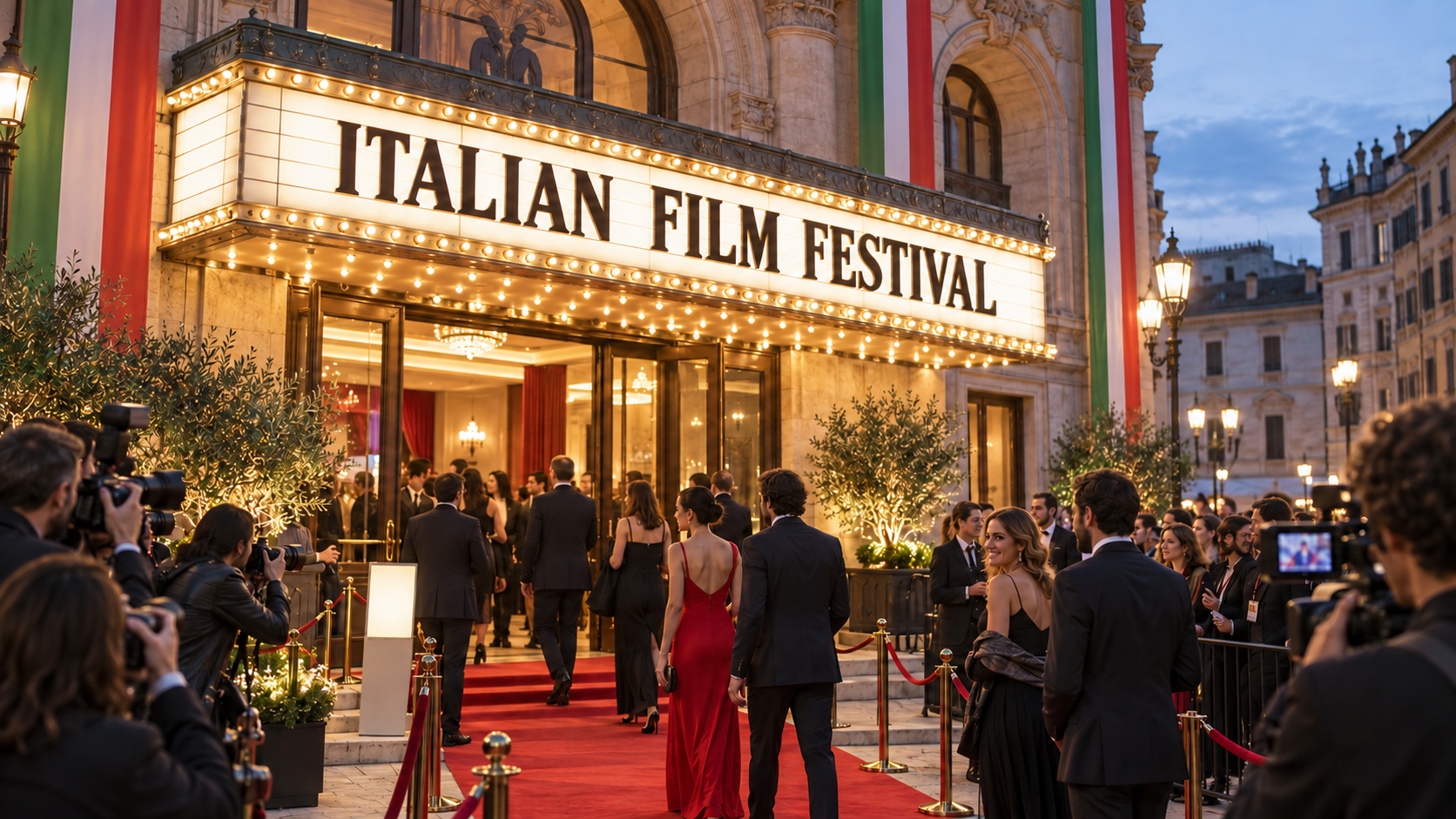
 The Venice International Film Festival may command the world’s attention each year, but Italy’s festival culture extends far beyond the Lido. From restored silent films accompanied by live orchestras to daring independent features, Asian blockbusters, documentaries and films judged by young audiences, the country offers a remarkably varied cinema calendar.
These festivals are not minor versions of Venice. Each has developed its own identity, audience and relationship with its host city. Turin champions independent and unconventional filmmaking. Rome mixes international premieres with the atmosphere of a major public celebration. Bologna turns film restoration into a communal spectacle, while festivals in Trieste, Udine, Pordenone, Florence and southern Italy explore subjects that rarely receive such sustained attention elsewhere.
For travelers who love cinema, attending one of these events also offers a different way to experience Italy: inside historic theaters, cinematheques, university halls, open-air arenas and city squares filled with viewers discussing what they have just seen.
Torino Film Festival: Independent Cinema and New Voices
Usually held in November, the Torino Film Festival is one of Italy’s most respected showcases for independent and emerging cinema. It began in 1982 as the Festival Internazionale Cinema Giovani and has retained much of that original interest in experimentation, younger filmmakers and work produced outside the commercial mainstream.
The festival presents international competitions, documentaries, retrospectives and restored films alongside new features from Italy and abroad. Its programming is often adventurous without becoming inaccessible. First or second films may appear beside rediscovered works by established directors, giving audiences an opportunity to see how contemporary cinema converses with the past.
Turin is an especially appropriate setting. The city played a decisive role during the formative years of Italian cinema, when studios such as Ambrosio Film and Itala Film helped make it one of Europe’s early filmmaking centers. Today, the National Museum of Cinema inside the Mole Antonelliana and the Cinema Massimo reinforce that historic connection.
Compared with Venice or Rome, the Turin festival can feel less dominated by red carpets and celebrity appearances. Its character is more cinephile and exploratory, making it a good choice for viewers interested in new directors, unusual narrative forms and films that may not immediately receive wide distribution.
Rome Film Fest: Premieres in the Capital
The Festa del Cinema di Roma, generally held in October, is a much younger institution. Established in 2006, it has grown into one of Italy’s most visible autumn cinema events.
Its principal venue is the Auditorium Parco della Musica Ennio Morricone, designed by Renzo Piano. Screenings, conversations, exhibitions and public appearances transform the complex and its surrounding spaces into a large cinema village. Other cultural institutions and theaters across Rome frequently participate in the program.
The festival combines international premieres with Italian productions, documentaries, restored classics and meetings with actors and directors. Its Progressive Cinema competition highlights contemporary work from different countries, while the program’s broader sections create room for both popular films and more formally ambitious projects.
Rome also benefits from its deep connection to the Italian film industry. Cinecittà, the city’s production history and the legacy of directors such as Federico Fellini, Roberto Rossellini and Pier Paolo Pasolini give the festival a cultural context that extends far beyond its official venues.
Running alongside the main event, Alice nella Città focuses on films for younger audiences, coming-of-age stories and new talent. It has developed a strong reputation of its own and is worth following separately, particularly for families, educators and viewers interested in youth-oriented cinema.
The Rome festival is a good option for travelers who want premieres and major guests without the logistical complications of Venice. Many events are open to the general public, although the most anticipated screenings can sell out rapidly.
Il Cinema Ritrovato in Bologna: The Past Brought Back to Life
Il Cinema Ritrovato is unlike a conventional premiere festival. Organized by the Cineteca di Bologna and normally held in June, it is devoted to film history, restoration and rediscovery.
The program ranges from silent cinema and early sound films to restored classics, neglected directors, rare archival prints and national film traditions that have received limited international exposure. Screenings are accompanied by lectures, discussions with archivists and restoration specialists, and introductions by historians and filmmakers.
Its most memorable events take place in Piazza Maggiore, where thousands of spectators gather for evening screenings beneath the open sky. Seeing a restored classic projected in the center of Bologna turns film preservation into a public celebration rather than a specialist exercise.
Other screenings take place in cinemas throughout the city. A typical day can include early silent shorts, a director retrospective, a presentation about restoration methods and a major evening screening with live musical accompaniment.
For anyone interested in the history of Italian cinema, Il Cinema Ritrovato is among the most rewarding events in Europe. It also shows that restoration is not merely technical repair. The choice of print, color, soundtrack, projection speed and musical accompaniment can transform the way a historical film is understood.
Demand can be considerable, particularly for Piazza Maggiore events and screenings in smaller theaters. Visitors should consult the program carefully and avoid trying to attend too many consecutive films in different locations.
Giffoni Film Festival: Young People as Critics
Held in Giffoni Valle Piana near Salerno, the Giffoni Film Festival has built its identity around children and young adults. Founded in 1971, it is internationally known for placing young people at the center of the event rather than treating them as a secondary audience.
Children and teenagers from Italy and many other countries participate in juries organized by age group. They watch films, discuss them and select award winners. Filmmakers therefore present their work directly to an audience that can be candid, enthusiastic and extremely demanding.
The program focuses on childhood, adolescence, education, identity, family relationships and social change, although its films span many styles and national traditions. Workshops, discussions and encounters with actors, directors and other public figures add an educational dimension.
Giffoni is not simply a festival where adults choose suitable films for children. Its defining principle is that younger viewers can interpret, debate and evaluate cinema for themselves. This makes it an important platform for films that take their experiences seriously.
Because Giffoni Valle Piana is a small town, accommodation and transportation require more planning than they would in Rome, Turin or Bologna. Salerno can serve as a practical base for some visitors.
Trieste Film Festival: A Gateway to Central and Eastern Europe
The Trieste Film Festival, usually staged in January, specializes in cinema from Central and Eastern Europe. Its location is essential to its identity. Trieste stands at the meeting point of Italian, Slavic and Central European cultures, shaped by shifting borders and a complex multilingual history.
The festival presents features, documentaries and short films from countries extending across the Adriatic, the Balkans, the Baltic region and the former Soviet sphere. Many address migration, borders, political memory, post-socialist societies and changing national identities, but the program also includes comedy, experimental work and intimate personal stories.
For Italian audiences, Trieste provides access to films that may otherwise receive little or no theatrical distribution in the country. For filmmakers, it offers a meeting place between eastern and western European industries.
January weather can be cold and affected by the bora, Trieste’s famously powerful wind. Yet the winter setting suits a festival built around concentrated viewing, discussion and cultural exchange.
Far East Film Festival in Udine: Asian Cinema for European Audiences
Udine’s Far East Film Festival has become one of Europe’s most significant showcases for popular East Asian cinema. Founded in 1999, it generally takes place between late April and early May.
The festival embraces genres that European festivals once tended to overlook: crime thrillers, romantic comedies, action films, melodramas, horror, animation and large-scale commercial entertainment. Its selections come from countries and territories including Japan, South Korea, China, Hong Kong, Taiwan, the Philippines and Thailand.
The atmosphere is welcoming and enthusiastic, with audiences often remaining for multiple screenings each day. Directors, actors and producers regularly attend, and the festival’s industry activities help connect Asian filmmakers with European distributors and partners.
Far East demonstrates that serious film culture does not need to exclude popular cinema. A polished thriller or exuberant comedy can reveal as much about a society’s changing values as a formally experimental art film.
Le Giornate del Cinema Muto in Pordenone
Every autumn, Pordenone becomes an international center for silent-film scholarship and performance during Le Giornate del Cinema Muto, known in English as the Pordenone Silent Film Festival.
Founded in 1982, the festival presents restored prints, rediscovered films and extensive retrospectives accompanied by live music. Pianists, ensembles and orchestras do not simply decorate the screenings; their performances shape the audience’s emotional and rhythmic experience of each film.
The program reaches far beyond the most familiar names of silent cinema. Alongside celebrated directors and stars, audiences encounter early women filmmakers, national film industries, newsreels, animation, fragments and works reconstructed from surviving material.
Pordenone attracts historians, archivists, collectors, musicians and devoted viewers from around the world. It is highly specialized, but its communal atmosphere can also make silent cinema approachable for newcomers.
Pesaro and the Search for New Cinema
The Mostra Internazionale del Nuovo Cinema in Pesaro has supported innovative and politically engaged filmmaking since the 1960s. Its history is connected to debates about film criticism, experimental cinema and the changing language of the medium.
Pesaro’s programming has often looked beyond already established movements, presenting filmmakers and national cinemas before they became widely recognized. Retrospectives, scholarly discussions and publications remain an important part of its identity.
The festival is a natural fit for audiences who view cinema as an art form capable of questioning social conventions and reinventing its own structure. Its Adriatic location also allows visitors to combine screenings with time along the Marche coast.
Festival dei Popoli in Florence: Documentary Cinema
Founded in 1959, Festival dei Popoli is one of Europe’s longest-running international documentary festivals. Held in Florence, it treats documentary not as a narrow category of factual reporting but as a flexible cinematic form.
Its selections address politics, labor, migration, the environment, family life, personal memory and artistic creation. Observational documentaries may appear alongside essay films, archival works and projects that blur the division between documentary and fiction.
The festival also organizes retrospectives and professional activities while preserving a substantial documentary archive. For travelers, it provides a counterpoint to Florence’s Renaissance image, drawing attention to contemporary lives and urgent international questions.
Taormina Film Festival: Cinema in a Historic Theater
The Taormina Film Festival brings an unmistakably Sicilian setting to the international festival calendar. Its signature screenings are held in Taormina’s ancient theater, where the screen, stone architecture and surrounding landscape create one of Italy’s most dramatic cinema venues.
The festival has welcomed major international and Italian actors and directors while presenting premieres, popular films and special events. Its glamorous side is evident, but the event also serves as a showcase for Italian and Mediterranean cinema.
Taormina is especially appealing to travelers who want to combine a festival with a broader stay in Sicily. However, summer demand can make accommodation expensive, so reservations should be made well in advance.
Festivals Dedicated to Particular Communities and Genres
Italy’s cinema calendar includes many events defined by subject, community or geography.
The Lovers Film Festival in Turin is dedicated to LGBTQ+ cinema and is closely connected to the themes explored in queer Italian cinema. Its program brings together features, documentaries and shorts dealing with sexuality, identity, rights and changing forms of representation.
Biografilm in Bologna concentrates on biographies and stories inspired by real lives. Its films frequently cross the boundary between documentary and narrative cinema.
The Ravenna Nightmare Film Fest explores horror, fantasy and darker forms of genre cinema, while the Noir in Festival program is devoted to crime, mystery and noir across film and literature.
Environmental, archaeological, mountain, African, Mediterranean and human-rights film festivals can also be found in cities and smaller communities throughout the country. Together they create space for films that would struggle to compete for attention in a general international festival.
An Approximate Festival Calendar
Dates change every year, but Italy’s principal festivals generally follow this seasonal pattern:
- January: Trieste Film Festival
- April: Lovers Film Festival in Turin
- Late April or early May: Far East Film Festival in Udine
- June: Il Cinema Ritrovato in Bologna and the Pesaro Film Festival
- June or July: Taormina Film Festival
- July: Giffoni Film Festival
- Late August and early September: Venice International Film Festival
- October: Rome Film Fest and the Pordenone Silent Film Festival
- November: Torino Film Festival and Festival dei Popoli in Florence
Programs and tickets may be released only weeks before an event begins. Dates should always be confirmed through the festival’s official website before booking transportation or accommodation.
How to Attend an Italian Film Festival
Most Italian festivals are not restricted to industry professionals. Individual tickets, daily passes and full-festival accreditations are frequently available to the public.
Before attending, check how tickets are issued. Some festivals use assigned seating, while others require pass holders to reserve each screening separately. Free events may still require advance booking.
Language information is equally important. International films are often screened in their original language with Italian subtitles. Italian films may not always have English subtitles, particularly at smaller festivals. Programs usually indicate the available subtitle languages.
Leave sufficient travel time between venues. Festivals in compact cities such as Pordenone may be easy to navigate on foot, while events in Rome can involve longer journeys. A tightly packed schedule can become impractical if screenings are held in different districts.
Public conversations, masterclasses and restoration presentations can be as rewarding as the films themselves. They reveal how festivals influence distribution, preservation and critical reputation—and how a film can find its audience long after production has ended.
Why Italy’s Smaller Festivals Matter
A major festival can place a film before the international press, but specialized and regional festivals perform a different cultural function. They preserve overlooked work, introduce emerging filmmakers, connect audiences with distant film traditions and sustain discussion outside the commercial release cycle.
They also reveal that Italian cinema culture is not concentrated in a single city. Turin’s industrial history, Bologna’s restoration expertise, Rome’s production infrastructure, Trieste’s border identity and the international outlook of Udine and Pordenone all produce distinct ways of watching and discussing film.
Venice remains indispensable, but it is only the beginning. Italy’s wider festival circuit offers something less predictable: the pleasure of entering a theater without knowing whether the next film will be a restored silent masterpiece, a first feature by an unknown director or a popular genre film that challenges assumptions about what belongs at a festival.
External Sources
Torino Film Festival – Official Website
Rome Film Fest – Official Website
Il Cinema Ritrovato – Cineteca di Bologna
Giffoni Film Festival – Official Website
Trieste Film Festival – Official Website
Far East Film Festival – Official Website
Pordenone Silent Film Festival – Official Website
Festival dei Popoli – Official Website