
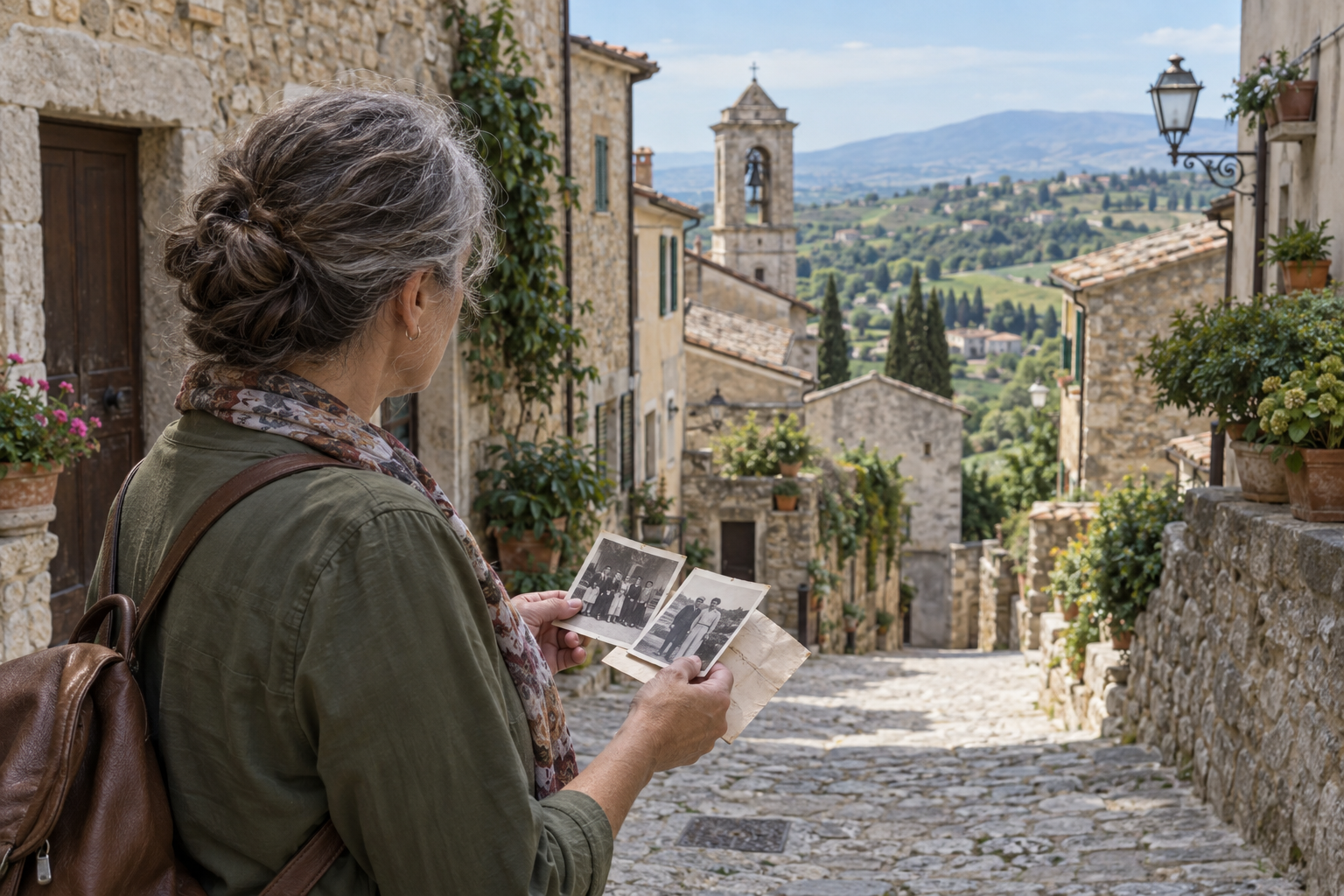
 An ancestry trip to Italy is different from an ordinary vacation. The purpose is not simply to see a beautiful village, but to understand where your family lived: the church where children were baptized, the streets relatives walked, the landscape that shaped local work and food, and perhaps the house or neighborhood they left behind.
The most rewarding Italian heritage trips begin months before departure. First confirm the exact town, study the records, contact the appropriate offices, and allow enough time in the area to do more than take a photograph beside the town sign. A successful visit combines family research with patient, respectful travel.
Start With the Exact Italian Town—not Just the Region
“My family came from Naples” or “our ancestors were Sicilian” is rarely precise enough. In family stories, the name of a famous city may stand for a province, a port of departure or an entire region. Your ancestor may actually have been born in a small comune many miles away.
A comune is an Italian municipality and the basic local government unit that usually maintains modern civil-status records. A frazione is a smaller village or hamlet within a comune. That distinction matters: a frazione may appear on a family document or in oral history, while the records are held by the parent comune.
Before booking the trip, try to establish:
- The ancestor’s complete Italian name, including a woman’s birth surname
- Date or approximate year of birth
- Names of parents and spouse
- Exact comune and province
- Parish, neighborhood or frazione, if known
- Approximate emigration date and destination
- Names of siblings or relatives who remained in Italy
Passenger lists, naturalization files, marriage records, death certificates, obituaries, military registrations and church records created abroad can all contain the place of origin. Do not rely on a surname alone. Italia Mia’s guide to researching Italian ancestors explains how to work backward from family documents, civil records and parish archives. The related guide to Italian surname origins and regional clues shows why a surname is useful evidence but not proof of a particular hometown.
Research the Village Before You Travel
Once you have a likely comune, confirm it through an original record whenever possible. The Italian Ministry of Culture’s Portale Antenati provides free access to many digitized birth, marriage and death registers held by Italian State Archives. Not every register has been indexed, so a surname search may fail even when images are available to browse.
FamilySearch’s Italy research center is another useful starting point for civil and Catholic Church records. Availability varies by location and period, and some images may have access restrictions.
Study more than a single birth certificate. A marriage act may identify both sets of parents and the spouses’ birthplaces. A death record can confirm residence and family relationships, although the information depends on what the informant knew. Marginal notes on a birth record may mention a later marriage or death.
Create a compact research folder containing:
- A one-page family tree
- Copies of the most important records
- A timeline of names, dates and addresses
- A list of spelling variations
- A map showing the comune, nearby towns and former provincial boundaries
- Digital backups stored separately from the originals
- A list of unanswered questions
Print the key pages. A phone battery, weak signal or forgotten password should not prevent you from explaining your connection at a municipal office or parish.
Contact the Comune, Parish and Archives in Advance
Do not assume you can arrive unannounced and ask someone to research several generations while you wait. Small municipal offices may have limited public hours and few employees. Parish priests and volunteers have pastoral responsibilities and may not be available to open historical registers for visitors.
The municipal civil-status office
The office you will usually need is the Ufficio di Stato Civile, the civil-status office. Write in Italian several weeks before your visit. Give one precise name, event and approximate date, and explain that you plan to visit the town because your family originated there.
Ask whether:
- The relevant register is still held by the comune
- An appointment is required
- Visitors may consult the record or receive a copy
- A fee, stamp or identification document is necessary
- The office can suggest a local historical association or archivist
A short message is more likely to receive attention than a request to reconstruct an entire family tree.
Suggested wording:
Gentile Ufficio di Stato Civile,
mi chiamo [name] e vivo negli Stati Uniti. Sto facendo una ricerca sulla mia famiglia. Il mio bisnonno [ancestor’s name], figlio di [parents’ names], nacque presumibilmente nel Comune di [town] il [date or approximate year]. Sarò a [town] nel periodo [dates] e vorrei sapere se è possibile consultare l’atto di nascita o riceverne una copia. È necessario fissare un appuntamento?
Vi ringrazio cordialmente per l’aiuto.
This means that you are researching a great-grandparent believed to have been born in the comune, will be visiting on specified dates, and would like to know whether the birth record can be consulted or copied and whether an appointment is required.
The parish or diocesan archive
Civil registration began at different times in different parts of Italy. For earlier generations, or where civil holdings are incomplete, baptism, marriage and burial registers may be essential. Contact the parish first; older registers may have been transferred to a diocesan archive.
Ask for a specific record and offer the same identifying details. If a parish provides substantial help without a formal charge, a voluntary donation may be appropriate. Never pressure a priest or volunteer to allow photography, and do not handle an old register without permission.
The State Archive
Italy has a State Archive, Archivio di Stato, for each provincial capital, with some additional sections elsewhere. Holdings differ, but they can include transferred civil registers, military conscription lists, notarial acts, cadastral records and other material that reveals how a family lived.
Consult the archive’s website before traveling. Registration, identification, opening hours, reservation procedures and rules for photography can vary. Build the archival visit into the first part of the trip so you have time to follow any new clues.
Decide Where to Stay
The ancestral village may have only a few rooms—or none at all. Staying in the village can be deeply atmospheric, especially in the evening after day visitors leave, but a nearby town may offer better transportation, restaurants and services.
Choose among three practical bases:
- Stay in the ancestral village if it has suitable accommodation and you want time to walk, talk with residents and observe daily life.
- Stay in the provincial capital if you need the State Archive, railway access or a wider choice of hotels.
- Divide the stay between both places: use the city for research, then move closer to the village for the personal part of the journey.
Some links in this article are affiliate links. Italia Mia may earn a commission if you make a purchase or booking, at no additional cost to you.
Use Trip.com’s Italy accommodation listings to compare the village with nearby provincial towns. Search the precise comune and then examine the map rather than trusting a property’s description of itself as “near” the destination. For research methods and useful reference books, browse Italian genealogy guides on Amazon.com.
Italia Mia’s guide to where to stay in every Italian region can help you select a practical regional base.
Plan Transportation to a Small Italian Village
Many ancestral towns are in inland Sicily, Calabria, Campania, Basilicata, Molise, Abruzzo, Puglia or the Apennines. Regional trains may reach the nearest city but not the village itself. Bus service can be infrequent, reduced on Sundays and holidays, or designed around school and work schedules rather than tourists.
Check the complete journey in both directions. A morning bus to the village is not useful if there is no afternoon return. Confirm schedules with the regional operator close to departure because route times can change seasonally.
A rental car often provides the greatest flexibility, but historic centers may have narrow streets, limited parking and camera-controlled restricted zones called ZTLs. Plan a legal parking location before arriving and walk into the center. If you prefer public transportation, begin with Italia Mia’s first-time guide to train travel in Italy.
For a remote village, consider hiring a licensed driver or local guide for the day. A guide who speaks the local dialect and knows the comune can sometimes help with logistics and introductions, but should never promise access to private records or living relatives.
What to See in Your Ancestral Town
The most meaningful places are often ordinary rather than monumental.
The municipal building
The municipio or town hall may be where births, marriages and deaths were recorded. Even when you already found the document online, seeing the place where local civil life was administered provides valuable context.
The parish church
Identify the correct historical parish rather than assuming the largest church served every family. An ancestor may have been baptized in a neighborhood chapel or in a parish that later changed name, jurisdiction or building.
The family street or neighborhood
A record may include a street, district, rural contrada or house number. Street names and numbering systems change, so compare documents with historical maps, cadastral records and local knowledge. Treat any current residence as private property. Photograph from a public street only when appropriate, and never knock on a door expecting entry.
The cemetery
A cemetery can reveal surnames, photographs, marriage connections and living branches of a family. Older graves may no longer survive because burial concessions can expire and remains may be moved. Dress respectfully, keep your voice low, and ask permission before photographing people or an active funeral.
The local landscape
Learn what supported the town when your family lived there: farming, fishing, quarrying, shepherding, crafts, sulfur mining, factory work or seasonal labor. Visit the fields, coast, market, old railway, workers’ quarter or mountain paths connected with that history. Family migration makes more sense when placed within the local economy.
Food, festivals and traditions
Eat the town’s characteristic dishes, look for patron-saint celebrations and visit local museums or cultural associations. These traditions are not decorative additions to the trip; they help explain the rhythms and identity your ancestors knew.
How to Approach Possible Relatives
Finding people with the same surname does not prove a relationship. In some villages a surname is widespread, while unrelated branches may have used it for centuries.
If documentary evidence points to a living family, make contact politely before appearing at a private home. Introduce yourself, explain the shared ancestor you are investigating, and provide a simple family tree. Avoid opening with requests for documents, lodging or access to property.
Some people will be enthusiastic; others may be cautious, busy or uninterested. Privacy, language and family history can make the encounter complicated. Accept any response graciously. A small album of old photographs or copies of American family records can be a better conversation starter than a long verbal explanation.
Consider a Genealogist or Roots-Travel Specialist
Professional assistance can be worthwhile when records are not online, handwriting is difficult, a town has changed administrative jurisdiction, or you need someone to arrange local appointments.
Italy’s Ministry of Foreign Affairs supports Italea, the official roots-tourism program, which offers regional itineraries and access to genealogy and trip-planning services. Italea’s genealogical consultation request asks for an ancestor’s name, approximate birth year, region and municipality before providing a quote.
Before hiring any independent researcher, ask for:
- A written scope of work
- The archives and record types to be searched
- Fees and expected expenses
- Copies and citations for every record found
- The researcher’s policy when no record is located
- A clear distinction between genealogy, tour guiding and citizenship assistance
An ancestry trip can support family-history research, but it does not establish eligibility for citizenship. For current legal context, see Italia Mia’s separate guide to Italian citizenship by descent.
A Sample Five-Day Italian Heritage Itinerary
Day 1: Arrive in the regional base
Settle into the provincial capital or nearest well-connected town. Review your documents, confirm appointments and visit a local library or museum for historical context.
Day 2: Research day
Visit the State Archive, diocesan archive or another repository arranged in advance. Record full citations and note every new place name, address and witness.
Day 3: First day in the ancestral village
Walk through the center, visit the municipio and parish, locate family streets, and eat at a local restaurant. Leave space for conversations and unexpected leads.
Day 4: Landscape and community
Visit the cemetery, surrounding countryside, neighboring frazioni and a local museum or association. Meet a guide or possible relatives only through prior arrangement.
Day 5: Follow-up and reflection
Return to an archive or office if a new clue emerged. Scan notes, label photographs while locations are fresh in your mind, and write down the names of everyone who helped.
If the village is very remote or your research is complex, allow a full week. Rushing through for two hours may produce a photograph, but it rarely produces understanding.
Mistakes That Can Undermine an Ancestry Trip
- Booking flights before confirming the correct comune
- Confusing a province, port or famous city with the actual birthplace
- Expecting municipal employees or priests to perform extensive research immediately
- Arriving when offices are closed for weekends, holidays or local schedules
- Assuming everyone with the same surname is related
- Entering private homes, land or archives without permission
- Treating current residents as characters in a family story rather than people with their own privacy
- Spending every day in archives and no time experiencing the town itself
- Assuming genealogical evidence automatically proves a citizenship claim
Make the Visit Part of the Family Record
An Italian heritage trip should create evidence and memories for the next generation. Each evening, label photographs with the town, building and people shown. Record pronunciations, recipes, local expressions and stories, while distinguishing documented facts from family recollections.
After returning home, send a thank-you message to municipal employees, parish staff, guides, relatives and residents who assisted you. Share promised photographs or documents. Add new findings to your family tree with complete source citations.
The deepest value of ancestry travel is not a dramatic discovery guaranteed in advance. It is the chance to place names from old documents back into a living geography—and to understand that the ancestral village continued to change long after your family left it.
Frequently Asked Questions
Can I simply visit the town hall and ask for my ancestor’s record?
You can visit during public hours, but advance contact is strongly recommended. The record may be held elsewhere, an appointment may be required, and staff may not have time for an unscheduled genealogy search.
What if I know the region but not the town?
Continue researching records created in the country of immigration. Passenger manifests, naturalization petitions, marriages, obituaries and siblings’ documents may identify the comune. Do not plan a village visit from a surname distribution map alone.
Will I be able to find my ancestor’s house?
Sometimes. A civil or parish record may contain an address, contrada or house number, but names and numbering can change. Historical maps, cadastral records and local expertise are often necessary. The building may also have been rebuilt or demolished.
Is it acceptable to photograph records and graves?
Ask first. Archives, churches and cemeteries may have their own rules, and privacy considerations apply to recent records and living families.
Do I need to speak Italian?
Fluency is not essential, but basic Italian and a prepared written explanation are extremely helpful. In a small town, fewer people may speak English than in major tourist cities. A local interpreter can make official visits and family meetings more productive.
Can Italea help with Italian citizenship?
Italea is designed for roots travel and genealogical discovery, not citizenship applications. Citizenship eligibility and documentation should be addressed separately through the competent Italian authorities or a qualified professional.
External Sources
- Portale Antenati — Italian Ministry of Culture
- Portale Antenati instructions for finding civil registers
- Italea official roots-tourism itineraries
- Italea genealogical consultation service
- Italian Ministry of Foreign Affairs on the Italea Roots Tourism project
- FamilySearch Italy research resources