

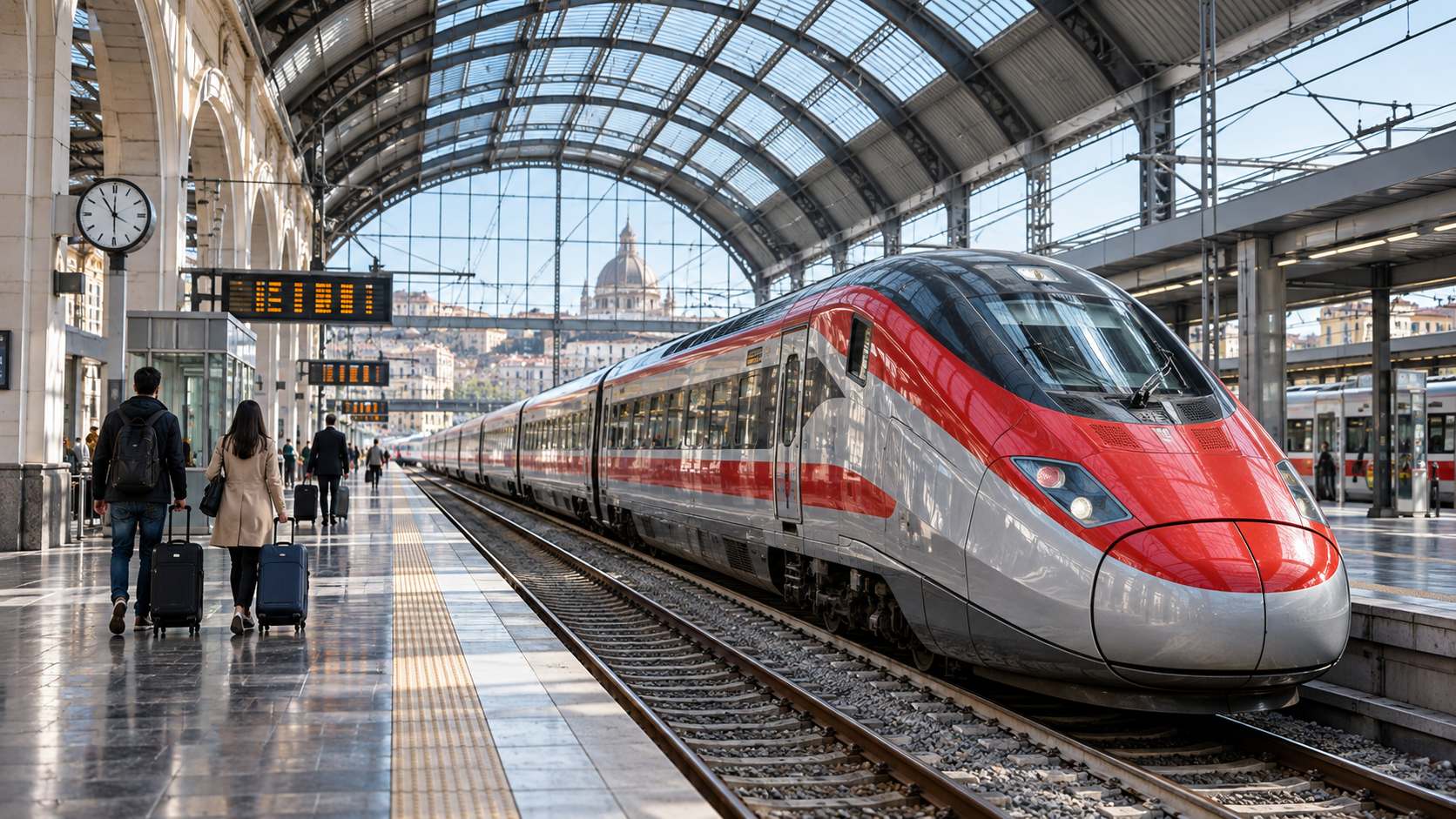
 Traveling through Italy by train is usually faster and more convenient than driving, especially when an itinerary includes cities such as Rome, Florence, Bologna, Milan, Venice and Naples. High-speed trains connect the major destinations, while regional services reach smaller cities, coastal towns and rural areas.
The system becomes much easier once you understand the differences between train operators, ticket types, reservations and validation rules. This guide explains what first-time visitors need to know before boarding.
Italy’s Main Types of Trains
Italian passenger trains fall into several broad categories.
High-speed trains connect major cities along Italy’s busiest routes. Trenitalia operates Frecciarossa services, while the privately owned Italo competes on many of the same high-speed lines.
Intercity trains are generally slower than high-speed trains but serve additional cities and longer routes that may not be covered by Frecciarossa or Italo.
Intercity Notte trains operate overnight services, with choices that may include ordinary seats, couchettes and private sleeping compartments.
Regional trains, usually identified as Regionale or Regionale Veloce, make more frequent stops and connect cities with smaller towns. Regional trains are essential for destinations such as the Cinque Terre, Lake Como, Lucca, Assisi and many coastal communities.
Some regional services are operated by companies other than Trenitalia, including Trenord in Lombardy and various local operators. Ticket and validation rules can therefore differ slightly by region.
Trenitalia vs Italo
Trenitalia is Italy’s largest railway operator. Its network includes Frecciarossa high-speed trains, Intercity services, night trains and an extensive regional network.
Italo operates high-speed trains on major routes linking cities such as Turin, Milan, Venice, Bologna, Florence, Rome, Naples, Salerno and Bari. Italo does not operate a nationwide regional network.
On routes served by both companies, compare:
• Departure and arrival stations
• Total travel time
• Fare conditions
• Luggage rules
• Seat and service level
• Change and refund policies
Neither company is automatically better for every journey. The most convenient choice may simply be the train with the best departure time and price.
Trenitalia and Italo tickets are not interchangeable. A Trenitalia ticket cannot ordinarily be used on an Italo train, and an Italo ticket cannot be used on Trenitalia.
Where to Buy Train Tickets
The safest places to buy tickets are the official Trenitalia and Italo websites, their official mobile apps, station ticket offices and authorized ticket machines.
Tickets purchased through third-party booking platforms may be perfectly valid, but changes and refunds sometimes have to be handled through the company that sold the ticket. Buying directly from the rail operator generally makes it easier to manage the reservation.
At larger stations, ticket machines usually offer instructions in English. Be cautious if a stranger approaches and offers unsolicited help at a machine. Official railway employees can be identified by their uniforms and credentials.
For high-speed and Intercity trains, booking in advance can produce substantial savings. The least expensive fares are usually less flexible and may not permit refunds or unrestricted changes.
Regional ticket prices are normally fixed according to distance. Purchasing months in advance usually offers little or no financial advantage, although buying online can save time at the station.
Do Italian Train Tickets Need to Be Validated?
This is one of the most confusing subjects for first-time visitors because the answer depends on the type of ticket.
High-Speed and Intercity Tickets
Frecciarossa, Italo and most Intercity tickets are issued for a specific train, date and departure time. They include a reserved seat and do not need to be stamped in a station validation machine.
Board the train shown on the ticket and sit in the assigned carriage and seat.
Paper Regional Tickets
A traditional paper regional ticket that is not already restricted to a specific train generally must be validated before boarding. Insert it into one of the small validation machines near the platform or elsewhere in the station.
The machine prints the date and time on the ticket. Traveling with an unvalidated paper ticket can result in a fine, even if the ticket was legitimately purchased.
If a validation machine is not working, look for another one. If none is available, find the conductor immediately after boarding and explain the situation before an inspection begins.
Because regional and local operators may use different systems, always read the instructions printed on the ticket.
Digital Regional Tickets
Trenitalia’s current Digital Regional Ticket is automatically validated at the scheduled departure time of the selected train. The former manual check-in requirement is no longer normally necessary for this ticket type.
Before the scheduled departure, passengers can generally use the “Manage Ticket” function to change the travel time, subject to the applicable conditions. After automatic validation, flexibility becomes more limited.
Do not rely on old online articles telling passengers to complete a manual check-in. Instead, open the ticket in the official app or through the link supplied by Trenitalia and follow the current instructions displayed there.
Digital rules may differ for tickets issued by Trenord or another local operator, so check the ticket itself rather than assuming that every regional mobile ticket works in the same way.
Seat Reservations
Seat reservations are included with ordinary Frecciarossa, Italo and Intercity tickets. Your ticket displays the train number, carriage or coach number and assigned seat.
Regional trains generally do not offer reserved seating. Passengers may choose any available seat in the correct class. On popular routes, especially during summer, a regional train can become crowded and some passengers may have to stand.
A rail pass does not always eliminate the need for a reservation. Eurail and Interrail holders must normally purchase a separate reservation before using Italian high-speed and many Intercity trains.
Understanding Italian Train Stations
Italian station names are not always identical to the city name. Common examples include:
• Roma Termini, Roma Tiburtina and Roma Ostiense
• Milano Centrale, Milano Porta Garibaldi and Milano Rogoredo
• Firenze Santa Maria Novella and Firenze Campo di Marte
• Venezia Santa Lucia and Venezia Mestre
• Napoli Centrale and Napoli Afragola
• Torino Porta Nuova and Torino Porta Susa
Always check the complete station name before buying a ticket. A connection marked “Milano” may require arrival at one station and departure from another.
Venezia Santa Lucia is located in Venice’s historic center, directly beside the Grand Canal. Venezia Mestre is on the mainland. Travelers staying in central Venice will normally find Santa Lucia more convenient.
Firenze Santa Maria Novella, often abbreviated Firenze S. M. Novella or Firenze SMN, is the principal station for Florence’s historic center.
Finding Your Train and Platform
Departure boards use the Italian word partenze for departures and arrivi for arrivals. The platform is shown as binario.
Search for your train number rather than relying only on the destination. The city displayed on the board may be the train’s final destination, not the city where you are getting off.
For example, a passenger traveling from Florence to Bologna may be boarding a train whose final destination is Milan or Turin.
Platforms are sometimes announced only shortly before departure and can change. Check the electronic board again before going through the platform gates.
Italian trains do not require airline-style check-in. Nevertheless, arriving 20 to 30 minutes early is sensible at a large and unfamiliar station.
Changing Trains and Station Transfers
A connection shown in one Trenitalia booking may include a combination of Frecciarossa, Intercity and regional services. Leave enough time to find the next platform, particularly if you have luggage or reduced mobility.
At large stations, a connection of 10 minutes may be technically possible but stressful. A 20- to 30-minute margin is safer for a first-time visitor, while considerably more time may be needed if the trains use different stations.
Do not assume that two stations with the same city name are within walking distance. Transfers between Roma Termini and Roma Tiburtina, for example, normally require a local train, metro or taxi.
If separate tickets were purchased from different operators, protection after a missed connection may be more limited. For an important connection, consider allowing extra time or booking the complete journey as a single transaction whenever possible.
European rail passengers have rights concerning cancellations, delays and missed connections, but the precise protection depends on how the journey was sold and whether it qualifies as a through-ticket.
Traveling With Luggage
Italian trains do not normally provide an airline-style checked-baggage service. Passengers carry their luggage onto the train and remain responsible for it.
Small bags can be stored above the seat or underneath it. Larger suitcases usually go in luggage racks near the doors or at the ends of the carriage.
Italo currently permits luggage without an additional charge but publishes size and placement rules. In Smart class, its stated maximum suitcase dimensions are 75 × 53 × 30 centimeters. Travelers with unusually large luggage should check the operator’s latest conditions before departure.
Keep passports, money, phones, medication and other valuables with you rather than inside a suitcase left on a communal rack. A small cable lock can discourage opportunistic theft, but luggage must never obstruct doors, aisles or emergency equipment.
Boarding is easier if you can lift and control your own suitcase. Stations and trains can be crowded, and assistance with ordinary luggage is not guaranteed.
What Happens During a Train Strike?
Rail strikes, called scioperi, are announced periodically in Italy. A strike does not necessarily mean that every train will be canceled.
Trenitalia provides certain guaranteed services. For regional transportation, protected service periods are normally scheduled from 6:00 to 9:00 and from 18:00 to 21:00, Monday through Saturday. Selected long-distance trains may also be guaranteed.
However, last-minute changes remain possible. A train operating at the beginning of a strike may terminate before reaching its scheduled destination.
Before traveling, check:
• The Italian Ministry of Transport strike calendar
• The operator’s strike notices
• The train number in the official app
• Station departure boards and announcements
The word garantito indicates a guaranteed train. Do not assume that every train running during a protected period is guaranteed; consult the operator’s published list.
If your train is canceled, ask the operator about rebooking or a refund before purchasing a replacement ticket from another company.
Are Rail Passes Worth Buying?
A rail pass can be useful, but it is not automatically the least expensive way to travel in Italy.
Trenitalia Pass
The Trenitalia Pass is designed for foreign citizens residing outside Italy. It offers a specified number of journeys—currently 3, 4, 7 or 10—within a defined period.
It can be used on eligible Frecce, Intercity, Intercity Night and certain Eurocity services within Italy. It does not function as an unlimited pass for every regional train.
Reservations for eligible journeys are mandatory but included without an additional charge. A connecting itinerary made under one booking can count as one journey, making the pass potentially useful for longer trips.
Eurail and Interrail
Eurail passes are generally intended for travelers residing outside Europe, while Interrail passes are intended for European residents.
The pass itself does not guarantee a place on an Italian high-speed train. Reservations are required for many long-distance services and usually involve an additional fee. Popular trains can sell out of pass-holder reservation space.
Pass or Individual Tickets?
Individual advance-purchase tickets are often less expensive for travelers with a fixed itinerary. A pass may be worthwhile when:
• You plan several long-distance journeys
• Your schedule requires flexibility
• You are comparing expensive last-minute fares
• You will travel across several European countries
Before buying a pass, list every planned journey and compare the complete cost—including reservation fees—with ordinary point-to-point tickets.
Should You Book in Advance?
For Frecciarossa and Italo, book early if your dates and times are fixed. Discounted fares can sell out, particularly on Friday and Sunday evenings, holiday weekends and popular summer routes.
Flexible or refundable fares cost more but may be worthwhile when connecting from an international flight or cruise whose arrival could be delayed.
Regional trains can usually be booked closer to the travel date. However, buying the ticket before reaching a busy station removes one source of stress.
Useful Italian Railway Words
Binario — Platform or track
Carrozza — Carriage or coach
Posto — Seat
Partenze — Departures
Arrivi — Arrivals
Ritardo — Delay
Cancellato or soppresso — Canceled
Cambio — Change or transfer
Biglietteria — Ticket office
Convalidare — To validate
Sciopero — Strike
Treno garantito — Guaranteed train
Final Tips for Traveling Italy by Train
Download the official operator’s app before leaving home and keep a screenshot or offline copy of every ticket whenever possible. Carry a portable phone charger, because digital tickets must remain accessible during the journey.
Confirm the station, date, departure time, operator, train number, carriage and seat before boarding. On regional services, inspect the ticket carefully to determine whether it requires validation.
Pack luggage that you can manage without assistance, allow extra time for unfamiliar stations and check for strikes shortly before every travel day.
Once these basic rules are understood, train travel in Italy is remarkably straightforward. It also makes it possible to visit destinations beyond the usual itinerary without renting a car. Italia Mia’s Italy travel guides can help you choose the cities, small towns and regions to add to your journey.
External Sources
Trenitalia: Essential services during a strike
Italian Ministry of Transport: Official strike calendar
Interrail information and reservation rules
European Commission: Rail passenger rights