A car rental in Florence can be useful for exploring Tuscany, but it needs careful planning. Before booking, decide whether you need a vehicle during your city stay or only when you leave for the countryside.
For a visit focused on museums, churches, restaurants, and the historic center, I recommend arranging your stay without a rental car. Florence’s restricted traffic zones make driving into the center complicated. You also need to account for parking, collection time, and the cost of keeping a car you may barely use.
A more practical approach is to collect your vehicle when your road trip begins. Here is what to check before booking, signing the contract, and setting off.
Decide When You Actually Need a Car
Start with your itinerary. If your next stop is a rural farmhouse, a small village, or several countryside addresses in one day, a car gives you flexibility. If you are traveling between major city centers, compare the train journey before committing.
Think about the whole cost of each option. A cheap daily rental can become less attractive after parking, fuel, tolls, extra drivers, and protection products.
For a mixed holiday, consider spending your Florence nights without a car and renting for the countryside portion only. Choose accommodation with confirmed parking for the driving days.
For broader preparation, read Italia Mia’s essential tips before renting a car in Italy.
Choose Your Pickup Location Carefully
Florence Airport’s main rental facilities are in Via Palagio degli Spini, connected to the terminal by a shuttle. Do not plan your collection as though every supplier hands over vehicles inside the terminal. Check your booking confirmation for the exact meeting point and transfer arrangements.
Airport collection may suit a trip that begins with a drive into Tuscany. A city office may be more convenient after a stay in Florence. Neither location is automatically cheaper.
Before choosing, ask about opening hours, late arrivals, the return address, and the route out of the rental location. A downtown office requires particular attention to restricted streets.
Book an automatic explicitly if you need one. Also consider luggage capacity: a small car is easier to maneuver, but it should hold your bags out of sight.
Bring the Right Documents and Payment Card
Carry your original valid driving license, identification, booking confirmation, and the payment card required by the supplier.
For a license issued outside the EU or EEA, check the Italian requirements before departure. Italy generally requires the foreign license to be accompanied by an International Driving Permit or an official Italian translation. The supporting document does not replace your original license.
The rental company may impose additional conditions concerning age, how long you have held your license, and accepted payment cards. Check these for every proposed driver.
Ask these questions before paying:
- Must the card be in the main driver’s name?
- Are debit cards accepted for this vehicle category?
- How much available credit is needed for the deposit?
- Does the selected protection change the deposit?
- Are there age restrictions or surcharges?
Keep the answers with your reservation. A booking voucher alone does not establish that every collection requirement has been met.
Understand What Rental Insurance Covers
Several different products can appear under the heading “insurance.” Read the actual terms rather than relying on a label such as “complete protection.”
Third-party liability insurance covers liability for injury or damage caused to other people, subject to the policy. Rental vehicles in the EU must have this cover, and it should be included in the price. It is different from protection against damage to the rental car itself.
Collision damage waiver, or CDW, limits your contractual responsibility for covered vehicle damage. It commonly leaves an excess, also called a deductible. Confirm whether it is included and what conditions apply.
Theft protection concerns theft of the vehicle and may have a separate excess. Check requirements involving keys, security, and reporting.
Personal accident and belongings cover are separate products. Compare their benefits and exclusions with any existing travel policy before purchasing them.
There is no universal Florence rental excess. The amounts depend on the supplier, vehicle, booking, and protection selected.
Compare Excess Reduction With Reimbursement Cover
A supplier’s excess-reduction product and a separate reimbursement policy can work differently.
With a rental-company waiver, the supplier reduces your responsibility for covered claims under its contract. With a separate reimbursement policy, you may first have to pay the rental company and then submit a claim to another provider.
Ask who handles the claim, what you must pay initially, and which documents you need. Also confirm whether the rental company will still block the full deposit.
For an illustrative example, suppose covered damage costs €600 and the applicable excess is €1,200. You could be responsible for the €600 damage cost. If covered damage costs €3,000, the excess could limit that damage liability to €1,200. Exclusions and additional contractual charges must still be checked.
“Zero excess” does not mean that every event is covered. Europcar’s published Italy protection comparison, for example, lists exclusions even for its premium tier, including unauthorized drivers, incorrect fuel, and lost keys.
Ask specifically about tires, glass, underbody damage, towing, and administrative charges. Credit-card benefits also need checking for Italy, the vehicle category, rental duration, and any requirement to decline particular waivers.
Plan Your Route Around Florence’s ZTL
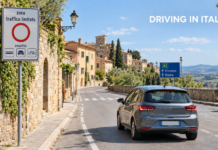
Florence’s Zona a Traffico Limitato, or ZTL, covers much of the historic center. Cameras record vehicle plates. Never assume that a navigation app’s route gives you permission to enter.
Contact a hotel or garage inside the zone before driving there. Ask for the permitted route and how it will register your plate. Supplying the number does not create unrestricted access to every street.
Check the official Florence ZTL guidance shortly before traveling. Restrictions vary by sector and time, with seasonal nighttime controls. Pedestrian areas and bus lanes have separate restrictions.
Florence also operates the wider Scudo Verde environmental access system. Confirm that your vehicle meets the rules applicable on your travel dates.
For peace of mind, save the hotel or garage’s instructions offline before collecting the car.
Arrange Parking Before You Arrive
Choose a specific parking destination rather than circling the center. Florence’s official tourism information lists peripheral park-and-ride options, including Villa Costanza and Guidoni, with tram connections.
Read the signs at the actual space. Do not interpret white markings as a universal invitation to park for free. Blue bays can involve payment and local conditions; reserved spaces require the relevant entitlement.
Check restrictions for street cleaning, loading, time limits, and residents. Payment does not override another restriction.
A garage booking should answer practical questions too: Can you enter and leave whenever needed? Is the quoted price for a calendar day or 24 hours? Are there height limits? Does reaching it involve a ZTL?
Inspect the Car Before Leaving
Allow time for a careful handover, especially after a flight. Walk around the vehicle and compare its condition with the damage report.
Take clear photographs of the bodywork, wheels, windshield, interior, fuel gauge, and mileage. Ask staff to record anything missing from the report before you drive away. Save a copy of the agreed record.
Check how to operate the lights, reverse gear, parking brake, fuel flap, and navigation. Confirm the fuel type directly from the vehicle and documentation.
Locate the warning triangle, reflective vest, and breakdown contact details. If a warning light is illuminated or a tire looks damaged, raise it immediately.
Before setting off, adjust your seat and mirrors and enter the first destination. A quiet few minutes at collection can prevent a stressful stop later.
Follow Italian Road Safety Rules
Drive on the right and follow posted signs. General maximum speeds for ordinary passenger cars are 50 km/h in built-up areas, 90 km/h on secondary extra-urban roads, 110 km/h on main extra-urban roads, and 130 km/h on motorways.
Lower posted limits apply where indicated. Rain reduces the general motorway maximum to 110 km/h and the main extra-urban maximum to 90 km/h. Additional limits apply to novice drivers.
Keep your attention on the road, leave space around cyclists, and slow down on narrow rural bends. Pull over somewhere permitted if you need to change your route.
The general Italian alcohol limit is 0.5 grams per liter of blood, equivalent to 0.05%. A zero limit applies to drivers under 21, drivers in their first three years after obtaining their license, and specified professional drivers. The simplest plan is to avoid alcohol when driving. For winery visits, arrange another form of transport.
Everyone must use the required seat belt. Children below 150 cm generally need an approved restraint appropriate to them. Italian-registered cars carrying children under four also require an approved anti-abandonment alarm device. Confirm both items with your supplier in advance.
For additional context, see Italia Mia’s complete guide to driving in Italy.
Know What to Do if Something Goes Wrong
Save the rental company’s assistance number before your first journey. For an emergency involving injury or immediate danger, call 112.
After an incident, prioritize safety and contact the supplier promptly. Follow its reporting instructions and obtain any police report required by the circumstances or protection terms.
Record the location, time, other vehicle details, and relevant contact information. Photograph the scene only when safe. Do not sign a statement you cannot understand or agree with.
For a breakdown, ask the supplier to authorize assistance. For a disputed charge, request the supporting documents in writing and retain your own photographs and correspondence.
The European Consumer Centres Network’s rental guidance is a useful starting point for understanding consumer rights and complaints.
Return the Vehicle With Time to Spare
Check the return instructions the day before departure. Confirm the location, opening hours, fuel or battery requirement, and any shuttle transfer you need afterward.
Photograph the vehicle again, including the fuel gauge and mileage. Keep your fuel receipt. If staff are available, request a joint inspection and written confirmation of the return condition.
For an unattended return, document where and when you parked and follow the key-drop instructions exactly. Ask beforehand when your contractual responsibility ends.
My recommendation is to make the car serve your itinerary. Enjoy Florence without unnecessary driving, then collect a suitable vehicle for the days when exploring Tuscany really calls for one.
External Sources
- FeelFlorence: official ZTL and vehicle-access guidance
- FeelFlorence: car parks
- Enterprise: Florence Airport collection information
- Italian Ministry of Transport: foreign driving licenses
- Your Europe: hiring a car in another EU country
- European Consumer Centres Network: car rental rights
- Europcar: protection comparison for Italy
- ACI: alcohol and driving
- ACI: speed limits, Article 142
- ACI: seat belts and child restraints, Article 172