
 Venini: A Century of Murano Glass, Color and Italian Design
Few names express the artistic possibilities of Murano glass as powerfully as Venini. Founded in 1921, the celebrated glassmaker brought together centuries-old Venetian techniques and the experimental spirit of modern Italian design.
Venini does not simply manufacture vases, bowls and lamps. Its master glassmakers transform molten glass into objects that seem to capture light, movement and color. Some pieces are deliberately restrained, while others feature unexpected silhouettes, vivid chromatic contrasts and surfaces that reveal the hand of the artisan.
During its history, Venini has worked with influential artists, architects and designers including Carlo Scarpa, Fulvio Bianconi, Gio Ponti, Napoleone Martinuzzi, Ettore Sottsass, Alessandro Mendini, Tapio Wirkkala, Gae Aulenti, Tadao Ando and Peter Marino.
This combination of traditional craftsmanship and contemporary creativity helped make Venini one of the most internationally recognizable names in Italian design.
The Origins of Venini
The company’s history began in 1921, when Milanese lawyer Paolo Venini and Venetian antiques dealer Giacomo Cappellin established a glassworks on the island of Murano. Their original company was called Vetri Soffiati Muranesi Cappellin Venini & C.
Murano already possessed an extraordinary glassmaking tradition extending back hundreds of years. However, Venini’s ambitions went beyond reproducing historic Venetian forms. He wanted to introduce a modern design language while preserving the skills of Murano’s master glassblowers.
After Venini and Cappellin separated professionally in 1925, Paolo Venini reorganized the business under the name Vetri Soffiati Muranesi Venini & C. The company later became known simply as Venini.
Venini’s willingness to collaborate with artists and architects proved decisive. Rather than treating designers as occasional consultants, the company invited them to experiment directly with Murano’s materials, furnaces and artisan traditions.
The results helped move Murano glass into the modern era.
Paolo Venini and the Reinvention of Murano Glass
Paolo Venini was not a glassblower, yet he understood both craftsmanship and modern commerce. He recognized that Murano glass could remain faithful to its origins while embracing abstraction, minimalism and new forms of interior decoration.
Under his leadership, Venini participated in international exhibitions and developed relationships with some of the leading figures in Italian architecture and design. Pieces created by the company appeared in prestigious galleries, museums and private collections.
Venini also experimented personally with form and color. Several of the company’s enduring designs were developed by Paolo Venini himself or in collaboration with other designers.
Today, the brand’s work can be understood within the broader history explored in Italia Mia’s guide to Murano glass, its famous designers and how to identify authentic pieces.
The Designers Who Shaped Venini
Carlo Scarpa
Before becoming one of Italy’s most admired modern architects, Carlo Scarpa worked extensively with glass. His collaboration with Venini during the 1930s and 1940s produced experimental surfaces, unusual color combinations and sculptural forms.
Scarpa explored techniques such as battuto, in which the cooled glass is carefully ground to create a hammered or textured surface. His historic Venini pieces are now among the company’s most desirable works at international auctions.
Fulvio Bianconi
Artist and designer Fulvio Bianconi brought movement, humor and expressive asymmetry to Venini after the Second World War. His designs helped overturn the idea that fine glass needed to be perfectly formal or symmetrical.
Bianconi’s best-known contribution is the Fazzoletto, designed with Paolo Venini. Its undulating rim suggests a handkerchief caught in the air.
Napoleone Martinuzzi
Sculptor and designer Napoleone Martinuzzi served as Venini’s artistic director during an important period of experimentation. He introduced substantial sculptural forms and developed designs that emphasized the physical character of glass.
His Deco vase remains one of Venini’s most recognizable creations.
Gio Ponti and Later Collaborations
Venini’s creative circle also included Gio Ponti, one of the defining figures of twentieth-century Italian design. Later collaborations with Ettore Sottsass, Alessandro Mendini, Tadao Ando and other celebrated designers ensured that the company continued to evolve.
This ability to combine historic craftsmanship with new creative ideas is one reason Venini pieces appear naturally beside furniture, lighting and decorative objects produced by Italy’s other great design houses.
How Venini Glass Is Made
Every Venini object begins with the work of Murano’s skilled artisans. Glass is heated inside a furnace until it reaches a molten state, after which it can be gathered, blown, shaped and combined with different colors.
The production process may involve several artisans working together. Timing is essential: the glass must be manipulated while it remains hot and workable.
Venini is particularly celebrated for its color archive. Subtle differences in temperature, mineral composition and layering can produce dramatically different effects. A color may appear dense and opaque in one area but become luminous when light passes through a thinner section.
Frequently encountered Venini techniques include:
- Incalmo: Separate glass sections of different colors are joined while hot.
- Sommerso: One layer of colored glass is submerged within another layer.
- Balloton: A metal mold creates a distinctive raised diamond or crosshatched pattern.
- Battuto: The exterior is ground to produce a textured, hammered appearance.
- Opalino: Layers of opaque and transparent glass create a soft, luminous finish.
- Murrine: Colored glass rods are arranged, fused and sliced to create intricate patterns.
These techniques connect Venini to the wider artistic tradition described in Italia Mia’s introduction to Murano glass art.
10 Iconic Venini Murano Glass Designs to Buy
Availability and colors can vary significantly. Some Venini designs remain in regular production, while vintage examples and discontinued colors may only be found through specialist dealers, auction houses or selected online sellers.
1. Venini Monofiori Balloton Vase
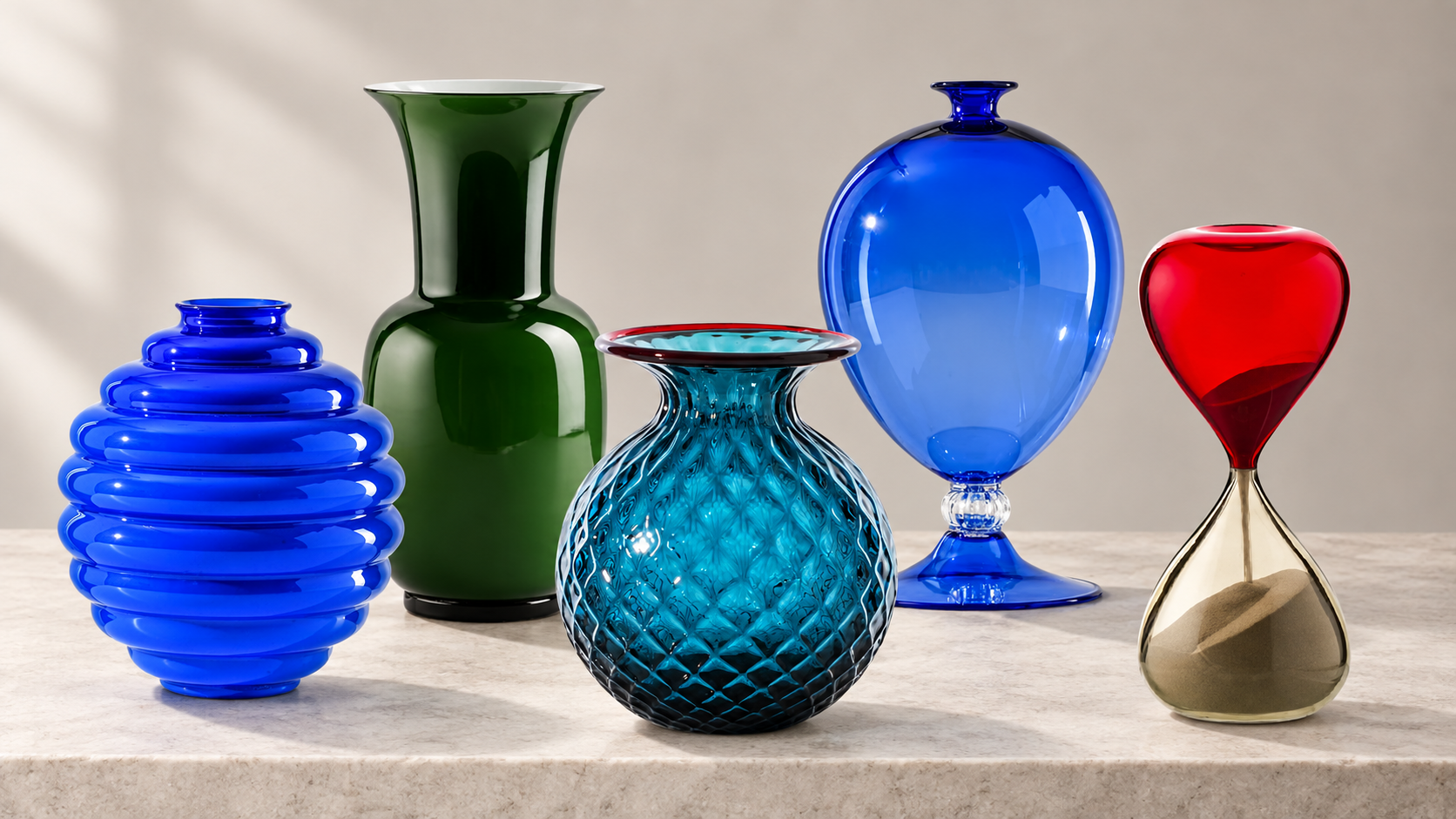
The Monofiori Balloton is one of the most accessible introductions to Venini design. Its rounded body is decorated with the geometric texture produced by the traditional balloton mold.
A contrasting colored thread is applied around the narrow neck, emphasizing the handmade character of the vase. Although compact enough for a shelf or desk, it has sufficient visual presence to stand alone without flowers.
Venini produces the design in a changing selection of colors, making it appealing to collectors who enjoy arranging several examples together.
Shop for the Venini Monofiori Balloton on Amazon
2. Venini Fazzoletto Vase
Created in 1948 by Fulvio Bianconi and Paolo Venini, the Fazzoletto is a masterpiece of postwar Italian glass design. Its irregular, folded rim resembles a handkerchief floating or turning in the wind.
Each vase is shaped by hand, so the precise curves and folds vary from one example to another. This individuality is part of the Fazzoletto’s appeal: it is a recognizable design, but no two pieces are completely identical.
The vase is available in different sizes and color combinations. Vintage Fazzoletto vases can be highly collectible, especially when their date, signature and provenance are properly documented.
Shop for the Venini Fazzoletto vase on Amazon
3. Venini Clessidra Hourglass
Designed in 1957 by Fulvio Bianconi and Paolo Venini, the Clessidra transforms an ordinary hourglass into a sculptural celebration of color.
Two handblown glass chambers meet at the center, often combining contrasting or complementary shades. Sand passes gradually between them, allowing the object to function as both a timekeeper and a decorative work.
The Clessidra looks particularly striking on a desk, console table or illuminated shelf. Its simple geometry makes it compatible with both contemporary and traditional interiors.
Shop for the Venini Clessidra on Amazon
4. Venini Deco Vase
Created by Napoleone Martinuzzi in 1930, the Deco vase consists of stacked rounded sections that rise rhythmically from a stable base to a narrower opening.
Its silhouette reflects the geometric elegance of the Art Deco period, but the form remains surprisingly contemporary. The curves also interact beautifully with light, producing shifts in color and transparency across the surface.
The Deco is an excellent choice for anyone seeking a recognizable Venini object with a strong architectural presence.
Shop for the Venini Deco vase on Amazon
5. Venini Opalino Vase
The Opalino, introduced in 1932, demonstrates Venini’s mastery of layered color. Its elegant, restrained silhouette allows the material itself to become the main attraction.
The technique combines different layers of glass to produce a soft, almost porcelain-like luminosity. Depending on the color and surrounding light, the vase can appear delicate and translucent or rich and saturated.
Its balanced proportions make the Opalino one of the easiest Venini pieces to incorporate into a home.
Shop for the Venini Opalino vase on Amazon
6. Venini Veronese Vase
The Veronese is based on the elegant glass vessel depicted in Paolo Veronese’s sixteenth-century painting The Annunciation. Artist Vittorio Zecchin interpreted the historic form for Venini during the company’s early years.
Its elongated neck, harmonious proportions and classical silhouette made it one of the defining shapes of modern Murano glass. The vase illustrates Venini’s ability to draw inspiration from Venetian history without merely copying the past.
For collectors, the Veronese represents an important connection between Renaissance painting, early twentieth-century design and Murano craftsmanship.
Shop for the Venini Veronese vase on Amazon
7. Venini Labuan Vase
The Labuan, designed by Thomas Stearns in 1962, is distinguished by its generous rounded body and long, slender neck. Its profile is elegant, organic and immediately recognizable.
The contrast between the broad base and narrow opening creates a sense of upward movement. Depending on its size and color, Labuan can serve as a discreet decorative accent or the centerpiece of an entire room.
It looks especially effective when positioned where natural light can pass through the glass.
Shop for the Venini Labuan vase on Amazon
8. Venini Idria Vase
The Idria takes inspiration from the ancient Mediterranean water vessel of the same name. Venini simplifies the traditional form, creating a sculptural vase with a rounded body and refined neck.
Its historical reference is subtle rather than literal. The result is a piece that feels simultaneously ancient and modern—an approach that appears throughout the history of Italian design.
Idria is a particularly attractive choice for buyers who prefer understated forms over strongly textured or irregular glass.
Shop for the Venini Idria vase on Amazon
9. Venini Anelli Vase
The Anelli design is characterized by horizontal rings of glass that create a rhythmic, layered surface. These raised bands catch reflections and produce variations in color as the viewer moves around the object.
Despite its decorative surface, the overall silhouette remains clean and architectural. Anelli works well as a solitary display piece but can also be paired with smoother Venini designs for contrast.
Shop for the Venini Anelli vase on Amazon
10. Venini Balloton Fiori Vase
The Balloton Fiori combines Venini’s traditional diamond-patterned surface with applied floral decorations. The flowers bring a playful, romantic quality to the disciplined geometry of the vase.
Because the decorative elements are applied by hand, the object clearly communicates the skill and imagination involved in Murano production. It is an attractive gift for someone who appreciates colorful Italian craftsmanship.
Shop for the Venini Balloton Fiori vase on Amazon
How to Recognize Authentic Venini Glass
Venini’s reputation inevitably attracts imitations. A colorful vase described simply as “Venetian style” or “Murano inspired” should not be assumed to be a genuine Venini creation.
When evaluating a piece, consider the following:
- Look for an engraved or acid-stamped Venini signature.
- Examine any original label, box, certificate or purchase documentation.
- Compare the dimensions, colors and shape with documented Venini models.
- Remember that signatures changed during different periods of production.
- Treat unusually low prices with caution.
- Request photographs of the base, signature and labels when buying online.
- Purchase expensive vintage pieces from reputable dealers or auction houses with experience in Italian glass.
A signature alone does not guarantee authenticity because markings can be copied. The object’s form, construction, documented history and quality should all be considered together. Italia Mia’s guide to spotting fake Murano glass provides additional advice for collectors.
Is Venini Glass a Good Investment?
Certain Venini pieces have achieved substantial prices at international auctions, particularly rare works associated with Carlo Scarpa, Fulvio Bianconi, Napoleone Martinuzzi and other major designers.
However, not every Venini vase will increase in value. Prices depend on several factors:
- Designer and historical importance
- Production date
- Rarity of the form or color
- Condition
- Signature and labels
- Exhibition or publication history
- Provenance
- Current collector demand
Buyers should generally choose Venini glass because they admire it, not because a profit is guaranteed. A beautiful object can provide decades of enjoyment even if its market value remains unchanged.
Caring for Venini Murano Glass
Venini pieces should be handled as works of art. Lift a vase by supporting its body or base rather than holding it by the rim or neck.
Use a soft microfiber cloth for routine dusting. If washing is necessary, use lukewarm water and a small amount of mild soap. Avoid abrasive cleaners, dishwashers and sudden temperature changes.
Rings, watches and bracelets can scratch glass during handling, so removing them is sensible when cleaning a valuable piece.
Display the object on a stable surface away from busy walkways and vulnerable edges. Prolonged exposure to intense direct sunlight should also be avoided, especially with older pieces or objects combining several materials.
Visiting Venini and Murano
For admirers of glass, a visit to Murano provides valuable context. Watching master glassmakers work reveals the speed, coordination and experience required to transform molten material into a balanced form.
Murano can be reached from Venice by vaporetto. Visitors can explore the island’s furnaces, galleries and the Museo del Vetro, which documents the long history of Venetian glassmaking.
Before planning a trip, explore Italia Mia’s guides to Venice and the wider Veneto region.
When shopping on Murano, ask where an object was produced and whether it includes documentation. Authentic glass made on the island should be distinguished from imported souvenirs that merely use Murano’s name or imagery.
Why Venini Still Matters
Venini’s greatest achievement is not a single vase or technique. It is the company’s continuing dialogue between artisanship and design.
The master glassblower brings knowledge that can only be acquired through years of practice. The designer contributes a new idea, silhouette or way of seeing the material. Between them lies the unpredictable behavior of molten glass.
This relationship has allowed Venini to preserve Murano traditions without turning them into museum relics. Its finest objects feel connected to Venetian history while remaining unmistakably modern.
Whether you choose a small Monofiori Balloton, a sculptural Fazzoletto or a rare vintage work, owning Venini means living with a distinctive expression of Italian creativity—one made from fire, breath, color and extraordinary human skill.
External Links
- Venini Official Website
- Venini History
- Venini Murano Glass Collections
- Museo del Vetro di Murano
- Venini Works in the Museum of Modern Art Collection
- Carlo Scarpa’s Glass Designs for Venini