
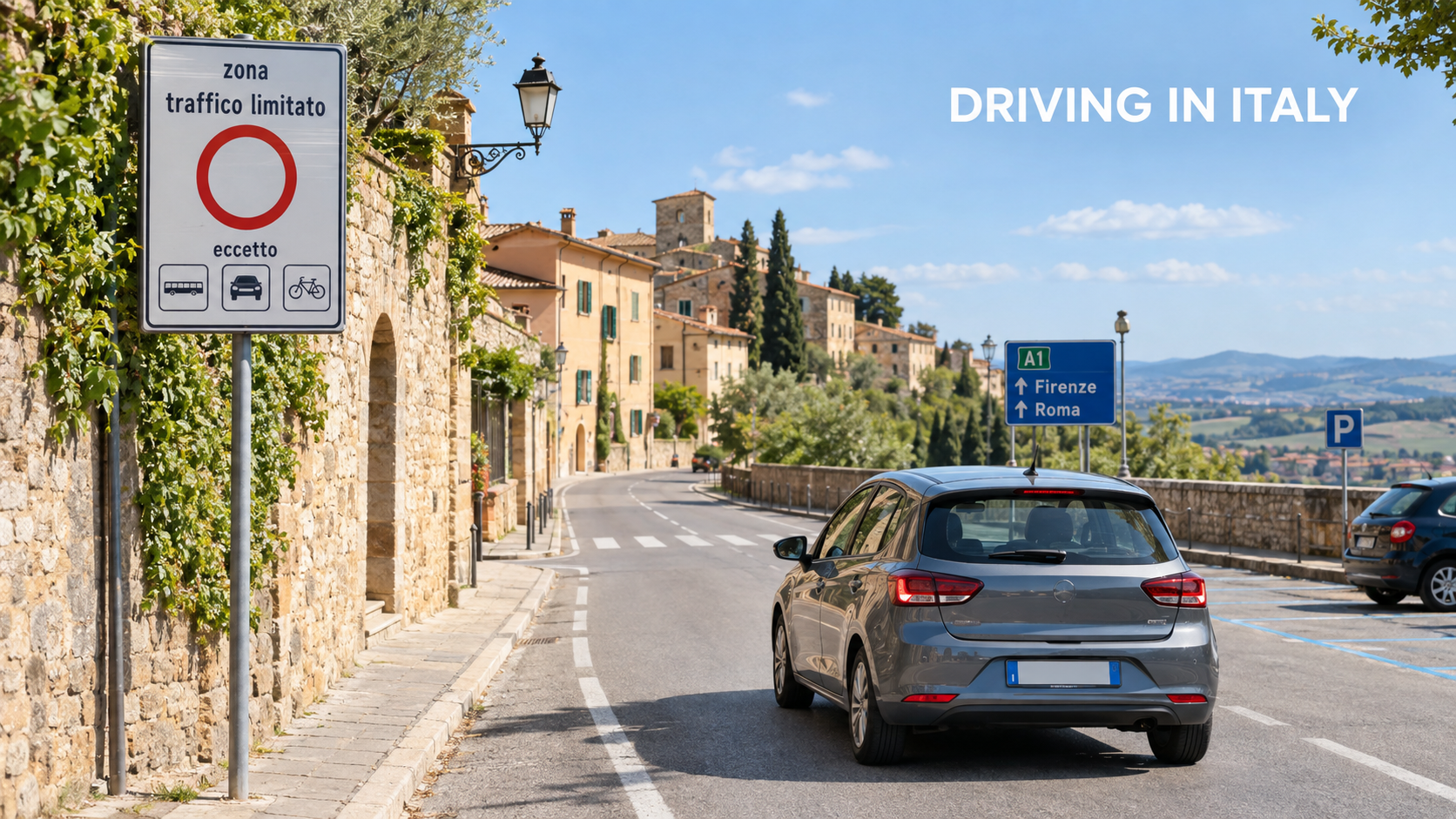
 Driving in Italy can be one of the best ways to reach hill towns, beaches, vineyards and rural areas that are difficult to visit by train. However, unfamiliar road signs, restricted historic centers, automated speed cameras and toll systems can quickly turn a pleasant road trip into an expensive experience.
The rules are not especially difficult once you understand them. The most important advice is simple: never enter an Italian city center without checking for a ZTL, observe the posted speed limit even when local drivers appear to ignore it, and read every parking sign before leaving the car.
What Americans Need to Drive in Italy
Italy drives on the right, and distances and speed limits are shown in kilometers.
Visitors with a driving licence issued outside the European Union should carry their valid licence together with an International Driving Permit or an official Italian translation. Rental companies may impose additional requirements, including minimum or maximum ages and a minimum period for which the licence must have been held.
Keep your passport or another accepted identity document, rental agreement and insurance information in the car. Confirm the rental company’s rules before leaving the United States, since requirements can vary.
Rental cars normally contain the legally required warning triangle and reflective vest. Check that they are present before driving away.
ZTL Zones: The Rule Tourists Most Often Miss
ZTL means Zona a Traffico Limitato, or Limited Traffic Zone. These restricted areas are common in the historic centers of Rome, Florence, Milan, Bologna, Pisa, Siena and many other Italian cities and towns.
A ZTL entrance is usually marked by a white circular sign with a red border. Additional signs display the hours during which access is restricted and the categories of vehicles that may enter.
Many ZTL entrances are monitored by cameras that photograph every number plate. If the vehicle is not authorized, the local authority can issue a fine. A rental company may later charge its own administration fee for supplying the driver’s information to the authorities. That fee is separate from the actual traffic fine.
Driving through several monitored entrances can result in more than one violation. Leaving a ZTL and entering it again may create another recorded access.
How to Avoid Entering a ZTL
Do not follow a GPS route blindly into a historic center. Navigation apps sometimes select a street that crosses an active ZTL, particularly when the destination is a hotel, restaurant or parking garage in the old town.
Before arriving:
• Check the municipality’s official ZTL map and operating hours.
• Ask your hotel where guests should park.
• Choose a garage outside the restricted area whenever possible.
• Look for park-and-ride facilities near tram, metro or bus routes.
• Watch for the words Zona Traffico Limitato and the red-bordered circular sign.
Electronic signs may display “varco attivo,” meaning that the restriction is active. “Varco non attivo” generally indicates that the electronic restriction is not operating at that time, but drivers must still read the complete sign because other limitations may apply.
Bus lanes are not automatically part of a ZTL. They are separate restricted lanes and may also be monitored by cameras.
Can a Hotel Authorize Your Car?
Some hotels and authorized garages located inside a ZTL can register a guest’s number plate for temporary access. This is not automatic.
Contact the hotel before entering the restricted area, provide the correct licence plate and ask for written confirmation of the permitted route and times. Do not assume that booking a hotel inside the ZTL gives you permission to drive there.
If the hotel says it can register the vehicle after arrival, confirm how quickly this must be done. A typing error in the licence plate can prevent the authorization from working.
Speed Limits in Italy
Unless signs establish a different limit, the standard limits for ordinary passenger cars are:
• 50 km/h in built-up areas
• 90 km/h on secondary roads outside built-up areas
• 110 km/h on principal extra-urban roads and many divided highways
• 130 km/h on motorways
Lower limits of 30 km/h are increasingly common in historic centers, residential neighborhoods, school zones and other urban areas. The posted sign always takes precedence over the general national limit.
In rain or other adverse weather, maximum limits on major extra-urban roads and motorways may be reduced. Roadworks, tunnels, dangerous curves and temporary traffic conditions may also carry lower limits.
Drivers who have held their licence for fewer than three years are subject to lower maximum speeds on major roads and motorways.
Autovelox and Tutor Speed Cameras
Italy uses several types of electronic speed enforcement.
Autovelox is the general term commonly used for a speed camera. Cameras may be fixed beside the road, installed in roadside equipment or operated by police from a mobile location. A warning sign reading “controllo elettronico della velocità” indicates electronic speed enforcement.
The Tutor system is frequently used on motorways. Instead of measuring speed at one point, it can calculate a vehicle’s average speed between two locations. Slowing down only when passing beneath a camera does not avoid an average-speed violation.
Not every camera is easy to see, and warning signs may appear well before the monitored point. The safest approach is to treat every posted limit as enforceable.
A speed-camera alert from a navigation app is not a guarantee. Cameras can change, mobile controls may not appear in the app, and temporary limits can be introduced without being reflected immediately in digital maps.
What Happens to a Fine from a Rental Car?
When a traffic violation is connected to a rental vehicle, the police or municipality normally contacts the rental company to identify the driver. The company may charge the credit card for an administrative handling fee and then provide the renter’s details to the authority.
The official fine may arrive separately, sometimes much later. It should identify the issuing authority, vehicle, location, date, alleged violation, payment procedure and appeal instructions.
Do not confuse the rental company’s administration fee with payment of the fine. If you believe a notice is incorrect, follow the appeal instructions provided by the issuing authority rather than ignoring it.
Understanding Italian Motorway Tolls
Most Italian motorways, known as autostrade, charge tolls. Motorway signs are normally green, while blue signs usually identify other major or extra-urban roads.
On a traditional toll motorway, you collect a ticket when entering and pay when exiting. Keep the ticket somewhere safe and do not bend or damage it.
The amount is generally based on the distance travelled and the vehicle category. Payment methods usually include cash and major credit or debit cards.
At a toll plaza, look carefully at the lane symbols:
• White lanes generally accept cash, although some may be automated.
• Blue lanes are normally intended for card payments.
• Yellow Telepass lanes are for vehicles equipped with an authorized electronic toll device.
Do not enter a Telepass-only lane unless the rental car includes a compatible toll device. If you make a mistake, do not reverse, walk between lanes or cross the barrier. Stop safely and press the assistance button.
Motorways Without Toll Booths
A limited number of Italian roads use a barrier-free electronic system, often described as Free Flow. Cameras record the vehicle’s number plate, and the toll must then be paid through the motorway operator’s authorized system.
Because these roads do not have traditional booths, it can be easy for visitors to drive through without realizing that payment is required. Pay attention to roadside notices and check the operator’s website promptly.
Ask the rental company whether electronic tolls are included or whether you are responsible for paying them directly.
What to Do If You Miss a Toll Payment
If a machine does not accept your payment or you accidentally use the wrong lane, the system may issue a mancato pagamento receipt—an unpaid toll report.
Keep this document. It contains the information needed to pay the amount online or through another authorized method.
Autostrade per l’Italia states that eligible unpaid toll reports can be paid online after 24 hours. Payment made within 15 days of the report’s issue can generally be completed without an additional administration charge. Later payment may result in extra costs.
Never reverse at a toll booth or attempt to drive around a lowered barrier. Use the assistance button and follow the operator’s instructions.
Parking-Line Colors in Italy
Painted lines provide a useful first indication of the parking rules:
• Blue lines usually indicate paid parking.
• White lines usually indicate free parking.
• Yellow lines normally indicate spaces reserved for residents, disabled permit holders, commercial vehicles, taxis or other authorized users.
White lines do not always mean unlimited parking. A sign may impose a time limit or require a parking disc, called a disco orario, displaying the time of arrival.
Blue parking may be paid at a nearby machine, through an authorized mobile app or, in some locations, by purchasing a ticket from a tobacconist. Display the printed ticket as instructed unless the system records payment electronically by number plate.
Parking apps differ between municipalities. Check the signs beside the parking area rather than assuming that an app used in one city will work in another.
Parking Signs Take Priority
The painted line alone is not enough. Always read the vertical sign, including:
• Operating days and hours
• Maximum parking duration
• Resident-only periods
• Street-cleaning restrictions
• Market-day restrictions
• Loading and unloading hours
• Temporary construction notices
• Requirements to use a parking disc
A space that is legal during the day may be restricted overnight or on market mornings. Temporary paper signs can also prohibit parking for roadworks, events or removals.
Never park in front of driveways marked passo carrabile, at bus stops, on pedestrian crossings, on sidewalks or in spaces reserved for disabled drivers without the appropriate permit. Illegally parked vehicles may be fined, clamped or towed.
Parking Garages and Park-and-Ride Facilities
A supervised garage is often the easiest choice in a large city. Before booking, verify whether the garage is outside the ZTL. If it is inside, ask whether its staff can legally register the rental car’s number plate.
Park-and-ride facilities are particularly useful in cities with congested historic centers. You can leave the car outside the restricted area and continue by train, metro, tram or bus.
If most of your trip involves Rome, Florence, Venice, Milan or other major cities, consider travelling between them by train and renting a car only for the countryside. See more practical planning advice in Italia Mia’s Italy travel guides.
Essential Tips for a Trouble-Free Road Trip
Photograph the rental car, fuel level and dashboard mileage when collecting and returning it. Also photograph any existing damage.
Save the exact location of the rental return office before beginning the final journey. Airport rental returns may use a different entrance from the passenger terminal.
Allow extra time for fuel stops, toll booths and parking. Italian service stations may operate differently outside normal business hours, with automated pumps requiring payment before fuel is dispensed.
Keep toll tickets, parking receipts and fuel receipts until the rental company confirms that the contract is closed.
Most importantly, slow down when approaching a historic center. A few minutes spent checking signs can prevent a fine that arrives months after the vacation.
Quick Driving Checklist
Before setting out, confirm that you have:
• Your driving licence and International Driving Permit or accepted translation
• Passport or identity document
• Rental and insurance documents
• A credit or debit card for tolls and fuel
• Some euros for machines that do not accept your card
• Offline navigation or a reliable data connection
• The address of a legal parking facility
• Confirmation of any ZTL authorization
• The rental company’s emergency number
Driving in Italy is manageable when you plan where to leave the car before you reach the city center. Use the car for the countryside and smaller destinations, respect every posted limit, and treat ZTL signs as a firm boundary unless you have confirmed authorization.
External Sources
Italia.it – Driving in Italy: Requirements and Rules
Autostrade per l’Italia – Paying an Unpaid Toll Online
European Union – Road Rules and Safety in Italy