
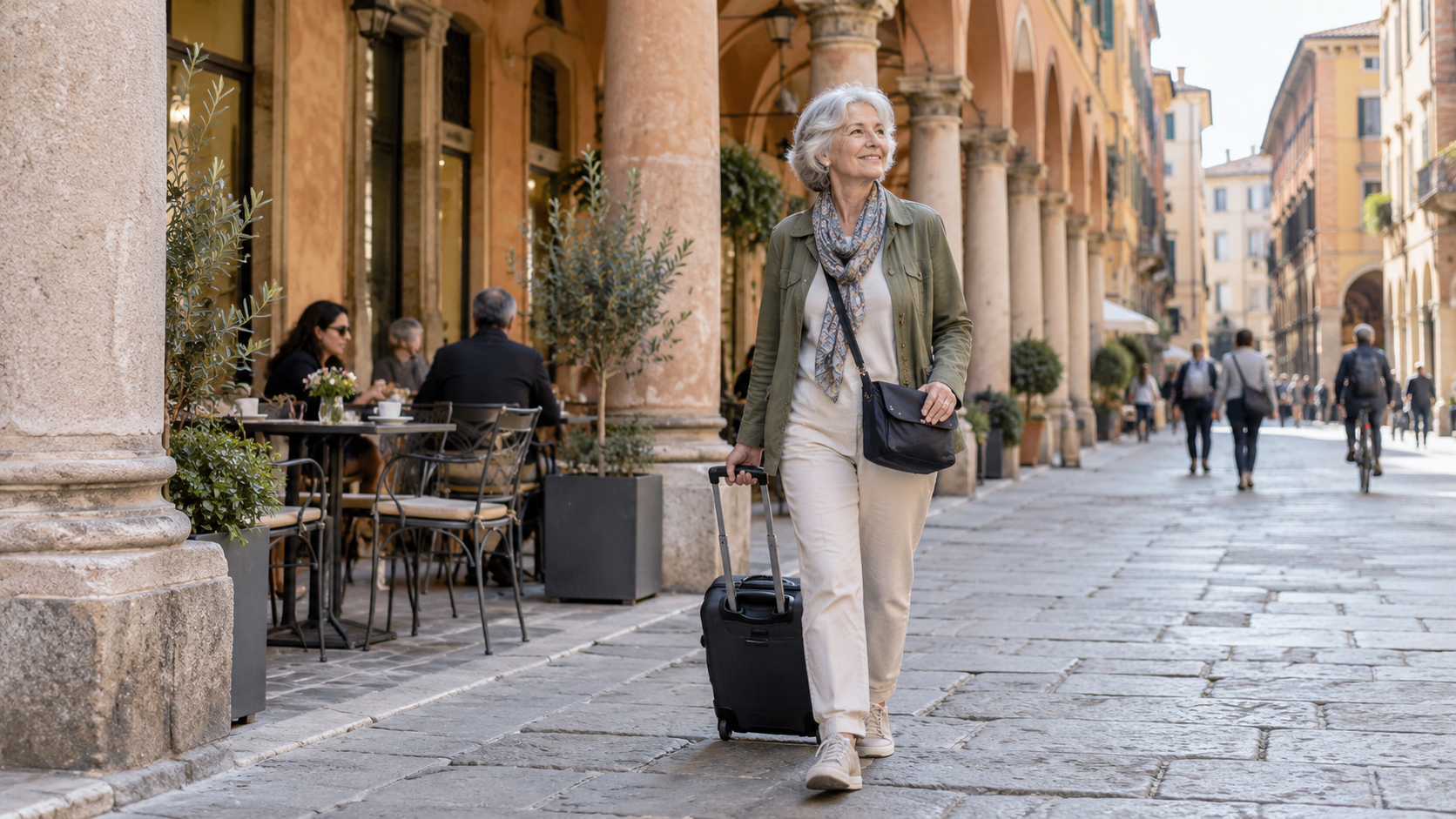
 Traveling alone in Italy after 60 can be comfortable, rewarding and surprisingly easy when the itinerary matches your pace. Italy has an extensive rail network, centrally located hotels, lively public spaces and countless destinations where dining or sightseeing alone feels entirely natural.
The key is not trying to travel as you did at 25. A successful solo trip usually means fewer hotel changes, manageable luggage, centrally located accommodations and enough unscheduled time to rest or change plans.
Age alone should not discourage anyone from traveling independently. Health, mobility, confidence and travel experience matter much more than the number on a passport.
Is Italy Safe for Solo Travelers Over 60?
Italy is generally a manageable destination for independent older travelers, including women traveling alone. The principal everyday concern is opportunistic theft rather than violent crime.
Pickpocketing and bag theft occur most often in crowded transportation areas and major tourist zones, including:
- Train stations and station platforms
- Metro trains and crowded buses
- Airport transportation
- Lines outside famous attractions
- Outdoor cafés where phones are left on tables
- Busy squares and markets
- Trains during boarding and luggage storage
The current U.S. Department of State advisory recommends increased caution in Italy and specifically warns that pickpocketing is common in congested areas and on public transportation.
This does not mean that travelers should avoid Italian cities. It means remaining attentive during the predictable moments when thieves take advantage of distraction, crowds and luggage.
Practical ways to reduce the risk of theft
Carry only the money and cards you expect to use that day. Keep a second credit card and emergency cash secured separately at your hotel.
A zipped crossbody bag worn in front is more practical than an open tote or backpack in crowded areas. When seated at a café or restaurant, do not hang a bag over the back of the chair.
Keep your passport secure unless you specifically need it. Carry a paper photocopy and a protected digital copy, while remembering that a copy is not a legal substitute when an original document is required.
Do not place a phone on the edge of an outdoor table. On trains, keep your small personal bag with you even if your suitcase is stored near the carriage entrance.
For more examples of common distractions and payment tricks, read Italia Mia’s guide to tourist scams in Italy.
Returning to the hotel at night
Italian city centers remain active well into the evening, especially in warm weather. Dining alone at 7:30 or 8:00 p.m. is not unusual, and busy central streets can feel more comfortable than deserted areas closer to an inexpensive suburban hotel.
Choose accommodations on a well-lit street and check the route from the nearest station before booking. If the walk involves an isolated underpass, steep hill or complicated bus connection, a cheaper room may not be worth the inconvenience.
Use official taxi stands, a hotel-arranged car or the city’s authorized taxi service. Avoid accepting unsolicited rides from drivers approaching passengers inside airports or stations.
The European emergency number is 112. It can connect callers with the appropriate emergency service in Italy.
Health and Travel Insurance After 60
American Medicare generally provides very limited coverage outside the United States. Some Medicare Advantage and Medigap policies offer international emergency benefits, but travelers should never assume that their regular plan will pay for treatment or medical evacuation in Italy.
Before departure, confirm:
- Whether emergency treatment abroad is covered
- Whether pre-existing conditions are included
- Whether the policy pays providers directly or reimburses later
- Whether medical evacuation and repatriation are covered
- What documentation is required for a claim
- Whether there is an age-related coverage limit
A comprehensive travel-insurance policy can be especially important for an expensive trip with prepaid hotels, tours and train tickets.
Carry medications in their original labeled containers. Bring enough for the full journey plus a modest delay, and place essential medication in your carry-on rather than checked baggage. A printed list should include each medication’s generic name, dosage, allergies and important medical conditions.
If a medication is controlled or requires special handling, verify Italian entry rules before traveling. A brief letter from your doctor can be useful, particularly when carrying syringes, medical equipment or a substantial supply.
Planning the Right Pace
Many disappointing Italy itineraries fail because they include too many hotel changes. A traveler may technically be able to visit Rome, Florence, Venice, Milan and the Amalfi Coast in ten days, but the repeated packing, station transfers and check-in times quickly become exhausting.
A better solo itinerary after 60 might use:
- Three nights in Rome
- Four nights in Florence, with a day trip by train
- Three nights in Bologna or Verona
- Four nights in Venice, Turin or another final base
Staying longer in each place creates room for laundry, rest, weather changes and spontaneous discoveries. It also allows you to become familiar with the neighborhood, a local café and the route back to your hotel.
Schedule no more than one major timed attraction in each half-day. Museums such as the Vatican Museums or Uffizi can require considerable standing and walking before you even account for the journey there.
Traveling Around Italy by Train
For most solo travelers, trains are the easiest way to move between major Italian cities. High-speed services connect cities such as Turin, Milan, Bologna, Florence, Rome, Naples and Salerno without the responsibilities of driving or parking.
Trenitalia operates high-speed Frecce trains, Intercity services and much of the regional network. Italo is a private high-speed operator serving many of the same principal routes.
Before booking, compare departure times, arrival stations, fare conditions and the distance between your hotel and the station. Italia Mia’s first-time guide to traveling Italy by train explains reservations, validation, luggage and the differences between Trenitalia and Italo.
Italo’s discount for travelers over 60
Italo currently offers passengers over 60 discounts of up to 60% on eligible journeys and fares. Availability and restrictions vary, and the least expensive ticket may have limited change or refund options.
Carry identification showing your age when traveling with a senior fare. Compare the discounted price with standard fares before purchasing; promotional tickets available to all passengers can occasionally be competitive.
Reduced-mobility assistance
Travelers do not need to use a wheelchair to benefit from planning around reduced mobility. Long platforms, stairs, crowded boarding areas and last-minute platform changes can be difficult for anyone with limited walking endurance, balance problems or heavy luggage.
Trenitalia directs passengers who need assistance to the RFI Sala Blu service. Assistance can include help moving through participating stations and boarding or leaving the train. The service is free, but it should be arranged in advance.
European passenger-rights rules also protect travelers with disabilities or reduced mobility and provide for assistance without an additional charge. Contact the operator early, explain exactly what help is required and retain the confirmation.
Managing luggage by yourself
Railway staff do not ordinarily handle every passenger’s luggage. You should expect to lift your suitcase onto the train, maneuver it through narrow doors and store it in the available luggage area.
A medium or carry-on-sized rolling suitcase is usually easier than a large case. Pack clothing that can be combined and washed during the trip rather than bringing a different outfit for every day.
A small crossbody bag should contain your passport, wallet, phone, medication and train information. Keep this bag with you when using the restroom or visiting the café car.
Some links in this article are affiliate links. Italia Mia may earn a commission if you make a purchase or booking, at no additional cost to you.
Travelers comparing accommodations in several cities can use this Trip.com Italy hotel search. Prioritize proximity to the station or principal attractions, an elevator, air conditioning and a staffed reception desk.
Useful packing options include a lightweight spinner suitcase and an anti-theft crossbody travel bag. Check current dimensions and airline restrictions before purchasing.
Regional Trains, Buses and Local Transportation
Regional trains reach smaller cities and towns that are not served by high-speed services. They can be convenient and economical, but may have fewer luggage spaces, more intermediate stops and older station infrastructure.
Ticket rules vary according to the operator and ticket format. Digital regional tickets and paper tickets may not follow identical procedures, so read the conditions displayed during purchase rather than relying on an old travel guide.
Local transportation is different in every city. Rome, Milan, Turin and Naples have metro systems, while cities such as Florence rely heavily on buses and trams. Ticket validation and contactless-payment rules are not uniform throughout Italy.
Allow extra time the first time you use a new system. A taxi can be a sensible expense when arriving after a long flight, carrying luggage or returning from an attraction that requires multiple connections.
Transport Strikes and Schedule Changes
Strikes are part of the transportation landscape in Italy. Some are national, while others affect a particular company, city, region or group of workers.
Check your train operator and the Italian Ministry of Infrastructure and Transport’s official strike calendar several days before an important journey. Review it again the day before departure because announced actions can be modified or canceled.
During a railway strike, certain guaranteed services may continue, but travelers should not assume their particular train will operate. Build extra flexibility into any journey connected with a flight or cruise departure.
Driving Alone in Italy
Renting a car is useful for rural Tuscany, parts of Puglia, small villages and countryside accommodations. It is often unnecessary—and sometimes burdensome—for a trip centered on major cities.
Italian historic centers frequently contain ZTLs, restricted-traffic zones monitored by cameras. Entering without authorization can result in a fine that arrives long after the trip. Parking spaces can also be narrow, and manual-transmission cars remain common.
Read Italia Mia’s guide to driving in Italy, ZTL zones, tolls and parking before deciding whether a rental car improves the itinerary.
For a solo traveler who is uncomfortable navigating unfamiliar roads, the best compromise is often to travel between cities by train and rent a car only for a short rural portion.
The Best Italian Destinations for Solo Travelers Over 60
The ideal destination is not necessarily the quietest or most famous. It should offer reliable transportation, centrally located lodging, restaurants where solo diners feel comfortable and enough attractions to justify staying several nights.
Bologna: The easiest all-around base
Bologna may be the best first choice for solo travel in Italy after 60. Its main station has excellent rail connections, while the historic center is compact and protected by miles of porticoes that provide shade and shelter from rain.
The city is lively without feeling as overwhelming as Rome or Milan. Food markets, traditional trattorias, medieval streets and the university atmosphere make it easy to spend several days alone without running out of things to do.
Bologna is also an excellent base for train trips to Modena, Parma, Ferrara, Ravenna and Florence.
Mobility note: the center is relatively manageable, but paving can be uneven and the climb to the Sanctuary of San Luca requires careful planning.
Turin: Elegant, organized and less crowded
Turin has broad avenues, arcaded sidewalks, grand cafés and an understandable street grid. It offers major cultural attractions without the constant visitor pressure found in Rome, Florence or Venice.
The Egyptian Museum alone justifies a visit, while the Royal Museums, cinema heritage and historic cafés provide varied indoor activities when the weather is poor.
For advance booking, check Turin Egyptian Museum ticket options through Weekend in Italy. This is an affiliate reseller, not the museum’s official ticket office; compare availability and conditions before booking.
Mobility note: central Turin is relatively level, although some attractions and viewpoints outside the center require additional transportation.
Florence: Best for art with minimal transportation
Florence places an extraordinary concentration of art, churches and historic streets within a compact area. A solo visitor can walk from a central hotel to most major attractions without learning a complicated public-transportation system.
The challenge is crowding. Reserve the most important museums, begin sightseeing early and leave room for rest between long visits.
Travelers who want to secure a time in advance can view Uffizi Gallery ticket availability through Weekend in Italy. It is an affiliate booking service rather than the official museum ticket office.
Mobility note: distances are short, but cobblestones, crowds and long museum visits can be tiring. A hotel near—but not directly beside—the busiest monuments can provide a quieter evening.
Lucca: A gentle introduction to Tuscany
Lucca is one of the most comfortable Tuscan cities for a slower solo stay. Its historic center lies within Renaissance walls, traffic is limited, and the broad path on top of the walls provides an attractive place to walk without negotiating cars.
The center contains churches, cafés, shops and small museums, yet it rarely feels as demanding as Florence or Siena. Pisa is an easy rail excursion, while Florence can be visited on a longer day trip.
Mobility note: central Lucca is mostly level, although old paving remains uneven. Confirm elevator access when booking accommodation in a historic building.
Verona: Compact, cultured and well connected
Verona combines a manageable historic center with strong rail connections to Milan, Venice, Bologna and Lake Garda. The Arena, churches, riverfront and piazzas provide enough variety for a stay of several nights.
The city is busy around the Arena and Juliet-related attractions, but quieter streets are never far away. Verona is particularly appealing to travelers who want a beautiful northern Italian city without Venice’s bridges or Milan’s faster pace.
Mobility note: the central area is generally approachable, although some viewpoints and riverbank routes involve slopes or steps.
Trieste: Best for cafés, sea views and a slower rhythm
Trieste feels different from Italy’s more familiar art cities. Its Habsburg architecture, historic cafés, Adriatic waterfront and Central European influences create a sophisticated destination for travelers who enjoy atmosphere as much as sightseeing.
It is an excellent place to sit alone with coffee or lunch without feeling rushed. Excursions can include Miramare Castle and, with additional planning, nearby areas of Friuli Venezia Giulia.
Mobility note: the waterfront and principal central squares are easy to navigate, but parts of the city rise steeply behind the center.
Rome: Essential, but plan it in sections
Rome is not the easiest solo destination, but it remains one of the most rewarding. The mistake is treating the entire historic center as one walkable attraction.
Plan geographically:
- Ancient Rome and the Colosseum on one day
- The Vatican area on another
- The Pantheon, Piazza Navona and Campo de’ Fiori together
- Villa Borghese and nearby neighborhoods on a separate day
Stay near a useful bus, tram or metro route and use taxis selectively when fatigue would otherwise shorten the day.
Mobility note: Rome includes cobblestones, hills, stairs and large archaeological areas. Four or five nights are much more comfortable than attempting the city in two rushed days.
Venice: Unforgettable, but difficult with luggage
Venice can be wonderful for solo travelers because there are no cars, the streets remain animated and wandering alone feels natural. However, bridges, steps, crowded vaporetto stops and confusing routes make it more demanding for anyone with knee, balance or endurance problems.
Stay near a vaporetto stop and avoid carrying a heavy suitcase across several bridges. Consider using porter or water-taxi services when appropriate.
Reserve only one major attraction per half-day. An affiliate option is to view Doge’s Palace and St. Mark’s Square museum tickets through Weekend in Italy. Check inclusions carefully and compare the offer with the official ticket office.
Mobility note: Venice can be difficult even for strong walkers. Accessible routes exist, but they require advance research and may change with bridge conditions, construction or seasonal water levels.
Choosing a Solo-Friendly Hotel
For independent travel after 60, hotel location is often more important than room size or decorative luxury.
Look for:
- A staffed reception desk
- An elevator that reaches your floor
- A walk-in shower or secure bathtub access
- Air conditioning during warm months
- A location near restaurants and transportation
- Good lighting around the entrance
- A room not reached solely through steep stairs
- Flexible cancellation when possible
- Recent reviews that mention noise, accessibility and elevator reliability
In Italy, “first floor” normally means the level above the ground floor. An advertisement saying that a property has an elevator does not guarantee step-free access from the street. Ask whether stairs must be climbed before reaching the elevator and whether it is large enough for your needs.
Do not book an isolated apartment solely because it is inexpensive. A hotel or guesthouse with reception can provide valuable help with taxis, restaurant reservations, lost belongings and unexpected health concerns.
Dining Alone in Italy
Solo dining is widely accepted, particularly in cities and tourist destinations. A reservation can help at small restaurants, but there is no need to apologize for requesting a table for one.
Lunch is often the easiest time to try a popular restaurant. Enotecas, trattorias, cafés and market counters can also feel less formal than elaborate evening dining rooms.
In Italian, you can say:
Un tavolo per uno, per favore — A table for one, please.
Posso prenotare per questa sera? — May I reserve for this evening?
Il conto, per favore — The check, please.
Keep enough flexibility to return to a place you enjoy. Familiarity with one neighborhood café or restaurant can make a solo stay feel much more personal.
Staying Connected Without Feeling Constantly Online
A working phone is an important safety tool. Arrange international roaming, a local SIM or an eSIM before leaving home or immediately after arrival.
Download:
- Offline maps for each destination
- Train and airline apps
- Hotel confirmations
- Travel-insurance details
- Copies of prescriptions
- Emergency contacts
- Translation tools with offline Italian
- Tickets that may not remain available without internet access
Share your itinerary and accommodation details with a trusted person. A brief daily message is enough to provide reassurance without turning the journey into constant reporting.
A Practical Packing List
A solo traveler must manage every item independently, so lighter is almost always better.
Useful essentials include:
- Comfortable, already broken-in walking shoes
- A second pair of lightweight shoes
- A compact rain jacket
- Prescription medication in carry-on luggage
- A crossbody bag with secure closures
- A lightweight suitcase
- A European plug adapter
- A portable phone battery
- Paper copies of essential contacts
- A reusable water bottle
- A few laundry detergent sheets or packets
A current Italy travel guide can be useful for maps and background reading, but verify transportation schedules, prices and opening procedures through official sources.
Frequently Asked Questions
Is 70 too old to travel alone in Italy?
No. Many people travel independently in Italy during their 60s, 70s and beyond. The appropriate itinerary depends on health, mobility, confidence and experience rather than age alone. Longer stays, fewer transfers and lighter luggage make a substantial difference.
Which Italian city is easiest for an older solo traveler?
Bologna is one of the strongest overall choices because it is well connected, compact and protected by porticoes. Turin, Lucca and Verona are also relatively manageable. The easiest city for a particular traveler depends on mobility, interests and preferred pace.
Is Italy safe for a woman traveling alone after 60?
Italy is generally manageable for older women traveling alone. The most common visitor problems involve pickpocketing, bag theft and transportation confusion. Central accommodations, secure belongings and planned evening transportation reduce those risks.
Should a solo traveler use trains or rent a car?
Trains are usually preferable for travel between major cities. A car becomes useful for countryside stays, rural villages and regions with limited public transportation. Avoid keeping a rental car while staying in historic city centers unless it is genuinely necessary.
Are senior discounts available in Italy?
Some transportation companies and attractions offer age-based discounts, but the rules vary. Italo currently has an offer for passengers over 60 on eligible trains. Many Italian museum concessions depend on citizenship, residency, disability status or specific age bands, so being over 60 does not automatically produce a discount everywhere.
What should I do if I need medical help?
Call 112 for an emergency. For non-emergency concerns, ask the hotel reception, travel insurer or local pharmacy for guidance. Pharmacies are widely available and display a green cross, but pharmacists cannot replace emergency medical care.
What is the best time for senior solo travel in Italy?
April through early June and mid-September through October often offer a favorable balance of weather and daylight, although popular cities can still be crowded. July and August bring heat, high demand and long periods of sun exposure. Winter can be rewarding for cities, but daylight is shorter and seasonal transportation may be reduced.
Traveling Independently Without Rushing
A solo trip after 60 does not have to prove anything. Its value comes from having the freedom to stay longer in a museum, cancel a tiring excursion, return to a favorite restaurant or spend an afternoon simply watching Italian life unfold.
Choose two or three well-connected bases, keep the suitcase manageable and pay for convenience when it meaningfully reduces strain. Italy rewards curiosity, but it rewards patience even more.
External Sources
- U.S. Department of State travel advisory for Italy
- Italian emergency service information for 112
- Trenitalia assistance for passengers with disabilities or reduced mobility
- Official Italo Senior offer
- European Union rights for travelers with reduced mobility
- Italian Ministry of Infrastructure and Transport strike calendar
- Medicare information about coverage outside the United States