

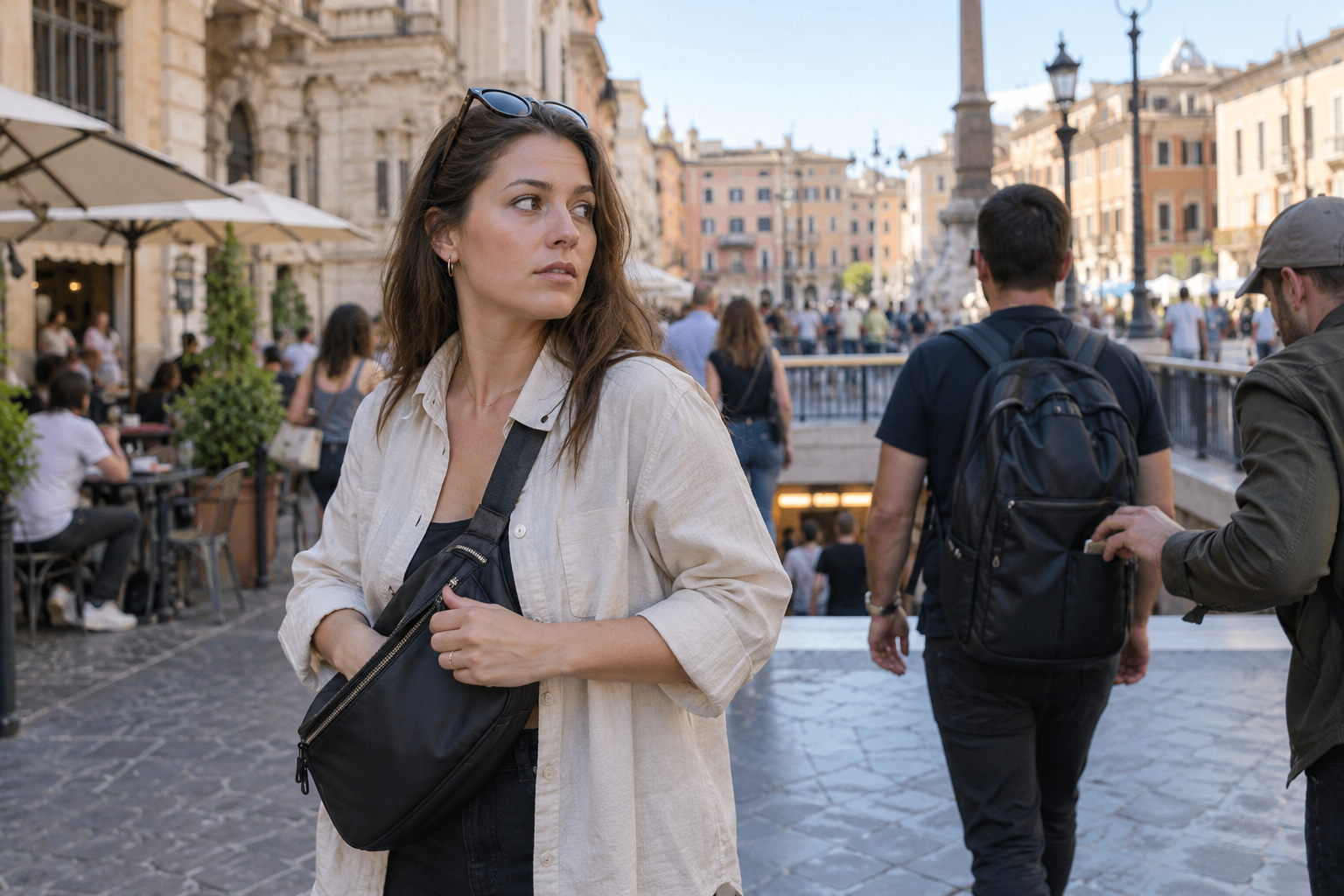
 Italy is generally a safe and welcoming destination, and most travelers experience no serious problems. However, crowded historic centers, railway stations, public transportation and major attractions create opportunities for pickpockets and people who deliberately target distracted visitors.
The most common tourist scams in Italy rarely involve violence. They depend instead on confusion, social pressure, distraction or a visitor’s unfamiliarity with local prices and procedures. Knowing how these situations work can help you avoid losing money without becoming suspicious of every person you meet.
Pickpockets in Crowded Tourist Areas
Pickpocketing is the most common problem visitors should prepare for. Thieves frequently operate where people are distracted or pressed close together, including:
• Railway stations and station platforms
• Metro trains, buses and trams
• Airport transportation
• Crowded squares and shopping streets
• Lines outside museums and monuments
• Outdoor cafés and restaurant terraces
• Escalators and ticket machines
In Rome, visitors should be especially attentive around Termini Station, the Metro and heavily visited areas near the Colosseum, Trevi Fountain and Vatican City. Similar precautions are sensible around Milano Centrale, Venice Santa Lucia, Florence Santa Maria Novella, Naples Centrale and other busy stations.
Pickpockets may work in teams. One person creates a distraction while another opens a bag or removes a phone or wallet. Common distractions include bumping into someone, asking for directions, blocking a train door, dropping objects or creating an argument nearby.
Keep your phone, passport and wallet in separate secure places. A zipped crossbody bag worn in front is safer than an open tote bag or a wallet in a back pocket. On crowded public transportation, keep one hand over the opening of your bag.
Do not hang a purse on the back of a restaurant chair or place a phone at the edge of an outdoor table. A thief may grab it and disappear before you have time to react.
The Fake Petition Scam
A person carrying a clipboard may approach you near an attraction or railway station and ask you to sign a petition for a charitable cause. The petition may claim to support children, people with disabilities or another sympathetic group.
After you sign, the person may demand a donation. In other cases, the clipboard is used to hide someone’s hands while an accomplice reaches into your bag or pocket.
Legitimate charities do not normally surround tourists or pressure them into giving cash on the street. Do not take the clipboard, open your wallet or enter into a prolonged conversation. A firm “No, grazie” followed by walking away is usually sufficient.
Friendship Bracelets, Roses and “Free” Gifts
This approach is common near major attractions in Rome, Milan, Florence and other popular cities. Someone may place a bracelet around your wrist, hand you a rose or offer a small souvenir while insisting that it is free.
Once you accept it, the person demands payment and may become persistent. An accomplice could also use the conversation as an opportunity to search an accessible pocket or bag.
Do not allow anyone to tie or place something on your wrist. Keep your hands close to your belongings and continue walking. If an object is placed in your hand, return it immediately rather than negotiating over the price.
Strangers Offering Help at Ticket Machines
Travelers who appear uncertain at a train or metro ticket machine may attract people offering unsolicited assistance. After “helping,” the person may demand money, keep the change, attempt to see your card PIN or direct you toward an unnecessarily expensive ticket.
Use ticket machines inside official stations and follow the on-screen language options. Purchase railway tickets directly from Trenitalia, Italo, authorized ticket offices or recognized vendors. If you need help, ask a uniformed employee or go to an official information desk.
Some regional paper train tickets must be validated before boarding, while many electronic tickets have different check-in or validation rules. A legitimate fine for traveling with an invalid ticket is not a scam. Read the conditions attached to your particular ticket before beginning your journey. Our Italy travel guides offer more advice for planning transportation and sightseeing.
Unofficial Attraction Tickets and Fake Skip-the-Line Offers
Outside famous attractions, visitors may encounter people claiming that tickets are sold out, the regular entrance is closed or the public line will take several hours. They then offer an expensive “special,” “priority” or “skip-the-line” ticket.
Some resellers provide a genuine service at a considerable markup. Others sell the wrong ticket, misleading tour packages, invalid reservations or tickets that require the original purchaser’s identification. A convincing website or QR code does not automatically mean that a ticket is valid.
Before buying, check the attraction’s official website and compare the admission price, entry time, cancellation rules and exact services included. For highly visited places such as the Colosseum, Vatican Museums and Uffizi Gallery, reserve through an official website or an established authorized tour operator.
Be particularly cautious when a seller insists on cash, refuses to provide a receipt or pressures you to decide immediately.
Taxi Scams and Unlicensed Drivers
At airports and railway stations, unofficial drivers may approach arriving passengers and offer a taxi or private transfer. The vehicle may not have a meter, and the final charge can be far higher than expected.
Official taxis in Italy are normally white, display the word “TAXI” on the roof and have identifying information and a license number on the vehicle. Use a designated taxi rank, an official local taxi service or a transfer booked through a reputable company.
Before starting the trip:
• Confirm whether the fare is metered or fixed
• Ask whether luggage, nighttime or holiday supplements apply
• Check that the meter begins at the correct rate
• Keep the destination available on your phone
• Request a receipt at the end of the ride
Rome publishes official taxi rates, including fixed airport fares for specified destinations. Because prices and boundaries can change, check the current municipal tariff instead of relying on a driver, social-media post or outdated travel guide.
A price disagreement does not necessarily mean that you have been scammed; official supplements may apply. The important point is that the rate should be explained and consistent with the displayed tariff.
ATM Conversion and Unnecessary Exchange Costs
An ATM or payment terminal may ask whether you want to complete the transaction in euros or U.S. dollars. The dollar option is known as dynamic currency conversion. It lets the ATM operator or merchant perform the conversion using the rate displayed on the screen, which may include a substantial markup.
For most American travelers, choosing euros and allowing their own bank or card issuer to convert the transaction produces a better result. Look for wording such as “decline conversion,” “continue without conversion” or “charge in EUR.”
Declining conversion does not cancel the withdrawal or purchase. It simply means that the transaction remains in euros.
Whenever possible, use an ATM attached to a recognized bank during opening hours. Inspect the card slot, shield the keypad while entering your PIN and avoid accepting assistance from strangers. Review any access fee before completing the withdrawal and check your account afterward.
Restaurant Bills and Undisclosed Prices
Most Italian restaurants treat visitors honestly, but misunderstandings are more likely in heavily touristed areas. A verbal special may be considerably more expensive than expected, particularly when fish is priced by weight. A restaurant may also add a cover charge called coperto, but it should be shown on the menu.
Before ordering, ask for the price of anything not listed clearly. When fish, steak or another item is priced by weight, ask approximately how much the portion will cost. Review the bill before paying and request a receipt.
Remember that a coperto is not the same as a tip. Tipping in Italy is optional and generally more modest than in the United States.
Distraction Scams and Manufactured Confusion
Someone may tell you that you have dropped something, point to a stain on your clothing or claim that there is a problem with your car. While you inspect the supposed problem, another person may take a bag or valuables.
Remain especially alert if several strangers suddenly crowd around you. Move to a safer location before checking your clothing or luggage, and never leave a bag on the ground while responding to a distraction.
If someone claims to be a police officer but refuses to show proper identification, do not hand over your wallet or card. Ask to continue the conversation at a police station or call 112 if you feel threatened.
Vacation-Rental and Payment Scams
Fake accommodation listings can appear on social media, classified sites and even copied versions of legitimate booking pages. Warning signs include an unusually low price, pressure to communicate outside the booking platform and requests for payment by wire transfer, cryptocurrency, gift card or payment to an unrelated individual.
Keep messages and payments within the original booking platform whenever possible. Confirm the exact address, cancellation policy, host identity and recent guest reviews. Never send a passport scan to an unverified contact.
Italian accommodations are required to register guests, so a legitimate hotel or host may ask to see identification. The request itself is normal, but you should make sure you are communicating with the actual property or booking platform.
What to Do If You Are Robbed or Scammed
If a card or phone has been stolen, act immediately:
- Lock or cancel your cards through your banking app or issuer.
- Use your phone’s location and remote-lock features.
- Change passwords if the device contained accessible financial or email accounts.
- Report the theft to the Polizia di Stato or Carabinieri and obtain a copy of the report for insurance purposes.
- Contact your embassy or consulate if your passport was stolen.
- Save receipts, screenshots, messages and other evidence.
- Contact your travel insurer as soon as possible.
For an immediate emergency in Italy, call 112. This is the European emergency number and can connect callers with the appropriate assistance.
A Simple Anti-Scam Checklist
Before leaving your hotel each day:
• Carry only the cash and cards you expect to need
• Leave unnecessary documents and spare cards securely stored
• Keep digital copies of important travel documents
• Use a zipped bag rather than an open pocket
• Purchase tickets from official or clearly authorized sellers
• Agree on taxi pricing before departure
• Choose euros at ATMs and payment terminals
• Avoid showing large amounts of cash in public
• Walk away from anyone using pressure, urgency or an unsolicited gift
Awareness is more useful than fear. Italy welcomes millions of international visitors, and the overwhelming majority enjoy their trips without serious incidents. A few sensible habits will allow you to concentrate on the country’s cities, landscapes, food and culture instead of worrying about your belongings.
External Sources
U.S. Department of State – Italy Travel Information
Government of Canada – Travel Advice for Italy
Roma Capitale – Official Taxi Tariff
Italy’s Official Tourism Website – Emergency Numbers and Assistance
Official Colosseum Archaeological Park
Visa – Understanding Dynamic Currency Conversion