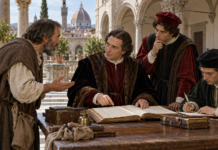
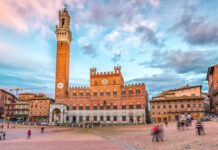
 Renaissance Italy was a world of wealthy merchants, competing rulers, crowded workshops and ambitious scholars. Behind its celebrated paintings and palaces stood a society negotiating difficult questions: Who should govern? What made a good citizen? How should wealth be used? And what could ancient history teach people about their own uncertain times?
Between the fourteenth and sixteenth centuries, the Italian peninsula became a major center of cultural and intellectual change. Yet Italy was not a unified country, and the Renaissance did not transform everyone’s life in the same way. Political rivalry, religious devotion, social inequality and warfare accompanied its extraordinary achievements.
To understand this period, we need to look beyond individual masterpieces and consider the people, institutions and conflicts that made them possible.
When Was Renaissance Italy?
There is no single year in which medieval Italy became Renaissance Italy. Historians generally trace the movement’s intellectual beginnings to the fourteenth century, its expansion through the fifteenth, and its continuing development during the sixteenth.
Two Italian terms help identify these centuries: Quattrocento refers to the 1400s, while Cinquecento refers to the 1500s.
The word Renaissance means “rebirth,” especially the renewed study and adaptation of ancient Greek and Roman culture. However, medieval scholars had already preserved and studied classical learning. Renaissance thinkers built on that inheritance while developing different approaches to language, history, education and artistic representation.
The transition was gradual and uneven. Republican institutions, merchant networks and workshops described in Medieval Italy and the Rise of the City-States continued to shape the peninsula.
Likewise, the devastation explored in The Black Death in Italy remained part of its social memory. Plague returned repeatedly. Cultural innovation developed within a world still vulnerable to disease, food shortages and sudden loss.
Why Italy Became a Center of Renaissance Change
Several circumstances helped Renaissance culture develop across the peninsula.
First, many Italian cities possessed substantial commercial wealth. Banking, textile production, shipping and other businesses supported families and institutions capable of financing ambitious projects.
Second, the ancient world was physically present. Roman buildings, inscriptions and sculptures offered material that scholars and artists could examine directly.
Third, Italy’s political divisions created competition. A palace, library or public monument could advertise the prestige of a family, a ruler or an entire city.
Finally, Italian communities participated in international networks. Merchants, diplomats, scholars and craftspeople carried objects and ideas across borders. Exchanges with the Byzantine world helped sustain and expand Greek studies, both before and after Constantinople fell to the Ottomans in 1453.
These conditions did not make innovation inevitable. They created opportunities that particular people and institutions used in different ways.
A Peninsula of Competing States
Renaissance Italy had no national government. Its political geography included republics, duchies, kingdoms and territories governed by the papacy.
By the middle of the fifteenth century, five major powers dominated much of the peninsula’s diplomacy.
| State | Political character | Principal sources of influence |
|---|---|---|
| Florence | A republic increasingly dominated by the Medici, with interruptions | Banking, textiles and regional power |
| Venice | A republic governed by a hereditary patrician elite | Maritime commerce, naval strength and mainland territories |
| Milan | A duchy ruled first by the Visconti and then the Sforza | Agriculture, manufacturing and military resources |
| Papal States | Territories under papal sovereignty, with uneven local control | Land, taxation and the international authority of the Church |
| Kingdom of Naples | A southern monarchy contested by rival dynasties | Extensive territory, agricultural resources and strategic importance |
Other states mattered greatly. Ferrara, Mantua and Urbino supported influential courts, while Genoa remained a major maritime and financial center.
The word “republic” should not suggest modern democracy. Political participation depended on factors such as gender, family background, citizenship and guild membership. Large sections of the population had little direct influence over government.
Cities also ruled surrounding countryside and smaller towns. Their independence could coexist with the subordination of neighboring communities.
Florence and the Rise of the Medici
Florence illustrates how financial influence could become political authority.
The Medici accumulated wealth through banking and built networks of clients, supporters and allies. After returning from exile in 1434, Cosimo de’ Medici became the dominant figure in Florentine politics without abolishing the republic’s institutions.
His influence rested on relationships and the management of political appointments. Florence retained republican forms, but access to power became closely connected to the family.
Cosimo’s grandson Lorenzo de’ Medici later combined political leadership with cultural patronage. Nevertheless, the family never enjoyed universal support. Opposition, conspiracy and exile remained recurring features of its history.
Medici influence also changed over time. Their informal dominance during the fifteenth century differed from the hereditary ducal government established in the sixteenth. Treating the entire period as a single uninterrupted “Medici reign” obscures those changes.
Patronage: Why People Paid for Art
A Renaissance commission could serve several purposes at once.
A merchant might finance a chapel out of religious devotion while also securing a prestigious family burial place. A ruler might employ an architect to improve a residence and impress visiting ambassadors. A guild might commission sculpture to demonstrate its importance within the city.
Patronage supported artists, but it also gave patrons considerable influence. Contracts could specify materials, dimensions, subjects, payments and deadlines.
Moreover, great works emerged from workshops. Assistants prepared surfaces, mixed pigments and helped carry out commissions. Carvers, metalworkers, builders and suppliers contributed specialized knowledge.
Thinking about these relationships changes how we see Renaissance art. A painting becomes evidence of labor, money, belief and social ambition as well as an expression of individual talent.
For a closer look at the artists and their work, see The Italian Renaissance: Artists, Ideas, Cities and Masterpieces That Changed the World.
Humanism and a Different Approach to Education
Humanism was one of Renaissance Italy’s most influential intellectual movements.
Its educational program emphasized grammar, rhetoric, poetry, history and moral philosophy. Humanists studied ancient texts to improve writing, develop judgment and consider questions about conduct and public life.
This was not simply a rejection of religion. Many humanists were committed Christians, and some worked for church institutions. Classical learning and Christian belief could reinforce one another, although tensions also arose.
Nor was humanism the equivalent of modern experimental science. Its starting point was largely textual: reading carefully, comparing manuscripts and understanding language in its historical setting.
Petrarch helped establish influential models of classical scholarship and literary self-examination. Boccaccio combined literary invention with learned interests. Their work forms part of the transition explored in Italian Literature in the Early Renaissance.
Education also had practical uses. Skilled writers could serve as secretaries, teachers, diplomats and government officials. The ability to construct a persuasive argument mattered in a competitive political world.
Beyond Florence: Many Renaissance Italies
Florence’s prominence can make the Renaissance appear more geographically concentrated than it was.
Venice developed within a maritime empire connected to the eastern Mediterranean and northern Europe. Its political institutions and trading relationships gave its cultural life a distinctive setting.
Milan supported a powerful court under the Sforza. Artists and engineers worked in an environment where military planning, ceremonial display and urban development could overlap.
Rome attracted scholars, builders and artists through papal patronage. The city’s ancient remains supplied models, while the Church offered commissions on an exceptional scale.
Naples was a major royal capital. Its court participated in humanist scholarship and artistic exchange, connecting southern Italy with wider Mediterranean and European networks.
Smaller courts also exercised influence beyond their size. In Mantua, Ferrara and Urbino, rulers used collections, buildings and learned households to establish cultural standing.
These centers exchanged people and ideas, but they did not produce an identical Renaissance. Different political systems and local traditions shaped what patrons wanted and what artists created.
Trade, Work and Everyday Life
Most inhabitants of Renaissance Italy were not artists, bankers or scholars. Many lived in the countryside and depended on agriculture.
Urban prosperity relied on rural production. Grain, wine, oil, livestock and other goods supplied cities, while rents and landownership supported many wealthy households.
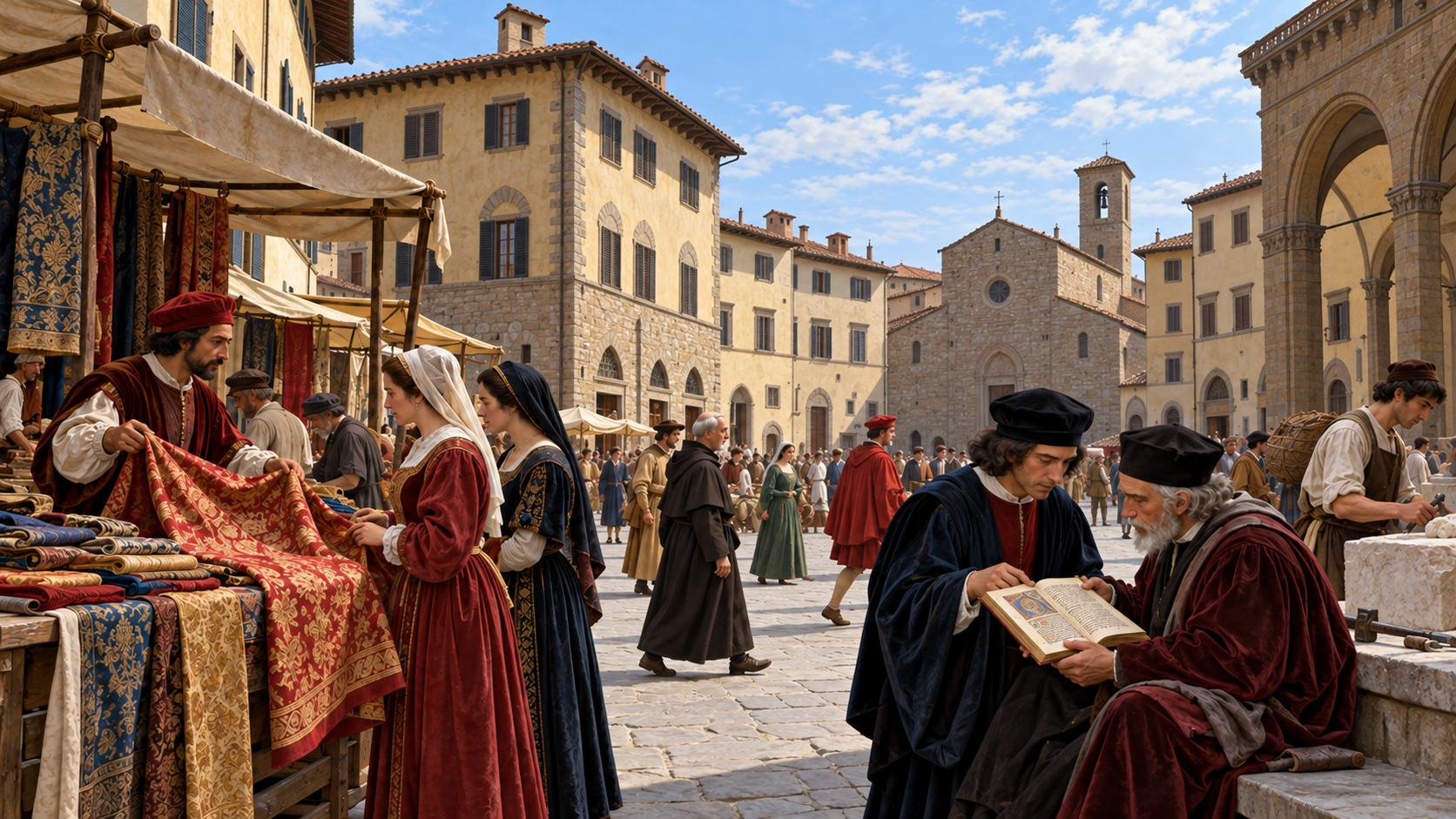
Inside towns, workshops employed people in textiles, construction, metalworking, food preparation and numerous other trades. Apprentices learned through practical work, often within households where business and domestic life overlapped.
Economic security varied enormously. A successful merchant could commission a family chapel, while a wage worker struggled with changing food prices or irregular employment.
Family connections helped people obtain work, arrange marriages and manage risk. For prosperous households, marriage could also transfer property and strengthen alliances. Objects associated with weddings and childbirth—including decorated chests, ceramics and portraits—show how artistic production entered domestic life.
The Renaissance’s visible splendor therefore represents only part of its society. Surviving palaces tell us much about wealth, but less about the people whose labor sustained it.
Women, Learning and Cultural Influence
Women faced substantial restrictions on formal education, professional opportunities and political participation. Their experiences also differed according to wealth, location, marital status and family circumstances.
Some gained influence through patronage, writing, religious communities or the management of estates and businesses.
Isabella d’Este, Marchioness of Mantua, became an important collector and patron. Her pursuit of works of art shows that women could actively shape court culture rather than merely appear in its portraits. Her opportunities, however, depended on an exceptional social position.
Women also contributed through paid and unpaid labor, household administration and the transmission of practical knowledge. These activities often left fewer records than the achievements of elite patrons.
A balanced history must recognize both women’s agency and the barriers that limited it. Celebrating a handful of prominent individuals should not imply equal access to Renaissance learning or power.
Religion Remained Central
Church bells, feast days, processions and religious obligations structured everyday life.
Churches and religious communities were employers, property holders, centers of charity and major patrons. Many works now displayed in museums originally belonged to spaces of worship.
Religious criticism was also part of Renaissance society. The Dominican preacher Girolamo Savonarola gained influence in Florence during the political upheaval that followed the Medici expulsion in 1494. His calls for moral reform reveal how strongly religious expectations could shape civic politics.
The period’s fascination with antiquity did not remove fears about sin, salvation or divine judgment. A person could admire classical literature, support innovative art and participate deeply in Christian devotion.
Printing and the Movement of Ideas
The spread of printing with movable type changed how texts circulated during the second half of the fifteenth century.
Printed editions could reproduce works in larger numbers than manuscript copying alone. However, books still required money, distribution networks and readers with the necessary education. Manuscripts continued to circulate alongside print.
Venice became a particularly important publishing center. Its printers produced religious texts, classical works, practical books and literature. Illustrated editions also brought images into new relationships with written material.
Publishing encouraged debate over language and readership. Latin remained important for scholarship, while writers and printers also developed markets for works in the vernacular.
These questions continued into the sixteenth century, as explored in Italian Literature of the Renaissance: Bembo, Machiavelli, Ariosto and Tasso.
Diplomacy, Warfare and the Balance of Power
Italian states competed through negotiation as well as force. Rulers needed information about their neighbors, reliable envoys and alliances that could prevent one rival from becoming dominant.
The Peace of Lodi in 1454 ended conflict between Milan and Venice and helped establish a broader political balance. Yet the following decades were not free from warfare. The settlement created a framework for managing rivalry rather than a permanent peace.
Military commanders known as condottieri served states under contract. Their careers could connect warfare with political advancement, while armies placed heavy demands on public finances and civilian communities.
In 1494, Charles VIII of France invaded Italy to pursue his claim to Naples. His intervention helped open the prolonged conflicts known as the Italian Wars.
Italian rulers continued to make strategic choices, but the involvement of larger monarchies transformed the scale of competition. Local rivalries became entangled with the struggle between France and the Habsburg powers.
Did the Renaissance End in 1527?
The Sack of Rome in 1527, when imperial troops devastated the city, is often used as a symbolic endpoint for the High Renaissance.
It was a profound catastrophe, but cultural activity did not stop. Artists continued working, patrons commissioned buildings and books circulated throughout the sixteenth century.
Political history followed another timetable. The Italian Wars continued until the settlements of 1559, which confirmed Spanish predominance over substantial parts of Italy without creating a unified peninsula.
These different dates remind us that an artistic period, a political system and a society do not necessarily change together. The Renaissance had several transitions rather than one definitive ending.
Renaissance Italy: A Short Timeline
| Date or period | Development |
|---|---|
| Fourteenth century | Petrarch, Boccaccio and other writers help develop new approaches to classical learning and literature |
| Early fifteenth century | Florence becomes a major center of artistic and architectural experimentation |
| 1434 | Cosimo de’ Medici returns from exile and consolidates his political influence |
| 1454 | The Peace of Lodi helps establish a new balance among major Italian states |
| Second half of the fifteenth century | Printing expands in Italy |
| 1494 | Charles VIII invades Italy; the Medici are expelled from Florence |
| 1527 | Imperial troops sack Rome |
| 1532 | Florence becomes a hereditary duchy under Alessandro de’ Medici |
| 1559 | Peace settlements end the main sequence of the Italian Wars |
Why Renaissance Italy Still Matters
Renaissance Italy changed the ways people studied the past, represented the human body, discussed government and communicated ideas.
Its legacy also raises questions that remain familiar. How does wealth influence culture? Can public institutions survive the dominance of powerful families? Who gains access to education? How do states defend their independence while competing with their neighbors?
The period offers no simple story of uninterrupted progress. Intellectual ambition coexisted with exclusion, and artistic achievement flourished amid political instability.
Understanding those tensions makes the Renaissance more compelling. Its achievements emerged from real communities whose creativity, disagreements and vulnerabilities helped shape the world that followed.
Explore the wider sequence in Italia Mia’s History series.
External Sources
- The Metropolitan Museum of Art: Florence and Central Italy, 1400–1600
- Smarthistory: Humanism in Renaissance Italy
- The Metropolitan Museum of Art: Art and Love in Renaissance Italy
- The National Gallery: Isabella d’Este, Marchioness of Mantua
- The Metropolitan Museum of Art: Woodcut Book Illustration in Renaissance Italy
- Treccani: Venice and Italian Politics, 1454–1530 — Italian