
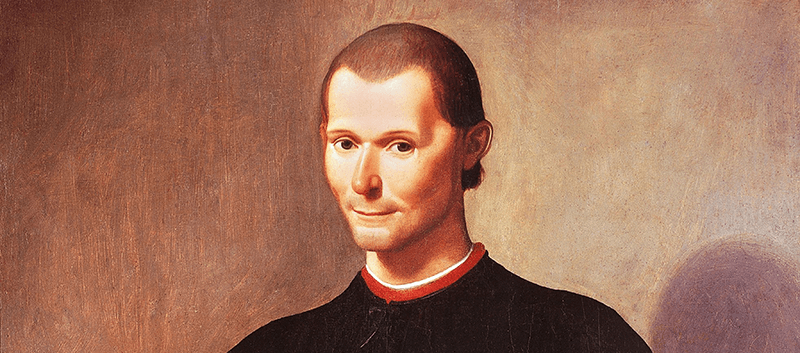
The Italian Renaissance did not replace medieval literature overnight. Dante, Petrarch and Boccaccio had already shown what writing in the vernacular could achieve, while humanist scholars renewed the study of Greek and Latin. During the sixteenth century, writers brought those traditions together in works about language, political power, courtly life, love and war.
This guide continues Italia Mia’s account of Italian literature in the early Renaissance. Four writers reveal the period’s range: Pietro Bembo argued over what literary Italian should sound like; Niccolò Machiavelli examined how states gain and keep power; Ludovico Ariosto turned chivalric romance into a playful, intricate epic; and Torquato Tasso gave the epic a more troubled religious and emotional intensity.
Pietro Bembo and the Making of Literary Italian
Italy had no single spoken language in Bembo’s lifetime. Authors wrote in Latin and in regional forms of Italian, while printers needed texts that readers across the peninsula could recognize. In Prose della volgar lingua (1525), Bembo made a powerful case for using fourteenth-century Tuscan literature as a model: Petrarch’s poetry for verse and Boccaccio’s Decameron for prose.
Bembo did not invent Italian or make everyone speak alike. His influence was chiefly on written literary language, and other writers argued for different models. His position nevertheless helped establish conventions that authors and editors could follow. It also gave Petrarch’s style renewed authority among sixteenth-century poets. For the earlier development of the vernacular, see Italia Mia’s guide to the origins of Italian literature. Treccani
Bembo’s influence becomes especially clear in Ariosto. When revising Orlando Furioso for its 1532 edition, Ariosto adjusted its language toward the literary Tuscan associated with Bembo’s proposals. Treccani
Niccolò Machiavelli: Politics, History and Comedy
Machiavelli’s writing grew out of political experience. He had served the Florentine Republic as an official and diplomat; after the Medici returned to power, he lost his post. In the years that followed, he considered the successes and failures of rulers, armies and republics through both recent events and ancient Roman history.
The Prince, written chiefly around 1513 and first printed after his death in 1532, asks how a ruler can acquire, secure and defend a state. Its attention to force, calculation and the gap between public appearance and political action made it controversial. It should not, however, be treated as a section of his Discourses on Livy: the two are distinct works. The Discourses give sustained attention to republics, institutions and civic life. Reading them together reveals a thinker whose questions extended beyond the conduct of a single prince. Enciclopedia
Machiavelli also wrote history and drama. His comedy Mandragola uses deception and desire to expose the weaknesses people exploit in one another. For his life, political career and major books, read Italia Mia’s newer Niccolò Machiavelli biography.
Ludovico Ariosto and the World of Orlando Furioso
Ariosto’s Orlando Furioso continues the chivalric story begun in Matteo Maria Boiardo’s Orlando Innamorato. Its knights pursue enemies, lovers, honor and impossible hopes across an ever-changing landscape. Orlando’s love for Angelica leads him into madness, but his story is only one thread among many.
First published in 1516, the poem appeared in revised editions in 1521 and 1532. Ariosto expanded it from 40 to 46 cantos and continued refining its language. Its shifting plots, humor and changes of tone allow a scene of combat to give way to romance, absurdity or reflection. The narrator can admire heroic ambition while gently questioning it. Treccani
Orlando Furioso shows how Renaissance literature could transform inherited material. Ariosto drew on medieval chivalric tales, classical writing and contemporary court culture, yet made their combination distinctly his own.
Courtly Life and Other Renaissance Voices
The four central writers did not work in isolation. Baldassare Castiglione’s The Book of the Courtier (1528) explores conversation, education, conduct and the role of women and men at court. Giovanni Della Casa’s Galateo, published in 1558, examines manners in everyday social life. Their books offer another view of a society intensely interested in how people presented themselves to others. Treccani
Renaissance writing was broader still. Pietro Aretino’s satire and letters could be provocative and confrontational; Giorgio Vasari’s Lives shaped how later generations understood Renaissance artists. Women also took part in literary debates, as Italia Mia’s guide to Italian women writers shows. A history confined to a few celebrated men gives only part of the picture.
Torquato Tasso and Jerusalem Delivered
By Tasso’s lifetime, the literary world had changed. Debates over the proper form of an epic took place alongside religious tensions and the Catholic reforms associated with the Council of Trent, held between 1545 and 1563. These pressures shaped the setting in which he wrote, but they did not bring Renaissance creativity to a sudden end. Treccani
Tasso completed the poem now known as Gerusalemme liberata (Jerusalem Delivered) in 1575. It was published in 1581 without his authorization under that title. Set during the First Crusade, it centers on the Christian campaign to take Jerusalem while following characters whose duties conflict with love, fear and desire. Its episodes of enchantment and romance sit within a more unified and serious design than Ariosto’s wandering narrative. Enciclopedia
Tasso remained troubled by questions about the poem’s form and religious propriety. He later reworked it as Gerusalemme conquistata (Jerusalem Conquered), published in 1593. His revisions show an author wrestling with artistic ambition and criticism, rather than a simple story in which one cultural era ended and another began. Enciclopedia
Where to Begin Reading
These books offer different entrances to Renaissance literature. Choose an edition or translation with an introduction and notes, particularly for the long poems. The Amazon links lead to search results so you can compare available editions before buying.
• Bembo, Prose della volgar lingua on Amazon.com — for the debate over literary Italian.
• Machiavelli, The Prince on Amazon.com and Discourses on Livy on Amazon.com — two different approaches to political power.
• Ariosto, Orlando Furioso on Amazon.com — for adventure, irony and an expansive cast of characters.
• Tasso, Jerusalem Delivered on Amazon.com — for an epic shaped by conflicting loyalties and emotions.
Italia Mia may earn a commission from qualifying Amazon purchases.
Bembo’s literary rules, Machiavelli’s political questions, Ariosto’s imaginative freedom and Tasso’s searching revisions belong to the same century. Together they show a Renaissance literature engaged in argument with its own models, institutions and beliefs.
External Sources
• Treccani: Pietro Bembo and literary Italian
• Treccani: Machiavelli and The Prince
• Treccani: Orlando Furioso
• Treccani: Gerusalemme liberata
• Treccani: The Counter Reformation