

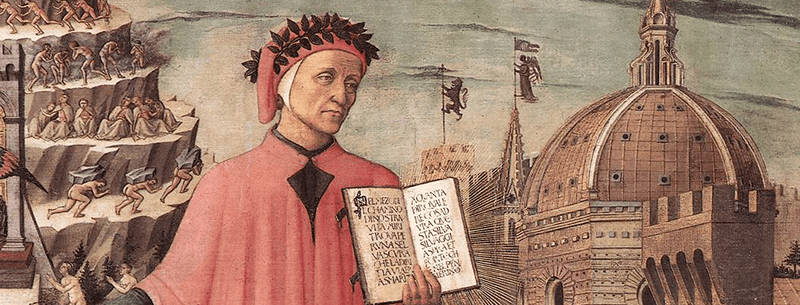
Italian literature did not begin at a single moment or in a single city. It emerged gradually from a multilingual medieval world in which Latin coexisted with numerous regional vernaculars, while writers also absorbed influences from French, Occitan, Arabic, Byzantine and classical traditions.
Long before Italy became a unified country, its courts, monasteries, universities and city-states produced an extraordinary variety of religious texts, love poetry, chronicles, moral tales and political works. From these different traditions came a literary language capable of expressing everything from mystical devotion to romantic desire, civic conflict and philosophical speculation.
The decisive transformation occurred between the 13th and 14th centuries. The Sicilian School established a sophisticated tradition of vernacular lyric poetry. Tuscan poets developed new ideas about love and personal identity. Saint Francis demonstrated the spiritual power of ordinary language, while Dante Alighieri showed that the vernacular could sustain one of the most ambitious poems ever written.
Together with Petrarch and Giovanni Boccaccio, Dante helped give Tuscan—and especially Florentine—a literary prestige that would profoundly influence the development of standard Italian.
Before Italian: Latin and the Medieval Vernaculars
For centuries after the fall of the Western Roman Empire, Latin remained the principal written language of the Italian peninsula. It was used by the Church, government officials, scholars, chroniclers and educated authors. Theology, philosophy, law, medicine and history were normally written in Latin because it connected intellectual communities across Europe.
The spoken language, however, was changing. Everyday Latin gradually developed into numerous Romance vernaculars. These forms of speech differed from region to region and would eventually contribute to the languages and dialects spoken throughout Italy.
It is important not to imagine “Italian” already existing as a unified national language. Medieval Sicily, Tuscany, Lombardy, Veneto, Umbria and other areas possessed distinct linguistic traditions. Writers could choose among Latin, a local vernacular and, in some courts, prestigious foreign literary languages such as Occitan or French.
This coexistence of languages was not an obstacle to Italian literature. It was one of the conditions that made its later richness possible.
The First Written Evidence of the Italian Vernacular
Several early documents reveal the gradual movement from Latin toward recognizable Italian vernaculars.
The Indovinello veronese, or Veronese Riddle, was written around the late eighth or early ninth century. Scholars continue to debate whether its language should be classified as very late Latin or an early Romance vernacular. Its linguistic uncertainty makes it especially valuable: it captures a language in transition.
Another early example is the inscription found in the Catacomb of Commodilla in Rome, probably dating from the ninth century. It contains an instruction concerning the correct recitation of prayers and shows features of spoken language entering written communication.
The documents traditionally identified as the first securely recognizable written examples of an Italian vernacular are the Placiti Cassinesi, also called the Placiti Capuani. Produced between 960 and 963, these legal records concern disputes over lands claimed by the Abbey of Montecassino.
Most of the documents were written in Latin, but witness statements were recorded in the local Campanian vernacular. Their importance lies not in literary beauty but in the deliberate decision to preserve spoken testimony in a language different from formal Latin.
These early texts did not immediately create an Italian literary tradition. They demonstrate, however, that vernacular speech had begun to acquire a written identity.
Readers interested in the broader evolution from Latin to modern Italian can continue with ItaliaMia’s overview of the Italian language.
Religious Poetry and Saint Francis of Assisi
One of the earliest masterpieces written in an Italian vernacular is the Canticle of the Creatures, also known as the Canticle of Brother Sun. It was composed by Saint Francis of Assisi during the final years of his life, traditionally beginning around 1224.
Written in an Umbrian vernacular enriched by biblical and liturgical language, the poem praises God through the elements of creation: the sun, moon, stars, wind, water, fire and earth. It eventually incorporates forgiveness, suffering and death into its vision of universal spiritual kinship.
The poem is important for more than its early date. Francis used language associated with ordinary speech to communicate a religious experience of remarkable poetic intensity. The work’s repetitions and rhythms also suggest that it was intended for oral or musical performance.
Franciscan poetry developed further in the writings of Jacopone da Todi, whose passionate laude explored sin, repentance, divine love and mystical longing. His language could be dramatic, confrontational and emotionally extreme, offering a striking contrast with the refined poetry of aristocratic courts.
The Latin hymn Stabat Mater has traditionally been attributed to Jacopone, although its authorship remains uncertain.
French and Occitan Influences
Medieval Italian writers participated in a European literary culture that extended far beyond the peninsula. The troubadours of southern France created an influential tradition of Occitan lyric poetry centered on courtly love, desire, loyalty and the social rituals of aristocratic life.
Some poets born in Italy wrote directly in Occitan. Sordello da Goito, later encountered by Dante in Purgatorio, became one of the best-known Italian-born troubadours.
French was also used for prose and chivalric narratives. Stories about Charlemagne, Roland, King Arthur and the Knights of the Round Table circulated through manuscripts, performances and oral storytelling. In northern Italy, these traditions contributed to hybrid Franco-Italian or Franco-Venetian texts.
The stories would eventually be reworked by Italian writers, storytellers and performers. Centuries later, the same chivalric world would inspire major Renaissance poems including Matteo Maria Boiardo’s Orlando Innamorato, Ludovico Ariosto’s Orlando Furioso and Torquato Tasso’s Jerusalem Delivered.
Frederick II and the Sicilian School
The first organized tradition of literary poetry in an Italian vernacular emerged during the 13th century at the court of Frederick II, Holy Roman Emperor and king of Sicily.
Frederick’s court was one of medieval Europe’s most culturally diverse environments. Its intellectual life drew upon Latin, Greek, Arabic, Jewish, Norman and southern Italian traditions. The poets associated with the court were often educated officials, judges, notaries or administrators rather than professional entertainers.
Collectively, they became known as the Sicilian School.
These poets adapted the themes and forms of Occitan troubadour poetry but wrote in an elevated Sicilian vernacular. Their primary subject was love, examined through desire, absence, praise, emotional conflict and the idealization of the beloved.
Because the poets were connected through a court and administrative network, the Sicilian School represented something more coherent than a collection of isolated regional voices. It demonstrated that a vernacular associated with the Italian peninsula could support sophisticated, formal literature.
Giacomo da Lentini and the Sonnet
The most important poet of the Sicilian School was Giacomo da Lentini, a notary at Frederick II’s court. Dante later referred to him simply as “the Notary,” evidence of his enduring reputation.
Giacomo is traditionally credited with inventing the sonnet. Its compact structure of fourteen lines provided poets with a flexible framework for developing an argument, describing an emotion or exploring a contradiction.
The sonnet became one of the most influential poetic forms in European literature. It was refined by Petrarch and subsequently adapted by poets writing in English, French, Spanish and many other languages.
Other writers associated with the Sicilian School included Pier delle Vigne, Guido delle Colonne, Rinaldo d’Aquino, Stefano Protonotaro and Giacomino Pugliese.
Much of their poetry survives in manuscripts copied by Tuscan scribes. Because the scribes adapted the language to Tuscan conventions, the original Sicilian character of many poems was partly obscured. Stefano Protonotaro’s Pir meu cori alligrari is particularly valuable because it survives in a linguistic form much closer to the original Sicilian.
From Sicily to Tuscany
The Sicilian School declined as the Hohenstaufen, or Swabian, dynasty lost political control of southern Italy during the second half of the 13th century. Its poetic legacy, however, migrated northward.
Tuscan writers adopted Sicilian subjects and verse forms but modified them according to their own language, political environment and intellectual concerns.
Guittone d’Arezzo became one of the most prominent poets of this transitional period. His work included love lyrics, religious compositions and poetry addressing civic and political events. His language could be deliberately complex, filled with elaborate rhetorical patterns and difficult constructions.
Guittone influenced many contemporaries, but the younger poets associated with the dolce stil novo eventually rejected aspects of his style. Dante himself treated Guittone as a representative of an older literary manner that the new generation intended to surpass.
Bologna and the Dolce Stil Novo
The next major development began with Guido Guinizelli of Bologna. Dante regarded him as an important poetic predecessor, describing him in Purgatorio as a father of the new tradition.
Guinizelli transformed the conventions of courtly love. In his poetry, love was connected with the cor gentile—the noble or virtuous heart. Nobility was no longer simply a matter of ancestry or social rank. It became an inward moral and spiritual quality.
The woman celebrated by the poet could assume an almost angelic character. Her presence awakened virtue, purified desire and directed the mind toward a higher form of understanding.
These ideas helped establish the movement later known as the dolce stil novo, or Sweet New Style. The expression itself comes from Dante’s Purgatorio, although modern literary history uses it to identify a group of poets active between Bologna and Tuscany in the late 13th and early 14th centuries.
The Stilnovo poets shared an interest in love, interior experience, philosophical inquiry and refined language. Yet they did not all interpret love in the same way.
For Guido Cavalcanti, love could be frightening and destructive. It overwhelmed the body, divided the personality and threatened the lover’s capacity for reason. His poetry often feels psychologically intense and remarkably modern.
For the young Dante, love became a force capable of moral and spiritual transformation. His early poetry absorbed the language of Guinizelli and Cavalcanti but eventually moved beyond both.
Poetry Beyond Idealized Love
Not all medieval Italian poetry was solemn, spiritual or aristocratic. Comic-realistic poets wrote about money, gambling, food, sex, quarrels and the frustrations of everyday life.
Rustico Filippi produced both refined love poetry and satirical verse. Cecco Angiolieri became famous for poems built around provocation, exaggeration and comic self-presentation. Folgore da San Gimignano wrote sonnet cycles describing the pleasures appropriate to the months of the year and the days of the week.
These writers remind us that medieval Italian literature included parody, humor and social observation alongside theological reflection and idealized love. Their poems also reveal voices, attitudes and material details often absent from formal courtly writing.
The Growth of Italian Prose
Poetry initially occupied the most prestigious position in vernacular literature, but Italian prose also developed rapidly during the 13th century.
Translations and adaptations introduced readers to biblical narratives, saints’ lives, classical history, moral instruction and French romances. Merchants and city officials increasingly used vernacular prose for letters, records and practical communication.
The anonymous Novellino, a collection of short narratives assembled near the end of the 13th century, helped establish the tradition of the Italian novella. Its compact tales feature ancient rulers, biblical figures, knights, merchants and clever speakers. The collection anticipates the more complex narrative world of Boccaccio’s Decameron.
Marco Polo’s account of his travels also belongs to this multilingual culture. While imprisoned in Genoa around 1298, the Venetian traveler reportedly dictated his experiences to Rustichello da Pisa. The earliest form of the work commonly known in Italian as Il Milione was written in a Franco-Italian literary language rather than standard Italian.
The book expanded Europe’s geographical imagination and became one of the most influential travel narratives of the Middle Ages.
Dante Alighieri and the Power of the Vernacular
Dante Alighieri brought together the poetic, philosophical, theological and political traditions of medieval Italy on an unprecedented scale.
Born in Florence in 1265, Dante participated in the city’s cultural and political life before factional conflict led to his exile in 1302. He never returned permanently to Florence, and the experience of exile profoundly shaped his later work.
His Vita Nuova combines prose commentary with lyric poems centered on his relationship with Beatrice. The book draws upon the Stilnovo but also presents poetry as the record of an evolving inner life.
In the Latin treatise De vulgari eloquentia, Dante examined the vernaculars of Italy and searched for an illustrious literary language that could transcend individual cities and courts. His argument was not simply that everyday speech should replace Latin. He sought a refined vernacular capable of carrying the highest literary subjects.
The Convivio used Italian prose to discuss philosophy, ethics, knowledge and human aspiration. Monarchia, written in Latin, examined the relationship between spiritual and secular authority. Dante’s body of work therefore demonstrates that Latin and the vernacular could coexist within the career of the same author.
For a complete account of his life and writings, visit ItaliaMia’s Dante Alighieri guide.
The Divine Comedy
Dante’s greatest work, the Divine Comedy, was written during his exile in the early 14th century. It recounts an imagined journey through Hell, Purgatory and Paradise, guided first by the Roman poet Virgil and later by Beatrice.
The poem contains 100 cantos organized into three canticles: Inferno, Purgatorio and Paradiso. Its interlocking rhyme scheme, known as terza rima, helps propel the narrative forward while connecting successive groups of verses.
The Comedy encompasses theology, philosophy, astronomy, classical mythology, politics, biography and personal memory. Popes, emperors, saints, warriors, poets and people Dante knew personally all occupy its moral universe.
Its characters are not merely illustrations of abstract ideas. They speak with individual voices, defend their choices, remember their earthly lives and sometimes challenge the pilgrim’s judgment. This union of intellectual structure and human drama is central to the poem’s enduring power.
Dante’s use of the vernacular proved that it could sustain a work of extraordinary stylistic range. The poem moves between elevated theological language, political invective, tenderness, grotesque comedy and vivid realism.
Readers can compare the Italian text, translations, recordings and scholarly commentary through the Princeton Dante Project and Dante Lab at Dartmouth College.
Dante, Petrarch and Boccaccio: The Three Crowns
Dante did not single-handedly create modern Italian. However, the immense authority of his work—combined with the achievements of Francesco Petrarch and Giovanni Boccaccio—gave the Tuscan literary tradition exceptional prestige.
The three writers became known as the Tre Corone, or Three Crowns of Italian literature.
Petrarch’s Canzoniere refined the sonnet tradition through poems examining love, time, memory, spiritual conflict and literary fame. His influence spread across Europe, shaping lyric poetry for centuries.
Boccaccio demonstrated the expressive possibilities of Italian prose. In the Decameron, ten young Florentines sheltering from the plague tell 100 stories about love, intelligence, deception, fortune, desire and survival. Its range of characters and social settings made it one of the foundational works of European narrative literature.
Their language was not identical to contemporary standard Italian, and regional traditions continued to flourish. Nevertheless, later writers, scholars and grammarians increasingly treated the Tuscan models represented by Dante, Petrarch and Boccaccio as authoritative.
The story continues in ItaliaMia’s guide to Italian literature during the early Renaissance.
Why Early Italian Literature Still Matters
The origins of Italian literature reveal how a language acquires cultural authority. Italian did not replace Latin through a single decree, nor did one regional dialect immediately triumph over all others. Its literary identity emerged through experimentation, translation, cultural exchange and competition among different cities and courts.
Religious writers demonstrated that vernacular language could express mystical experience. The Sicilian poets created a sophisticated tradition of love poetry. Tuscan writers transformed those forms. Comic poets recorded worldly appetites and frustrations. Prose storytellers described merchants, travelers and urban society.
Dante then showed that the vernacular could contain an entire moral, political and cosmic vision.
This early literature also preserves the diversity of medieval Italy. Sicily, Umbria, Bologna, Florence, Arezzo, Lombardy and Veneto all contributed to a tradition that was never culturally uniform. Italian literature was born not from isolation but from encounters among languages, religions, political systems and literary forms.
Essential Early Italian Books
Readers who want to explore the period can begin with these works:
The Divine Comedy by Dante Alighieri
The central masterpiece of medieval Italian literature, combining an unforgettable journey through the afterlife with theology, politics, poetry and personal history. Find editions of The Divine Comedy on Amazon.com.
Vita Nuova by Dante Alighieri
A mixture of poetry and autobiographical prose exploring Dante’s love for Beatrice and the development of his poetic identity. Find editions of Vita Nuova on Amazon.com.
The Decameron by Giovanni Boccaccio
One hundred stories presenting a broad, entertaining and often critical portrait of medieval society. Find editions of The Decameron on Amazon.com.
Early Italian Poets
A good anthology can introduce readers to the Sicilian School, Guinizelli, Cavalcanti, Jacopone da Todi and the comic-realistic poets. Find anthologies of early Italian poetry on Amazon.com.
ItaliaMia also maintains a broader guide to Italian literature and fiction and a selection of the best Italian books.
Literary Places to Visit in Italy
Florence remains the essential destination for readers interested in Dante and the rise of Tuscan literature. The medieval center preserves streets, churches and public spaces associated with the political and religious world represented in his writings.
The Museo Casa di Dante introduces visitors to Dante’s life, works and medieval Florence. The present building should be understood as a reconstructed museum site rather than an intact, fully documented birthplace.
A medieval and Renaissance Florence walking tour passes through the historic district traditionally associated with Dante and Beatrice.
Other important literary destinations include Ravenna, where Dante died and was buried; Assisi, associated with Saint Francis and the Canticle of the Creatures; Certaldo, traditionally linked with Boccaccio; and Arquà Petrarca in Veneto, where Petrarch spent the final years of his life.
Frequently Asked Questions
When did Italian literature begin?
Its earliest written foundations can be traced to vernacular documents of the early Middle Ages, but a continuous artistic tradition became visible during the 13th century through religious poetry and the Sicilian School.
What are the Placiti Cassinesi?
They are legal documents produced between 960 and 963. Although primarily written in Latin, they contain witness statements recorded in a Campanian vernacular and are traditionally considered among the earliest securely recognizable examples of written Italian.
Why was the Sicilian School important?
It created the first organized tradition of literary poetry in an Italian vernacular. Its poets adapted troubadour themes, developed an elevated poetic language and transmitted forms—including the sonnet—to later Tuscan writers.
Who invented the sonnet?
Giacomo da Lentini of the Sicilian School is traditionally credited with inventing the fourteen-line form. It was later perfected by Petrarch and adopted by poets throughout Europe.
What was the Dolce Stil Novo?
The Dolce Stil Novo was a poetic tendency associated with writers including Guido Guinizelli, Guido Cavalcanti and the young Dante. It explored love through philosophical, psychological and spiritual ideas while favoring a refined poetic language.
Did Dante create the Italian language?
Not by himself. Italian developed over centuries from multiple spoken and written vernaculars. However, Dante’s literary achievement gave the Tuscan vernacular enormous prestige, while Petrarch and Boccaccio reinforced its influence.
Why is The Divine Comedy so important?
It united theology, philosophy, politics, history and personal experience in a vast poetic narrative. Its stylistic power demonstrated that the vernacular could rival Latin as a language of serious literature.
External Sources
The Birth of the Italian Language — Treccani
The Sicilian School — Treccani
The Dolce Stil Novo — Treccani
Saint Francis of Assisi and the Canticle — Treccani
Biblioteca Italiana — Sapienza University of Rome
Museo Casa di Dante — Official Website