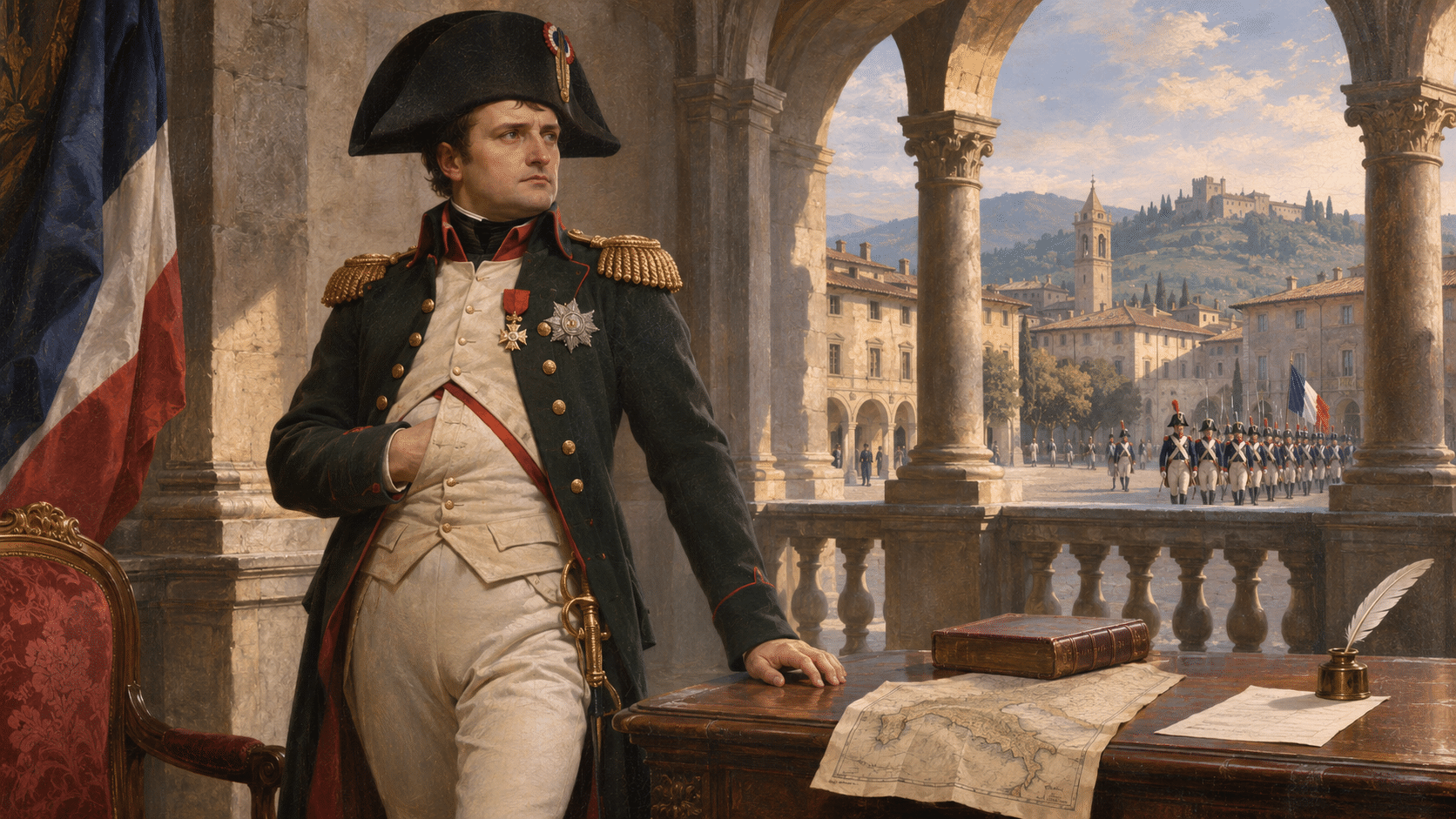
In May 1796, a young French general entered Milan at the head of a victorious army. Nine years later, Napoleon Bonaparte returned to the city to be crowned King of Italy. Between those moments, republics rose and fell, old governments disappeared, and the language of liberty became entangled with the demands of conquest.
Napoleon in Italy was both a military story and a transformation of everyday government. His armies brought requisitions and destruction; the regimes established under French protection reorganized courts, administration and property rights. Italians encountered new opportunities, new obligations and a state increasingly determined to record, tax and recruit them.
Yet Napoleon did not unite Italy into an independent nation. His Italian kingdom covered only part of the peninsula, while other territories were annexed to France or assigned to members of his family. Understanding that distinction helps explain both the achievements of the period and the resentment it left behind.
Napoleon in Italy at a Glance
| Date | Event | Why it mattered |
|---|---|---|
| 1796–1797 | Napoleon’s first Italian campaign | French victories overturned the balance between Austria, Savoy and the Italian states. |
| January 7, 1797 | The Cispadane Republic adopted the green, white and red flag | The tricolor acquired a political identity later central to Italian nationhood. |
| October 17, 1797 | Treaty of Campo Formio | Austria accepted the loss of Lombardy and received Venice and much of its former territory. |
| June 14, 1800 | Battle of Marengo | Napoleon’s victory restored French military predominance in northern Italy. |
| 1802 | Establishment of the Italian Republic | Napoleon became president of a state centered on Milan. |
| 1805 | Creation of the Napoleonic Kingdom of Italy | Napoleon became king, with Eugène de Beauharnais serving as viceroy. |
| 1806 | French conquest of mainland Naples | Joseph Bonaparte’s government began major legal and administrative reforms. |
| 1809 | Annexation of Rome and remaining papal territories | The struggle with papal sovereignty reached a decisive stage. |
| 1814–1815 | Collapse of Napoleonic rule and postwar settlement | Dynasties returned, but the experience of reform could not simply be erased. |
The Peninsula Napoleon Entered
Late eighteenth-century Italy was divided among monarchies, republics and the Papal States. Austria controlled Lombardy; the House of Savoy ruled the Kingdom of Sardinia, including Piedmont; Venice remained an independent republic; and Bourbon rulers governed Naples and Sicily.
This was not a society waiting passively for foreign ideas. As explored in Italy Under Foreign Rule: Spanish and Austrian Power, Italian thinkers and reforming governments had already challenged inherited institutions. Changes in taxation, justice and state administration preceded the French invasion.
The French Revolution nevertheless introduced a more disruptive possibility: political authority might be reconstructed around citizenship and written constitutions rather than inherited dynastic rights. For some Italians, French victories opened a door. For others, they threatened religion, livelihoods and familiar loyalties.
The First Italian Campaign, 1796–1797
Napoleon’s campaign began with rapid attacks that separated the Piedmontese and Austrian forces. The Kingdom of Sardinia withdrew from the struggle, allowing the French to concentrate on Austria’s northern Italian position.
Victories and maneuver carried Napoleon into Milan in May 1796. Further fighting, including the struggle for Mantua, strengthened his position until Austria sought negotiations in 1797.
These successes made the young commander famous. They also demonstrated how an army could remake political geography. Italian rulers faced demands for money and supplies, while local supporters of the Revolution sought to turn military occupation into political renewal.
The two projects did not always coincide. French generals needed resources to sustain their forces. Italian reformers wanted institutions that would serve their own communities. The resulting republics lived within that tension.
Republics, Patriots and the Italian Tricolor
The revolutionary years produced several new states. Among the most significant were the Cispadane Republic and the Cisalpine Republic, the latter established in 1797 with Milan as its capital.
Their names reflected geography: “Cispadane” referred to the area on this side of the Po from a Roman perspective, while “Cisalpine” meant this side of the Alps. Their political vocabulary, however, pointed toward a different future, emphasizing constitutions and citizenship.
On January 7, 1797, representatives of the Cispadane Republic at Reggio Emilia adopted green, white and red as the republic’s colors. The flag’s arrangement differed from today’s Italian flag, but the event became a defining moment in the history of the tricolor.
It would be misleading to imagine all supporters of these republics demanding the same unified Italy. Some favored broader national projects; others concentrated on local or regional reform. Nevertheless, political debate and military service began creating connections across older boundaries.
Venice and the Limits of Liberation
Venice exposed the gap between revolutionary language and great-power bargaining.
The Venetian Republic fell in 1797 under French pressure. In the Treaty of Campo Formio, Napoleon accepted the transfer of Venice and much of its former territory to Austria as part of the settlement ending the campaign.
For Italians who had associated French victory with liberation, this was a painful lesson. The future of an Italian state could still be negotiated without its inhabitants determining the outcome.
Napoleon’s diplomacy followed strategic calculations. A republic’s political traditions or the hopes of its reformers did not outweigh the advantages of an agreement with Austria.
From Marengo to the Kingdom of Italy
French control was not secure after the first campaign. Coalition victories in 1799 dismantled much of the republican order while Napoleon was absent from Italy.
His return culminated in the Battle of Marengo, near Alessandria, on June 14, 1800. The victory restored his position and opened another phase of political reconstruction.
In 1802, the Cisalpine Republic became the Italian Republic, with Napoleon as president and Francesco Melzi d’Eril as vice-president. In 1805, after Napoleon had become Emperor of the French, the republic became a kingdom.
He was crowned King of Italy in Milan Cathedral on May 26, 1805, using the Iron Crown associated with earlier Italian kingship. His stepson, Eugène de Beauharnais, became viceroy.
The ceremony advertised continuity and legitimacy even as the regime claimed to embody a new political age. The revolutionary general now ruled through monarchy, court ceremony and dynastic appointments.
Did Napoleon Rule All of Italy?
Most of the peninsula eventually came under Napoleonic control, but it did not form one state. Borders and arrangements changed repeatedly.
| Territory or political unit | Position within the Napoleonic system |
|---|---|
| Kingdom of Italy | A state centered on Milan, ruled by Napoleon and administered through his viceroy; it expanded beyond its original boundaries. |
| Piedmont, Liguria and Tuscany | Incorporated into France at different stages. |
| Rome and Lazio, with Umbria | Annexed to the French Empire in 1809 after the destruction of papal temporal government there. |
| Kingdom of Naples | Mainland southern kingdom ruled by Joseph Bonaparte from 1806, then Joachim Murat from 1808. |
| Lucca and Piombino | Governed under Napoleon’s sister Elisa and her husband, Felice Baciocchi. |
| Sicily | Remained under the Bourbon monarchy, supported by Britain. |
| Sardinia | Remained a refuge of the Savoy monarchy outside Napoleonic control. |
This patchwork served French imperial interests. The name “Kingdom of Italy” should not be confused with the kingdom proclaimed in 1861, which emerged from the later struggle for unification.
Laws, Courts and a More Powerful State
Napoleonic government sought greater uniformity. Officials worked within clearer administrative hierarchies, courts were reorganized, and legal codes replaced or reduced the influence of overlapping traditions and privileges.
The Civil Code was especially influential. It strengthened principles of civil equality for men and the protection of private property while placing family life under a strongly patriarchal legal framework. Legal modernization therefore did not mean equal rights for everyone.
Nor did clearer laws mean democratic government. Political power remained concentrated at the top. A person could gain more predictable procedures in a property dispute while having little influence over the government enforcing them.
In mainland Naples, the abolition of feudalism in August 1806 attacked the jurisdiction and privileges of baronial power. Administrative reforms also reorganized provinces and districts, bringing state officials into a more systematic relationship with local communities.
These changes did not instantly redistribute wealth or eliminate rural hardship. Abolishing a lord’s legal powers was different from giving land to those who worked it. Established owners and well-positioned buyers could benefit more readily than poor households.
Births, Marriages and the Administrative Record
One particularly tangible legacy survives in archives.
French and Napoleonic governments introduced or expanded civil registration in many Italian territories. Births, marriages and deaths became matters for state recordkeeping as well as religious institutions.
Implementation varied by place, and the end of French rule did not produce the same outcome everywhere. Some systems continued; others were interrupted or reorganized. There is no single Napoleonic starting date that applies to every Italian town.
For family historians, this explains why a series of records may begin in the early nineteenth century, change format or disappear after a political transition. Our guide to Italian Civil Records: How to Find Birth, Marriage and Death Records in Italy explains how to approach these local differences.
Conscription and the Cost of Empire
The expanding state also demanded soldiers.
Military service offered some men careers, training and experiences beyond their birthplace. Italian officers and officials could regard a locally recruited army as an institution through which their country might acquire greater political weight.
For many households, however, recruitment meant losing a worker and risking a son’s life in distant campaigns. Service under an Italian banner did not guarantee that a soldier would fight for objectives chosen in Italy.
Resistance, evasion and desertion reveal the distance between official descriptions of patriotic duty and the priorities of families struggling to survive. The same administrative machinery that made government more organized also made military demands harder to escape.
The Church, the Pope and Religious Resistance
Napoleonic rule challenged the Church as a landowner, an institutional power and, in the Papal States, a sovereign government.
Religious houses were suppressed and their property transferred or sold. Such measures could redirect resources toward the state, but they also disrupted communities whose education, charity and devotional life were connected to religious institutions.
The confrontation with Pope Pius VII intensified as French control expanded. French troops occupied Rome in 1808; Napoleon decreed the annexation of the remaining papal state in 1809. Pius VII was arrested that July and taken away from Rome.
For Catholic opponents, these events made it difficult to distinguish administrative reform from an attack on legitimate religious authority. Opposition to Napoleon could draw on faith and local attachments without being a movement for national unification.
Art Taken from Italy
Conquest also changed the location of Italian cultural treasures.
French authorities selected paintings, sculptures and manuscripts for transfer to France. These removals were sometimes written into armistices and treaties imposed on defeated governments. The paperwork did not remove the coercion behind the agreements.
Works taken from Italian churches and collections contributed to the ambition of making Paris Europe’s artistic capital. Veronese’s vast Wedding at Cana, removed from Venice in 1797, became one of the best-known examples.
After Napoleon’s fall, some objects returned to Italy, but restitution was incomplete. The history of these transfers remains essential to understanding how European museum collections were formed.
Defeat, Elba and the Restoration
Napoleon’s military collapse brought down his Italian system in 1814. He abdicated and arrived on Elba in May, exchanging an empire for a small island principality off the Tuscan coast.
He continued to govern and undertake projects on the island before leaving on February 26, 1815, to return to France. His final defeat at Waterloo followed in June.
Meanwhile, the postwar settlement restored dynasties and strengthened Austria’s position in Italy. Venice did not regain its old republican independence: it entered the Austrian Kingdom of Lombardy-Venetia. Genoa was incorporated into the Kingdom of Sardinia rather than restored as an independent republic.
Restoration did not mean that every administrative change was reversed. In the south, significant features of the French decade’s organization survived under the returning Bourbons. Elsewhere, governments chose different combinations of repeal and retention.
Napoleon’s Legacy and the Road Toward Unification
Napoleon did not create an independent Italy, and the Risorgimento was not an automatic consequence of his campaigns. Later national movements developed through their own conflicts, ideas and political choices.
Nevertheless, the Napoleonic period changed the range of possibilities Italians had experienced. Larger political units, common institutions, military careers and new administrative practices made older divisions seem less permanent.
The experience also exposed a contradiction that would remain politically powerful: reform could arrive through foreign domination, while the promise of liberation could coexist with occupation.
For an official, Napoleon’s legacy might be a career and a new way of governing. For a rural family, it might be conscription or a dispute over land. For a later patriot, it could be both an inspiration and a warning.
The changing peninsula emerged from these competing experiences. Napoleon’s empire disappeared, but the questions it sharpened—who should govern Italy, under which laws, and in whose interests—remained.
External Links
- Treccani: Italy—historical overview — Political change during the revolutionary and Napoleonic periods.
- Presidency of the Italian Republic: The Tricolor — The flag’s adoption at Reggio Emilia in 1797.
- Fondation Napoléon: Napoleon’s coronation in Milan — The events surrounding the coronation of 1805.
- Bank of Italy: Napoleonic Administrative Reforms and Development in the Italian Mezzogiorno — Research on southern administrative reform and its legacy.
- Smarthistory: Napoleon’s Appropriation of Italian Cultural Treasures — Art seizures and the movement of Italian collections.
- Fondation Napoléon: Napoleon and the Pope — Relations between Napoleon and Pius VII.
- Visit Elba: Napoleon on Elba — Napoleon’s island exile and its surviving traces.