
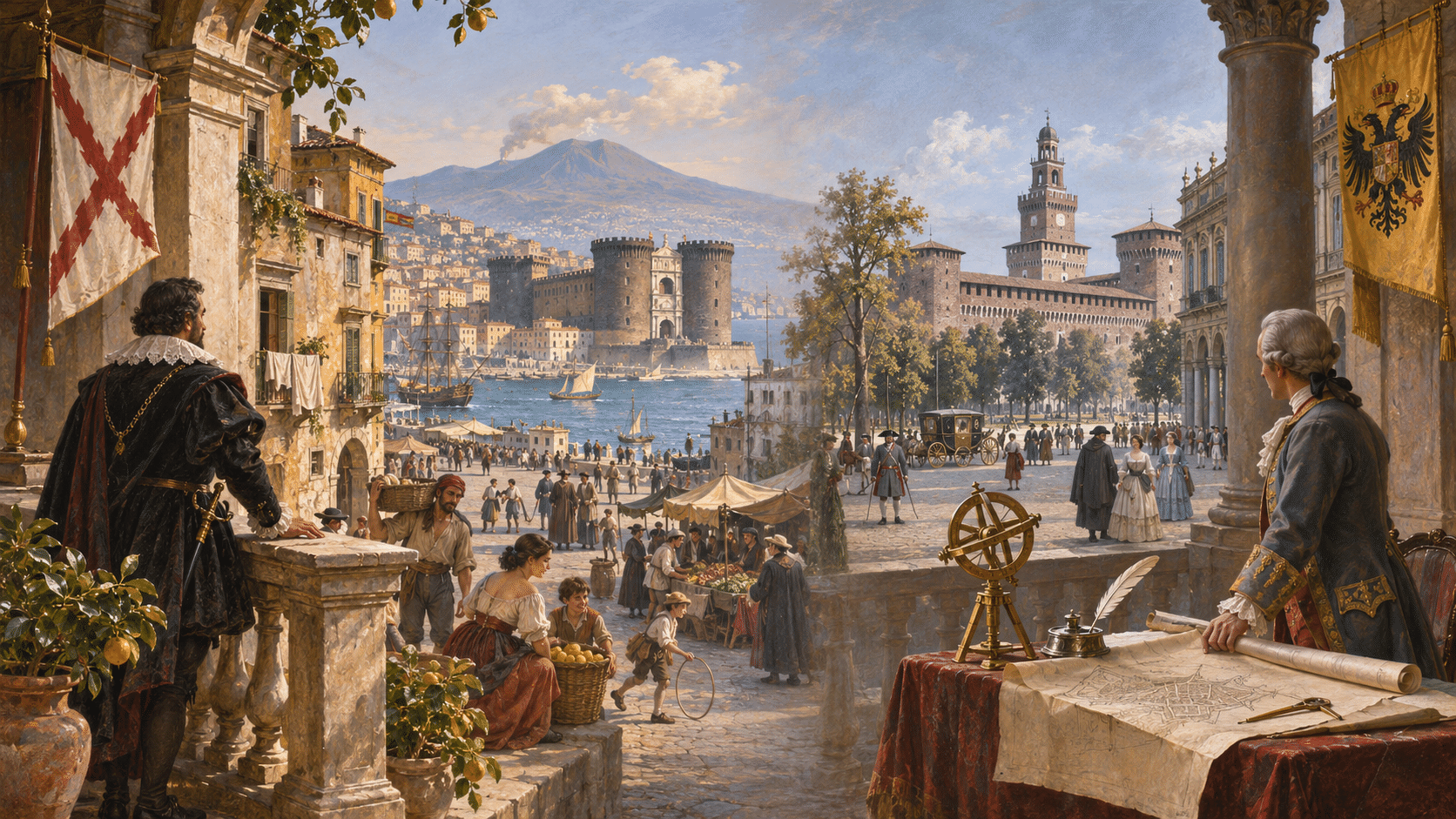
A Spanish viceroy governing Naples, an Austrian official surveying Lombard farmland, a Tuscan ruler abolishing the death penalty: foreign power in Italy took many forms. Between the sixteenth and eighteenth centuries, much of the peninsula became part of larger dynastic systems whose priorities extended far beyond Italian borders.
Yet Italy never became a single Spanish province or one Austrian possession. Republics survived, local dynasties negotiated their independence, and Italian nobles, merchants and officials helped sustain the governments under which they lived.
Understanding Italy under foreign rule therefore means looking beyond a succession of conquerors. It means asking who governed each territory, how authority worked, and what these arrangements meant for ordinary people.
From Renaissance Rivalry to Foreign Supremacy
The political divisions explored in Renaissance Italy: Power, Society and the Making of a New Age helped make the peninsula both prosperous and vulnerable. Wealthy states competed for territory and influence, but their rivalries also created opportunities for outside intervention.
The French invasion of 1494 opened a prolonged struggle involving France, Spain, the Holy Roman Empire and shifting coalitions of Italian rulers. Local governments were active participants: they invited allies, changed sides and tried to use international rivalries to strengthen their own positions.
Naples became a major Spanish possession following the defeat of French forces in 1503. Milan, commanding important routes between the Mediterranean and the Alps, became another central prize. Possession of Italian territory offered revenue, troops, ports and strategic access to the rest of Europe.
The Peace of Cateau-Cambrésis in 1559 consolidated Spanish predominance and is conventionally treated as the conclusion of the Italian Wars. It did not create Spanish power from nothing; it confirmed an order that decades of warfare had helped establish.
Who Ruled Italy?
The expression “Spanish Italy” describes particular territories and a wider sphere of influence. It should not be mistaken for a unified country.
| Territory or state | Position during the era of Spanish predominance |
|---|---|
| Duchy of Milan | Governed under the Spanish monarchy; strategically important for military communications |
| Kingdom of Naples | Ruled on the monarch’s behalf by a viceroy |
| Kingdom of Sicily | A separate kingdom under the Spanish crown, with its own institutions |
| Kingdom of Sardinia | Another distinct kingdom within the Spanish monarchy |
| Republic of Genoa | Formally independent, with close financial and strategic connections to Spain |
| Republic of Venice | Independent, pursuing its own mainland and maritime interests |
| Papal States | Governed by the pope, who also participated in European diplomacy |
| Tuscany and Savoy | Dynastic states whose rulers negotiated with stronger neighboring powers |
These distinctions mattered. A state could depend heavily on Spanish protection without being directly administered by Spain. Equally, sharing a monarch did not mean that Naples, Sicily and Milan shared identical laws or political institutions.
How Spanish Government Worked
A distant monarch could not govern Italian territories through military force alone. Authority depended on cooperation with people already embedded in local society.
Viceroys and governors represented the sovereign, but they worked through courts, municipal institutions, aristocratic networks and established privileges. Italian elites could defend their interests while serving the monarchy. The relationship involved negotiation as well as coercion.
This complicates the familiar image of foreign rulers facing a uniformly hostile population. Different groups had different priorities. A noble family might seek royal appointments; a merchant might value commercial connections; an urban community might defend a tax exemption.
For people with little political influence, the important question was often less where the monarch lived than how government affected food prices, taxation and access to justice.
The transition from Spanish to Austrian power would also depend on these local relationships. Changing the sovereign did not automatically erase institutions or the interests of the people who controlled them.
Naples and the Revolt of Masaniello
The pressures of government became dramatically visible in Naples in July 1647.
The immediate flashpoint was a tax on fruit. In a crowded city where everyday purchases absorbed much of a poor household’s income, such duties could provoke intense resentment. Protest spread around the market, and Tommaso Aniello, remembered as Masaniello, emerged as its most famous leader.
Crowds attacked tax offices, opened prisons and challenged the authorities. Masaniello briefly acquired extraordinary influence before his assassination on July 16.
The uprising should not be read simply as an early campaign for Italian national independence. Protesters could express loyalty to the Spanish king while condemning his government’s conduct. Their demands concerned taxation, political representation and abuses of power within the world they knew.
That apparent contradiction is revealing. People could distinguish between a legitimate sovereign and officials they considered responsible for injustice. Seventeenth-century political loyalties did not follow the same assumptions as nineteenth-century nationalism.
Why Spanish Rule Ended
The decisive turning point came from a succession crisis.
When Charles II of Spain died in 1700, the Spanish branch of the Habsburg dynasty ended. Rival claims to his inheritance helped trigger the War of the Spanish Succession. The dispute concerned much more than the Spanish throne: it threatened to rearrange the balance of power across Europe.
The Bourbon claimant, Philip of Anjou, ultimately retained Spain as Philip V. The Austrian Habsburgs secured important former Spanish possessions elsewhere.
The settlements of Utrecht in 1713 and Rastatt in 1714 transferred Milan, Naples and Sardinia to Austrian Habsburg rule. Italy’s political future had again become part of a broader European bargain.
Austria’s Gains—and Their Limits
The early eighteenth century did not produce a permanent Austrian takeover of all former Spanish Italy.
Sicily initially went to the House of Savoy. In 1720, Savoy exchanged it for Sardinia, giving Austria Sicily and establishing the territorial basis for the Savoyard Kingdom of Sardinia.
Further warfare changed the arrangement again. Charles of Bourbon conquered Naples in 1734, and Bourbon control extended to Sicily. The Peace of Vienna in 1738 recognized the new southern settlement.
The south consequently developed under a resident Bourbon monarchy rather than continuing as an Austrian possession. Although Charles belonged to the Spanish royal family, his Italian kingdoms were distinct states, not simply restored Spanish provinces.
Meanwhile, Tuscany passed to Francis Stephen of Lorraine in 1737, following the extinction of the ruling Medici line. His marriage to Maria Theresa connected Tuscany to the emerging Habsburg-Lorraine dynasty, but the grand duchy remained a separate state.
Austrian Lombardy and the Business of Reform
Austria’s most enduring eighteenth-century position in Italy centered on Lombardy.
Under Maria Theresa and Joseph II, government pursued changes intended to make administration more effective, improve revenue collection and bring institutions more firmly under state authority.
These aims could overlap with demands for greater fairness, but they were also practical. A monarchy needed dependable income and officials capable of understanding the resources it governed.
One particularly revealing example was the Catasto Teresiano, the land survey associated with Maria Theresa, although its preparation began under Charles VI.
Surveyors measured individual parcels and recorded ownership, land use and other characteristics relevant to assessment. Government sought a more systematic basis for taxing landed property.
The surviving maps make this transformation tangible. Fields, buildings and boundaries became part of a detailed administrative record. Today, these documents also help researchers investigate landscapes, property and local history.
The project’s surviving documentation in Cremona illustrates its scale and long-term value. Early surveys were produced in 1722–23, and the archive now provides access to historical maps that preserve a geography sometimes very different from today’s municipal boundaries.
Milan and the Italian Enlightenment
Administrative reform developed alongside a wider debate about how society should be governed.
Milan became an important center of the Italian Enlightenment. Pietro Verri and his circle discussed economic policy, education and justice, while the journal Il Caffè, first published in 1764, provided a forum for new ideas.
The most internationally influential work associated with this environment was Cesare Beccaria’s On Crimes and Punishments, published in 1764.
Beccaria challenged torture and the death penalty, asking whether punishment should be judged by its usefulness to society rather than by tradition or the desire for vengeance. His work made the treatment of accused and convicted people a central question of political reform.
These arguments were not merely ideas imported by foreign rulers. Italian thinkers helped shape the intellectual world in which reforming governments operated.
Cultural patronage also left a lasting monument. La Scala opened in Milan in 1778, following Maria Theresa’s authorization of a replacement for the theater destroyed by fire in 1776. Its history connects one of Italy’s best-known cultural institutions directly to the Austrian period.
Tuscany and the Abolition of the Death Penalty
The distinction between direct Austrian government and rule by a related dynasty is particularly important in Tuscany.
Under Peter Leopold, the grand duchy pursued its own program of reform. Its most famous measure came on November 30, 1786, when a new criminal law abolished the death penalty and torture.
This legislation made Tuscany a landmark in the history of penal reform. The date is still commemorated through the Festa della Toscana.
The Tuscan example also exposes the limits of describing the period only through national labels. A ruler from a dynasty with roots outside Italy could introduce measures that later generations would regard as major achievements.
That did not make such government democratic. Reform still came from above, and the relationship between ruler and subject remained fundamentally unequal. Nevertheless, the policies of different foreign-born sovereigns could vary considerably.
From Eighteenth-Century Reform to Nineteenth-Century Resistance
Austria’s role in Italian history changed over time.
The reforming monarchy associated with eighteenth-century Lombardy should not be treated as identical to the political order that followed the Napoleonic Wars. After 1815, Austria became a principal defender of the restored European settlement and a major obstacle to movements seeking Italian national independence.
Its authority in northern Italy increasingly required military support, while national aspirations challenged the legitimacy of dynastic rule. Later campaigns for unification gave foreign domination a powerful place in Italian historical memory.
Looking backward from the Risorgimento can therefore distort earlier centuries. Masaniello’s Naples, Maria Theresa’s Milan and the Italy of nineteenth-century national movements belonged to different political worlds.
Recognizing those differences does not excuse coercion or inequality. It makes their causes and consequences easier to understand.
What Foreign Rule Changed
Spanish and Austrian power linked Italian territories to decisions made elsewhere in Europe. Wars of succession could change a community’s sovereign without its inhabitants having any meaningful say.
Yet the effects of these arrangements were never uniform. Regional institutions survived, local elites negotiated advantages, popular movements challenged taxation, and reformers proposed new ways to administer land and deliver justice.
The most useful question is therefore not whether foreign rule was entirely beneficial or entirely destructive. It is which government, in which territory, during which period—and for whom.
Seen this way, the centuries between the Renaissance and the revolutionary age become more than an interval before unification. They reveal how Italian societies adapted to powerful monarchies, defended local interests and helped generate ideas that would reshape Europe.
External Links
- Treccani: Italy—historical overview — A reference overview of Italy’s changing political geography.
- The World of the Habsburgs: Charles and the Spanish succession — The dynastic conflict behind Austria’s acquisition of Spanish territories.
- Treccani: Masaniello — The Neapolitan revolt and its best-known leader.
- State Archives of Cremona: Catasto Teresiano — Historical land surveys and surviving maps.
- Teatro alla Scala: History — The theater’s foundation under Maria Theresa.