

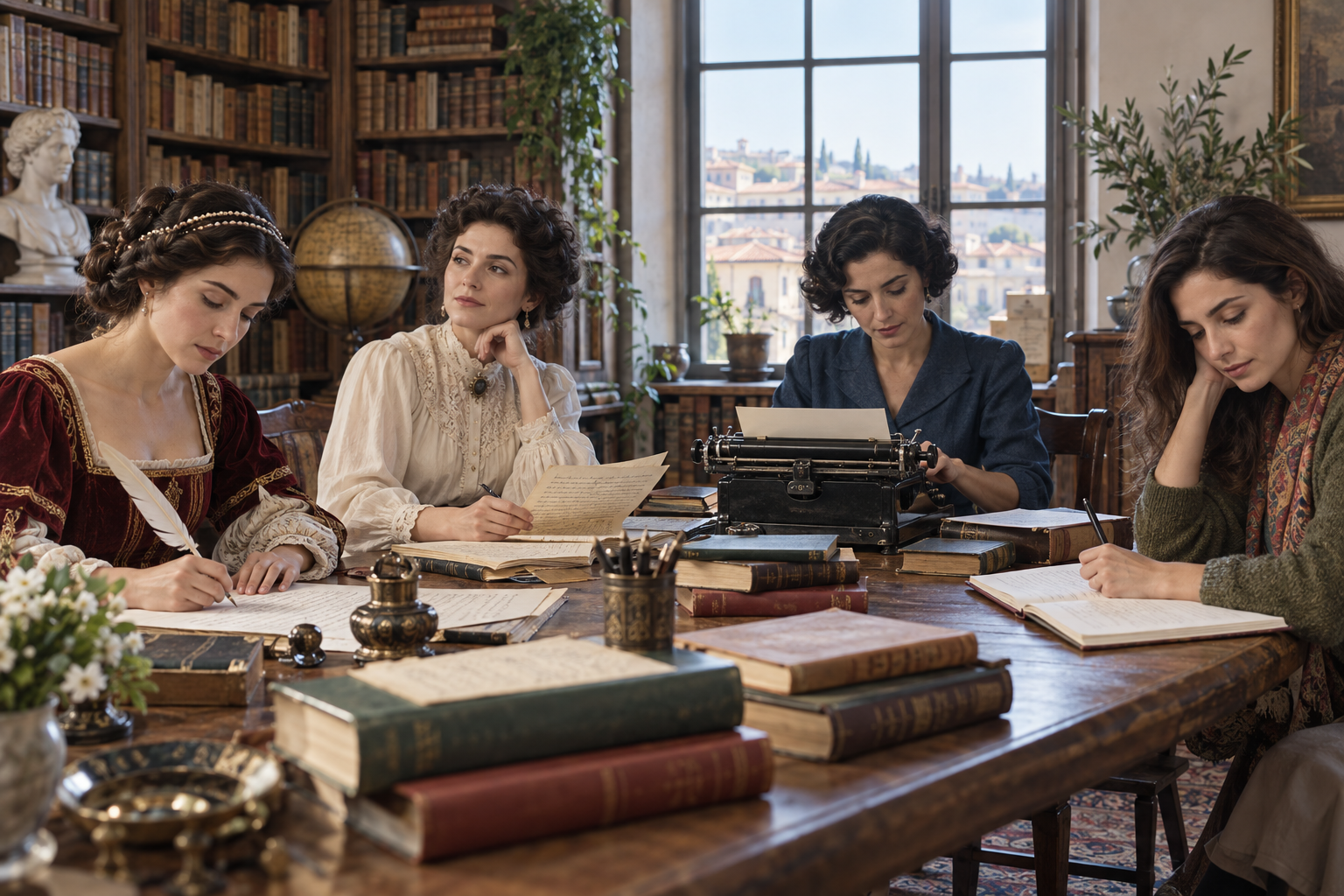
 For centuries, Italian literature was presented to the world primarily through its great male figures: Dante, Petrarch, Boccaccio, Machiavelli, Manzoni, Pirandello, Calvino and Eco. Yet women were also writing—sometimes anonymously, sometimes under pseudonyms and often in defiance of the social roles assigned to them.
Italian women writers transformed literature by introducing experiences that the traditional canon had neglected. They wrote about female education, marriage, motherhood, work, poverty, political persecution, sexuality, mental illness and the private language of families. In doing so, they demonstrated that domestic life could be as historically significant as a battlefield or parliament.
This is not a ranking or a complete list. It is a chronological journey through some of the women whose books changed how Italy—and eventually the world—understood literature.
Moderata Fonte: Questioning Male Authority in Renaissance Venice
Long before modern feminism acquired its name, Moderata Fonte was questioning the assumptions on which male authority rested.
Born Modesta Pozzo in Venice in 1555, she adopted a literary pseudonym whose meaning closely echoed her real name. Her best-known work, Il merito delle donne—published posthumously in 1600 and translated as The Worth of Women or The Merits of Women—takes the form of a conversation among seven Venetian women.
Within the protected space of a garden, the speakers discuss marriage, education, love, work and women’s intellectual abilities. They challenge the belief that women are naturally inferior and argue that their disadvantages result largely from restricted education and dependence on men.
Fonte did not write a political manifesto in the modern sense. She used the Renaissance dialogue, a respected intellectual form, to allow women to reason with one another without requiring a male character to validate their conclusions. The result is one of the most striking early contributions to Europe’s long debate about the status of women.
Her importance lies not only in what she argued but in whom she allowed to speak. Women in The Worth of Women are not merely objects of praise, romance or moral instruction. They are thinkers.
Matilde Serao: Writing the Modern City from Street Level
Matilde Serao brought the noise, poverty and human density of modern Naples into Italian prose.
Born in Patras, Greece, in 1856 to an Italian father and Greek mother, Serao grew up in Naples and became one of the most prominent journalists and novelists of her generation. With her husband, Edoardo Scarfoglio, she helped establish Il Mattino in 1892. She later founded and directed Il Giorno.
Her most enduring work, Il ventre di Napoli—The Belly of Naples—began as a response to official attempts to explain the city’s devastating cholera epidemic of 1884. Serao rejected superficial descriptions of Naples and led readers into crowded alleys, basement dwellings, markets and working-class homes.
She wrote about poverty without reducing the poor to statistics. Food, superstition, debt, overcrowding and informal labor became part of a living urban portrait. Her combination of journalism, social observation and literary narrative anticipated forms of reportage that would become increasingly important during the twentieth century.
At a time when women were often confined to writing about society or the home, Serao claimed the entire city as her subject.
Grazia Deledda: Sardinia as a Universal Landscape
Grazia Deledda became the first—and so far only—Italian woman to receive the Nobel Prize in Literature.
Born in Nuoro, Sardinia, in 1871, Deledda received limited formal schooling but educated herself through extensive reading. She began publishing stories while still young, despite the disapproval that literary ambition could attract in a conservative provincial community.
Her novels include Elias Portolu, Cenere and Canne al vento—Reeds in the Wind. They are rooted in Sardinian landscapes, customs and social structures, but their central themes are universal: guilt, desire, honor, isolation, sin and the hope of redemption.
Deledda’s Sardinia is not decorative scenery. Mountains, wind, drought and distance exert moral and psychological pressure upon her characters. People struggle against family obligations, religious belief and forces that appear larger than individual will.
Awarded the 1926 Nobel Prize in Literature, Deledda proved that a writer from a geographically and culturally marginalized region could speak to an international audience. Readers can explore more of her life and books in the Italia Mia profile of Grazia Deledda.
Sibilla Aleramo: Turning a Woman’s Life into a Declaration of Freedom
When Sibilla Aleramo published Una donna in 1906, she turned personal experience into one of Italy’s foundational feminist novels.
Aleramo was the pseudonym of Rina Faccio. Her autobiographical novel follows an intelligent young woman whose ambitions are restricted by sexual violence, an unhappy marriage and the expectations surrounding motherhood. To preserve her independence, the narrator ultimately makes a decision that society considers unforgivable: she leaves her husband even though doing so means separation from her son.
The novel’s power comes from its refusal to present female self-sacrifice as naturally virtuous. Its narrator gradually recognizes that her suffering is not an isolated misfortune but part of a social structure repeated across generations.
Una donna blurred the boundaries between memoir, confession and fiction. It also challenged the sentimental image of motherhood by asking whether a woman can truly educate a child in freedom while accepting her own subjugation.
Now widely translated as A Woman, the book remains startlingly direct. It gave literary form to a question that would echo through later Italian writing: what price is a woman expected to pay for autonomy?
Alba de Céspedes: The Secret Rebellion of Everyday Women
Alba de Céspedes understood that a woman’s most dangerous act might be to describe her own life honestly.
Born in Rome in 1911 to a Cuban father and Italian mother, de Céspedes participated in anti-Fascist activity and was imprisoned for her political involvement. Her fiction, however, often locates rebellion within apparently conventional homes.
Her novels Nessuno torna indietro, Dalla parte di lei and Quaderno proibito examine women whose private thoughts conflict with the identities imposed upon them. In Quaderno proibito—Forbidden Notebook—a middle-aged wife and mother secretly buys a notebook and begins recording her thoughts.
The diary gives Valeria a private language. As she writes, she starts to see the unpaid labor, compromises and emotional inequalities upon which her family depends. Nothing outwardly dramatic is required to destabilize her life. The simple act of paying attention becomes revolutionary.
De Céspedes wrote about the internal transformation that can occur before any visible act of liberation. Her work has received renewed international attention, revealing important connections between postwar women’s writing and the intimate, psychologically precise fiction of later authors.
Elsa Morante: History Seen Through the Powerless
Elsa Morante possessed one of the most original imaginations in twentieth-century Italian literature.
Her first major novel, Menzogna e sortilegio—House of Liars—combined family mythology, memory and psychological obsession on an almost operatic scale. L’isola di Arturo, which won the Premio Strega in 1957, transformed an island childhood into a story about illusion, abandonment and the painful end of innocence.
Morante’s most debated novel, La Storia, appeared in 1974. Set largely in Rome during and after the Second World War, it follows Ida, a widowed schoolteacher, and her children as Fascism, occupation, racial persecution and poverty invade their lives.
Instead of placing generals and political leaders at the center of history, Morante concentrated on those who endure its consequences: women, children, the poor, animals and people who possess little control over public events. The novel’s deliberately accessible language and original low price reflected her desire to reach readers beyond a narrow literary elite.
Morante demonstrated that the historical novel did not have to celebrate powerful people. It could reveal how power crushes those whom official histories barely record. Read more about Elsa Morante and her books on Italia Mia.
Anna Maria Ortese: Where Reportage Meets the Fantastic
Anna Maria Ortese resisted simple literary categories. Her writing could move from documentary observation to dream, allegory and the supernatural without abandoning its moral seriousness.
Born in Rome in 1914 and raised partly in Naples, Ortese experienced financial insecurity for much of her life. Her 1953 collection Il mare non bagna Napoli—often published in English as Neapolitan Chronicles—presented a disturbing vision of postwar Naples. Rather than repeating picturesque images of the city, she wrote about poverty, damaged communities and the distance between intellectual ideals and material reality.
The book provoked hostility in Naples, but it established Ortese as an uncompromising observer.
In later works such as L’Iguana and Il cardillo addolorato, realism gives way to strange creatures, enchanted landscapes and unstable identities. These fantastic elements are not an escape from reality. They allow Ortese to examine cruelty, exploitation and humanity’s treatment of vulnerable beings from unexpected angles.
Her work challenged the division between journalism and fiction, human and animal, reason and imagination. Once difficult to classify, Ortese is increasingly recognized as a precursor to contemporary ecological, posthuman and hybrid forms of writing.
Natalia Ginzburg: The Political Meaning of Family Language
Natalia Ginzburg changed Italian prose through restraint. Her sentences are often plain, direct and apparently conversational, yet they carry the weight of Fascism, war, bereavement and family conflict.
Born Natalia Levi in Palermo in 1916 and raised in Turin, she grew up in an intellectually active anti-Fascist family. Her first husband, Leone Ginzburg, was an editor, activist and member of the Italian Resistance. He died in prison in 1944 after being tortured by Fascist forces.
Ginzburg rarely separated public history from private life. In Lessico famigliare—Family Lexicon or Family Sayings—she reconstructs her family through the repeated expressions, jokes, arguments and verbal habits shared inside the home. These ordinary phrases become a form of collective memory.
Her novels, plays and essays examine marriage, parenting, friendship, vocation and loss without idealizing family life. She recognized that affection and injury can coexist within the same relationship.
By treating household speech as serious literary material, Ginzburg helped redefine autobiographical writing. She showed that history survives not only in archives and monuments but also in the peculiar words families repeat across generations. Italia Mia has a dedicated introduction to Natalia Ginzburg.
Alda Merini: Poetry from the Edge of Sanity and Desire
Alda Merini gave Italian poetry a voice that was intimate, sensual, spiritual and wounded.
Born in Milan in 1931, Merini began writing poetry while still very young. Her life included periods of psychiatric hospitalization, poverty and public neglect, experiences she later addressed without allowing them to define the whole of her identity.
In collections such as La Terra Santa, the psychiatric hospital becomes a place of suffering, abandonment and distorted spirituality. Merini’s poems move between sacred imagery and physical desire, tenderness and violence, lucidity and visionary intensity.
She refused the reassuring boundary between the supposedly sane observer and the person labeled mentally ill. Instead, she wrote from within experiences that polite society preferred to hide.
During her later years, Merini became a widely recognized cultural figure, particularly associated with Milan’s Navigli district. Her aphorisms made her popular with a broad audience, but her major poetry remains more demanding and more powerful than the inspirational quotations frequently attributed to her online.
Merini expanded what could be spoken in Italian poetry and insisted that female desire, psychological pain and spiritual hunger belonged at its center.
Dacia Maraini: Literature as Resistance to Silence
Dacia Maraini has spent more than six decades examining the relationship between language and power.
Born in Fiesole in 1936, Maraini spent part of her childhood in Japan, where her family was interned after refusing to recognize Mussolini’s Republic of Salò. She later became closely involved in Italy’s literary, theatrical and feminist movements.
Her novels, stories and plays repeatedly address violence, sexual inequality and the silencing of women. La lunga vita di Marianna Ucrìa—The Silent Duchess—follows a deaf woman in eighteenth-century Sicily whose apparent powerlessness conceals a developing intellectual independence. The novel won the Premio Campiello in 1990.
Maraini’s story collection Buio, winner of the Premio Strega in 1999, confronts abuse and violence without turning victims into narrative decorations. Her work in experimental and feminist theater also created spaces in which women could write, perform and interpret their own experiences.
Maraini’s achievement lies in connecting literary form with social testimony. She does not simply give silenced characters a voice; she investigates the institutions that made their silence convenient. More information is available in Italia Mia’s profile of Dacia Maraini.
Elena Ferrante: Female Friendship Becomes a Modern Epic
Few contemporary Italian writers have had an international impact comparable to Elena Ferrante, the pseudonymous author of the Neapolitan Novels.
Beginning with L’amica geniale—My Brilliant Friend—the four-volume series follows Elena Greco and Raffaella “Lila” Cerullo from childhood in a poor Naples neighborhood through education, marriage, political conflict, motherhood, professional success and old age.
Ferrante treats female friendship with the scale and seriousness traditionally reserved for war, dynasties or national politics. Elena and Lila love, imitate, compete with and wound one another. Their relationship cannot be reduced to either loyalty or rivalry.
The novels also examine the power of language. Standard Italian offers Elena education and social mobility, while dialect carries intimacy, anger and the violence of the neighborhood. Leaving Naples can create opportunity, but it cannot completely erase class or origin.
Ferrante’s work builds upon themes explored by Aleramo, de Céspedes, Morante and Ginzburg: women’s education, the cost of creative ambition, family language and the conflict between personal freedom and social expectation. Yet the Neapolitan Novels combine them in a vast narrative that has reached readers around the world.
Italia Mia’s Elena Ferrante guide offers an introduction to the novels and their major themes.
A Tradition That Continues to Change
The history of Italian women’s writing does not end with Ferrante. Contemporary authors continue to broaden both the subjects and the identities represented in Italian literature.
Melania G. Mazzucco has combined historical research with ambitious storytelling. The late Michela Murgia wrote forcefully about family, religion, gender and Sardinian identity. Donatella Di Pietrantonio examines kinship, abandonment and the landscapes of Abruzzo. Igiaba Scego brings migration, colonial memory and Black Italian identity into the center of national literature. Nadia Terranova explores memory, absence and the legacies carried by families and places.
These writers differ in generation, region, politics and style. What connects them is not a single “female” way of writing. It is their refusal to accept that only certain lives, experiences or forms of language deserve literary attention.
Why These Writers Matter
Italian women writers did more than add female characters to an existing canon. They changed its boundaries.
Moderata Fonte transformed women from literary subjects into participants in philosophical debate. Matilde Serao made the life of the modern city visible from below. Grazia Deledda turned regional Sardinia into a universal moral landscape. Sibilla Aleramo made female autonomy the center of an autobiographical novel. Alba de Céspedes revealed the rebellion hidden inside domestic thought.
Elsa Morante rewrote history from the perspective of its victims. Anna Maria Ortese broke down the border between reportage and the fantastic. Natalia Ginzburg discovered history within family speech. Alda Merini brought desire and psychiatric experience into poetry. Dacia Maraini exposed the structures that silence women, while Elena Ferrante made female friendship the foundation of an international literary phenomenon.
Their books belong not at the margins of Italian literature but within its central story. Together, they demonstrate that literature changes whenever a writer finds language for an experience that society has taught people not to see.
External Sources
Moderata Fonte and The Worth of Women — University of Chicago Press
Sibilla Aleramo and A Woman — Penguin Books
Anna Maria Ortese — World Literature Today
Dacia Maraini — The Booker Prizes