
 In the decades after Italian unification, writers began asking what the new nation looked like beyond its political ideals. They turned to fishing villages, farms, crowded streets and provincial households. Their characters faced debt, ambition, family duty and the limits imposed by social class. This shift gave rise to verismo, the Italian form of literary realism most closely associated with Giovanni Verga.
Verismo belongs chiefly to the late 19th century. It provides a bridge between the historical and moral concerns of Italian Classicism and Romanticism and the experiments in psychology and form explored in our guide to 20th-century Italian authors.
What Was Italian Verismo?
Verismo means a commitment to portraying life as it is lived, especially among people who had rarely occupied the center of prestigious fiction. Its writers paid close attention to work, money, local customs and the language of a community. A village or neighborhood could shape a person’s prospects as powerfully as any individual decision.
French naturalism helped inspire the movement, but Italian verismo developed its own methods. In Verga’s fiction, the narrator often withdraws from view, allowing events to be understood through the assumptions and judgments of the characters’ community. Readers encounter a world from within, without a guiding voice that explains whom to admire or blame.
That apparent simplicity is carefully made. Verga wrote in Italian while drawing on Sicilian speech patterns, proverbs and ways of thinking. His prose could sound like the people it portrayed without becoming a straightforward transcription of dialect.
Giovanni Verga: The Central Voice of Verismo
Born in Catania in 1840, Giovanni Verga did not begin with the village stories for which he is now best known. His early fiction included fashionable and romantic subjects. Over time, he turned toward the lives of people whose choices were constrained by poverty, reputation and the struggle to survive.
The stories collected in Vita dei campi (1880) show this change clearly. In “Rosso Malpelo,” a boy working in a mine is judged so harshly by those around him that their cruelty becomes part of the story’s voice. “Cavalleria rusticana” depicts desire and violence within a community governed by honor and gossip; Verga later adapted the story for the stage, and it inspired Pietro Mascagni’s opera. These are brief works, but they establish the tension that runs through his major novels: individuals seek a place in a society that is quick to define them.
Readers can find English editions of Verga’s stories on Amazon.com.
I Malavoglia: A Family and a Village
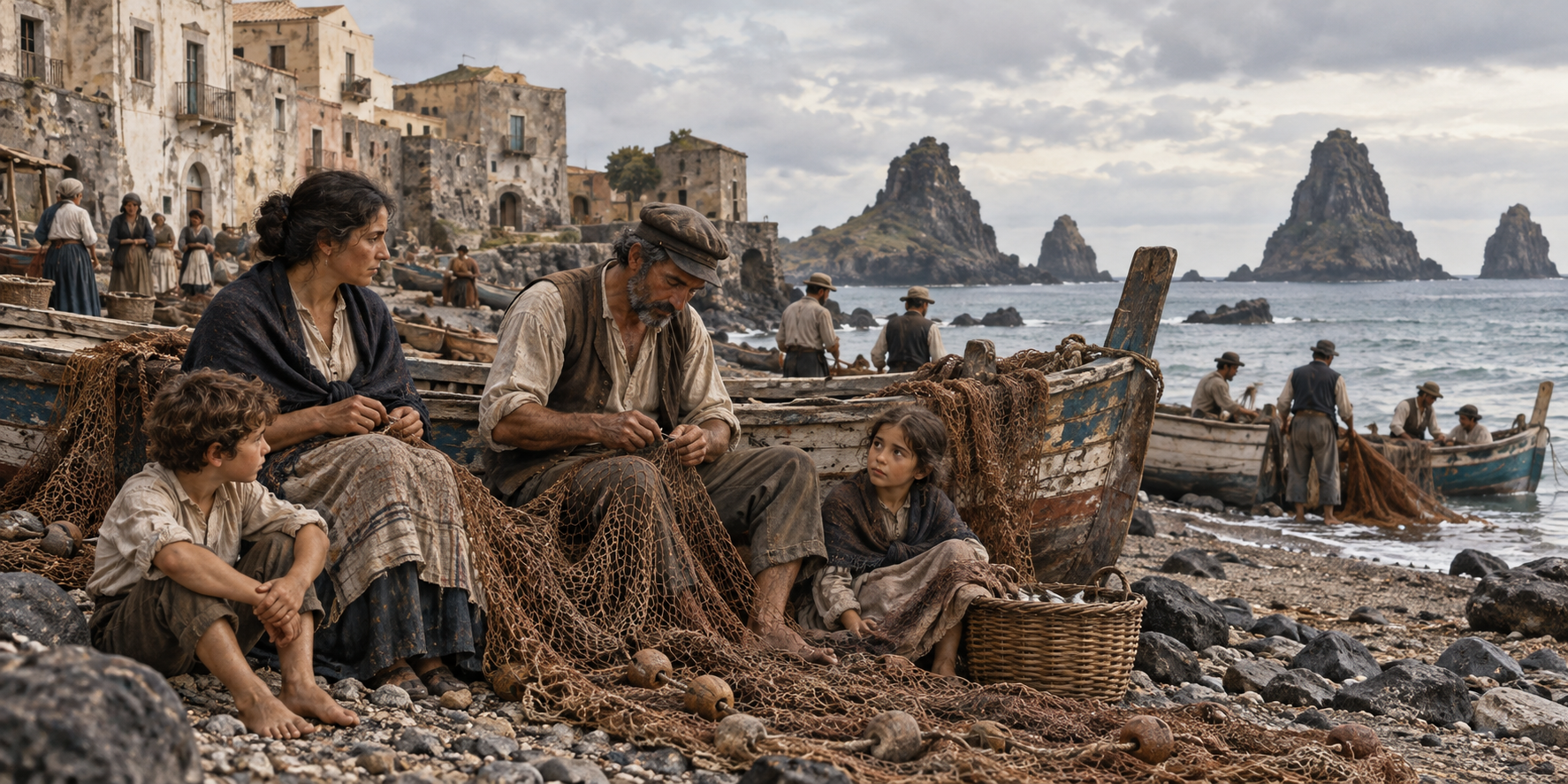
Published in 1881, I Malavoglia follows a fishing family in Aci Trezza, Sicily, as an attempt to improve its fortunes leads to loss and mounting hardship. The family’s troubles matter, but so does the surrounding village. Neighbors comment, remember, speculate and judge. Their collective voice makes the community feel like another character in the novel.
Verga does not present poverty as a picturesque backdrop. A boat, a house, a debt and a family name all carry practical weight. Even the hope of getting ahead brings risk. The novel asks what happens when people try to change their circumstances while remaining bound to a close community and an uncertain livelihood.
An English translation is available through Amazon.com’s listings for The House by the Medlar Tree, a title under which I Malavoglia has been published in English.
Mastro-don Gesualdo: The Price of Rising
If I Malavoglia examines a family struggling to hold on to what it has, Mastro-don Gesualdo (1889) follows a man determined to acquire more. Gesualdo builds wealth through relentless work, yet money cannot secure the belonging and affection he wants. His rise exposes the distance between economic success and acceptance by an established social class.
The two novels were the completed parts of Verga’s planned Cycle of the Defeated, which was intended to examine ambition and struggle across different levels of society. “Defeat” in this context extends beyond material poverty. Gesualdo gains property while losing much of what might make that success satisfying.
Readers can look for Mastro-don Gesualdo in English on Amazon.com.
Capuana and De Roberto: Other Perspectives on Verismo
Luigi Capuana helped argue for a new kind of Italian fiction through his criticism as well as his novels. Giacinta (1879) became an important early statement of verismo. His interest in psychology and unusual personal circumstances also shows why the writers associated with the movement should not be treated as if they all followed one formula.
Federico De Roberto took a different social view in I Vicerè (1894). Rather than concentrating on a fishing family or a self-made landowner, he portrayed the Uzeda, an aristocratic Sicilian family protecting its power through a period of political change. Together, Verga, Capuana and De Roberto show how realism could examine both those with little influence and those determined to keep it.
Realism Beyond Sicily
Late 19th-century realism was not confined to one island or one literary circle. Matilde Serao brought a journalist’s eye to Naples. In Il ventre di Napoli (1884), she confronted the living conditions behind official plans to remake the city. Her fiction likewise drew on the streets, workplaces and social worlds she knew.
Grazia Deledda’s writing grew from Sardinian settings and traditions, although it cannot be contained neatly within verismo. Her work gave increasing attention to conscience, desire and moral conflict. She went on to receive the 1926 Nobel Prize in Literature. Her career is a reminder that a writer could begin with a closely observed regional world and take it in a distinct direction.
From the Visible World to the Inner Life
Verismo changed Italian fiction by making social surroundings inseparable from character. Its writers showed how work, class, family expectations and communal opinion shape a life. By the end of the century, other novelists were placing still more emphasis on uncertainty within the individual.
Italo Svevo’s Senilità appeared in 1898. Its concern with self-deception and inner conflict points toward the psychological fiction of the new century. Later works by Svevo and Luigi Pirandello would ask whether people can understand even their own motives or maintain a stable sense of identity. That next stage belongs in our guide to 20th-century Italian authors, followed by late 20th-century Italian literature.
Verga remains the essential starting point for this transition. His stories bring readers close to a particular place and its people, while his novels raise a question that extends far beyond Sicily: how much freedom does a person have when every choice is shaped by the world around them?
Book links to Amazon.com are affiliate links. Italia Mia may earn a commission from qualifying purchases at no additional cost to you.
External Sources
Treccani: Giovanni Verga and his language
Treccani: Luigi Capuana and Federico De Roberto
Nobel Prize: Grazia Deledda and Treccani: Italo Svevo