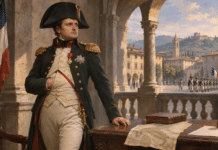

On March 17, 1861, Victor Emmanuel II assumed the title of King of Italy. A peninsula long divided among competing states now had a national kingdom. Yet Venice remained under Austrian rule, Rome belonged to the pope, and millions of inhabitants faced a government whose promises they had barely begun to understand.
The Risorgimento—the movement and historical process that produced Italian unification—was neither a single revolution nor the work of one hero. It brought together political exiles, constitutional monarchists, republican activists, volunteer soldiers and foreign allies. Their ambitions overlapped, but their visions of Italy often conflicted.
Understanding how Italy became a nation means following both the extraordinary speed of its territorial transformation and the much slower task of turning that territory into a shared political community.
The Risorgimento at a Glance
| Date | Event | Significance |
|---|---|---|
| 1814–1815 | Congress of Vienna | Restored dynastic rule and reinforced Austrian influence in Italy. |
| 1820–1821 and 1831 | Revolutionary uprisings | Challenged established governments but failed to overturn the political order. |
| 1831 | Mazzini founded Young Italy | Gave the campaign for a united republic an organized political program. |
| 1848–1849 | Revolutions and First War of Independence | Raised hopes of constitutional change and independence, followed by defeat. |
| 1859 | Second War of Independence | French and Piedmontese victories brought most of Lombardy into the Savoy kingdom. |
| 1860 | Central Italian annexations and Garibaldi’s expedition | Transformed the scale and prospects of unification. |
| March 17, 1861 | Kingdom of Italy proclaimed | Established the new national monarchy, initially with Turin as its capital. |
| 1866 | Venetia joined Italy | Extended the kingdom after the war fought alongside Prussia against Austria. |
| September 20, 1870 | Italian troops entered Rome | Ended papal territorial government in the city. |
| 1871 | Rome became the capital | Established the political center envisaged by many nationalists. |
What Does Risorgimento Mean?
Risorgimento is commonly translated as “resurgence” or “rebirth.” Applied to Italian history, it describes the cultural and political awakening associated with the struggle for independence and unity.
Its boundaries are not absolute. The decisive state-building phase belongs to the nineteenth century, especially the decades between 1815 and 1871, but its roots reach into eighteenth-century reform and the revolutionary era.
The word also contains an interpretation: that Italy was recovering a national existence. In practice, the modern Italian state was something new. Shared literary traditions, historical memories and cultural connections did not automatically determine its borders, constitution or government.
Italy After Napoleon: A Divided Peninsula
The collapse of Napoleon’s empire restored rulers without restoring the world exactly as it had been. New legal practices, administrative experience and political expectations survived his defeat.
As explored in Napoleon in Italy: Conquest, Reform and a Changing Peninsula, French rule had reorganized large parts of the peninsula without creating an independent, united Italy.
After the Congress of Vienna, Austria directly ruled Lombardy and Venetia and exercised influence elsewhere. The House of Savoy governed the Kingdom of Sardinia, which included Piedmont and Liguria as well as the island of Sardinia. The pope governed central territories, while the Bourbon monarchy ruled the Kingdom of the Two Sicilies in the south. Tuscany and smaller duchies retained separate governments.
These arrangements developed from the dynastic politics described in Italy Under Foreign Rule: Spanish and Austrian Power. The obstacle to unity was therefore more complicated than expelling a single occupying army: several states, ruling houses and international interests stood in the way.
Revolutionaries Without One Common Plan
Early opposition often operated through secret societies, including the Carbonari. Uprisings in 1820–1821 and 1831 exposed dissatisfaction with absolutist rule, but repression and foreign intervention defeated them.
Even among opponents of the restored order, priorities differed. Some wanted constitutions within existing states. Others demanded independence from Austria or a broader Italian political union.
Giuseppe Mazzini gave the national cause a particularly ambitious program. In 1831, he founded Giovine Italia, or Young Italy, promoting a united, independent republic. For him, political liberation depended on popular commitment and a sense of moral duty.
Yet republican unity was only one possibility. Vincenzo Gioberti proposed a confederation associated with papal leadership. Carlo Cattaneo advocated a federal republican arrangement. Moderate liberals increasingly looked toward the Savoy monarchy.
The Italy eventually created was the outcome of these competing projects, not a design everyone had accepted from the beginning.
1848–1849: Revolution and Defeat
The European revolutionary wave of 1848 turned political debate into open confrontation. Milan rose against Austrian rule during the Five Days, while Venice established a republic.
Charles Albert of Sardinia went to war against Austria. His campaign ended in defeat, first at Custoza in 1848 and then at Novara in March 1849. He abdicated in favor of his son, Victor Emmanuel II.
Republican experiments also failed. In Rome, the republic proclaimed in 1849 included Mazzini among its leaders and Garibaldi among its defenders. French intervention restored papal government. Venice eventually surrendered to Austria.
Nevertheless, Piedmont retained the Statuto Albertino, the constitution granted in 1848. That survival gave the Savoy state a distinctive role: constitutional politics could continue there after revolutionary hopes had been crushed elsewhere.
Cavour and the International Route to Unity
Camillo Benso, Count of Cavour, became Piedmont’s prime minister in 1852. His approach combined economic modernization, parliamentary politics and international diplomacy.
He recognized that Austria could not easily be displaced by Italian enthusiasm alone. Piedmont needed powerful partners. Participation in the Crimean War helped bring its interests into European diplomatic discussions.
At Plombières in 1858, Cavour sought French military support from Napoleon III. War followed in 1859. Franco-Piedmontese victories at Magenta and Solferino weakened Austria’s position, although Napoleon III halted the campaign before the sweeping victory Italian nationalists had hoped for.
Most of Lombardy passed to the Savoy kingdom, while Venetia remained Austrian. Subsequent upheavals and plebiscites brought Tuscany and territories in central Italy into the expanding state in 1860. Nice and Savoy were ceded to France.
These exchanges reveal how closely national aspirations depended on great-power bargaining. The emerging country was shaped at negotiating tables as well as on battlefields.
Garibaldi and the Expedition of the Thousand
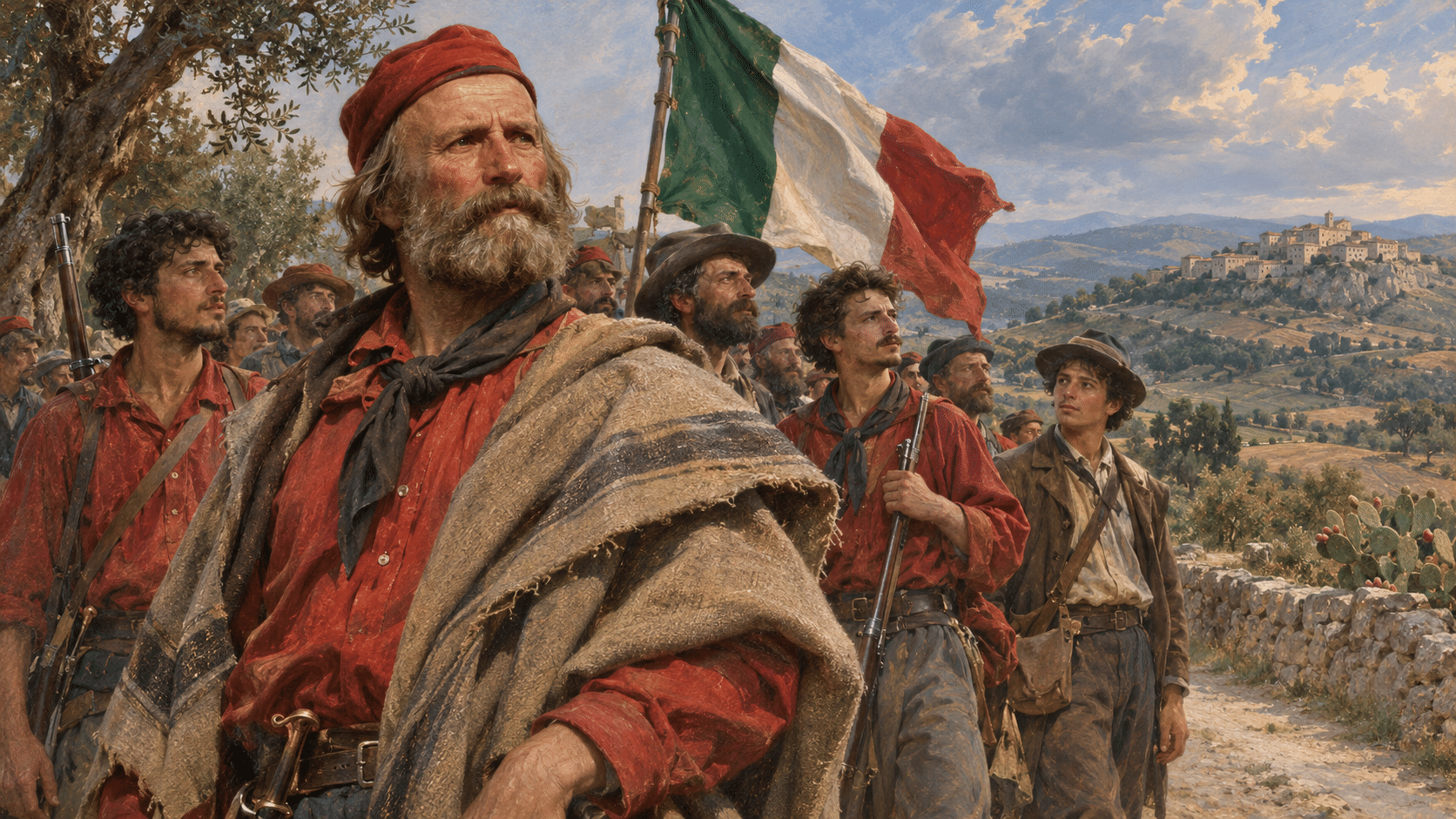
In May 1860, Giuseppe Garibaldi sailed from Quarto, near Genoa, with approximately a thousand volunteers. Their landing at Marsala began one of the most remarkable campaigns of the century.
Victory at Calatafimi and the struggle for Palermo helped undermine Bourbon control in Sicily. Local insurgents and additional volunteers expanded Garibaldi’s forces: the expedition’s success was never simply a thousand outsiders conquering an entire kingdom alone.
Garibaldi crossed to the mainland and entered Naples on September 7. Fighting continued, including the decisive battle of the Volturno in early October.
For Cavour and the monarchy, the advance created both an opportunity and a danger. A revolutionary movement could help unite Italy, but might also provoke foreign intervention or escape royal control. Piedmontese troops moved through the Marche and Umbria, defeating papal forces while leaving Rome outside their occupation.
Garibaldi met Victor Emmanuel II near Teano on October 26. His acceptance of the king’s authority helped secure a monarchical outcome. The collapse of Bourbon resistance continued into 1861, including the siege of Gaeta.
1861: A Kingdom, but Not Yet the Whole Country
The proclamation of March 17, 1861, established the Kingdom of Italy. Victor Emmanuel retained the numeral II, emphasizing continuity with his existing dynasty. Turin became the first capital.
The new state inherited the Savoy constitutional framework rather than beginning with a wholly new republican settlement. It had a parliament, but voting rights were restricted to a small, qualified male electorate. Women and most men could not vote in national elections.
Unification therefore established a constitutional national state without establishing modern mass democracy. Republican activists could welcome the end of fragmentation while objecting to the political arrangements that replaced it.
Two major territorial questions also remained: Venice and Rome.
Venice in 1866 and Rome in 1870
Italy allied with Prussia against Austria in 1866. Despite Italian defeats at Custoza and at sea near Lissa, Prussia’s victory transformed the diplomatic settlement. Venetia passed to Italy through French mediation and a subsequent plebiscite.
Rome proved more difficult. French military protection had helped preserve papal sovereignty, and efforts to seize the city risked confrontation with France. Garibaldi’s attempts to advance on Rome in the 1860s failed.
The Franco-Prussian War changed the situation in 1870. With French protection removed and Napoleon III’s regime collapsing, Italian troops advanced. On September 20, they breached Rome’s walls near Porta Pia. Annexation followed, and Rome became the kingdom’s capital in 1871, succeeding Florence, which had replaced Turin in 1865.
Pope Pius IX rejected the loss of his temporal sovereignty. The resulting Roman Question outlasted the nineteenth century and was formally resolved by the Lateran agreements in 1929.
The People Left Outside the Celebrations
National unity did not mean that everyone experienced the new government as liberation.
In parts of southern Italy, the early kingdom faced armed resistance commonly described as brigandage. It combined different forces: Bourbon loyalism, rural grievances, resistance to state demands and criminal violence. Reducing the conflict either to ordinary banditry or to a single unified resistance movement obscures its complexity.
The government answered with military repression and exceptional measures. Rural communities could find themselves caught between armed bands and the forces of the new state.
Land, taxation and military service mattered more immediately to many families than constitutional arguments. The disappearance of a frontier did not guarantee better wages, access to property or protection from powerful local interests.
Making Italians After Making Italy
The kingdom also had to connect people who used different everyday languages and dialects, lived under different local traditions and possessed unequal access to education.
Standard Italian already provided a literary language, but it was not the everyday speech of most inhabitants. Schools, public administration, military service and migration gradually widened its use. National identity developed alongside regional attachments rather than simply replacing them.
Women participated in political networks, fundraising, writing and the care of the wounded, yet the new political system excluded them from the national vote. Their participation underscores the distance between helping create a country and receiving equal power within it.
The Risorgimento thus left two connected inheritances: an independent national state and unresolved questions about who could participate, who benefited and what national belonging should mean. Italy’s borders changed dramatically within a generation; the negotiation of Italian citizenship continued long afterward.
Frequently Asked Questions
When did Italy become a unified country?
The Kingdom of Italy was proclaimed on March 17, 1861. Venetia joined in 1866, Rome was annexed in 1870, and Rome became the capital in 1871. These dates mark different stages of unification.
Who unified Italy?
No single person did. Mazzini helped articulate republican nationalism, Cavour pursued diplomacy and state expansion, Garibaldi led volunteer campaigns, and Victor Emmanuel II supplied the monarchy around which the kingdom formed. Local movements and foreign powers were also essential.
Was Italy a republic in 1861?
No. It was a constitutional monarchy under the House of Savoy. Italy became a republic following the referendum of June 2, 1946.
Was Rome Italy’s first capital?
No. Turin was the first capital, followed by Florence in 1865 and Rome in 1871.
External Links
- Treccani: Risorgimento — Overview of the movement and wars of independence, in Italian.
- State Archives of Turin: The Birth of the Kingdom of Italy — The documentary history of the founding act.
- Treccani: Giuseppe Garibaldi — Biography and campaign chronology, in Italian.
- Treccani: Camillo Benso, Count of Cavour — Biography of the statesman, in Italian.
- Italian Senate: March 17 and National Unity — Institutional material on the anniversary of unification.