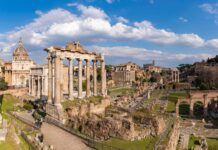

The fall of Rome is often presented as one of history’s most dramatic events: an empire collapses, civilization disappears, and Europe enters a thousand years of darkness.
The reality was far more complicated.
When the last Western Roman emperor was deposed in 476 CE, Italy did not suddenly lose its cities, language, laws, or cultural traditions. Roman institutions continued to function, Christianity expanded its influence, and new rulers attempted to govern a society that remained deeply connected to its imperial past.
Yet the centuries that followed brought profound changes.
Germanic kingdoms replaced the Western imperial court. Byzantine armies fought to restore imperial control. The Lombards established powerful territories across the peninsula. The papacy became a political authority, while the Franks introduced new forms of government and military organization.
By the year 1000, Italy was no longer the center of a unified Mediterranean empire. It had become a complex collection of kingdoms, duchies, principalities, church territories, and cities.
The foundations of medieval Italy were already taking shape.
This period is essential to understanding the origins of the country’s regional identities, the political importance of the Catholic Church, and the emergence of the powerful cities that would later transform European commerce, culture, and art.
Why Did the Western Roman Empire Fall?
The Roman Empire did not collapse because of a single invasion or disastrous battle.
Its western territories had experienced centuries of political instability, military pressure, economic difficulties, and internal conflict.
By the fourth century, the empire was increasingly governed through separate eastern and western administrative centers.
The eastern territories, with Constantinople as their capital, possessed major commercial cities, substantial resources, and strong administrative institutions.
The Western Roman Empire faced particular difficulties in maintaining military control over distant provinces.
Powerful military commanders frequently competed for influence, while emperors sometimes became dependent on generals and their armies.
Groups traditionally described by Roman writers as barbarians—including Goths, Vandals, Franks, and others—became increasingly important within the empire.
Many were not simply foreign invaders.
Some had served as Roman soldiers, entered agreements with imperial authorities, settled within Roman territories, or adopted elements of Roman culture.
The distinction between Roman and non-Roman became increasingly complicated.
During the fifth century, the Western Empire lost much of its political and military authority.
In 410 CE, the Visigoths led by Alaric sacked Rome.
The attack shocked the Roman world, although the city was no longer the principal residence of the Western emperor.
In 455, Rome suffered another sack, this time by the Vandals.
These events damaged the city’s prestige and demonstrated the weakness of imperial power.
However, neither marked the immediate disappearance of Western Roman government.
That conventional turning point came in 476.
The Year 476: The End of an Empire, Not of Roman Civilization
In 476 CE, the military leader Odoacer deposed Romulus Augustulus, the young emperor ruling from Italy.
Historians traditionally identify this event as the fall of the Western Roman Empire.
But an important distinction is necessary.
Romulus Augustulus was not recognized as legitimate by everyone, and Julius Nepos, a previous Western emperor, survived in Dalmatia until 480.
Odoacer did not establish a completely new political civilization.
Instead, he governed Italy as king while formally acknowledging the superior imperial authority of the Eastern Roman emperor.
Roman administrators continued working.
The Senate still existed.
Latin remained the language of government.
Roman laws and established institutions continued to influence public administration.
For many inhabitants, daily life probably changed less immediately than the familiar date of 476 suggests.
The disappearance of the Western imperial office mattered enormously, but the transformation of Roman Italy had already been underway for generations.
The distinction is fundamental: Rome fell as a Western imperial government, but Roman civilization survived in many forms.
The Ostrogoths and Theodoric the Great
The next major chapter began with the arrival of the Ostrogoths.
The Ostrogoths were a Gothic people with strong military traditions and a long history of interaction with the Roman Empire.
Their leader, Theodoric, entered Italy in 489 with the encouragement of the Eastern Roman emperor Zeno, who wanted Odoacer removed.
After years of fighting, Theodoric defeated and killed Odoacer in 493.
He established an Ostrogothic kingdom that governed Italy for more than three decades.
Theodoric is one of the most important figures in the transition from Roman to medieval Italy.
Although he was a Gothic king, he understood the political value of Roman institutions.
He maintained much of the existing administrative structure and worked with members of the Roman aristocracy.
The Roman Senate retained prestige, while officials trained in Roman traditions helped operate the government.
The philosopher and statesman Boethius served in Theodoric’s administration before falling from favor and being executed.
Religion presented another challenge.
Theodoric and many of his Gothic followers practiced Arian Christianity, while much of the Roman population followed Nicene Christianity.
For much of his reign, Theodoric attempted to maintain a workable relationship between these communities, although political and religious tensions intensified in his final years.
His court was based in Ravenna, a city that had already served as the residence of Western Roman emperors.
Ravenna: A Capital Between Two Worlds
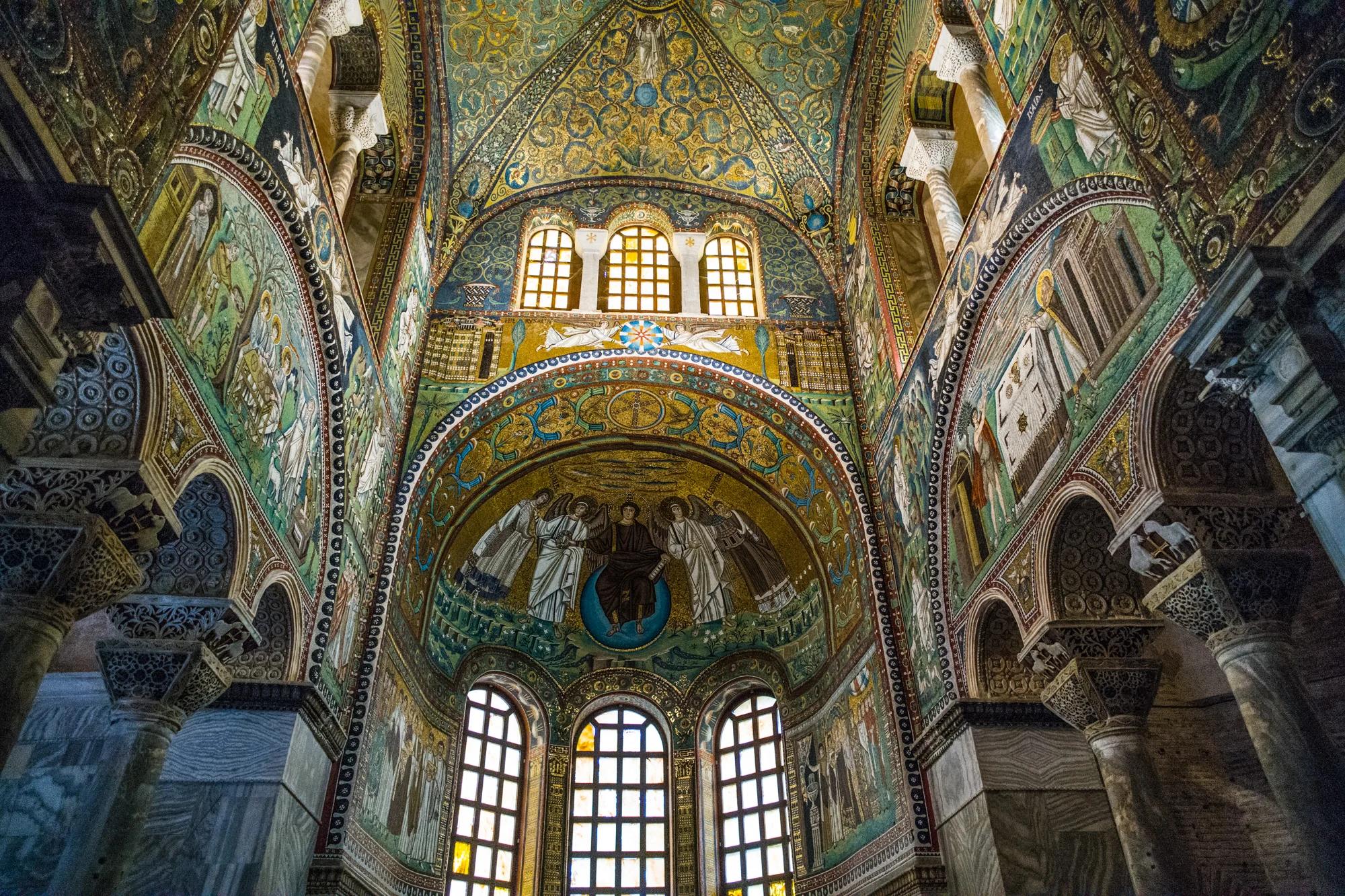
Ravenna offers some of the clearest physical evidence of the transition from antiquity to the Middle Ages.
Theodoric commissioned important religious and public buildings, including the structure now known as the Basilica of Sant’Apollinare Nuovo.
His mausoleum, constructed from massive blocks of stone, remains an extraordinary monument.
The city also preserves earlier Christian buildings and later Byzantine masterpieces.
Its architecture demonstrates that the transition from Roman to medieval culture was not simply a story of destruction.
It also involved adaptation, continuity, and new artistic achievements.
Readers interested in this period can explore Italia Mia’s guide to the mosaics of Italy, from Ravenna to Sicily.
Justinian and the Byzantine Reconquest of Italy
Theodoric’s death in 526 exposed weaknesses within the Ostrogothic kingdom.
Political disputes and struggles over royal succession created opportunities for intervention.
In Constantinople, Emperor Justinian I was pursuing an ambitious policy of restoring imperial control over former Western Roman territories.
His armies had already conquered the Vandal kingdom in North Africa.
Italy became their next major objective.
In 535, Byzantine forces commanded by the general Belisarius invaded Ostrogothic territory.
The resulting conflict, known as the Gothic War, lasted almost two decades, with major campaigns continuing into the early 550s.
Both sides fought for control of strategic cities, ports, and roads.
Rome changed hands during the conflict and endured destructive sieges.
Milan suffered a particularly devastating episode during the fighting.
Agricultural production, commerce, and urban infrastructure were disrupted in many regions.
The war also coincided with broader difficulties, including disease and episodes of famine.
The Justinianic Plague, first documented in the Mediterranean during the 540s, added to the pressures experienced by the population.
By 554, Byzantine forces had defeated the principal Ostrogothic resistance.
For a brief period, the Eastern Roman Empire again controlled much of Italy.
Yet the reconquest came at an enormous cost.
Years of warfare weakened communities and damaged the economic networks that had sustained Roman Italy.
The imperial government inherited territories that were difficult and expensive to defend.
Just fourteen years later, another major invasion transformed the peninsula.
The Lombard Invasion of 568
In 568, the Lombards entered northern Italy under their king Alboin.
They were a Germanic-speaking people whose origins and earlier history lay beyond the Italian peninsula.
Their arrival marked a decisive turning point.
The Lombards established control over substantial parts of northern Italy and gradually expanded into other regions.
Pavia, captured in 572, eventually became the capital of the Lombard kingdom.
The Byzantines retained other territories, including Ravenna, Rome, parts of the Adriatic coast, and significant areas of southern Italy.
The peninsula was now divided between competing political systems.
This division would have lasting consequences.
The Lombards established duchies that developed distinctive regional identities.
Important Lombard centers included Friuli, Spoleto, and Benevento.
The duchies of Spoleto and Benevento became particularly influential, sometimes exercising considerable independence from the Lombard kings.
The geographical name Lombardy preserves the memory of the Lombards, although the territory of today’s Italian region does not correspond exactly to the much larger areas they once controlled.
Lombard Law and Government
The Lombards initially relied on traditions that differed from those of the Roman population.
Over time, however, their rulers adopted and adapted many Roman administrative and cultural practices.
In 643, King Rothari issued a written collection of Lombard laws, known as the Edictum Rothari.
The laws were recorded in Latin, demonstrating the continuing influence of Roman literary and administrative traditions.
The Lombards did not simply replace Roman civilization with a completely separate society.
They gradually became part of the Italian world they governed.
Marriage, religious conversion, political cooperation, and cultural exchange helped create new communities.
By the eighth century, Lombard rulers had become deeply involved in the religious and political affairs of Italy.
Christianity and the Growing Power of the Church
One of the most important changes during the early Middle Ages was the increasing influence of Christian institutions.
Christianity had become deeply established in Italy during the final centuries of Roman imperial rule.
After the disappearance of Western imperial government, bishops and other religious leaders often assumed responsibilities that extended beyond spiritual matters.
Church authorities administered property, organized charitable activities, supported communities, and sometimes negotiated with military leaders.
Rome occupied a special position because of its association with the apostles Peter and Paul.
The bishop of Rome, increasingly recognized as the pope, developed an expanding religious authority in Western Christianity.
However, papal power did not grow without opposition or difficulty.
The papacy had complex relationships with the Eastern Roman emperors, local aristocrats, Lombard rulers, and other political powers.
Pope Gregory the Great
Pope Gregory I, who served from 590 to 604, illustrates the changing role of the papacy.
Gregory was born into a prominent Roman family and had experience in civil administration.
As pope, he managed Church property, organized assistance for the poor, supported missionary activities, and negotiated with Lombard authorities.
His correspondence provides valuable evidence about the challenges facing late sixth-century Italy.
Gregory’s activities also reveal how Roman administrative traditions survived within Christian institutions.
The Church became one of the most important organizations preserving written records, legal procedures, education, and elements of classical learning.
This did not mean that religious authorities were free from political ambitions or conflicts.
Rather, spiritual and secular responsibilities increasingly overlapped.
That relationship would shape Italian history for centuries.
Monasteries and the Preservation of Learning
Monasteries became important centers of religious life, agricultural organization, education, and manuscript production.
One of the most influential figures was Benedict of Nursia, traditionally dated to approximately 480–547.
Benedict is closely associated with the monastery of Montecassino, south of Rome.
According to tradition, he established the monastery around 529.
The Rule of Saint Benedict offered practical guidance for monastic communities, emphasizing prayer, discipline, communal living, and organized responsibilities.
Benedictine monasticism eventually became enormously influential throughout medieval Western Europe.
Monasteries were not identical, and their activities varied according to location, resources, and historical circumstances.
Many nevertheless maintained libraries, copied religious and other texts, and helped preserve elements of classical education.
They also controlled agricultural estates and participated in local economies.
For surrounding communities, monasteries could provide employment, assistance, religious services, and connections to wider networks.
The monastery was therefore more than a place of prayer.
It was an institution that helped organize medieval society.
Women in Early Medieval Italy
The political history of this period is dominated by kings, generals, emperors, and popes.
Women nevertheless played important roles in aristocratic families, religious communities, property management, and political affairs.
The Lombard queen Theodelinda is particularly significant.
Active during the late sixth and early seventh centuries, she maintained relationships with Christian religious leaders, including Pope Gregory the Great.
She supported church foundations and helped strengthen Catholic connections within Lombard royal society.
Her influence demonstrates that queenship could involve diplomacy, religious patronage, and political negotiation.
Other women managed estates, contributed to religious foundations, or exercised authority within convents.
However, opportunities were shaped by social position, family relationships, legal traditions, and economic circumstances.
The experiences of noblewomen differed enormously from those of women working in farming households or urban trades.
Our surviving written sources also tend to describe wealthy and religious women far more frequently than ordinary women.
As a result, reconstructing the lives of most early medieval Italian women remains difficult.
The Birth of the Papal States
By the eighth century, the balance of power in Italy was changing again.
The Byzantine Empire was finding it increasingly difficult to defend its Italian territories.
Lombard rulers expanded their ambitions, while the papacy sought greater security and political independence.
In 751, the Lombards captured Ravenna, bringing an end to the Byzantine exarchate based there.
Pope Stephen II subsequently sought support from the Frankish king Pepin III, often called Pepin the Short.
Frankish military intervention helped defeat Lombard forces.
In 756, Pepin’s territorial grants to the papacy became a major foundation of what developed into the Papal States.
These territories gave the pope an increasingly important role as a political ruler as well as a religious leader.
The process was gradual, and the extent of papal control continued to be contested.
Nevertheless, the development of papal territorial authority permanently complicated the political geography of Italy.
For centuries afterward, central Italy included territories governed in the name of the pope.
The Papal States would survive, in changing forms, until the nineteenth century.
The medieval origins of papal government therefore help explain one of the major obstacles to the later political unification of Italy.
Charlemagne and the Franks
The Lombard kingdom reached another turning point in 774.
That year, Charlemagne, king of the Franks, conquered the Lombard kingdom and adopted the title King of the Lombards.
This brought much of northern and central Italy into the wider Frankish political world.
However, Lombard political authority did not disappear everywhere.
The southern Lombard principality of Benevento survived, later giving rise to other important political centers.
Charlemagne maintained elements of the existing Lombard administrative system while introducing Frankish political relationships and officials.
On Christmas Day in 800, Pope Leo III crowned Charlemagne emperor in Rome.
The coronation was an event of enormous symbolic significance.
It created a new claim to imperial authority in Western Europe and strengthened the relationship between the Frankish monarchy and the papacy.
Modern historians often describe Charlemagne’s empire as Carolingian, while the later Holy Roman Empire developed from related but changing political traditions.
The imperial title did not restore ancient Rome’s unified political system.
Italy remained divided among different rulers and jurisdictions.
Nevertheless, the coronation of 800 linked Italian affairs more closely to the political development of Western Europe.
The Limits of Carolingian Control
After Charlemagne’s death in 814, his empire experienced dynastic conflict and political fragmentation.
Power increasingly depended on regional rulers, aristocratic families, bishops, and local military authorities.
Italy became involved in disputes over kingship and imperial legitimacy.
During the ninth and tenth centuries, the peninsula experienced periods of warfare, unstable leadership, and competition among powerful families.
Yet these conflicts did not prevent the survival of towns, religious institutions, commerce, or local communities.
Political fragmentation became one of the defining characteristics of medieval Italy.
Southern Italy: Byzantines, Lombards, and Muslim Sicily
The history of southern Italy followed a different path from that of the north.
Byzantine influence remained important in parts of Calabria, Apulia, and other southern territories.
Greek language and religious traditions continued to shape many communities.
Meanwhile, Lombard principalities such as Benevento and Salerno became major political powers.
Sicily experienced another transformation.
In 827, Muslim forces from North Africa began the conquest of the island, which was then part of the Byzantine Empire.
The conquest was gradual rather than immediate.
Palermo fell in 831, while other cities and fortified settlements resisted for decades.
Taormina fell in 902, although some Byzantine-held positions survived longer.
Muslim rule reshaped Sicilian administration, agriculture, commerce, and cultural life.
Connections with North Africa and the wider Islamic Mediterranean grew in importance.
Arabic became influential, while Greek-speaking and Christian communities continued to exist under changing circumstances.
Sicily developed a distinctive Mediterranean society influenced by several cultures.
These foundations would become particularly important when Norman rulers conquered the island during the eleventh century.
The cultural mixture associated with medieval Palermo did not emerge from a single event.
It was the result of centuries of contact among Greek, Latin, Byzantine, Islamic, and later Norman traditions.
What Was Everyday Life Like in Early Medieval Italy?
For most inhabitants, the central concerns of life were not imperial coronations or royal successions.
They were food, land, family, work, and survival.
Agriculture remained the foundation of the economy.
Farmers cultivated grain, vines, olives, legumes, and vegetables, depending on local geography and climate.
Livestock provided meat, dairy products, wool, and agricultural labor.
Many rural communities lived within systems of dependence involving large landowners, monasteries, or aristocratic families.
Landholding patterns varied widely.
Some farmers possessed land, while others worked estates under different contractual or customary obligations.
Slavery continued in parts of the early medieval economy, while other forms of unfree or dependent labor also existed.
The social and economic landscape cannot be reduced to a single system of medieval feudalism.
That term is often used too broadly, particularly for the earlier centuries.
Did Italian Cities Disappear?
No.
Some Italian cities experienced significant population decline, changes in economic activity, or the contraction of their inhabited areas.
Others remained important administrative, religious, or commercial centers.
Rome, Ravenna, Milan, Pavia, Naples, and other towns continued to function, although their political roles evolved.
Ancient public buildings were sometimes abandoned, adapted, dismantled, or reused.
Materials from Roman monuments could be incorporated into churches and other structures.
Urban life increasingly centered on bishops, churches, markets, and local authorities.
The transformation of public space was gradual.
To understand how ancient and medieval urban traditions eventually contributed to one of Italy’s most recognizable institutions, see our article on the history of the Italian piazza.
From Latin to the Languages of Medieval Italy
The Western Roman Empire disappeared, but Latin did not.
It remained the principal written language of much of Italy.
Clergy, administrators, scholars, and legal professionals continued using Latin for documents and intellectual activity.
However, the spoken language was evolving.
The Latin spoken by ordinary people had always differed from the formal literary language associated with ancient Roman authors.
Over centuries, regional varieties developed different pronunciations, grammatical structures, and vocabularies.
Geography and political fragmentation contributed to these differences.
Contact with Lombard, Greek, Arabic, and other languages also influenced particular regions.
The result was not immediately modern Italian.
Instead, the peninsula gradually developed distinct Romance vernaculars.
These included the ancestors of several languages and dialects still associated with different parts of Italy.
The literary Italian that eventually emerged from Tuscan traditions belonged to a much later historical phase.
Our guide to the Italian language and its regional varieties explains this development in greater detail.
Was the Early Middle Ages Really a Dark Age?
The expression Dark Ages has traditionally been used to describe the centuries following the collapse of Western Roman rule.
Today, historians generally approach the term with caution.
There were real disruptions.
Warfare damaged communities. Some cities declined. Long-distance commercial networks changed. Monumental building became less common in certain regions, and the production and preservation of written records varied considerably.
However, describing the entire period as an age of darkness creates a misleading picture.
The early medieval world also produced significant religious architecture, legal texts, manuscripts, artistic innovations, and new political institutions.
Ravenna’s extraordinary mosaics belong to this era.
Lombard churches and monasteries reflect creative interactions among Roman, Christian, Byzantine, and Germanic traditions.
Monastic communities helped transmit ancient learning.
Political systems changed, but people continued creating art, building institutions, exchanging goods, and adapting inherited traditions.
The early Middle Ages were therefore a period of profound transformation rather than a thousand-year interruption of civilization.
Italy Around the Year 1000
By the end of the tenth century, Italy’s political geography looked very different from that of the Roman Empire.
In northern and parts of central Italy, kings and emperors competed with aristocratic families, bishops, and local authorities.
In 962, Otto I was crowned emperor in Rome, establishing a new phase of imperial power that would deeply influence later Italian politics.
The papacy exercised important religious and territorial authority, although its political position remained vulnerable.
Southern Italy included Byzantine territories and Lombard principalities.
Sicily was governed by Muslim rulers.
Maritime communities such as Venice and Amalfi were developing commercial relationships that would become increasingly important.
In the countryside, castles and fortified settlements were assuming greater prominence in many areas.
Urban communities were also changing.
Bishops, merchants, landowners, and other local groups developed institutions that would eventually contribute to the rise of medieval communes.
The famous independent city-republics of later medieval Italy had not yet fully emerged.
But some of the conditions that made them possible were already present.
Italy was entering a new phase of economic and urban development.
Where to Discover Early Medieval Italy Today
One of the most fascinating aspects of this historical period is the survival of its monuments.
Several Italian destinations allow visitors to explore the transition from Roman imperial culture to the early medieval world.
Ravenna, Emilia-Romagna
Ravenna is essential for understanding Ostrogothic and Byzantine Italy.
The Basilica of San Vitale, Mausoleum of Galla Placidia, Sant’Apollinare Nuovo, and Mausoleum of Theodoric reveal the artistic and political changes of the fifth and sixth centuries.
Its Early Christian monuments are recognized by UNESCO.
Cividale del Friuli, Friuli-Venezia Giulia
Cividale became an important Lombard center soon after the invasion of 568.
Its famous Tempietto Longobardo preserves exceptional early medieval decoration and architecture.
Brescia, Lombardy
The monumental complex of San Salvatore and Santa Giulia reflects the importance of monastic patronage in the Lombard kingdom.
Today, the museum complex offers an extraordinary encounter with the city’s long history.
Spoleto, Umbria
The Basilica of San Salvatore is an important example of early medieval architecture drawing on classical traditions.
Spoleto itself was a major Lombard ducal center.
Benevento, Campania
The Church of Santa Sofia is among the most important monuments associated with Lombard southern Italy.
Benevento’s history demonstrates that Lombard rule continued in the south even after Charlemagne conquered the northern kingdom.
Montecassino, Lazio
The Abbey of Montecassino remains an important symbol of Benedictine monasticism.
The buildings visible today are largely the result of later reconstruction, including rebuilding after the destruction of the abbey during World War II.
Nevertheless, the site preserves the historical memory of one of Western Europe’s most influential monastic foundations.
For a wider cultural itinerary, see Italia Mia’s guide to Italy’s greatest art cities.
Why the Early Middle Ages Matter to Italian History
The centuries between 476 and 1000 were crucial to the development of Italy.
The Western Roman Empire disappeared, but its language, institutions, legal traditions, and religious culture endured.
The Ostrogoths attempted to preserve Roman administration under new leadership.
The Byzantine reconquest temporarily restored imperial control but contributed to extensive disruption.
The Lombards introduced new political structures and became an important part of Italian society.
The papacy developed territorial power that would influence the peninsula for more than a millennium.
The Franks connected much of Italy to the political world of Western Europe.
In the south, Byzantine, Lombard, and Islamic influences created distinctive regional societies.
These developments help explain why Italy did not become a unified medieval kingdom.
Its political fragmentation was not simply evidence of weakness.
It also encouraged the emergence of local institutions, regional traditions, and eventually the independent cities that would become some of Europe’s most influential commercial and cultural centers.
The early Middle Ages established the conditions from which medieval Florence, Venice, Genoa, Pisa, Siena, and many other Italian cities would later develop.
The story of Italy therefore did not end with the fall of Rome.
It entered a different, complex, and creative chapter.
For a broader chronological perspective, read our complete history of Italy from the Roman Empire to the modern Republic.
The empire ended, but the people, institutions, languages, and traditions of Roman Italy continued to evolve. Out of that transformation, medieval Italy was born.
External Sources
- UNESCO — Early Christian Monuments of Ravenna
- UNESCO — Longobards in Italy: Places of Power, 568–774
- Italian Ministry of Culture — The Longobards in Italy
- UNESCO Italian National Commission — Lombard Heritage Sites
- Encyclopaedia Britannica — Theodoric, King of Italy
- UNESCO — Arab-Norman Palermo and the Cathedral Churches of Cefalù and Monreale