Italy Now: A practical guide to secondhand style in Milan, Rome, Florence, and Naples.
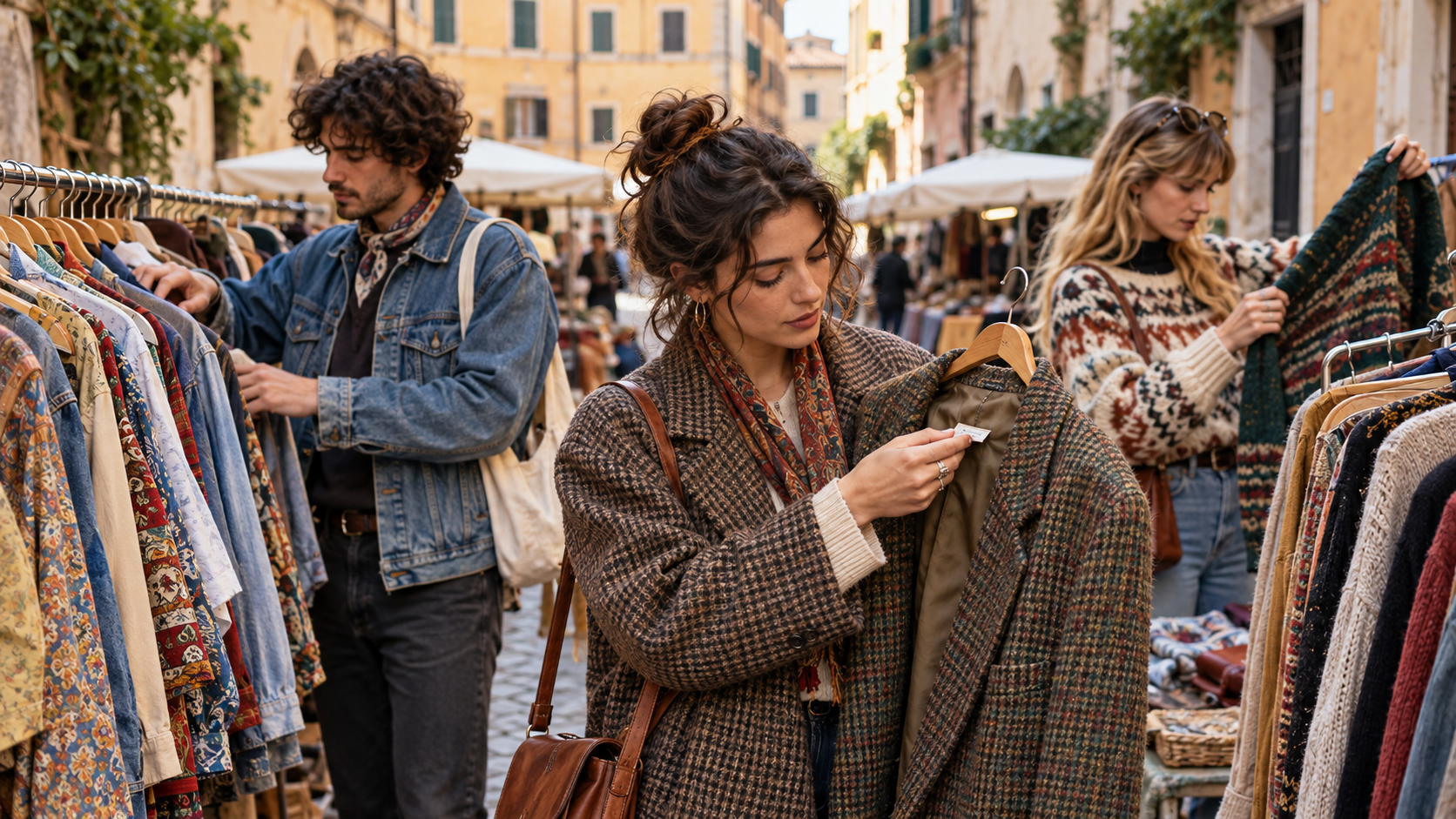 Vintage shopping in Italy can mean a carefully displayed designer jacket with a three-figure price tag. It can also mean rummaging through shirts at a Sunday market, finding a wool sweater from an unfamiliar Italian label, or trying on trousers that cost less than dinner.
The trick is knowing which kind of shopping experience you are walking into.
For travelers interested in clothes they can actually afford and wear, Italy’s secondhand scene offers a different way to explore its cities. You can browse neighborhood shops, compare fabrics, and bring home something more personal than a souvenir T-shirt.
Start with Milan, Rome, Florence, and Naples. Each offers a useful combination of shops and markets, although the cheapest finds usually demand the most patience.
Vintage, Secondhand, and Retro: Know the Difference
“Vintage” is often used loosely. In fashion, it generally describes clothing from an earlier period, commonly at least 20 years old. “Secondhand” includes much more recent pre-owned clothes. “Retro” can describe a newly made item inspired by an older style.
These differences matter when you compare prices.
A shop may charge more because it has selected, cleaned, dated, and presented each garment. A market trader selling mixed clothing may leave most of that work to you. Neither approach guarantees a better purchase.
Also, clothing bought in Italy is not necessarily made in Italy. American denim, British outerwear, and sportswear manufactured around the world appear throughout Italian vintage shops.
For the wider background, Italia Mia’s guide to Italian fashion and the meaning of Made in Italy explains the relationship between brands, manufacturing, and regional craftsmanship.
Milan: Combine Affordable Browsing with Selected Resale
Milan is a good place to compare different versions of secondhand shopping within the same visit. Start with an accessible shop, then move to a more selective resale store to see what the higher price buys.
Humana Vintage is a useful first stop. Its Milan shops offer an alternative to luxury vintage boutiques, with clothing and accessories spanning different styles and periods. The branch on Via Cappellari, 3, near the Duomo, is especially convenient for a central shopping break. Check the Humana store locator for branches and current hours.
Go with a loose brief: a patterned shirt, a cardigan, or a jacket in a color you already wear. That makes it easier to compare condition and price without buying something simply because it looks unusual.
BIVIO Milano offers a more selected resale experience. Its official locations include Via Gian Giacomo Mora, 4 and 14, Via Lambro, 12, and Corso Lodi, 18. BIVIO explicitly specializes in contemporary fashion, so expect recent secondhand pieces alongside older finds. It is a useful middle ground, but do not assume every rail carries bargain-market prices.
For a larger event, try East Market, at Via Mecenate, 88/A. The indoor market combines vintage clothing with records, sneakers, accessories, and other secondhand goods. Its official information currently lists admission at €5, with an event on one Sunday each month, usually the second-to-last Sunday. Confirm the actual date through East Market before planning your journey.
A practical Milan plan: browse Humana near the Duomo, then head toward the BIVIO shops on Via Mora. Treat East Market as a separate outing if its calendar matches your stay.
Rome: Sunday Markets and the Shops of Monti
Rome offers two very different starting points: the sprawling stalls of Porta Portese and the more manageable shops around Monti.
Porta Portese is the classic market choice. It takes place on Sunday mornings in the Trastevere area, extending along Via Portuense and neighboring streets. Clothing shares space with household goods, records, furniture, and assorted curiosities. It is a mixed flea market, so you will need to distinguish genuinely older clothing from recent secondhand pieces and new merchandise.
Arrive early enough to browse without rushing. Look through several stalls before buying, particularly when the same kind of garment appears repeatedly. A low price is useful only if the item fits and is worth wearing.
For a shop-based afternoon, head to Monti. Pifebo, at Via dei Serpenti, 135/136, is a convenient place to explore vintage clothing and accessories. Use its official website to check its current selection and location information.
Pifebo also illustrates why “vintage” does not automatically mean inexpensive. At the time of checking, its online selection included a Carhartt vest at €95 and a Burberry trench coat at €158. These are individual online asking prices, not promises of in-store stock or typical prices for every item.
For another comparison, check Humana’s Rome branches through its store locator. Having several options helps you judge whether you are paying for the garment itself, the label, or the convenience of a carefully selected shop.
A practical Rome plan: give Porta Portese a Sunday morning. Visit Monti on a separate afternoon, when you can take more time over fit and condition.
Florence: Start with Humana, Then Choose Your Market Carefully
Florence’s reputation for leather and luxury fashion can make secondhand shopping look more expensive than it needs to be.
A straightforward starting point is Humana Vintage on Via delle Belle Donne, 4/6R, conveniently located in the historic center. It makes an easy stop while walking between the station area and the city’s main sights.
For a broader market experience, consider Mercato delle Cascine. The city’s official information lists the regular market on Tuesday mornings, from 7 a.m. to 2 p.m., along Viale Lincoln and around Piazzale Kennedy. It sells a wide range of goods, including clothing, shoes, and bags. This is a general market rather than a dedicated vintage fair: ask whether garments are used, new, or old unsold stock.
Be more selective about advice involving Piazza Santo Spirito. The square hosts different markets, and their names and schedules are easily confused. Florence’s municipal information identifies the second-Sunday event as an arts-and-crafts market, while the third-Sunday Fierucola emphasizes rural products and craftsmanship. Neither should be treated as a guaranteed secondhand-clothing market.
If you also enjoy older accessories and objects, the Mercato delle Pulci in Piazza Annigoni is another option. Florence’s tourism office describes a daily market that expands into surrounding streets on the last Sunday of the month. Its emphasis is antiques and collectibles, so make it an additional stop rather than your main destination for affordable clothes.
A practical Florence plan: start with Humana. Add Cascine if you are there on Tuesday, or browse the flea market if you enjoy objects and accessories as much as clothing.
Naples: Browse the Historic Center, Then Explore Resina
Naples rewards travelers who leave time for browsing rather than attempting to follow a rigid list of “must-buy” items.
In the historic center, Oblomova, at Via San Sebastiano, 20, offers a mix of new, handmade, and secondhand clothing and accessories. That combination makes it worth exploring, but ask which pieces are vintage or pre-owned. The shop’s official website confirms the address; some older guides still point to a previous location.
Retrophilia, listed at Via Mezzocannone, 71, is another central option for a more selected vintage browse. Treat it as a comparison stop rather than assuming it will match street-market prices, and confirm opening hours before making a special trip.
For a more substantial vintage outing, look beyond Naples itself to the Resina market in Ercolano, around Via Pugliano. The Herculaneum Archaeological Park describes the area as a longstanding center for vintage clothing, visited by fashion enthusiasts and costume designers.
Resina is a separate excursion, not a market in central Naples. A common public-transport approach is the Circumvesuviana to Ercolano Scavi, followed by a walk toward Via Pugliano. Check current train services and local trading hours before leaving.
Allow time to compare the rougher mixed selections with more carefully presented stock. Ask prices before investing too much time in a garment, and do not assume everything on sale has Italian origins.
A practical Naples plan: browse Via San Sebastiano and Via Mezzocannone during a historic-center walk. Give Resina its own morning rather than squeezing it into an already crowded sightseeing day.
How Much Should You Budget?
There is no single “Italian vintage price.” Condition, brand, fabric, rarity, and the seller’s selection process all affect the amount.
The figures below are planning estimates for ordinary, non-collectible clothing, not verified price lists for the shops above. Use them to set a spending limit rather than as prices a seller should offer.
| Item | Budget market or mixed secondhand target | Selected vintage-shop budget |
|---|---|---|
| Basic T-shirt or simple top | €5–15 | €15–35 |
| Everyday shirt | €10–25 | €25–50 |
| Jeans or casual trousers | €15–35 | €30–65 |
| Ordinary knitwear | €15–35 | €30–70 |
| Blazer or light jacket | €20–50 | €50–100+ |
| Small scarf or simple accessory | €5–15 | €15–40 |
Recognizable designer pieces, collectible sportswear, leather jackets, and exceptional fabrics can cost considerably more.
For a concrete comparison, Humana’s online football selection listed Juventus 2015/16 training wear at €39, a Juventus 2004/05 away shirt at €89, and a Torino 1991/93 home shirt at €169 when checked. These specialist listings show how quickly collectible clothing can move beyond an everyday thrifting budget.
A sensible first outing is to set aside €50–80 for clothing, with transport and any market admission budgeted separately. Aim for one or two pieces you will use often.
How to Find Italian-Made Pieces
Start inside the garment.
An Italian brand name, an Italian flag, or a label mentioning Milan does not establish where an item was manufactured. Look for a separate country-of-origin label stating “Made in Italy” or “Prodotto in Italia.”
Use that as a starting clue rather than automatic proof of authenticity, especially on expensive branded clothing.
Read the fabric label as well. Useful Italian words include:
- Lana: wool.
- Seta: silk.
- Lino: linen.
- Cotone: cotton.
- Pelle: leather.
- Fodera: lining.
“Pura lana vergine” describes the fiber; it does not establish that the garment was made in Italy. Likewise, “Italian fabric” can refer to cloth used to manufacture a garment elsewhere.
Look beyond famous labels. An unfamiliar manufacturer’s wool cardigan or well-cut trousers may be a more satisfying purchase than a worn-out designer piece. Search for useful construction details: tidy seams, a lining that sits properly, secure buttons, and fabric that still holds its shape.
Ask about missing labels. Older garments sometimes have faded or removed tags. A knowledgeable seller may help, but an undocumented origin remains uncertain. Pay for the item’s condition and usefulness rather than an unverified story.
If you are considering tailoring, read Italia Mia’s guide to choosing an Italian suit before buying. Fit matters more than the excitement of finding a recognizable name.
Inspect Before You Pay
A two-minute inspection can prevent an expensive mistake.
Hold knitwear toward the light to spot small holes. Check shirt collars and underarms for discoloration. Look at trouser seats, inner thighs, and hems for thinning fabric.
On jackets, inspect the lining, pockets, and shoulder shape. On bags, test the zip and examine handles, corners, and interior surfaces.
Try clothes on whenever possible. Older size labels may bear little resemblance to your usual size, and previous alterations can change the fit again.
If there is no fitting room, carry a small tape measure and compare the garment with measurements from something you already own. Browse across the shop’s gender sections when useful; measurements and cut will tell you more than the rail’s label.
Finally, include cleaning and repairs in the decision. A €15 purchase needing substantial work may offer less value than a €35 piece ready to wear.
Useful Italian Phrases for Secondhand Shopping
| Italian | English |
|---|---|
| Posso provarlo? | Can I try it on? |
| È usato o nuovo? | Is it secondhand or new? |
| È stato prodotto in Italia? | Was it made in Italy? |
| Di che tessuto è? | What fabric is it? |
| Ha qualche difetto? | Does it have any faults? |
| Quanto costa? | How much does it cost? |
| Mi può fare un piccolo sconto? | Could you offer a small discount? |
Ask politely about a discount at markets, especially when buying several items. In shops, follow the seller’s approach rather than assuming prices are negotiable.
Bring a reusable bag and some small-denomination cash. East Market, for example, explicitly notes that not every vendor accepts cards. Ask about exchanges before paying, and keep your receipt where provided.
Buy Something You Will Actually Wear
The most rewarding vintage purchase does not need a famous label or an impressive story.
It might be a shirt with a good collar, a wool jacket that sits comfortably, or a pair of trousers that needs only a small adjustment. Wear it with what you already own rather than feeling obliged to assemble an entire period outfit.
Choose one neighborhood, one market, and a realistic budget. Leave room to find nothing. That makes it easier to recognize the right piece when it appears.
External Sources
- Humana Vintage: store locator
- BIVIO Milano: official store locations
- East Market: official visitor information
- Turismo Roma: Porta Portese Market
- Pifebo: official shop
- Feel Florence: the markets of Florence
- Oblomova: official website
- Herculaneum Archaeological Park: Pugliano and Resina Market
Shop details and online price examples checked in October 2026. Individual secondhand items may sell quickly; confirm opening hours and event dates before visiting.