

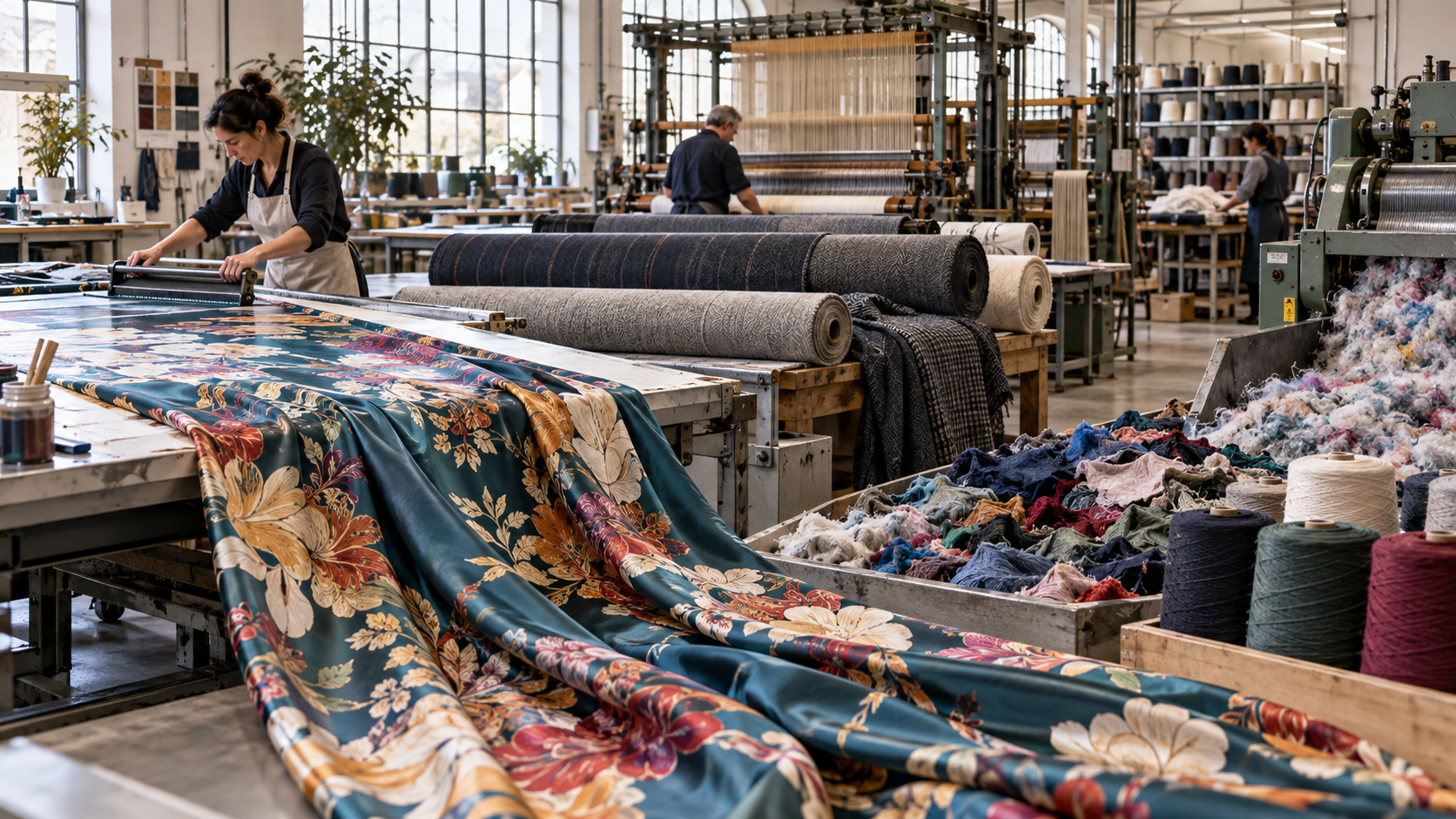
 Italy’s fashion reputation is usually associated with famous designers, elegant boutiques and the runways of Milan. Behind those visible symbols, however, stands a less familiar world of spinning mills, weaving workshops, dye houses, printers, finishers and fabric specialists.
Many of these businesses are concentrated in industrial districts: geographic networks in which companies with different skills cooperate within the same production chain. A single fabric may pass through several nearby firms before reaching a fashion house, allowing each company to specialize in one particular process.
Three districts illustrate this system particularly well. Como became internationally identified with silk and printed textiles. Biella built its reputation on fine wool and luxury suiting. Prato developed an extraordinarily adaptable fabric industry, including a tradition of recycling wool that began long before circular fashion became an international priority.
Together, these districts help explain why Italian fashion is not only about designers. It is also about the materials from which clothing is made.
What Is an Italian Textile District?
An Italian industrial district is not simply a city containing several factories. It is an interconnected local economy composed of manufacturers, artisans, suppliers, laboratories, schools, designers, transport companies and specialist subcontractors.
One business may prepare yarn, another weave it, another dye it and another apply the final treatment. Pattern designers, machinery technicians, chemical laboratories and quality-control specialists work alongside the manufacturers.
This structure became one of the foundations of postwar Made in Italy. It allowed relatively small companies to combine flexibility with highly specialized knowledge. Production could be adjusted rapidly, while expertise accumulated within families, factories and communities.
The districts are not isolated from international trade. Raw materials frequently come from abroad, and finished fabrics are sold to fashion houses throughout the world. What remains local is the concentration of technical knowledge: knowing how to transform a fiber into a material with a particular color, weight, texture, movement and performance.
This hidden manufacturing culture provides essential context for Italia Mia’s guide to Italian fashion designers. Designers may create the silhouette, but textile manufacturers give that silhouette its physical character.
Como: Italy’s Silk Capital
Como’s association with silk developed over several centuries. Silk working expanded under the rulers of the Duchy of Milan, who encouraged mulberry cultivation and sericulture in Lombardy. Mulberry leaves fed silkworms, while local workshops reeled, twisted and wove the resulting fiber.
The area’s waterways later supplied power for mechanized production. During the 19th and early 20th centuries, small workshops increasingly gave way to an industrial network of spinning, weaving, dyeing, printing and finishing businesses.
Como eventually became Italy’s most famous silk center. Its manufacturers developed particular expertise in lightweight woven materials, complex patterns and the precise printing required for scarves, ties, dresses and luxury accessories.
The UNESCO Creative Cities profile for Como estimates that the district produces approximately 70 percent of European silk. Como joined the UNESCO Creative Cities Network in 2021 in the Crafts and Folk Art category.
Como Silk Is More Than Sericulture
The expression “Como silk” can create a misleading picture of silkworms still being raised beside Lake Como on a large commercial scale. Sericulture was once important across northern Italy, but most raw silk and silk yarn used by the modern district now comes from abroad.
Como’s strength lies primarily in what happens after the raw material arrives. Local companies specialize in textile design, yarn preparation, weaving, dyeing, digital and screen printing, finishing and quality control.
A luxury scarf may begin as imported silk yarn but acquire its design, color, texture and finish within the Como district. This transformation—not necessarily the geographic origin of the fiber—is what gives the finished textile its local identity.
The district also works with cotton, wool, viscose and synthetic fibers. Many businesses that built their reputations through silk now produce fabrics for apparel, furnishings, accessories and technical applications.
The Art of Printing Silk
Printing is one of Como’s most distinctive skills. A complex scarf design must be transferred onto fabric without losing its sharpness, color balance or visual rhythm. The pattern must also be positioned correctly before the material is cut and sewn.
Traditional screen-printing methods require individual screens for different colors. Contemporary digital printing permits faster sampling and intricate imagery, but it has not eliminated the need for trained designers and color specialists.
Finishing is equally important. Washing, steaming and other treatments influence how silk feels, reflects light and moves against the body. Two fabrics woven from similar yarn can look and behave very differently after finishing.
This combination of artistic design and industrial precision has made Como an important supplier to Italian and international luxury houses. The district’s contribution may be invisible on a garment label, but it is often fundamental to the finished product.
Textile Education and Culture in Como
Como’s textile identity is supported by educational and cultural institutions. The Setificio Paolo Carcano, founded in the 19th century, has trained generations of textile technicians and designers. The Fondazione Antonio Ratti preserves an important collection of historic textiles while supporting contemporary art and research.
The Museo della Seta reconstructs the production chain from silkworm cultivation to yarn preparation, weaving, dyeing, printing and finishing. Its historic machinery helps visitors understand that silk is not simply a luxurious fiber but the product of a technically demanding manufacturing process.
For travelers, the museum offers an industrial counterpart to the villas and landscapes normally associated with Lake Como. It reveals a city shaped as much by work, machinery and design as by tourism.
Biella: The Territory of Fine Wool
At the foot of the Alps in Piedmont, Biella developed a different textile identity. Its specialty is wool, particularly the refined fabrics used in luxury tailoring, coats and high-quality menswear.
Wool working in the area dates back to the Middle Ages. Mountain streams supplied water for washing and finishing fibers and later helped power machinery. Villages throughout the valleys became involved in different parts of the production process.
Industrialization accelerated during the 19th century. Pietro Sella is traditionally credited with introducing mechanical wool-processing machinery from Britain to the Biella area in 1816. Over time, domestic and artisanal production evolved into a network of mechanized mills.
Unlike a fashion capital dominated by showrooms and retail stores, the Biella district developed around the preparation of the material itself: selecting fibers, spinning yarn, weaving cloth and carefully finishing its surface.
From Raw Fleece to Luxury Cloth
The quality of a wool fabric depends on far more than the name of the fiber. Manufacturers must consider fineness, length, strength, elasticity and consistency. The way the yarn is spun affects the fabric’s density and smoothness, while weaving determines its structure.
Finishing can completely change the final result. Washing, fulling, raising, shearing, pressing and other treatments influence softness, warmth, luster and drape.
Biella’s manufacturers became particularly skilled at producing worsted fabrics. In worsted processing, longer wool fibers are combed into a relatively smooth and parallel arrangement before spinning. The resulting yarn can be woven into the clean, elegant cloth associated with fine suits.
The district also works with cashmere, alpaca, mohair and other luxury fibers. Contemporary collections may combine natural fibers with silk, linen or performance materials to create lighter, more adaptable fabrics.
The Great Names of the Biella District
Biella and its surrounding valleys are associated with some of the most respected names in Italian textiles, including Vitale Barberis Canonico, Piacenza, Reda, Ermenegildo Zegna and companies connected with the Loro Piana tradition.
Their histories differ, but they share a strong emphasis on materials and manufacturing. Some began as mills and later developed international fashion brands. Others remain better known within the industry, supplying fabrics to tailors and fashion houses whose names are more familiar to consumers.
Ermenegildo Zegna, for example, established his wool mill in Trivero in 1910. The company eventually grew into a global luxury group, but fine fabric manufacturing remains central to its identity.
Biella therefore demonstrates an important principle of Italian fashion: textile production can be as prestigious and innovative as clothing design. The fabric manufacturer is not merely a supplier but a creative partner.
UNESCO recognizes Biella as a Creative City of Crafts and Folk Art, emphasizing the continuing relationship between textile manufacturing, local identity and technical knowledge.
Exploring Biella’s Wool Heritage
Biella’s industrial history can still be seen in former mills, workers’ settlements and factory buildings positioned along the valleys.
The Strada della Lana, or Wool Route, extends from Biella toward Borgosesia through an industrial landscape shaped by mills and waterways. One of its most interesting sites is the Fabbrica della Ruota at Pray, a preserved textile factory whose machinery was driven by a system connected to a large external wheel.
Visitors should not expect every working mill to offer public tours. These remain active industrial businesses rather than staged attractions. Museums, heritage routes and special events provide the most reliable access to the district’s textile culture.
Biella can also be combined with the Sanctuary of Oropa, the medieval upper district of Biella Piazzo and contemporary art at Cittadellarte–Fondazione Pistoletto.
Prato: Fabric, Reinvention and Recycled Wool
Prato, northwest of Florence, possesses one of Europe’s most important textile districts. Wool production can be traced to the Middle Ages, when water channels connected to the Bisenzio River powered fulling and other processes.
The city’s greatest industrial transformation, however, came through its ability to reuse existing material.
Beginning in the 19th century, Prato became famous for regenerated wool. Used clothing, production remnants and other wool textiles were collected, sorted and mechanically reduced to fiber. That recovered material could then be spun into new yarn and woven into new cloth.
This was not originally promoted as environmentalism. It was a practical industrial response to the cost and availability of raw wool. Yet the system anticipated many principles now associated with the circular economy.
The Cenciaioli and the Regeneration Process
The traditional cenciaioli were specialists who sorted old garments and textile scraps according to fiber, quality and color. Their knowledge was essential because recycled material could not be treated as a uniform mass.
Buttons, linings, zippers and unsuitable materials had to be removed. The remaining cloth was divided into categories before being shredded or pulled apart. The recovered fiber was then blended, carded, spun and woven again.
Sorting textiles by color sometimes reduced the amount of additional dyeing required. Dark blue scraps, for example, could contribute to a new blue or dark-colored yarn.
Regenerated fiber is generally shorter than virgin fiber because mechanical processing breaks and weakens it. Manufacturers may therefore blend recycled material with virgin wool or other fibers to obtain the required strength and performance.
Prato’s achievement was not simply learning how to tear old clothing apart. It was developing a coordinated production system capable of converting irregular discarded material into commercially useful cloth.
Prato Is Not Limited to Recycled Wool
Although regenerated wool remains central to Prato’s identity, the contemporary district is far more diverse. Its companies produce woven and knitted fabrics using wool, cotton, linen, viscose, polyester and numerous blends.
The district supplies fashion, accessories, upholstery and other markets. It is known for rapid experimentation with texture, color and surface treatment, as well as its ability to respond quickly to changing demand.
This flexibility distinguishes Prato from the more tightly defined identities of Como silk and Biella wool. Prato’s real specialty is reinvention: changing raw materials, processes and products as the market evolves.
The city has also developed a large garment-manufacturing sector, including many businesses created by Chinese entrepreneurs from the late 20th century onward. Textile production and ready-to-wear manufacturing are related but distinct parts of Prato’s modern economy, each with its own structure and challenges.
Travelers exploring Tuscany can place the city within a broader itinerary using Italia Mia’s guide to the best places to visit in Tuscany.
The Museo del Tessuto in Prato
The Museo del Tessuto is the best introduction to Prato’s industrial history. It occupies part of the former Campolmi textile factory, an atmospheric complex that preserves the connection between the museum collection and the city’s manufacturing past.
Its displays explain fibers, textile construction, historic design, Prato’s industrial development and the regenerated-wool cycle. The collections range from archaeological fabrics and European textiles to embroidery, garments, machinery and contemporary materials.
The museum is especially valuable because it presents textiles as both art and technology. A length of fabric can be appreciated for its pattern, but it can also be examined as the result of decisions about fiber, yarn, weave, dye and finish.
The Museo del Tessuto’s exhibition itinerary includes sections devoted to pre-industrial wool production and Prato’s regenerated-wool tradition.
Three Districts, Three Different Identities
Como, Biella and Prato are sometimes grouped together as Italian textile centers, but they should not be treated as interchangeable.
Como is distinguished by silk, textile design, printing and sophisticated finishing.
Biella is associated with fine wool, worsted cloth, luxury fibers and tailoring fabrics.
Prato is known for variety, responsiveness, regenerated wool and the ability to transform recovered or unconventional materials into new fabrics.
Their differences reflect the strength of Italy’s regional manufacturing system. Instead of concentrating every stage of production in a single national center, Italy developed territories with their own materials, machinery, skills and commercial relationships.
Other districts add further specialties: Carpi is associated with knitwear and clothing, areas of Veneto produce technical and fashion textiles, and parts of Tuscany and the Marche are known for leather and footwear. The same district principle appears throughout Italian manufacturing.
Textile Districts and the Meaning of Made in Italy
A Made in Italy garment is often presented as the vision of an individual designer. In reality, it may contain the work of many largely anonymous specialists.
A fabric technician determines how a yarn will behave. A colorist develops the exact shade. A weaver translates the design into structure. A finisher controls softness and drape. A quality inspector searches for flaws that most customers would never notice.
The close relationship between these specialists allows designers and fashion houses to develop exclusive materials. A company can experiment with a new weave, modify a finish or produce a limited sample without building every capability under one roof.
This system helps explain the continuing international influence of Italian fashion. Its strength lies not only in appearance or branding but in a manufacturing culture able to transform creative ideas into physical materials.
Sustainability: Tradition Meets Modern Pressure
Italy’s textile districts possess skills that can support more sustainable production, but tradition alone does not make a fabric environmentally responsible.
Prato’s regenerated-wool system provides genuine experience in recovering and reusing fiber. Durable wool fabrics from Biella may remain wearable for many years. Como’s technical knowledge can help manufacturers reduce waste during design, printing and sampling.
Nevertheless, textile manufacturing can consume water, energy and chemicals. Blended fibers are difficult to separate, mechanical recycling can reduce fiber quality, and synthetic textiles may release microfibers. Traceability is also complicated when raw materials and processing stages cross several countries.
The future of the districts therefore depends on combining inherited knowledge with better documentation, cleaner chemistry, renewable energy, efficient water treatment and designs that consider what will happen to a fabric after use.
The most promising lesson comes from the districts themselves: materials have value, technical knowledge matters, and discarded textiles can become industrial resources rather than waste.
The Invisible Foundation of Italian Fashion
Como, Biella and Prato reveal a side of Italy that tourists and fashion consumers rarely see. Their heritage is preserved not only in museums but also in operating factories, technical schools, archives and the knowledge of workers.
Como turns silk and other fibers into luminous printed surfaces. Biella transforms carefully selected wool into cloth for sophisticated tailoring. Prato takes materials apart and gives them another life.
The finished fabric may eventually appear on a runway in Milan, in a tailor’s workshop or inside a luxury boutique. Its real story, however, begins in these specialized communities where art, chemistry, engineering and craftsmanship meet.
External Sources
UNESCO Creative Cities Network – Como
UNESCO Creative Cities Network – Biella
Official Italy Tourism – Biella’s Textile Heritage and Wool Route
City of Prato – Textile Sector and Sustainability
Prato Recycled Carded Wool Association