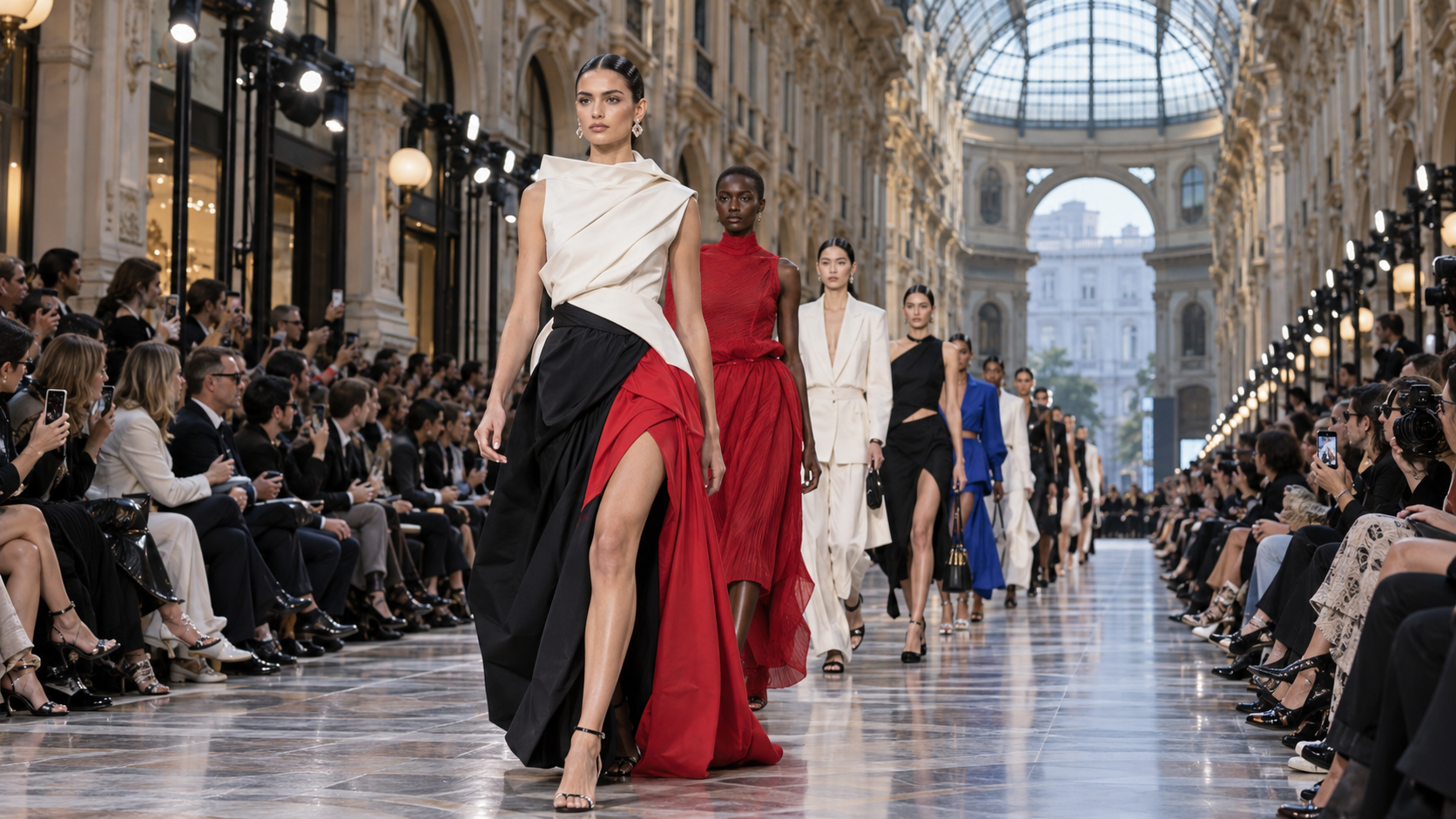
 Milan Fashion Week returns from September 22 to 28, 2026, with the women’s Spring/Summer 2027 collections, a packed official calendar and a citywide program extending well beyond the runway. Prada opened the week, Vogue World staged its first Milan edition beneath the glass vaults of the Galleria Vittorio Emanuele II, and the days ahead bring Fendi, Gucci, Moschino, Ferragamo, Dolce & Gabbana, Bottega Veneta and Giorgio Armani.
This is not simply another parade of famous labels. Milan is entering a period of major creative and corporate transition. Several houses are now developing the second or third collections of relatively new creative directors, while Armani is confronting its first year without its founder. Versace is absent as it prepares for another new chapter. Against that background, emerging designers, fashion schools, craftspeople and cultural institutions are competing for attention with the global luxury groups.
The official program includes 54 physical runway shows and a large number of presentations, appointments, exhibitions, screenings and industry events. Most fashion shows remain invitation-only, but many can be watched live or on replay through the official Camera Nazionale della Moda Italiana platform and the brands’ own channels.
Updated September 23, 2026. The calendar may still change; always confirm times on the official Milan Fashion Week website.
What Milan Fashion Week September 2026 Is Showing
The September edition is generally called Milano Moda Donna and is devoted principally to women’s ready-to-wear. Designers are presenting collections for Spring/Summer 2027, several months before the clothes arrive in stores.
The official dates are Tuesday, September 22 through Monday, September 28. Most of the physical runway activity takes place from Tuesday through Sunday, while Monday is primarily devoted to digital presentations. The week sits between London Fashion Week and Paris Fashion Week in the international fashion calendar.
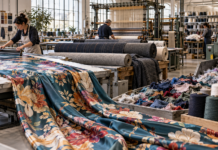
Milan’s importance goes well beyond glamour. Fashion supports an enormous network of Italian textile mills, leather workers, pattern cutters, factories, showrooms, photographers, stylists and independent craftspeople. The question running through this edition is whether the industry can protect that human expertise while adopting new technology and responding to a difficult luxury market.
Readers interested in the broader history behind the labels can also see our guide to Italian fashion, style and Made in Italy.
The Main Storylines of Milan Fashion Week
Prada Opens the Week with the Skirt as Its Central Idea
Prada made an unusually early appearance at 2:00 p.m. on Tuesday, opening the principal runway program rather than occupying its familiar Thursday position. Miuccia Prada and Raf Simons built all 63 looks around skirts, leaving trousers and dresses out of the collection.
The result was not a conventional exercise in ladylike dressing. A-line, pleated, leather, embroidered and transparent skirts were combined with sweaters, shirts, lace bras and restrained footwear. The skirt functioned as the expressive element in each look, allowing masculine and feminine ideas, severity and decoration, to coexist. It was a precise opening statement for a week concerned with how familiar Italian codes can be rearranged rather than merely repeated.
Vogue World Turns the Galleria into a Stage
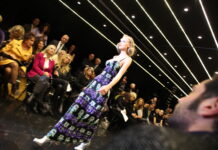
At 8:00 p.m. on opening night, Vogue World: Milano occupied the Galleria Vittorio Emanuele II. The theme, “The Human Touch in the Age of Technology,” placed Italian craftsmanship at the center of a production combining fashion, theatre, music and performance.
The event unfolded in five thematic acts, moving from Renaissance artisanship and industrial production to Made in Italy cinema, intelligent technology and speculative visions of fashion’s future. Teatro alla Scala collaborated on the production, and étoile Roberto Bolle appeared in a ballet performance choreographed by Laccio. Proceeds were directed to the library in Milan’s Quarto Oggiaro district.
The location mattered. The Galleria links Piazza del Duomo and Piazza della Scala and has long represented Milan’s particular mixture of commerce, urban ceremony and cultural prestige. Turning it into a fashion stage connected the global spectacle to a specifically Milanese setting.
Second Collections May Matter More Than Debuts
This is a season in which consolidation may prove more revealing than novelty. Maria Grazia Chiuri presents her second collection for Fendi on Wednesday. Meryll Rogge continues to define her Marni on Thursday, and Demna brings his second Gucci ready-to-wear collection to the runway on Friday after the house showed in Rome last season.
At Jil Sander, Simone Bellotti’s evolving minimalism remains closely watched. Louise Trotter continues her work at Bottega Veneta, while Maximilian Davis presents Ferragamo on Saturday. These are designers who have already delivered an initial statement; the more difficult task now is to create a coherent vocabulary that can survive beyond a debut.
Moschino Begins a New Creative Chapter
One of the week’s most anticipated appointments is Moschino at 5:00 p.m. on Friday. Simone Rizzo and Loris Messina, the founders of Sunnei, are presenting their first collection as Moschino’s creative directors. Their appointment gives the house two designers known for conceptual presentations, irony and an unconventional relationship with audiences.
The central question is how their sensibility will interact with Moschino’s own history of visual jokes, commercial wit and exaggerated Italian style. It is the only major creative-director debut on this season’s Milan calendar.
Armani in Transition
Giorgio Armani closes the principal Sunday morning program at 11:00 a.m. on Via Bergognone. The show carries unusual emotional and institutional weight after the death of Giorgio Armani in September 2025.
Longtime collaborators Silvana Armani and Leo Dell’Orco have continued to guide the design operation. Days before Fashion Week, the group also appointed Dario Vitale as creative director of Emporio Armani and Giorgio Armani accessories—the most important outside design appointment in the company’s history. Emporio Armani’s Summer 2027 collection is being introduced through a presentation on Thursday rather than its customary runway show.
The week therefore offers an early view of how one of Italy’s most independent fashion institutions intends to preserve its identity while gradually widening creative responsibility.
Versace and Boss Are Missing
Versace is absent from the Milan calendar for a second consecutive season. Pieter Mulier’s debut for the house is expected in 2027, leaving the brand outside this Fashion Week while its new direction is prepared. Boss is also absent.
An absence can be as revealing as a runway show. Milan’s schedule still has considerable star power, but the missing houses underline how extensively the leadership map of European luxury has changed.
Milan Fashion Week Program: Daily Highlights
The official calendar contains many presentations and private appointments in addition to the following selections. Times are Milan local time, Central European Summer Time, and may be revised.
Tuesday, September 22: Prada, Diesel and Vogue World
- 12:00 p.m. — Opening of the CNMI Fashion Hub
- 2:00 p.m. — Prada
- 3:00 p.m. — Dhruv Kapoor
- 4:00 p.m. — Diesel
- 5:00 p.m. — J. Salinas
- 6:00 p.m. — Venerdì Pomeriggio
- 8:00 p.m. — Vogue World: Milano
Prada supplied the day’s decisive runway statement, while Diesel and Dhruv Kapoor brought a younger, more street-oriented energy. Vogue World then shifted the emphasis from an individual collection to the wider narrative of Italian craft and cultural production.
Wednesday, September 23: Jil Sander, Fendi, Missoni and Etro
- 9:30 a.m. — Luisa Beccaria
- 10:30 a.m. — Jil Sander
- 11:30 a.m. — Daniela Gregis
- 12:30 p.m. — Antonio Marras
- 2:00 p.m. — Fendi
- 3:00 p.m. — Vivetta
- 4:00 p.m. — Missoni
- 5:00 p.m. — Marco Rambaldi
- 7:00 p.m. — Etro
- 8:00 p.m. — Onitsuka Tiger
Wednesday combines some of Milan’s most distinct design identities. Fendi is the major institutional focus, but Jil Sander, Antonio Marras, Missoni and Etro offer very different approaches to minimalism, narrative, knitwear, print and decoration.
Thursday, September 24: Max Mara, Marni, Alberta Ferretti and Roberto Cavalli
- 9:30 a.m. — Max Mara
- 10:30 a.m. — Genny
- 11:30 a.m. — Phan Dang Hoang
- 12:30 p.m. — Anteprima
- 2:00 p.m. — Marni
- 3:00 p.m. — Francesco Murano
- 4:00 p.m. — Alberta Ferretti
- 6:00 p.m. — Roberto Cavalli
The Thursday program moves from Max Mara’s controlled wardrobe-building to Marni’s more eccentric experimentation and the contrasting forms of femininity proposed by Alberta Ferretti and Roberto Cavalli. Emporio Armani also presents its Summer 2027 collection during the day in a non-runway format.
Friday, September 25: Sportmax, Gucci and the Moschino Debut
- 10:30 a.m. — Institution by Galib Gassanoff
- 11:30 a.m. — Sportmax
- 12:30 p.m. — Blumarine
- 2:00 p.m. — Gucci
- 3:00 p.m. — Simon Cracker
- 4:00 p.m. — Elisabetta Franchi
- 5:00 p.m. — Moschino
Friday is one of the most consequential days of the week. Demna’s Gucci at 2:00 p.m. will be examined for evidence of a stable new house identity. Three hours later, Rizzo and Messina make their Moschino debut, placing two very different forms of fashion theatre in direct conversation.
Saturday, September 26: Ferragamo, Dolce & Gabbana and Bottega Veneta
- 9:30 a.m. — Neithan Herbert
- 10:30 a.m. — Ermanno Scervino
- 11:30 a.m. — Ferragamo
- 12:30 p.m. — Dolce & Gabbana
- 2:00 p.m. — MSGM
- 8:00 p.m. — Bottega Veneta
- 9:00 p.m. — Philipp Plein
Saturday carries the density and visibility traditionally associated with a peak Fashion Week day. Ferragamo and Dolce & Gabbana lead the midday schedule; Bottega Veneta receives the evening spotlight. The long gap between major shows also reflects the geographical reality of Fashion Week: collections are staged across Milan, and moving between venues can be part of the challenge.
Sunday, September 27: Giorgio Armani and Milano Moda Graduate
- 10:00 a.m. — Hui
- 11:00 a.m. — Giorgio Armani
- 12:00 p.m. — Milano Moda Graduate
- 1:00 p.m. — Marques’Almeida
- 2:00 p.m. — Casa Preti
- 4:00 p.m. — Francesca Liberatore
Giorgio Armani is the Sunday anchor, but Milano Moda Graduate deserves attention. The project places fashion-school talent on an official platform and offers a useful counterweight to the concentration of attention around established luxury groups. Portuguese-founded Marques’Almeida also makes its Milan calendar appearance.
Monday, September 28: Digital Shows
Monday is devoted primarily to digital content, allowing participating labels to release collections through the official platform without a conventional physical runway. Miguel Vieira is among the names associated with the final day. Consult the live calendar for the confirmed sequence and streaming links.
Fashion Hub, New Talent and Events Beyond the Runway
The CNMI Fashion Hub is one of the week’s most useful initiatives for visitors interested in fashion’s next generation. Its projects place emerging designers, independent labels, education and more responsible forms of production alongside the main calendar.
The Sozzani Award, Milano Moda Graduate, Afro Fashion Association programs and Camera Moda Fashion Trust events broaden the week beyond the most powerful houses. Labels and designers including Nicolò Romano and Domenico Orefice are part of the conversation around emerging talent, while presentations distributed across the city give accessories, footwear and smaller collections space that a runway schedule cannot always provide.
Fashion Week also overlaps with exhibitions, brand installations, talks and film. The “Dalí and Fashion” project adds a historical and surrealist dimension, while Vogue Italia and Kering’s Cinemoda returns with fashion-related film screenings on September 25 and 26. Vogue Café operates at Palazzo Giureconsulti from September 24 to 26, close to the Galleria.
Not every accompanying event is open to the public, and a listing during Fashion Week does not automatically mean free admission. Check the organizer’s reservation rules before crossing the city for a presentation, screening or installation.
Can the Public Attend Milan Fashion Week?
Most official runway shows are professional events for buyers, editors, clients, celebrities and invited guests. Tickets advertised by unrelated businesses should not be confused with invitations to Prada, Gucci, Fendi or other official house shows.
The easiest and most reliable way for the public to follow the collections is through the official Milan Fashion Week live platform. Individual brands also stream selected shows and publish runway images shortly afterward.
Public exhibitions, fashion-school initiatives, screenings and retail events are often more accessible than the main runways. The Fashion Hub is particularly relevant, but opening hours and admission conditions should be checked on the official program.
Outside the venues, Via Montenapoleone, Via della Spiga, Brera, Corso Como, Tortona and the area around the Duomo become informal stages for street style, press activity and brand events. Visitors should respect entrances, security barriers and working photographers rather than obstructing access in the hope of seeing a celebrity.
Where to Stay During Milan Fashion Week
Fashion Week disperses events across the city, from the historic center and Brera to Tortona, Porta Romana, Bovisa and industrial venues beyond the inner ring. There is no single hotel that is close to every show. Access to the Metro and railway network is often more valuable than being within walking distance of one venue.
Some links in this article are affiliate links. Italia Mia may earn a commission if you make a purchase or booking, at no additional cost to you.
Armani Hotel Milano: For the Fashion District
The Armani Hotel Milano on Trip.com is in the Quadrilatero della Moda, convenient for Via Montenapoleone, Via della Spiga, Brera and central presentations. It is an expensive choice, but the location minimizes travel for guests whose appointments are concentrated in the luxury-shopping district.
Hotel Principe di Savoia: For Porta Nuova and Central Connections
The Hotel Principe di Savoia on Trip.com stands near Piazza della Repubblica, between the historic center, Porta Venezia and Porta Nuova. Its position works well for guests balancing central appointments with evening events in other districts.
NYX Hotel Milan: A Practical Base Beside Milano Centrale
The NYX Hotel Milan by Leonardo Hotels on Trip.com is a more practical option directly beside Milano Centrale. It is useful for airport connections, regional trains and Metro access, although it does not provide the atmosphere of Brera or the fashion district.
Travelers who prefer to compare a wider range of prices can check Milan hotel availability on Trip.com. Reserve early and favor a refundable rate: demand rises sharply, and the location of a last-minute bargain may create costly taxi journeys or long transfers.
Practical Advice for Fashion Week Visitors
Milan’s Metro is generally the fastest way to cross the city. Contactless payment is available at Metro gates, but travelers should still check current ATM Milano fares, service changes and the rules for changing lines. Allow generous time between appointments: a runway may start late, exits become congested, and venues that appear close on a map may be inconveniently connected.
Late September is usually mild, but rain is possible. A compact umbrella, comfortable shoes and a light layer are more useful than dressing solely for photographs. Taxis can be scarce immediately after important shows, and private-car traffic slows around major venues.
Anyone arriving by air should compare all three principal airports. Linate is closest to central Milan and connected by the M4 Metro. Malpensa has rail links to Milano Centrale and Cadorna, while Bergamo Orio al Serio relies mainly on road transfers. Do not schedule an airport departure immediately after a show without a substantial margin.
What This Edition May Tell Us About Italian Fashion
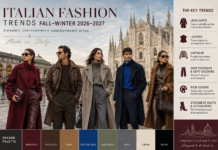
Milan Fashion Week September 2026 is less about a single dominant trend than about succession, authorship and the value of skilled work. Prada began with one familiar garment and demonstrated how much complexity it could carry. Vogue World enlarged the argument, presenting craft as a living system rather than a nostalgic decoration.
The rest of the week will test whether newly appointed designers can move beyond first impressions. Fendi, Marni, Gucci, Jil Sander, Bottega Veneta and Ferragamo must turn new creative leadership into recognizable, desirable collections. Moschino has to begin again without losing its wit. Armani must show that continuity can be active rather than ceremonial.
That is why this Milan Fashion Week matters. The industry is defending the economic and cultural meaning of Made in Italy while renegotiating who controls its historic houses, how collections reach audiences and how technology should serve—not erase—the human knowledge behind clothes.
Frequently Asked Questions
When is Milan Fashion Week in September 2026?
The women’s Spring/Summer 2027 edition runs from Tuesday, September 22 through Monday, September 28, 2026.
Which are the biggest shows?
The most closely watched names include Prada, Fendi, Jil Sander, Max Mara, Marni, Gucci, Moschino, Ferragamo, Dolce & Gabbana, Bottega Veneta and Giorgio Armani.
Is Versace showing in Milan?
No. Versace is absent from this season’s official Milan calendar. Pieter Mulier’s debut for the house is expected in 2027.
Can ordinary visitors buy tickets to the major runway shows?
Generally no. The major house shows are invitation-only professional events. Public livestreams, exhibitions, screenings, Fashion Hub projects and selected brand events are the legitimate ways for most visitors to participate.
Where can I watch the shows online?
Use the Camera Nazionale della Moda Italiana’s official Milan Fashion Week website. It identifies shows with live coverage and provides the current calendar.
What is the best area to stay in Milan during Fashion Week?
Choose the fashion district or Brera for central luxury appointments, Porta Nuova for a modern and well-connected base, Tortona for events in the southwest design district, or Centrale for rail and airport convenience. No area is close to every venue.
External Sources
- Camera Nazionale della Moda Italiana: official Spring/Summer 2027 calendar
- Camera Nazionale della Moda Italiana: Milan Fashion Week live platform
- Vogue: Milan Fashion Week Spring/Summer 2027 schedule
- Vogue: Spring/Summer 2027 Milan Fashion Week briefing
- Reuters: Dario Vitale joins the Armani design team
- The Guardian: Prada opens Milan Fashion Week with an all-skirt collection