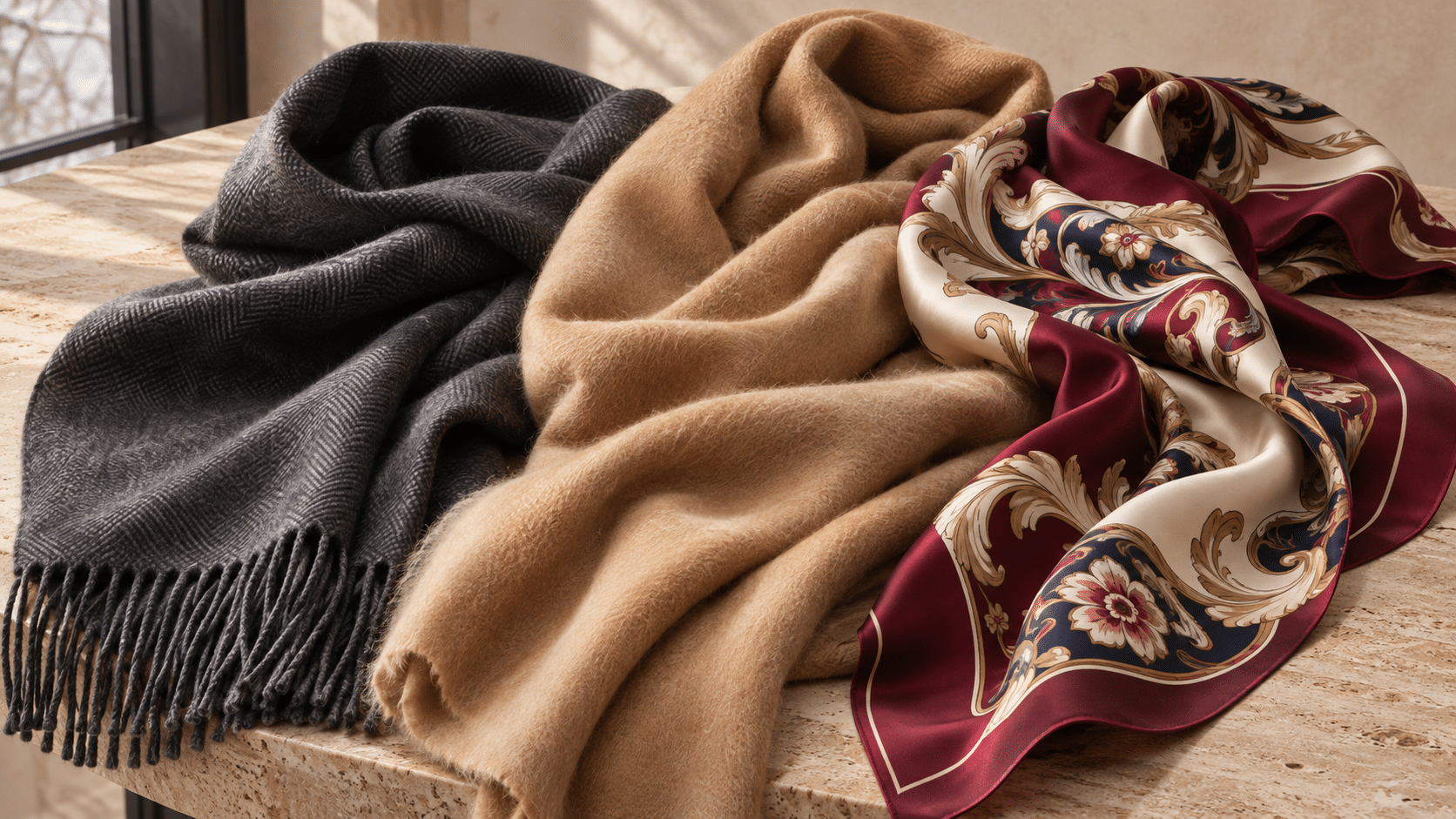
A scarf is often the first part of a winter outfit you notice: a soft fold of cashmere above a coat collar, a patterned silk square beneath a jacket, or a generous wool wrap pulled close on a cold morning. It is also one of the easiest accessories to buy for the wrong reason. An attractive print cannot make a thin scarf warm, and a cashmere label cannot tell you whether the size will work with your coat.
The most useful Italian scarves combine a fabric you enjoy wearing with proportions that suit your daily routine. Start with the job you need the scarf to do, then consider its composition, construction and finish.
Affiliate disclosure: Italia Mia may earn a commission from purchases made through the Italist links in this article, at no additional cost to you.
Wool, cashmere or silk: which scarf do you need?
For everyday winter use, begin with wool or cashmere in a sufficiently substantial fabric. For color, a smooth feel and a discreet layer beneath tailoring, consider silk. Blends can bridge those roles, but their proportions matter.
| Material | A useful choice for | What to check |
|---|---|---|
| Wool | Daily commuting, outdoor walks and casual winter coats | Softness against your neck, density and bulk |
| Merino wool | A relatively smooth scarf that fits beneath a collar | Finished fabric weight and personal skin comfort |
| Cashmere | Soft warmth without excessive weight | Construction, surface condition and care requirements |
| Wool–cashmere | An everyday scarf with a softer handle | Exact percentages and the feel of the finished fabric |
| Silk | Pattern, drape and a light layer under a coat | Dimensions, weave and whether warmth is your main priority |
| Wool–silk or cashmere–silk | A fluid scarf or stole for layering | Fiber proportions, transparency and thickness |
Fiber content is only part of the answer. A fine, loosely woven cashmere stole may provide less protection on a windy day than a denser wool scarf. The amount of fabric around your neck, the openness of the weave and the way you wear it all affect comfort.
Wool scarves: a practical starting point
A wool scarf makes sense when it will spend much of its life being wrapped, unwrapped and tucked into a coat. A medium-weight woven rectangle is particularly versatile: it can look tidy with tailoring yet feel appropriate with a puffer jacket.
“Wool” covers many different fabrics. Some are brushed and fluffy; others are compact and smooth. Merino is a type of sheep’s wool, while lambswool describes wool from a sheep’s first shearing. Neither term alone guarantees that a particular scarf will feel comfortable on your skin.
The neck is a demanding place to test a fabric. A scarf that feels pleasant in your hand may become irritating after half an hour beneath a raised collar. If you can try it on, let it touch the skin where you intend to wear it. When buying online, check the return conditions before choosing an unfamiliar texture.
For a first purchase, consider charcoal, navy, camel or a muted green. Choose a color that works with your most frequently worn coat, rather than trying to match every item in your wardrobe.
Cashmere scarves: softness with a few practical questions
Cashmere comes from the fine undercoat of cashmere goats. Its appeal in a scarf is easy to understand: softness matters when a fabric sits directly beneath the chin.
However, “100% cashmere” is a composition statement, not a complete quality assessment. It does not tell you the fiber length, yarn quality, fabric density or how the scarf will behave after repeated wear.
Look closely at the surface and edges. A brushed finish can be intentional, but loose fibers, pulled threads or uneven finishing deserve attention. If buying in person, feel whether the fabric has enough substance for its intended use. Avoid pulling or stretching it to test quality.
A wool–cashmere blend is also worth considering. Read the percentages: a scarf containing a small amount of cashmere should be assessed as that particular blend, rather than treated as equivalent to pure cashmere.
Pay more for comfort, construction and a size you will use. A luxury name is less helpful if the scarf is too narrow to wrap or so bulky that your coat will no longer close comfortably.
Silk scarves in winter: where they work best
Silk deserves a place in a winter wardrobe, but a light silk square serves a different purpose from a substantial wool scarf.
Worn inside a coat, a silk scarf can cover an open neckline, introduce a print and create a smooth layer against the skin. It is particularly useful for dinner, an indoor event or a journey that involves relatively little time outside.
For a long walk in cold weather, a thin silk foulard is unlikely to provide the insulation of a substantial wool or cashmere scarf. Keep the outerwear and weather in mind.
A wool–silk or cashmere–silk blend can offer a more fluid alternative to a traditional winter scarf. Inspect the actual fabric: a large, translucent stole may look generous in photographs while remaining very light.
For a related approach to adaptable layers, see The Italian Wardrobe Between Seasons.
Choose the dimensions before the print
“One size” is not enough information. Two scarves can look similar in a product photograph and behave very differently when wrapped.
The following measurements are useful shopping starting points, rather than fixed standards:
| Shape | Approximate dimensions | How it can work |
|---|---|---|
| Classic rectangle | 25–35 × 160–190 cm | A simple drape or a single wrap, depending on your build |
| Generous rectangle | 40–60 × 180–200 cm | More coverage and loose folds around the neck |
| Wide stole | 60–80 × 180–200 cm | Shoulder coverage or a larger wrap; check the bulk |
| Silk square | Around 90 × 90 cm | Folded diagonally and worn inside a neckline |
Check whether the listed length includes fringe. If dimensions are missing, ask before ordering.
The easiest reference is a scarf you already own. Measure it, then identify what you would change: more length for a loose loop, less width beneath a fitted coat, or enough fabric to cover your shoulders.
A wide scarf in fine fabric can fold down neatly. A narrower scarf in a chunky knit may create much more volume. Dimensions and thickness need to be considered together.
What makes a scarf Italian?
An Italian brand, Italian fabric and Italian manufacture are different claims.
If you specifically want a scarf made in Italy, look for an explicit origin statement on the product listing or label. An Italian designer name does not establish where every accessory is manufactured, and an item sold by an Italian boutique may come from an international brand.
Italian scarf design also extends beyond a single look. Faliero Sarti, for example, offers scarves and stoles in wool, cashmere, silk and blends, including both plain and printed designs. Its range illustrates why it is useful to compare individual compositions instead of assuming that every scarf from one maker will have the same weight or purpose.
Our guide to shopping clothing and accessories on Italist explains how to approach origin statements and individual listings.
Shop Italian scarves on Italist
Begin with a category, then narrow your search by material, dimensions and designer. Italist’s collections include international labels as well as Italian brands; check the manufacturing origin of each item if that matters to your purchase.
Explore women’s scarves on Italist
Look for a compact wool rectangle for daily wear, a cashmere scarf for a soft layer beneath a coat, or a silk square to add pattern around the neckline. For a stole, give particular attention to width and fabric weight.
Explore men’s scarves on Italist
Compare smooth woven scarves for tailored coats with more textured options for casual outerwear. A restrained check or a deep solid color is often easy to combine with existing clothes.
The same checks apply across both collections. Choose by measurements, color and intended use, regardless of how a scarf is categorized.
Before ordering, confirm the full composition, dimensions, care instructions and complete delivered price for your destination. Read the current return terms, including any return costs. Availability and prices can change, so these links lead to collections rather than a fixed product shortlist.
Color and pattern: start with your coat
A scarf sits close to the face and occupies a visible part of an outfit. It does not need to match everything, but it should have a clear relationship with the coat you wear most.
With navy, try camel, burgundy, cream or muted green. With charcoal, consider blue, rust or a soft neutral. A camel coat can work with chocolate, navy or a pattern that repeats one of those shades.
If the coat already has a strong check or textured surface, a plain scarf usually makes the combination easier. With a simple coat, a printed scarf has more room to stand out.
When assessing a pattern online, imagine it folded. A large motif may largely disappear once wrapped; the colors visible along the edges may matter more than the complete design shown flat.
Three easy ways to wear a winter scarf
A loose single wrap: place the scarf around your neck with one end longer, bring that end around once, then adjust without tightening it. This works well with a medium-length rectangle and an open coat collar.
A folded loop: fold a long rectangular scarf in half, place it around the neck and pass the ends through the loop. Keep it loose enough to sit comfortably. Very thick fabrics can become cumbersome this way.
A flat tuck: drape the scarf around your neck, cross the ends lightly and tuck them inside the coat. This is useful for fine wool, cashmere and silk when you want warmth or coverage without a prominent knot.
Try the arrangement with the coat fastened. If the scarf pushes the collar outward or feels crowded beneath the chin, use fewer folds or a lighter fabric.
Caring for wool, cashmere and silk scarves
Follow the scarf’s own care label. Fiber content alone does not determine whether washing is suitable: dyes, finishing and construction also matter.
For wool, Woolmark recommends following the approved washing instructions, using a suitable mild detergent and generally drying flat after washing. Only machine-wash a scarf when its label permits it.
For cashmere and silk, follow the specific maker’s instructions, particularly for printed fabrics and delicate finishes. Avoid improvised stain treatments on an expensive scarf.
Friction can cause pilling on wool and cashmere. Pay attention to rough coat collars, bag straps and exposed fasteners. Occasional pills do not automatically mean the scarf is defective. If using a suitable comb, work gently on a flat surface; avoid aggressive brushing or shaving of delicate, open fabrics.
Store scarves clean and completely dry. Fold soft knitted pieces rather than leaving them hanging under their own weight, and keep delicate silk away from accessories that could snag it.
A useful scarf earns its place through wear
For a first winter scarf, a medium-weight wool or wool–cashmere rectangle is a sensible starting point. Choose cashmere when its feel and lightness justify the extra cost for you. Add silk when you want a smooth layer or a print that changes the appearance of a familiar coat.
The final test is simple: can you wear it comfortably with your usual outerwear, care for it properly and imagine reaching for it on an ordinary winter morning?
External Links
- Italist women’s scarves — affiliate link
- Italist men’s scarves — affiliate link
- Faliero Sarti: official scarf collection
- Woolmark: how to wash wool
- Woolmark: understanding pilling