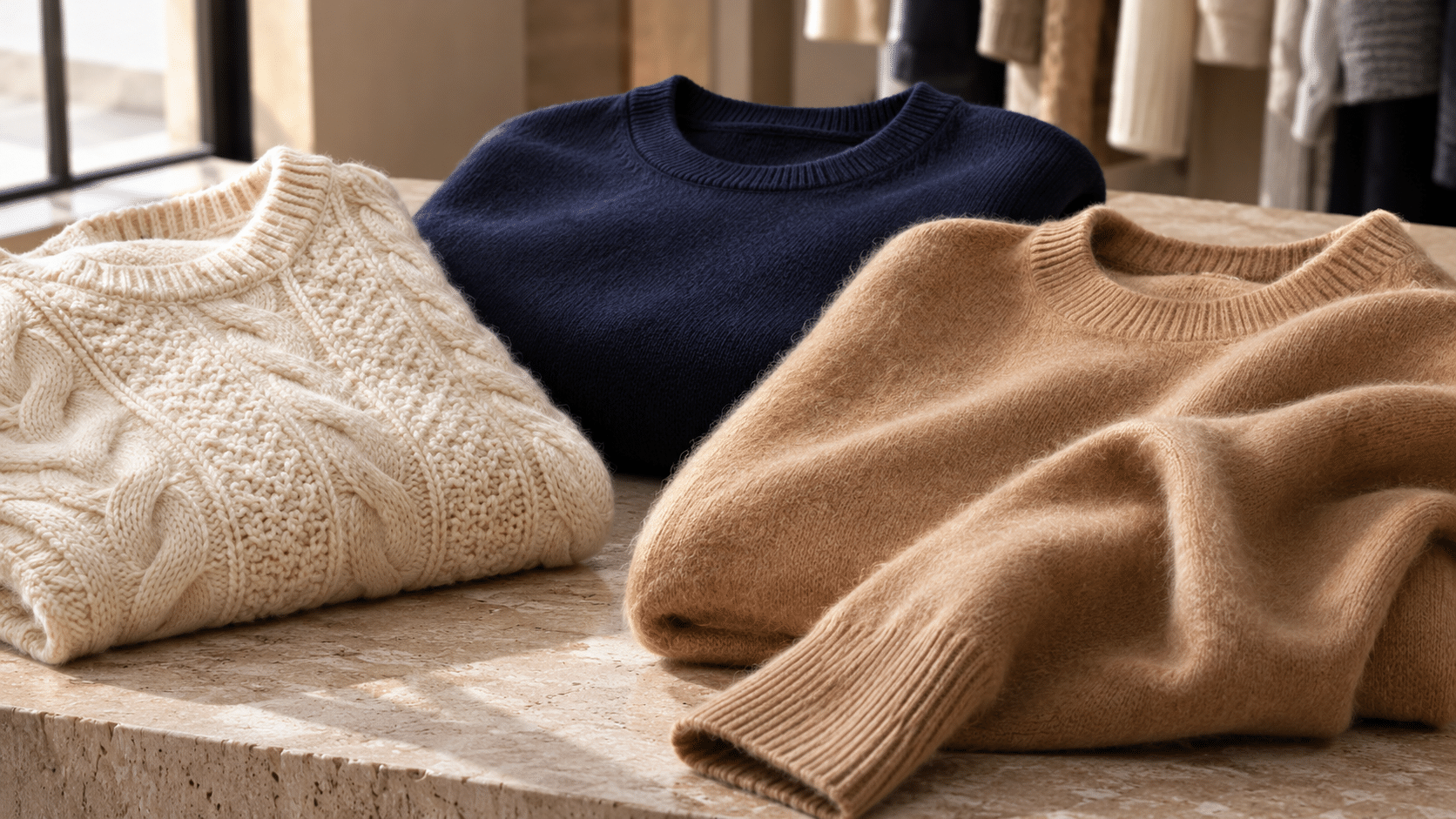
A beautiful sweater can win you over before you have checked a single detail. The color looks right, the fabric feels inviting and the label promises Italian style. But the real buying questions come afterward: what is it made from, how well is it knitted, and will it suit the way you actually dress?
Choosing Italian knitwear becomes easier when you separate the fiber from the finished garment. Cashmere is not automatically the best purchase, a thick sweater is not automatically well made, and a designer name cannot tell you how a cuff will behave after a season of wear.
Start with composition, examine construction, then consider fit and care. Those checks are more useful than an impressive discount or a particularly soft first touch.
Affiliate disclosure: Italia Mia may earn a commission from purchases made through the Italist links in this article, at no additional cost to you.
Wool, merino and cashmere at a glance
Merino is a type of sheep’s wool, not a separate alternative to wool. Cashmere comes from the fine undercoat of cashmere goats. Their names describe the raw material; they do not fully describe the quality or warmth of a sweater.
| Material | A useful starting point for | What to check |
|---|---|---|
| Sheep’s wool, with no breed specified | Everyday sweaters and textured layers | Feel against the skin, weight and stitch consistency |
| Merino wool | Fine sweaters, knitted polos and layers beneath jackets | Actual thickness, comfort and washing instructions |
| Cashmere | Soft sweaters and cardigans for gentle, regular wear | Surface condition, fabric stability and finishing |
| Wool–cashmere blend | A compromise between feel, price and intended use | The exact percentage of each fiber |
| Wool with synthetic fibers | Designs needing particular stretch, strength or texture | Whether the blend serves your needs and justifies the price |
For layering ideas, see The Italian Wardrobe Between Seasons. A buying decision should begin with the layer you need: something to wear under tailoring, a cardigan for the office or a substantial sweater for cold days.
Read the composition before the marketing
“Cashmere blend” leaves a great deal unsaid. A garment containing 5% cashmere and 95% wool is predominantly a wool sweater. That may be perfectly useful, but its price should make sense without treating the small cashmere content as the main attraction.
Consider these hypothetical labels:
- 100% merino wool: one fiber category, but still many possible yarn qualities and knit constructions.
- 90% wool, 10% cashmere: mainly wool; judge the whole garment rather than the luxury word.
- 70% wool, 30% polyamide: a blend that may suit its intended design; check feel, finish and care.
- 100% cashmere: a statement of composition, not a promise of exceptional workmanship.
Do not reject every blend. Equally, do not pay a premium for an unspecified “luxury blend.” If a listing omits percentages, request them before buying.
Italian brand, Italian yarn and Italian manufacture
These describe different parts of a garment’s story. An Italian brand can sell clothes manufactured elsewhere, and a sweater made with Italian yarn may be knitted in another country. Buying from an Italian boutique does not establish manufacturing origin either.
If Italian manufacture matters to you, look for an explicit garment origin statement. If the product only mentions Italian yarn, ask where the sweater itself was made. Our guide to shopping clothing and accessories on Italist explains how to approach listings with these distinctions in mind.
When merino wool is the useful choice
Fine merino deserves a place near the top of the shortlist for a sweater worn beneath a jacket. Its relatively fine fibers can make it comfortable next to the skin, although individual sensitivity varies. Fiber diameter helps explain why one wool garment feels smooth and another prickly; the word “wool” alone cannot settle the question.
A fine crew neck works with shirts, T-shirts and casual tailoring. A cardigan is convenient when you repeatedly move between outdoors and heated rooms. A knitted polo gives a softer alternative to a conventional shirt.
Check the finished weight rather than assuming all merino is lightweight. Examine a pale sweater over the layer you intend to wear beneath it: a deliberately sheer knit may be attractive, but it should not be a surprise when your shirt shows through.
If shopping in person, rest the fabric briefly against your inner forearm or neck without stretching it. Online, favor clear measurements and manageable return conditions over claims such as “incredibly soft.”
When cashmere earns its price
Cashmere makes sense when you particularly value its feel and are willing to give the garment appropriate care. It is less convincing as an automatic upgrade for every wardrobe.
The Cashmere and Camel Hair Manufacturers Institute identifies fiber length and fineness as important quality factors. Longer fibers can help reduce pilling. However, shoppers generally cannot verify these characteristics by touch alone, and many listings do not provide them.
Inspect whether the fabric feels coherent, the edges sit neatly and the sweater holds its intended shape. Very soft handling should not distract you from loose seams or an unstable neckline.
Think about use, too. A delicate knit will encounter more abrasion under a rough bag strap or through repeated contact with a desk. If that describes your routine, prioritize a construction suited to it instead of buying solely for softness.
Does more ply mean better cashmere?
Ply describes strands twisted together to form yarn. It is not a universal quality score. Additional plies can change weight and appearance, but the fiber, yarn thickness and knitting still matter. A higher ply number alone does not prove that one sweater is better than another.
Construction: what to inspect before buying
Turn the sweater inside out if you can. Good finishing should be visible where customers are less likely to look, too.
Seams and joins
Look for secure, even joins without gaps or uncomfortable bulk. Check the underarms, shoulder joins and neckline. Buttons should feel firmly attached, and buttonholes should look neat without obvious strain.
Fully fashioned knitwear is made from panels knitted to shape and then joined. Small shaping marks may appear near seams. This is useful construction information, but it should accompany inspection of the actual garment rather than replace it.
Cuffs, hem and neckline
Lay the sweater flat. Look for accidental waviness, obvious asymmetry or a neckline that already appears stretched. Deliberately relaxed edges and dropped shoulders are design choices; the question is whether the garment looks controlled and consistent with that design.
During a gentle try-on, check that cuffs sit comfortably and the hem does not continually ride upward. Avoid aggressive stretching as a quality test.
Gauge and stitch consistency
Gauge relates to knitting-machine needle spacing. Within comparable knitting systems, higher gauge generally means finer stitches, while lower gauge produces a coarser knit. It describes scale, not a ranking from poor to excellent.
A fine knit can be well made, and a chunky one can be poorly finished. Inspect for unintended holes, dropped stitches, snags or conspicuously uneven areas. Openwork, textured yarns and intentional irregularity require a different assessment from smooth jersey.
Holding the fabric toward light can reveal inconsistencies, but transparency by itself is not proof of poor quality.
Pilling: what is normal and what deserves attention?
Pilling is the formation of little balls of tangled fiber on the surface. Friction during wear encourages it, particularly around underarms, sleeves and places where clothing rubs against other surfaces. Wool and cashmere can both pill.
Some pilling does not automatically establish a defect. Fiber length, yarn twist, construction and wearing conditions all influence it. Nor does a high price guarantee a pill-free sweater.
If a new purchase develops extensive pilling very quickly, especially alongside distortion or thinning, photograph the condition and contact the retailer before attempting substantial treatment.
For ordinary maintenance, lay the dry knit flat and use a suitable sweater comb very gently. A fabric shaver requires particular care around raised stitches, seams and delicate areas. Follow the tool’s instructions and the garment maker’s advice; avoid repeatedly scraping the same patch.
Fit matters as much as fiber
Try the sweater with the clothes you plan to wear beneath and over it. A beautifully made knit can still be the wrong purchase if it bunches under your jacket or pulls across your chest.
Sit down, bend your elbows and reach forward. Check the underarms, upper sleeves and hem. On a cardigan, look for pulling between the buttons when fastened.
For online shopping, compare garment measurements with a sweater that already fits. Chest width, body length and sleeve length are more informative than assuming every brand’s medium is identical. Follow the seller’s measuring method, particularly for dropped shoulders and raglan sleeves.
Care: check the label before checkout
The care label is part of the buying decision. A sweater that needs more maintenance than you are willing to provide may be poor value even at an attractive price.
Washing
Follow the garment’s specified method and temperature. Some wool garments permit machine washing; others require hand washing or professional cleaning. A washing machine’s wool program does not make every wool sweater machine washable.
Use a suitable mild wool detergent where washing is allowed. Avoid vigorous rubbing or wringing, and support the garment when lifting it wet. For cashmere, follow its own care instructions rather than assuming advice for another sweater applies.
Drying
For washable knitwear, gently remove excess water and reshape without pulling. Dry flat in shade, away from direct heat, unless the care instructions specify otherwise. Do not hang a wet sweater by the shoulders. Only tumble dry when the label explicitly permits it.
Between wears and seasonal storage
Air garments when appropriate rather than automatically washing after every short wear. Fold dry sweaters for storage, and put seasonal pieces away clean and completely dry. Check stored knitwear periodically for moisture, insects or damage.
How to judge value without chasing a discount
Compare sweaters that meet the same need. A fine cardigan and a heavy cable knit are different purchases even when both say “100% wool.”
Before paying, check:
- Composition: Are the fiber percentages clear?
- Construction: Are the joins, edges and stitch pattern consistent?
- Fit: Does it work with your existing clothes?
- Care: Can you realistically maintain it?
- Total cost: Have you included delivery, applicable charges and potential return costs?
Cost per wear can clarify your priorities. A hypothetical €180 sweater worn 90 times costs €2 per wear before maintenance. A €90 sweater worn six times costs €15 per wear. The calculation is useful only when you make realistic assumptions about how often you will choose it.
Spend more for qualities you can identify: a better fit, more suitable fabric, careful finishing or a design you will repeatedly wear. A crossed-out original price is not evidence of those qualities.
Explore knitwear on Italist
Browse women’s knitwear on Italist or men’s knitwear on Italist, then compare individual listings for composition, measurements, care and manufacturing origin. These collections may include international brands and materials beyond wool and cashmere.
For a first purchase, choose the piece that fills a clear gap: a fine sweater beneath a jacket, a cardigan for changing temperatures or a substantial knit for colder days. Check current delivery and return terms for your destination before ordering.
The sweater worth keeping is the one that fits comfortably, suits your routine and still earns its place when the excitement of buying it has passed.
External Links
- Woolmark: What is merino wool?
- Woolmark: Fully fashioned knitting
- CCMI: Cashmere Purchasing Guide
- Woolmark: What is pilling?
- Woolmark: How to wash wool
- Woolmark: How to dry wool
- Woolmark: How to store wool clothes