
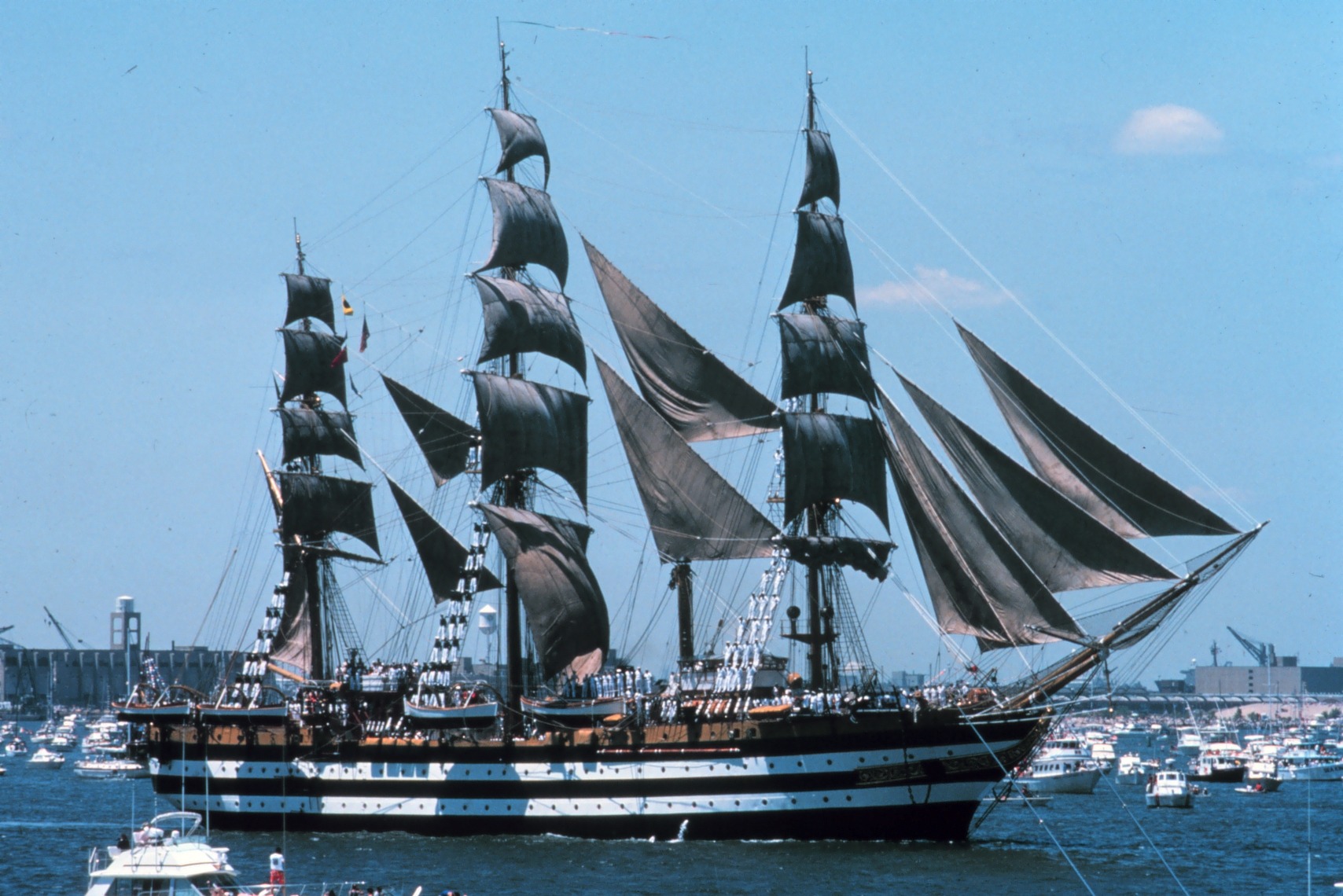
In 1962, the American aircraft carrier USS Independence sighted a three-masted sailing ship in the Mediterranean and asked her to identify herself. The question went out by signal lamp. The reply identified the Italian Navy training ship Amerigo Vespucci. Then came the message Italians still quote more than sixty years later. “You are the most beautiful ship in the world.”
It is easy to see what caught the Americans’ attention. Two white bands encircle a dark hull, and a gilded figure leans out over the water beneath the bowsprit. But look at a photograph of the Vespucci under sail and try following just one rope from the deck to the canvas. Somewhere aboard is a young sailor who has to know where that rope leads, what it moves and when to let it run. That is why Italy built this ship in the first place. It also explains why she was still crossing the Atlantic in 2026.
Why Italy built a square-rigged ship in 1931
The Vespucci began with a question facing the Italian Navy in the 1920s. How should the Naval Academy at Livorno, on the coast of Tuscany, prepare officers for their first experience of the sea? Its graduates could expect to serve aboard powered vessels. The Navy nevertheless wanted them to spend part of their education under sail, where wind direction, sea conditions and small errors of judgment would have consequences they could feel through the deck.
Naval engineer Francesco Rotundi designed the ship. Workers at the royal shipyard of Castellammare di Stabia, on the Bay of Naples, laid her keel on May 12, 1930, and launched her on February 22, 1931. By July she was heading for northern Europe on her first training cruise. She joined an older sister ship, the Cristoforo Colombo. Together, their names recalled two navigators whose Atlantic voyages had changed how Europeans understood the world.
The man represented at the Vespucci’s bow was a Florentine. Amerigo Vespucci sailed across the Atlantic around the turn of the sixteenth century, and a Latin form of his first name gave America its name. The ship carries his likeness in gilded wood. Her builders left a less obvious detail behind the figurehead, where a pair of bull’s horns serves as a traditional charm. From the quay, the gold catches the eye. It takes the ship’s own visitor guide to tell you what is on the other side.
How to read the Amerigo Vespucci from the quay
Start at the bow. The long spar projecting over the water is the bowsprit, and it helps explain why two different measurements appear in descriptions of the ship. The hull is about 82 meters long. Her overall length reaches 101 meters. Now count the upright masts from bow to stern. The foremast comes first, followed by the mainmast, the tallest at about 54 meters, and finally the mizzenmast. Each carries horizontal spars called yards. A vessel with square sails on all three masts is what sailors call a full-rigged ship.
From a little farther away, the ropes seem to merge into a fine mesh. They do different jobs. The shrouds brace the masts sideways and give sailors a way up into the rigging. Other lines allow the crew to turn a yard or control a sail from the deck. The Navy lists roughly 36 kilometers of rope aboard. With 24 sails to handle, learning the layout is much like learning the streets of an unfamiliar town, except that some destinations are fifty meters overhead and the whole place moves beneath your feet.
What cadets learn when the wind shifts
Imagine a breeze swinging several degrees while the ship holds her course. The first clue might be a tremor along the edge of a sail. To present the canvas to the wind at a better angle, the crew can turn the yard by hauling on a line called a brace while easing its counterpart. Pull too early on one side and someone on the other feels the strain. When the timing is right, the yard comes around, the canvas fills and the change is visible from the deck.
The Vespucci has auxiliary propulsion, and her crew handles the sails by hand. Both arrangements serve the same working ship. An engine gives the commanding officer an option when the wind is unfavorable. Working the rig gives a cadet an experience that will matter long after the voyage. Years later, an officer issuing an order from a bridge may remember what it felt like to receive one from the far end of a heavily loaded rope.
The training ship has changed with the people she teaches. In 2000, one of a succession of refits provided accommodation for female personnel. A visitor comparing photographs taken before and after that work might struggle to spot a difference. For the women coming aboard and unpacking their belongings for a voyage, the change was substantial.
How the “most beautiful ship in the world” story endured
The Italian Navy’s account of the encounter with USS Independence preserves a detail worth remembering. The crews exchanged their greeting in flashes of light. Each letter of the compliment had to be sent, read and understood across open water. What sounds today like a convenient nickname began as a message one group of sailors took the trouble to send another.
On September 1, 2022, a second American carrier, USS George H.W. Bush, met the Vespucci in the southern Adriatic while the Italian vessel was sailing from Manfredonia toward Taranto. Sixty years after the original exchange, the crews recalled the salute. By then the young sailors who had read the first message were old enough to be the grandparents of the people on deck.
From Genoa to Cape Horn and home again
On July 1, 2023, the Vespucci left Genoa for a world tour. The early itinerary traced a route through Dakar and the Caribbean before working down the Atlantic coast of South America. In April 2024 she rounded Cape Horn. Read that name on a map and the scale of the voyage becomes clearer. A ship built on the Bay of Naples to train cadets from Livorno had sailed to the southern tip of South America. Los Angeles and Honolulu still lay ahead.
By the time she returned to Genoa on June 10, 2025, Italian Navy Day, the Vespucci had covered 49,500 nautical miles. The tour organizers counted 53 ports in 33 countries. In port, visitors could look up at the yards and meet the people who worked them. Between ports, the same sailors had to take the night watches and bring the ship to her next landfall. Her sailing calendar continued the following year. The 2026 North American campaign ended in Trieste on October 8.
For anyone hoping to see the Vespucci, the distinction between her home port and her whereabouts matters. The Navy lists La Spezia as her port of assignment. Genoa hosted the departure and return of the world tour, and Trieste welcomed her after the North American voyage. Before arranging a visit, check the official campaign website for a dated port call and boarding information.
If you do get alongside, look for the ship’s motto: Non chi comincia ma quel che persevera. Adopted in 1978, it honors the person who perseveres. It could stand as a tribute to the less celebrated people in the ship’s story. Rotundi designed a silhouette that sailors recognized from another vessel in mid-Mediterranean. Nearly a century of sailmakers, riggers, engineers and cadets have kept her seaworthy enough to be recognized again.
External Links
- Italian Navy history of the Amerigo Vespucci
- Italian Navy account of the American carriers’ salutes
- Official illustrated guide to the ship’s decks, rigging and figurehead (PDF)
- Official world tour route and voyage statistics
- Amerigo Vespucci campaign news and port announcements