
 Kartell: How Plastic Became an Icon of Italian Design
Few companies have transformed an everyday material as completely as Kartell. Founded in Milan in 1949, the company turned plastic from something inexpensive and utilitarian into a material associated with experimentation, elegance and collectible design.
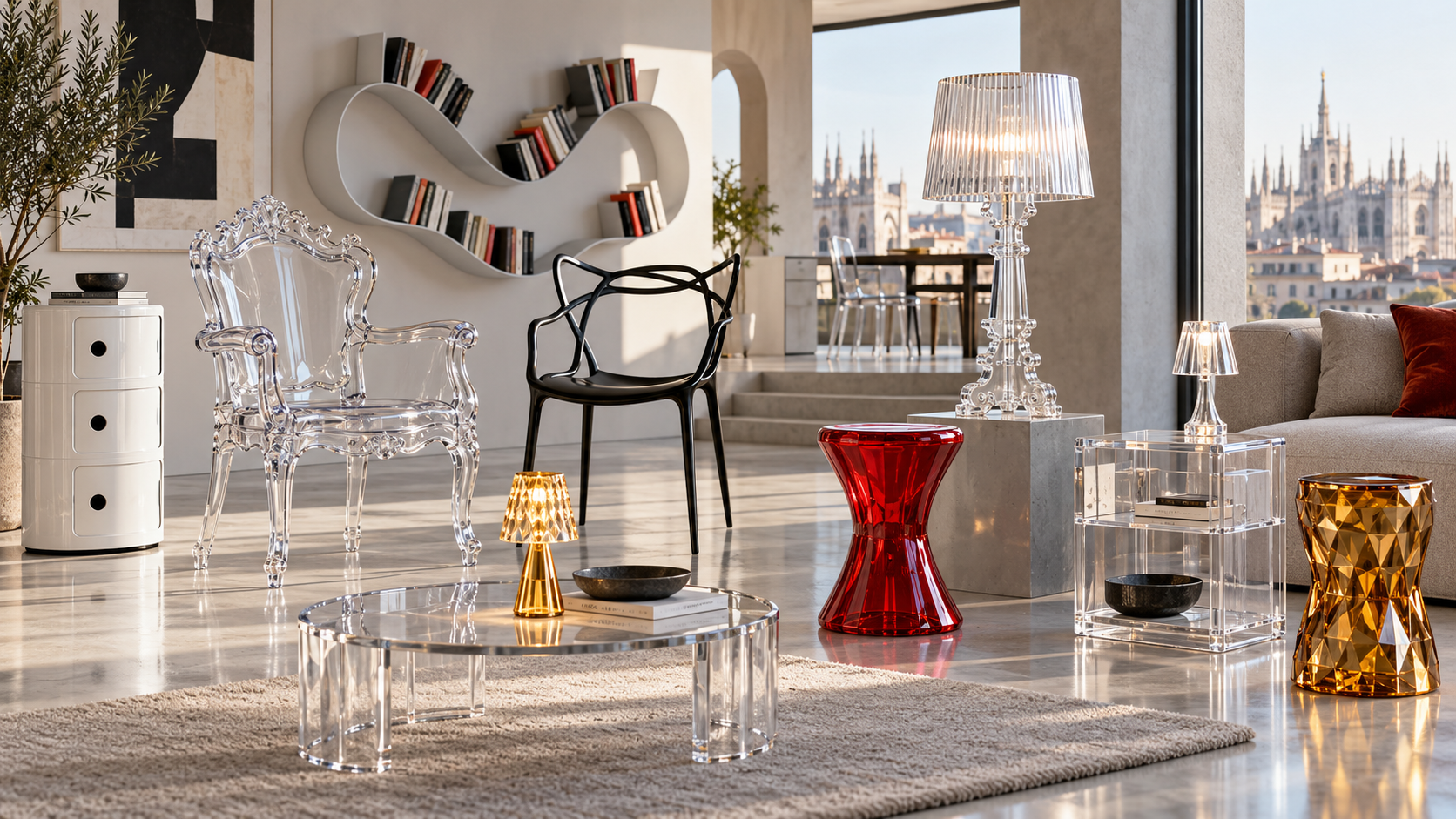
Kartell furniture is instantly recognizable. Transparent chairs catch and refract the light, glossy cabinets introduce color without overwhelming a room, and sculptural lamps combine modern technology with shapes inspired by the past. The brand’s best products are functional enough for daily life yet distinctive enough to be displayed in museums.
Kartell occupies an important place within the broader story of iconic Italian design brands. Like Alessi, Artemide, Bialetti, De’Longhi and Flos, it demonstrates how Italian companies can turn ordinary domestic objects into internationally recognized expressions of design.
Today, Kartell produces chairs, tables, bookcases, storage systems, lamps and accessories created by some of the most influential designers of the last century. Whether you are furnishing an entire contemporary home or searching for one memorable accent piece, Kartell offers a surprisingly diverse introduction to authentic Italian design.
The History of Kartell
Kartell was established in 1949 by Giulio Castelli, a chemical engineer who had studied under Nobel Prize-winning chemist Giulio Natta. Castelli understood that emerging plastics could be used to create more than disposable or purely industrial products. With careful engineering and imaginative design, they could become durable, practical and visually sophisticated.
The company initially manufactured accessories for automobiles. Its first product was the K101 ski rack, introduced in 1950. Kartell subsequently expanded into laboratory equipment and household objects, areas in which hygiene, lightness, durability and efficient manufacturing were especially important.
From the beginning, Kartell was based in the Milan area and closely connected to the development of modern Italian industrial design. The company collaborated with architects and designers including Gino Colombini, Marco Zanuso, Joe Colombo, Achille and Pier Giacomo Castiglioni, Richard Sapper and Gae Aulenti.
One of the central figures in Kartell’s history was Anna Castelli Ferrieri, Giulio Castelli’s wife and a pioneering Italian architect. Her work helped establish the company’s visual identity and demonstrated that plastic furniture could be both rational and inviting.
Her most famous contribution was the Componibili modular storage system, introduced in 1967. Its cylindrical form, sliding doors and stackable construction embodied the optimistic spirit of postwar Italian design. More than half a century later, Componibili remains one of Kartell’s best-known products.
In 1988, leadership of the company passed to Claudio Luti, who brought experience from the fashion industry. Under his direction, Kartell entered a new era characterized by collaborations with internationally celebrated designers, an expanded retail presence and increasingly sophisticated manufacturing methods.
Kartell and the Culture of Plastic
Kartell’s achievement was not simply to manufacture furniture from plastic. The company created what Giulio Castelli called a “culture of plastic.”
Instead of hiding the properties of synthetic materials, Kartell’s designers emphasized them. Transparency, intense color, molded curves, glossy surfaces and seamless construction became defining elements of the brand.
Plastic allowed Kartell to make shapes that would have been difficult, heavy or prohibitively expensive in wood, glass or metal. A chair could appear almost invisible. A traditional chandelier could be reinterpreted as a lightweight contemporary lamp. A small cabinet could be molded into a continuous geometric form.
Kartell also challenged the assumption that plastic must look cheap. Its technically demanding manufacturing processes produced objects with remarkable clarity, strength and precision. The best Kartell designs do not imitate other materials; they celebrate what advanced polymers can do.
This approach helped make Kartell an essential part of the history of Italian objects represented in major museum collections.
The Designers Behind Kartell
Kartell has always treated collaboration as a source of innovation. Rather than relying on one permanent aesthetic, the company invites designers to reinterpret its materials and production techniques.
Anna Castelli Ferrieri brought architectural discipline, modularity and practical intelligence to Kartell’s early domestic products.
Philippe Starck became one of the most visible figures in the company’s modern history. His Louis Ghost chair transformed the outline of an eighteenth-century armchair into a single transparent molded form.
Ferruccio Laviani created several of Kartell’s most successful lamps, including Bourgie, Take and Battery. His work frequently combines historical references with modern materials and lighting technology.
Ron Arad used flexibility and movement to create the Bookworm wall bookcase, while Marcel Wanders brought decorative surface effects to pieces such as the Stone stool.
Other collaborators have included Patricia Urquiola, Antonio Citterio, Piero Lissoni, Tokujin Yoshioka, Mario Bellini, Vico Magistretti and Eugeni Quitllet.
The variety of these partnerships explains why Kartell’s catalog can include restrained office furniture, playful accessories, baroque-inspired lamps and futuristic transparent chairs while still maintaining a recognizable identity.
Why Kartell Furniture Remains Popular
Kartell products work particularly well in contemporary interiors because they provide visual impact without necessarily adding visual weight. A transparent chair can furnish a small dining area without making it feel crowded, while a brightly colored cabinet can animate an otherwise neutral room.
The company’s pieces also mix easily with furniture from other periods. Louis Ghost chairs can surround an antique wooden table, a Bourgie lamp can sit on a minimalist console, and Componibili can function as a bedside cabinet in either a modern apartment or a traditional bedroom.
Kartell is therefore not limited to homes decorated entirely in a futuristic style. Its most successful objects act as accents: recognizable pieces that introduce color, humor or an unexpected contrast.
Ten Best Kartell Products to Buy
1. Kartell Componibili Storage Unit
Designed by Anna Castelli Ferrieri in 1967, Componibili is one of the defining objects of modern Italian furniture. Its compact cylindrical body contains sliding compartment doors that follow the curved profile of the unit.
Componibili can serve as a bedside table, bathroom cabinet, office organizer or living-room storage unit. Its rounded design avoids sharp corners, while its relatively small footprint makes it particularly useful in apartments.
The classic version is available in different heights and finishes. Kartell has also produced larger, metallic, matte and recycled-material variations. The original remains especially appealing because it captures the optimism and practicality of 1960s Italian design.
Buy the Kartell Componibili on Amazon
2. Kartell Louis Ghost Chair
The Louis Ghost chair, designed by Philippe Starck, is arguably Kartell’s most recognizable contemporary product. Its shape recalls a classical Louis XV armchair, complete with a rounded back and elegant arms, but the chair is molded in transparent polycarbonate.
This combination of historical silhouette and modern material gives Louis Ghost its distinctive character. It can appear formal, playful or almost invisible depending on the surrounding furniture.
The chair is suitable for indoor and outdoor use, resistant to impacts and weather, and stackable up to six chairs. Transparent crystal is the best-known finish, although colored and opaque versions are also available.
Buy the Kartell Louis Ghost Chair on Amazon
3. Kartell Masters Chair
Created by Philippe Starck and Eugeni Quitllet, the Masters chair pays tribute to three famous modern chairs by combining their outlines into one sculptural backrest.
The designs referenced are Arne Jacobsen’s Series 7 chair, Charles and Ray Eames’ molded shell chair and Eero Saarinen’s Tulip armchair. Their overlapping silhouettes become a flowing lattice that is decorative as well as supportive.
Despite its design-history references, Masters is practical and comfortable enough for everyday dining. It is lightweight, stackable and available in a range of neutral, bright and metallic finishes.
Buy the Kartell Masters Chair on Amazon
4. Kartell Bourgie Table Lamp
Designed by Ferruccio Laviani, Bourgie is a witty meeting of baroque decoration and modern industrial production. Its ornate base resembles a traditional carved lamp, while its pleated shade creates reflected patterns of light.
Because the lamp is made from transparent or colored thermoplastic material, the elaborate shape feels lighter and more contemporary than an antique lamp. The height can also be adjusted to suit different settings.
Bourgie works well on a sideboard, console, desk or bedside table. It is one of the best Kartell products for anyone who wants a dramatic design object rather than purely functional illumination.
Buy the Kartell Bourgie Lamp on Amazon
5. Kartell Battery Table Lamp
The Battery lamp, another design by Ferruccio Laviani, translates Kartell’s fascination with transparency into a compact portable light.
Its faceted shade creates reflections even when the lamp is switched off. When illuminated, the textured surface disperses the light and produces an effect reminiscent of cut crystal.
The rechargeable version can be moved from a dining table to a bedroom, terrace or reading corner without requiring a nearby outlet. Its small scale also makes it an accessible way to introduce Kartell design into the home.
Buy the Kartell Battery Lamp on Amazon
6. Kartell Bookworm Bookshelf
Designed by Ron Arad, Bookworm transforms a bookcase into a flexible line drawn across the wall. The long thermoplastic strip can be mounted in curves rather than being restricted to a conventional straight arrangement.
Book supports positioned along the strip allow it to hold books and small objects. The final configuration depends on the wall, the length selected and the imagination of the owner.
Bookworm is ideal for creative interiors, studios and home offices. It is functional, but its greatest appeal comes from turning a row of books into part of an architectural composition.
Buy the Kartell Bookworm Bookshelf on Amazon
7. Kartell Take Table Lamp
The Take lamp by Ferruccio Laviani is made from two transparent molded sections joined together to create the shape of a traditional bedside lamp.
The pleated interior surface enriches the light and gives the simple silhouette a more decorative appearance. Compact and relatively understated, Take is suitable for a nightstand, shelf, desk or narrow console.
It is a good choice for buyers who appreciate the transparency of the Bourgie lamp but prefer a smaller and more affordable design.
Buy the Kartell Take Lamp on Amazon
8. Kartell Prince AHA Stool
The Prince AHA stool by Philippe Starck consists of two cone-shaped forms joined at their narrowest point. The result resembles an hourglass, a spinning top or a small sculptural pedestal.
Prince AHA can be used as a stool, side table, plant stand or occasional surface. It is lightweight enough to move easily and compact enough for bedrooms, bathrooms, balconies and small living spaces.
Its textured surface and soft colors make it less glossy than many classic Kartell products, allowing it to blend into relaxed contemporary interiors.
Buy the Kartell Prince AHA Stool on Amazon
9. Kartell Small Ghost Buster Nightstand
Designed by Philippe Starck with Eugeni Quitllet, the Small Ghost Buster takes the outline of a traditional bedside cabinet and recreates it as a clean, transparent or opaque molded form.
The open front provides practical storage for books, devices and personal items. Because the design is visually simple, it can serve as a nightstand, side table or small storage unit.
The transparent version is particularly useful in compact rooms because it provides storage without appearing bulky. It also pairs naturally with Louis Ghost chairs and other transparent Kartell pieces.
Buy the Kartell Small Ghost Buster on Amazon
10. Kartell Stone Stool
Designed by Marcel Wanders, the Stone stool is a low cylindrical piece with an irregular geometric surface. Its faceted structure reflects light like a cut gemstone, especially in transparent and metallic finishes.
Stone can function as a stool, side table, decorative pedestal or bedside surface. Its compact dimensions make it easy to place beside a sofa or armchair.
Although highly decorative, it remains versatile. It is one of the easiest Kartell products to add to an existing room because it does not require replacing any major furniture.
Buy the Kartell Stone Stool on Amazon
How to Choose the Right Kartell Product
The best Kartell purchase depends on how much visual impact you want and how the object will be used.
For practical storage, Componibili and Small Ghost Buster are the most versatile options. Both can be used in bedrooms, living rooms, bathrooms or offices.
For dining areas, Louis Ghost creates a more classical and elegant atmosphere, while Masters has a stronger contemporary profile.
For lighting, Bourgie is the statement piece. Battery offers portability, while Take is smaller and easier to incorporate into a bedroom or compact apartment.
If you simply want to introduce one Kartell accent, Stone or Prince AHA can function as a stool, table or decorative object without requiring changes to the rest of the room.
Decorating with Kartell
Kartell pieces are most effective when given enough space to be noticed. Filling an entire room with transparent plastic and vivid colors can weaken the individuality of each object.
One Louis Ghost chair at a writing desk can be more visually interesting than a complete matching set. A red Componibili cabinet can provide a single point of color in a white bedroom. A transparent Bourgie lamp can create contrast on an antique wooden chest.
Kartell also works particularly well with marble, natural wood, exposed brick and traditional Italian architecture. The contrast between an old surface and a technically advanced molded object emphasizes the qualities of both.
Visitors interested in seeing how contemporary design interacts with Milanese style can consult Italia Mia’s guides to shopping in Milan and Italy’s vintage and antique fairs.
Authentic Kartell vs Imitations
The popularity of Kartell has led to numerous copies, particularly of Componibili, Louis Ghost, Masters and Bourgie.
Authentic products should have clear Kartell identification, consistent finishing and reliable documentation. Molding should be precise, surfaces should be even, and transparent pieces should not have the cloudy appearance, rough edges or visible manufacturing flaws commonly found on inexpensive copies.
When shopping online, check that the seller identifies the product as manufactured by Kartell rather than merely using expressions such as “Kartell style,” “ghost-style chair” or “inspired by Italian design.”
For expensive pieces, retain the receipt and product documentation. Buying from Kartell, an authorized dealer or an established retailer provides greater confidence regarding authenticity, materials and warranty coverage.
Vintage Kartell requires additional care. Early pieces may show wear, fading or surface marks, but original examples can be collectible. Check dimensions, colors, construction details and manufacturer markings before purchasing.
Is Kartell Worth the Price?
Kartell products cost more than ordinary plastic furniture because buyers are paying for original design, specialized tooling, refined materials, manufacturing quality and the cultural history associated with the brand.
The value is most apparent in products that combine everyday usefulness with a distinctive identity. Componibili provides genuine storage, Louis Ghost is a durable stackable chair, and Battery is a practical portable lamp. These are not simply decorative objects.
A Kartell purchase makes the most sense when the product is chosen because it fits a real purpose in the home. The strongest designs are recognizable, but they do not rely solely on the Kartell name: they remain useful and visually engaging over many years.
Kartell and Sustainable Design
Plastic production inevitably raises environmental questions. Kartell has responded by increasing its use of recycled and bio-based materials, developing products such as Componibili Recycled and Componibili Bio, and emphasizing durability rather than disposable consumption.
Long product life is an important part of the equation. Many Kartell objects remain in use for decades and are resold through vintage dealers rather than discarded. The company’s current work with recycled and renewable materials indicates an effort to preserve the design advantages of molded furniture while reducing dependence on conventional virgin plastics.
The Kartell Museum
The Kartell Museum was established in 1999 to celebrate the company’s fiftieth anniversary. Located at Kartell’s headquarters in Noviglio, near Milan, it preserves products, prototypes, photographs, technical documents and advertising material from the company’s history.
Its collection illustrates how Kartell evolved from automotive and laboratory accessories into one of the leading names in international furniture and lighting. The museum also demonstrates the importance of material research and industrial production within the wider history of Made in Italy.
The museum received the Guggenheim Enterprise & Culture Award in 2000 and remains an important destination for visitors interested in Italian industrial design.
A Lasting Symbol of Made in Italy
Kartell helped establish plastic as a serious material for modern interiors. Through technical experimentation and collaborations with influential designers, it created furniture and lighting that could be practical, industrially produced and culturally significant at the same time.
Products such as Componibili, Louis Ghost, Masters and Bourgie have remained popular because they balance invention with usability. They are unmistakably modern, yet many also refer to classical furniture, decorative art and the history of architecture.
For anyone beginning a collection of Italian design, Kartell offers numerous entry points. A small Take lamp or Prince AHA stool can introduce the brand subtly, while a Louis Ghost chair or Bourgie lamp can become the defining object in a room.
Kartell’s greatest achievement is that its products rarely treat daily life too seriously. They bring color, transparency, irony and imagination into the home—qualities that continue to make the brand one of the most distinctive expressions of modern Italian creativity.
External Links
- Kartell Official Website
- Kartell Company History
- Kartell Museum
- Kartell Store Locator
- ADI Design Museum
- Triennale Milano