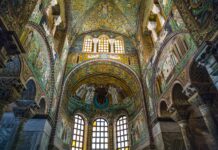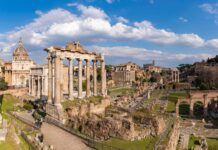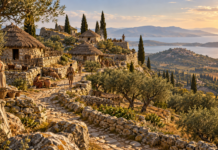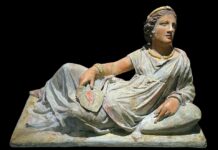

Italy was not a united country during the Middle Ages. Instead, the peninsula was divided among cities, republics, principalities, kingdoms, and territories controlled by the Catholic Church.
Some of these political communities became extraordinarily wealthy. Others developed powerful armies, sophisticated systems of government, and commercial networks that stretched across the Mediterranean and into northern Europe.
Florence became a center of banking and textile production. Venice built a maritime empire. Genoa competed for control of international trade. Milan expanded its influence across northern Italy, while Siena, Pisa, Bologna, and numerous smaller cities developed distinctive political and cultural identities.
This fragmented political landscape produced almost constant competition. Rival cities fought wars, formed alliances, betrayed agreements, and struggled to control the surrounding countryside.
Yet medieval Italy was also a place of remarkable creativity.
Merchants financed international businesses. Universities attracted students from across Europe. Architects constructed magnificent cathedrals, towers, and civic palaces. Artists developed new ways of representing the human experience, while poets and writers helped establish the foundations of the Italian language.
The medieval city-states created many of the economic, cultural, and political conditions that eventually made the Italian Renaissance possible.
To understand how this happened, we need to begin with the transformation of Italian society after the early Middle Ages.
Italy After the Early Middle Ages
Following the collapse of the Western Roman Empire in 476 CE, the Italian peninsula experienced centuries of political change.
Ostrogoths, Byzantines, Lombards, Franks, and other powers governed different parts of Italy. The papacy gradually expanded its temporal authority, while regional aristocracies established control over agricultural territories and fortified settlements.
For an overview of the earlier period, see our history of Italy from the Roman Empire to the modern Republic.
By approximately the eleventh century, important economic and social transformations were underway.
Agricultural production expanded in many regions. Markets developed, trade increased, and cities began attracting merchants, artisans, and people seeking opportunities beyond the countryside.
The weakening or fragmentation of traditional feudal authority created opportunities for urban communities to assume greater control over their own affairs.
This process became particularly important in northern and central Italy.
Unlike many other parts of medieval Europe, where royal governments gradually strengthened their authority over towns, numerous Italian cities developed substantial political autonomy.
The result was the emergence of the comuni, or self-governing communes.
The Rise of the Italian Communes
The Italian commune was one of the most important political institutions of medieval Europe.
A comune was an urban community that developed its own governing institutions and exercised authority over civic affairs and, frequently, the surrounding countryside.
These communities did not necessarily reject imperial or papal sovereignty altogether. Many continued to acknowledge a superior authority while exercising considerable independence in practice.
Beginning during the eleventh and twelfth centuries, cities such as Milan, Florence, Pisa, Bologna, and Siena developed increasingly autonomous governments.
Early communal administrations were often dominated by leading aristocratic families, wealthy merchants, judges, and other influential citizens.
They commonly appointed officials known as consuls, who exercised executive and judicial functions.
Over time, communal government became more complex.
Many cities appointed a podestà, frequently an outsider selected for a limited term, to administer justice and help control political disputes.
Other cities developed councils, assemblies, and magistracies representing powerful commercial and professional groups.
The medieval commune was therefore not a modern democracy.
Nevertheless, it represented a significant experiment in urban self-government at a time when much of Europe remained dominated by hereditary rulers and feudal relationships.
How a Medieval City-State Worked
As communes grew more powerful, many developed into city-states.
A city-state was a political entity centered on a dominant city that governed not only its urban population but also surrounding towns, villages, agricultural estates, and strategic territories.
The distinction mattered.
Florence, for example, was more than the area enclosed within its walls. Its political and economic influence extended into the Tuscan countryside.
Similarly, Milan sought to dominate neighboring cities and transportation routes across the Lombard plain.
The surrounding territory was generally called the contado.
Control over the contado provided agricultural supplies, taxation revenue, military resources, and access to roads and rivers.
Government, Guilds and Councils
The structure of government differed from one city to another, but several institutions appeared repeatedly:
- Consuls: Early elected or appointed officials who exercised executive authority.
- Podestà: A magistrate, frequently brought from another city, responsible for government and justice.
- Councils: Deliberative bodies representing politically influential citizens.
- Guilds: Associations of merchants and craftsmen that regulated economic activities and sometimes exercised political power.
- Capitano del Popolo: An official associated with organized groups seeking to counterbalance aristocratic influence.
Political participation remained limited.
Women were generally excluded from civic office. Large sections of the working population had little direct representation, while citizenship rights varied considerably.
Furthermore, political power could be concentrated in the hands of relatively small groups of families.
Even so, these institutions encouraged the development of administrative practices, legal statutes, public finance, and civic identities that would have lasting consequences.
The Conflict Between the Communes and the Holy Roman Empire
The growing independence of Italian communes eventually brought them into conflict with the Holy Roman Empire.
Emperors claimed authority over significant territories in northern and central Italy. However, enforcing those claims became increasingly difficult as cities strengthened their political and military institutions.
One of the most important confrontations involved Emperor Frederick I, better known as Frederick Barbarossa.
During the twelfth century, Barbarossa attempted to reassert imperial authority over the Italian communes.
His campaigns provoked determined resistance.
Several cities formed an alliance known as the Lombard League, established in 1167.
The conflict reached a decisive moment at the Battle of Legnano in 1176, when the forces of the Lombard League defeated the emperor.
The eventual settlement came with the Peace of Constance in 1183.
Under this agreement, the emperor recognized substantial communal rights of self-government, including important judicial and fiscal powers, while the cities formally acknowledged imperial sovereignty.
The agreement did not create complete political independence.
However, it confirmed the practical autonomy that many Italian communes had already established.
This balance between nominal imperial authority and actual local power became a defining characteristic of medieval Italian politics.
Florence: Merchants, Banking and Political Ambition
Florence eventually became one of the most influential cities in medieval Italy.
Its prosperity rested heavily on commerce, textile manufacturing, and financial services.
Florentine merchants imported wool and other materials, organized textile production, and sold finished goods through extensive trading networks.
Banking families developed operations that connected Florence with commercial centers across Europe.
The city also produced the gold florin, first minted in 1252, which became an important currency in international transactions.
Wealth, however, did not guarantee political stability.
Florence experienced repeated conflicts between aristocratic families, commercial groups, and rival political factions.
Its government gradually developed institutions in which the major guilds played an important role.
During the late thirteenth century, the Priorato delle Arti became central to the Florentine Republic.
The Ordinances of Justice of 1293 attempted to restrict the political influence of powerful magnate families.
Yet the struggle for control never truly disappeared.
During the fifteenth century, the Medici family gradually became the dominant political force in Florence, particularly after Cosimo de’ Medici’s return to power in 1434.
Florence illustrates both the achievements and contradictions of the medieval commune: commercial prosperity, remarkable cultural creativity, and persistent competition among powerful families.
Venice: The Republic Built on Water
Venice followed a different historical path.
Rather than emerging as a typical inland commune, Venice developed from settlements in the Venetian Lagoon with longstanding connections to the Byzantine world.
Its geographical position created exceptional commercial opportunities.
Venetian merchants connected the Adriatic Sea with the eastern Mediterranean, trading goods that included spices, textiles, grain, timber, and luxury products.
Over time, Venice established ports, commercial privileges, naval bases, and overseas territories.
The Fourth Crusade, culminating in the capture of Constantinople in 1204, significantly expanded Venetian influence in the eastern Mediterranean.
Venice was governed by a doge, supported and increasingly constrained by councils and institutions dominated by the city’s patrician elite.
The Serrata, or political restriction of the Great Council, beginning in 1297, helped consolidate government within a hereditary ruling class.
Venice remained a republic, but it was an oligarchic republic rather than a democracy based on universal participation.
Its political stability, maritime organization, and extensive commercial networks allowed it to remain a major Mediterranean power for centuries.
Today, the architecture of Venice still communicates the wealth and international connections of the medieval republic.
Genoa and Pisa: Rival Maritime Powers
Venice was not Italy’s only great maritime republic.
Genoa and Pisa also developed powerful commercial fleets and extensive Mediterranean interests.
Genoa
Genoa became a major commercial and naval power, particularly during the twelfth and thirteenth centuries.
Genoese merchants traded throughout the Mediterranean and established commercial communities and bases around the Black Sea.
Its competition with Venice produced several major conflicts.
One of the most significant occurred at the Battle of Curzola in 1298, when the Genoese fleet defeated Venice.
However, Genoa’s political history was often marked by factional struggles and changing systems of government.
Commercial success did not eliminate instability at home.
Pisa
Pisa was another important maritime power.
Its location near the mouth of the Arno helped connect Tuscany with Mediterranean trading routes.
During the eleventh and twelfth centuries, Pisa developed a strong fleet and participated in military and commercial expansion around the western Mediterranean.
The city’s power eventually came under pressure from Genoa and rival Tuscan communities.
The Battle of Meloria in 1284, fought against Genoa, severely damaged Pisa’s maritime position.
Pisa remained economically and culturally important, but it never fully recovered its earlier naval dominance.
The magnificent cathedral complex at Pisa reflects the city’s medieval prosperity and international connections.
Siena: A Republic of Merchants and Civic Pride
Siena offers another remarkable example of medieval urban civilization.
During the thirteenth and early fourteenth centuries, Siena became a prosperous center of banking, commerce, and artistic production.
Its rivalry with Florence influenced much of its political history.
In 1260, Siena and its allies defeated Florentine forces at the Battle of Montaperti.
The victory became a celebrated episode in Sienese history.
However, Siena’s greatest legacy may be the architectural and artistic expression of its communal institutions.
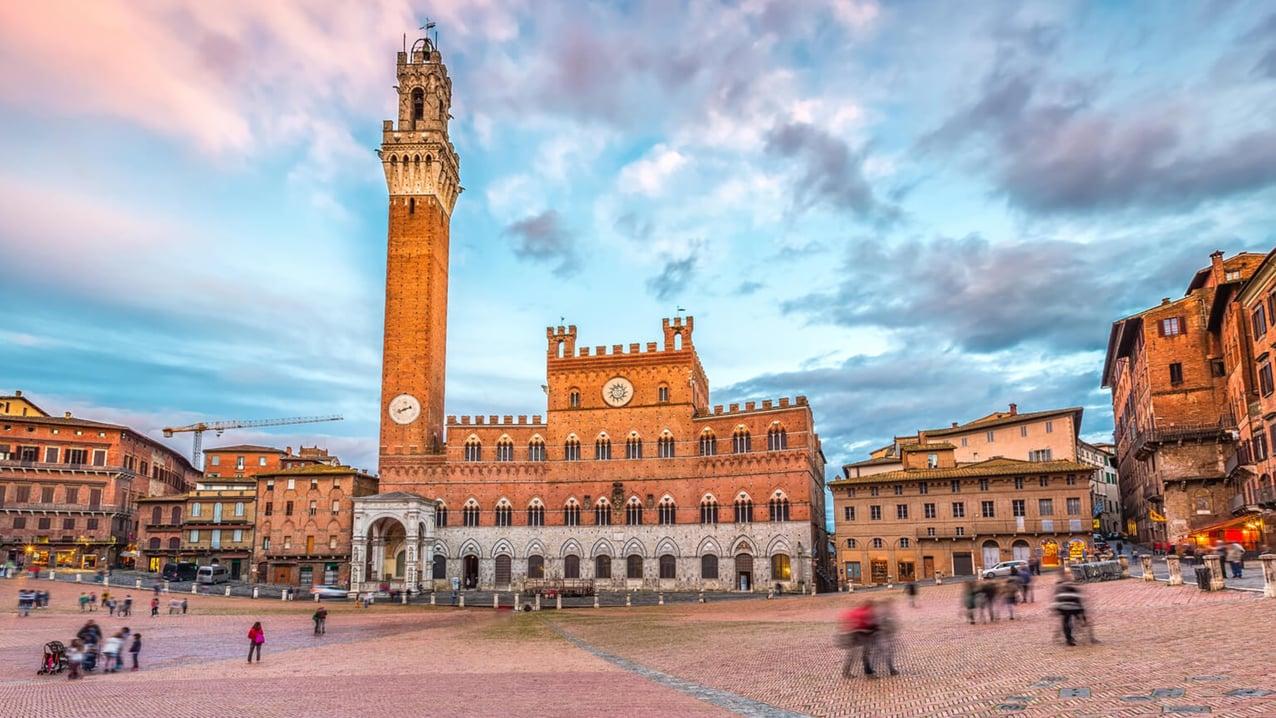
The Palazzo Pubblico, overlooking Piazza del Campo, was constructed as a seat of civic government.
Inside the palace, Ambrogio Lorenzetti painted the famous Allegory of Good and Bad Government between 1338 and 1339.
These frescoes illustrate the consequences of political decisions for the security, prosperity, and everyday life of a city and its countryside.
They remain among the most extraordinary visual expressions of medieval political thought.
Siena’s medieval urban environment also demonstrates the importance of public spaces in Italian civic life.
For more, read our article on the Italian piazza and its role in history and architecture.
Milan: From Commune to Powerful Signoria
Milan developed into one of the strongest political and military centers in northern Italy.
Its location on the Lombard plain provided access to fertile agricultural territories and important transportation routes through northern Italy and toward the Alps.
Milan played a prominent role in resistance to Frederick Barbarossa.
However, internal political competition eventually contributed to the rise of powerful ruling families.
The Visconti family consolidated control during the late thirteenth and fourteenth centuries.
Under their rule, Milan expanded its territories and developed a more centralized system of government.
The transformation from communal self-government to government under a powerful lord was not unique to Milan.
Similar developments occurred in other northern Italian cities.
The resulting political system became known as the signoria.
By the fifteenth century, Milan was one of the principal powers competing for influence across northern and central Italy.
Bologna, Universities and the Growth of Knowledge
Medieval Italy was also an important center of intellectual development.
Bologna became particularly famous for the study of law.
Its university traces its institutional origins to the late eleventh century, traditionally dated to 1088.
Students traveled from different European regions to study Roman law, canon law, and other subjects.
The rediscovery and systematic interpretation of Roman legal texts influenced the development of European legal institutions.
Other important centers of learning emerged in cities such as Padua, founded as a university in 1222, and Naples, where Frederick II established a university in 1224.
These institutions attracted scholars, encouraged the exchange of ideas, and helped establish intellectual networks extending beyond individual political boundaries.
Italy’s medieval universities therefore contributed substantially to the cultural developments later associated with the Renaissance.
The Papal States and the Kingdom of Sicily
Although the city-states dominated much of northern and central Italy, the political geography of the peninsula was considerably more complex.
Not every Italian region developed into an independent commune.
The Papal States
The popes controlled territories across central Italy, exercising both religious and temporal authority.
Rome remained the center of papal legitimacy, although relations between the papacy, Roman elites, emperors, and local communities were frequently tense.
Papal territorial control also varied considerably across different periods.
Some towns within papal territories developed their own communal institutions and enjoyed substantial autonomy.
Conflicts between papal authority and secular rulers became a recurring feature of Italian politics.
The Kingdom of Sicily
Southern Italy followed another important path.
During the eleventh century, Norman conquerors established control over large parts of southern Italy and Sicily.
In 1130, Roger II became king of Sicily.
The kingdom developed a comparatively centralized monarchy that differed from the political fragmentation of the northern communes.
Norman Sicily was also culturally diverse.
Latin Christian, Greek Christian, Islamic, and Jewish traditions interacted in administration, architecture, scholarship, and economic life, although relations among communities were not always equal or peaceful.
The palaces and churches of Palermo, Cefalù, and Monreale still demonstrate this remarkable cultural synthesis.
Later, Frederick II, Holy Roman Emperor and king of Sicily, made southern Italy an important center of imperial government and intellectual activity.
After the end of Hohenstaufen rule, the kingdom passed through further dynastic conflicts, including Angevin and Aragonese domination.
The history of medieval Italy cannot therefore be understood exclusively through Florence, Venice, and the northern city-states.
The monarchies and Mediterranean connections of the south were equally important.
Guelphs and Ghibellines: Italy’s Great Political Rivalry
Few political divisions are more closely associated with medieval Italy than the conflict between the Guelphs and Ghibellines.
The Guelphs were generally associated with support for the papacy, while the Ghibellines were associated with imperial interests.
However, this distinction can be misleading if interpreted too rigidly.
The terms acquired their familiar Italian political meaning during the thirteenth century, when conflicts involving popes, emperors, cities, and aristocratic families became increasingly interconnected.
Local circumstances often mattered more than ideological consistency.
A city’s political alignment could reflect its rivalry with a neighboring city rather than a principled commitment to papal or imperial authority.
Individual families also used these labels in struggles for local power.
Florence experienced particularly intense factional conflict.
Dante Alighieri became directly involved in the city’s political disputes and was exiled in 1302.
His experience influenced his writing and his understanding of political corruption, justice, and authority.
For more on Dante and the development of Italian literary culture, read our guide to the origins of Italian literature and the rise of Dante.
Trade, Banking and the Medieval Economy
The economic achievements of medieval Italy extended far beyond local markets.
Italian merchants helped connect European commercial centers with the Mediterranean world.
They organized the transportation of goods, financed transactions, and developed commercial partnerships that could operate across multiple cities.
Some Italian banking firms provided credit to rulers, merchants, and ecclesiastical institutions.
Bills of exchange and increasingly sophisticated accounting practices helped merchants manage transactions involving different currencies and locations.
Textile manufacturing was especially important in Florence, while maritime commerce supported Venice and Genoa.
Other cities specialized in metalworking, leather production, ceramics, food processing, and other industries.
The medieval economy nevertheless remained deeply connected to agriculture.
Urban populations depended on grain, wine, olive oil, livestock, and other products from surrounding rural territories.
Competition for agricultural resources and transportation routes could be just as important as competition for overseas markets.
This relationship between cities and countryside helps explain why expanding city-states invested so heavily in territorial conquest.
Everyday Life in Medieval Italian Cities
The prosperity of medieval Italy was accompanied by considerable social inequality.
Urban society included wealthy merchants, aristocrats, bankers, professional administrators, craftsmen, laborers, servants, and people living in poverty.
Guilds regulated aspects of production, training, quality standards, and competition.
Apprentices learned trades in workshops, while merchants operated from homes, warehouses, and commercial offices.
Women participated in household production, textile work, commerce, agriculture, and family enterprises, but their opportunities and legal rights depended heavily on social status, location, and marital circumstances.
Religious institutions played a central role in everyday life.
Churches, monasteries, hospitals, and charitable foundations provided spiritual services and forms of assistance.
Public celebrations, religious processions, markets, and civic ceremonies brought people into shared urban spaces.
Yet medieval cities were also vulnerable to fire, overcrowding, disease, food shortages, and violence.
Wealthy families sometimes constructed fortified towers as symbols of prestige and protection.
Bologna and San Gimignano still preserve remarkable examples of this architectural tradition.
Medieval urban life was therefore neither uniformly prosperous nor uniformly miserable. It was a complex world in which opportunity, social hierarchy, conflict, and cultural ambition existed side by side.
The Black Death and the Crisis of the Fourteenth Century
One of the greatest disasters of medieval European history was the Black Death.
The plague reached Italy in 1347–1348 as part of a pandemic spreading across Eurasia and the Mediterranean.
Italian cities were particularly exposed because of their commercial networks and concentrated populations.
The consequences were devastating.
Large numbers of people died, families were disrupted, and commercial and agricultural activities suffered profound shocks.
The scale of mortality varied among cities and regions, but the demographic losses were enormous.
Labor shortages changed economic relationships in some sectors, while surviving communities faced social and political uncertainty.
The plague also left a lasting cultural legacy.
Giovanni Boccaccio’s Decameron, written in the aftermath of the epidemic, opens with a famous account of plague-stricken Florence.
Yet the crisis did not bring Italian urban civilization to an end.
Many cities eventually recovered, although their economic, political, and demographic structures had been transformed.
The fourteenth century consequently marked both a period of extraordinary cultural achievement and a time of severe instability.
From Communes to Signorie and Regional States
By the late Middle Ages, many Italian communes had undergone significant political transformations.
Powerful individuals and families increasingly gained control over civic government.
These rulers were known as signori, and their political systems as signorie.
Some justified their authority by promising stability after prolonged factional conflict.
Others gained power through military success, alliances, wealth, or control of important government offices.
In Milan, the Visconti established an expansive territorial state.
Other important ruling dynasties included the Este in Ferrara, the Gonzaga in Mantua, and the Scaligeri in Verona.
Florence retained republican institutions but gradually came under Medici dominance.
Venice remained a republic governed by a restricted patrician elite.
The political map of Italy was therefore changing.
Smaller communes increasingly became incorporated into larger territorial states.
By the middle of the fifteenth century, five major powers dominated much of Italian politics: Venice, Milan, Florence, the Papal States, and the Kingdom of Naples.
The Peace of Lodi in 1454 helped establish a period of relative equilibrium among several of these powers, although conflicts did not disappear.
This political landscape formed the background to the extraordinary cultural developments of the Renaissance.
How the City-States Prepared the Italian Renaissance
The Renaissance did not emerge from a cultural vacuum.
Its foundations were established over centuries of medieval Italian urban development.
Commercial wealth created opportunities for artistic patronage.
Political competition encouraged rulers and civic institutions to commission impressive buildings, sculptures, and paintings.
Universities and scholarly networks preserved, studied, and reinterpreted classical texts.
Urban governments invested in public architecture and developed a strong sense of civic identity.
Meanwhile, writers began using Italian vernacular languages for increasingly ambitious literary works.
Dante, Petrarch, and Boccaccio helped establish literary traditions that later generations would transform.
Artists such as Giotto explored new approaches to space, narrative, and human emotion.
The Renaissance expanded these developments through humanism, classical scholarship, and new artistic techniques.
Its achievements cannot be separated from the wealth, institutions, rivalries, and intellectual traditions of medieval Italy.
Our article on the Italian Renaissance and the masterpieces that changed the world explores this transformation in greater detail.
Medieval Italy: A Timeline of Key Events
- c. 1000–1100: Commercial expansion and the emergence of self-governing communes in northern and central Italy.
- 1088: Traditional founding date of the University of Bologna.
- 1130: Roger II becomes king of Sicily.
- 1167: Formation of the Lombard League.
- 1176: The Lombard League defeats Frederick Barbarossa at Legnano.
- 1183: Peace of Constance recognizes important communal rights.
- 1204: The Fourth Crusade captures Constantinople, strengthening Venetian commercial influence.
- 1252: Florence begins minting the gold florin.
- 1284: Genoa defeats Pisa at the Battle of Meloria.
- 1293: Florence adopts the Ordinances of Justice.
- 1347–1348: The Black Death devastates Italian communities.
- 1434: Cosimo de’ Medici returns to Florence and consolidates his political influence.
- 1454: The Peace of Lodi helps establish a new balance among major Italian powers.
Where You Can Still See Medieval Italy Today
One of the most fascinating aspects of medieval Italian history is how much of its urban environment survives.
Modern visitors can still walk through streets shaped by medieval commerce, civic institutions, and family rivalries.
Siena offers an exceptionally preserved medieval urban center, including Piazza del Campo and the Palazzo Pubblico.
San Gimignano is famous for its surviving medieval towers, reminders of the wealth and prestige of competing families.
Bologna preserves medieval streets, towers, churches, and porticoes associated with its commercial and university traditions.
Florence retains major buildings from its communal past, including Palazzo Vecchio, churches, and historic neighborhoods.
Venice preserves a distinctive maritime urban environment shaped by centuries of republican government and international commerce.
Genoa retains a historic center whose narrow streets and palaces reflect the city’s development as a commercial republic.
Pisa offers one of the finest ensembles of medieval religious architecture in Europe.
Palermo demonstrates the cultural encounters that shaped medieval Sicily, particularly through its extraordinary Arab-Norman buildings.
Traveling through these cities reveals that medieval Italy was not a single civilization with one political system.
It was a collection of interconnected societies with different institutions, ambitions, and cultural traditions.
For a broader perspective on the country’s architectural inheritance, explore our chronological guide to Italian art movements and periods.
Why Medieval Italy Still Matters
The Italian city-states helped transform European economic, political, and cultural history.
They developed sophisticated commercial networks, experimented with urban government, expanded banking activities, and supported new intellectual and artistic traditions.
Their rivalries could be destructive, but competition also encouraged ambitious construction, public institutions, and cultural patronage.
The legacy of this period remains visible in the extraordinary diversity of Italian cities.
Florence does not resemble Venice. Siena has a different civic character from Milan. Bologna’s university traditions differ from Genoa’s maritime history.
These distinctions reflect centuries during which individual cities developed their own political institutions, commercial specializations, cultural identities, and regional loyalties.
Italy would not become a unified nation-state until the nineteenth century.
Long before that unification, however, its medieval cities had already helped create the cultural landscape for which the country is famous today.
The next major chapter of Italian history is the Renaissance, when the wealth, institutions, and intellectual ambitions of the medieval city-states helped produce one of the most influential cultural transformations in European history.
External Sources
- Treccani — Comune medievale
- Treccani — Guelphs and Ghibellines
- Treccani — Signorie and Principalities
- UNESCO — Venice and Its Lagoon
- UNESCO — Arab-Norman Palermo and the Cathedrals of Cefalù and Monreale