
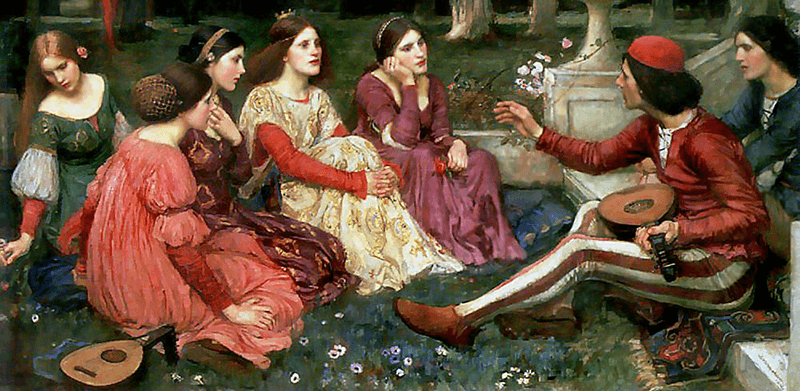
Petrarch and Boccaccio belong to the fourteenth century; Poliziano and Boiardo to the fifteenth. Reading them in that order shows how Italian literature moved from the achievements of the Three Crowns toward the poetry and prose of the Renaissance. This guide follows the writers and their works. The broader history of sixteenth-century literature continues in The Renaissance.
PETRARCH: A LIFETIME OF REVISION
Francesco Petrarca, known in English as Petrarch (1304–1374), studied ancient Latin authors closely while writing poetry in the Italian vernacular. His interest in classical texts made him a formative figure in humanism, but his writing also returned to Christian faith, moral uncertainty and the difficulty of governing his own desires.
His best-known work is the Rerum vulgarium fragmenta, usually called the Canzoniere. It contains 366 poems, most of them sonnets. Many concern Laura, whom Petrarch said he first saw on 6 April 1327. That date belongs to the story Petrarch told about their meeting: it is not a date for the composition or publication of the collection. He wrote, selected, arranged and revised its poems over decades, continuing to work on the book late in life.
The poems examine longing, memory, time, fame and spiritual conflict. Laura is central, yet the collection is also a portrait of a speaker questioning his own attachments. Petrarch inherited forms and ideas from earlier Italian love poetry; he did not invent the sonnet. His achievement was to give the lyric sequence an unusually sustained, carefully revised shape.
His Latin prose reveals related concerns. De vita solitaria, begun in 1346 and expanded later, reflects on study and solitude. De remediis utriusque fortunae, begun in the 1350s and completed in the 1360s, considers how to face prosperity and adversity. Dates attached to early printed editions of these works should not be mistaken for dates of composition.
BOCCACCIO AND THE WORLD OF THE DECAMERON
Giovanni Boccaccio (1313–1375) had already written romances and poetry before the plague struck Florence in 1348. He composed the Decameron chiefly in the years that followed, around 1349–1353, and later revised it.
Its frame is precise: seven women and three men leave plague-stricken Florence for the countryside and tell 100 stories over ten storytelling days. Merchants, lovers, clergy, servants and nobles fill those tales. Their choices can be generous or cruel, clever or foolish. Boccaccio’s prose makes room for humor and desire alongside the fear and grief established by the plague.
Boccaccio and Petrarch became friends, sharing an interest in classical learning while pursuing different literary paths. Boccaccio also wrote about Dante and delivered public lectures on the Divine Comedy. Dante, Petrarch and Boccaccio gave Tuscan writing enduring prestige; the selection of their works as models for literary Italian was a later, gradual process.
FIFTEENTH-CENTURY COURTS AND VERNACULAR POETRY
Literary activity developed in several Italian courts during the fifteenth century. Writers worked with classical Latin and Greek texts while also experimenting with Italian verse, drama and narrative. In Florence, Lorenzo de’ Medici (1449–1492) wrote poetry as well as supporting scholars and artists. Angelo Poliziano (1454–1494), associated with the Medici circle, wrote in Latin, Greek and Italian.
Poliziano began his Stanze per la giostra in the 1470s to celebrate Giuliano de’ Medici. The poem remained unfinished after Giuliano’s murder in 1478. His Fabula di Orfeo, generally dated to around 1480, brought a classical myth to the vernacular stage. Because its precise dating has been debated, “around 1480” is more useful than presenting a single year as certain.
At the Este court in Ferrara, Matteo Maria Boiardo (1441–1494) transformed the adventures of Charlemagne’s paladins in Orlando innamorato, also known by its original title Inamoramento de Orlando. Its first two books appeared in 1483. Boiardo left the third unfinished; it was printed after his death in 1495. The poem’s mingling of chivalry, love, combat and enchantment helped prepare the way for Ariosto’s Orlando furioso, discussed in The Renaissance.
A BRIDGE TO THE SIXTEENTH CENTURY
Iacopo Sannazaro’s Arcadia offers another path forward. Developed in the late fifteenth century and published in 1504, it combines prose and pastoral verse in an imagined landscape of shepherds, music and reflection. Its publication places it just beyond this guide’s main fifteenth-century span, while its composition connects it to that century’s experiments with the vernacular.
Petrarch’s lyrics, Boccaccio’s prose and the writing of the fifteenth-century courts gave later authors rich models to study and reshape. The Renaissance follows that development through Bembo, Machiavelli and Ariosto. For the much later periods, see The Foreign Influence and Classicism and Romanticism.
READ THE WORKS
Browse English editions of Petrarch’s Canzoniere on Amazon, Boccaccio’s Decameron on Amazon, Boiardo’s Orlando innamorato on Amazon and Sannazaro’s Arcadia on Amazon. These are search links so readers can compare available translations and editions. As an Amazon Associate, ItaliaMia may earn from qualifying purchases.
EXTERNAL SOURCES
Ente Nazionale Giovanni Boccaccio: Biography
Treccani: Poliziano and his vernacular works