

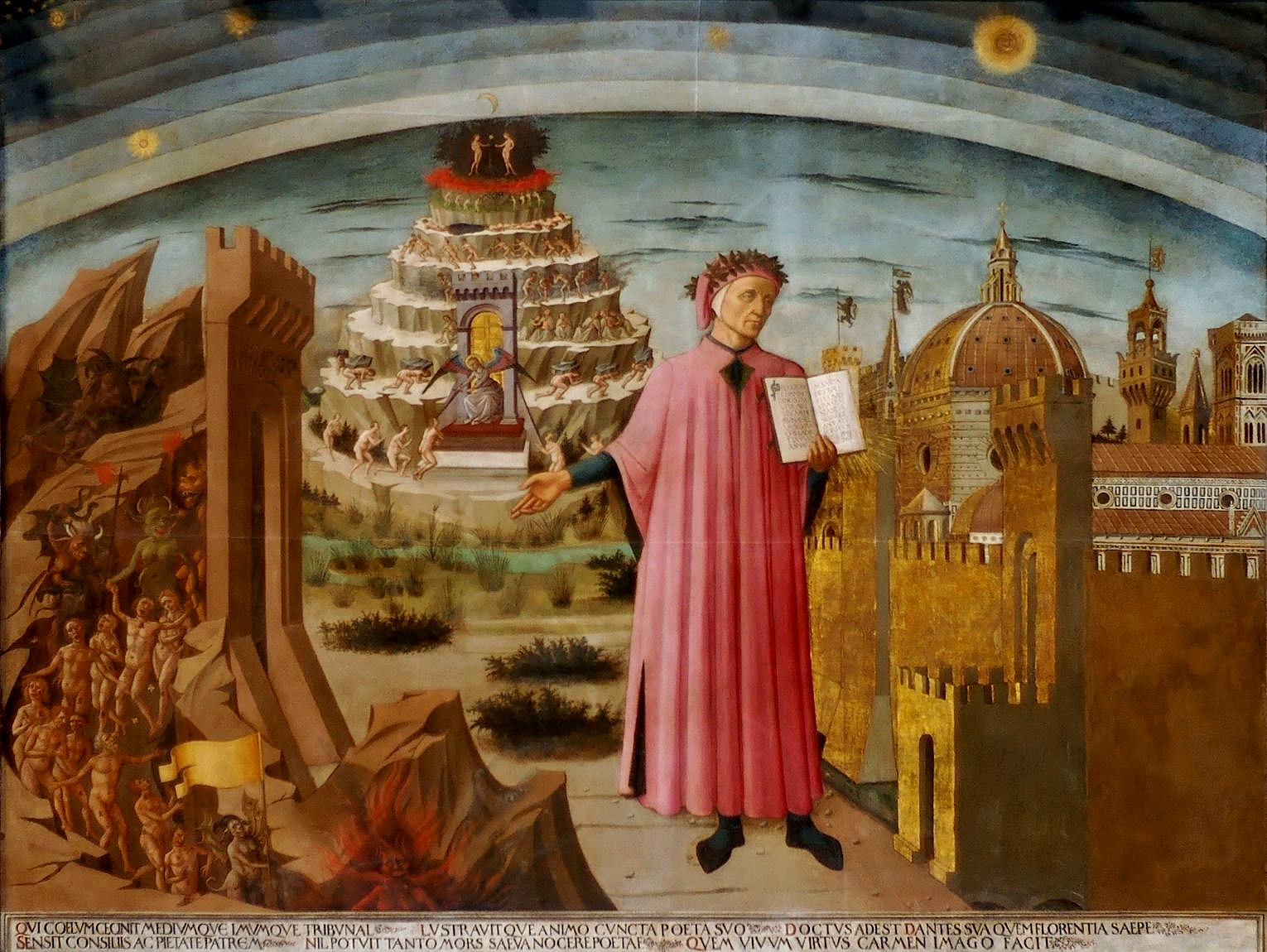
Dante Alighieri transformed a personal story of love, political defeat and exile into one of humanity’s greatest imaginative achievements. His Divine Comedy carries its reader through Hell, Purgatory and Paradise, but it is far more than a vision of the afterlife. It is also a poem about Italy, moral responsibility, political corruption, human freedom, language, memory and the soul’s search for meaning.
Known in Italy as il Sommo Poeta—the Supreme Poet—Dante helped demonstrate that the vernacular spoken in Tuscany could express philosophy, theology, satire, tenderness and epic drama as powerfully as Latin. He did not single-handedly invent modern Italian, as is sometimes claimed, but his work gave the Florentine vernacular extraordinary prestige and helped establish the foundation on which literary Italian developed.
More than seven centuries after his death, Dante remains present in Italian life. His verses are taught in schools, quoted in political debate and performed in theaters and public squares. His profile appears on Italy’s two-euro coin, while March 25 is celebrated nationally as Dantedì. His images of the dark wood, the circles of Hell and the stars above Paradise have become part of the world’s cultural vocabulary.
Dante’s Early Life in Medieval Florence
Dante was born in Florence in 1265, probably in the second half of May, although his exact birthday is unknown. His full name was likely Durante di Alighiero degli Alighieri, with Dante serving as the familiar shortened form.
The Alighieri belonged to Florence’s respectable urban society but were neither extremely wealthy nor members of the city’s highest aristocracy. Dante’s father, Alighiero di Bellincione, appears to have worked in business and finance. His mother, traditionally called Bella, died during Dante’s childhood, and his father also died before the future poet reached full adulthood.
Dante grew up in a Florence of commercial expansion, artistic innovation and violent political conflict. The city’s families were divided between the Guelphs, who generally supported the papacy, and the Ghibellines, who favored imperial authority. After the Guelph victory, the victors divided into rival White and Black factions. Those conflicts would eventually determine the course of Dante’s life.
Little is known with certainty about his formal education. He acquired an exceptional command of Latin literature, philosophy, rhetoric, theology, astronomy and contemporary poetry. Brunetto Latini, a Florentine writer, diplomat and intellectual, was an important influence, although the traditional description of Latini as Dante’s formal teacher cannot be proven.
Dante read Virgil, Ovid, Lucan, Cicero, Boethius and other ancient authors. He also absorbed the traditions of Provençal poetry, the Sicilian poetic school and the developing Tuscan lyric. His engagement with classical and Christian thought would eventually allow him to unite the ancient Mediterranean world with the religious culture of medieval Europe.
For additional context, read ItaliaMia’s guide to the beginnings of Italian literature.
Beatrice and the Poetry of Love
No figure in Dante’s emotional and poetic life is more famous than Beatrice. In La Vita Nuova, Dante says that he first saw her when both were about nine years old and encountered her again nine years later. Scholars generally identify her with Bice Portinari, a Florentine woman who married Simone de’ Bardi and died in 1290, although the surviving evidence does not permit complete certainty.
Dante’s relationship with Beatrice should not be understood as a conventional romance. There is no firm evidence that they were lovers or even close companions. In his writing, Beatrice becomes an increasingly spiritual figure: first the idealized lady of love poetry, then an agent of moral transformation, and finally the guide who leads Dante toward divine truth in Paradise.
Dante himself married Gemma Donati, probably during the 1280s. They had at least three children: Pietro, Jacopo and Antonia. A fourth child, Giovanni, may also have existed, although the identification remains disputed. Pietro and Jacopo later wrote commentaries on their father’s poem, while Antonia may have become a nun in Ravenna under the name Sister Beatrice.
Dante’s early poetry belonged to the dolce stil novo, or “sweet new style,” a movement associated with Guido Guinizelli, Guido Cavalcanti, Cino da Pistoia and other poets. These writers treated love as an ennobling and potentially spiritual experience rather than simply an earthly passion.
Dante was especially close to Guido Cavalcanti, whom he called his first friend. Their intellectual paths eventually diverged, but Cavalcanti’s psychological intensity and philosophical approach to love had a profound influence on Dante’s development.
La Vita Nuova
Written during the 1290s, La Vita Nuova—The New Life—combines poems with prose explanations of the circumstances in which they were supposedly composed. It recounts Dante’s love for Beatrice, his emotional confusion, her death and his determination to write something about her that had never been written about any woman.
The work is both autobiography and carefully constructed literary fiction. Dante revisits his earlier poems, arranges them into a spiritual narrative and interprets his younger self from a more mature perspective.
Beatrice’s death becomes the turning point. Personal grief develops into a larger poetic calling. Near the end, Dante promises to speak of her more worthily in the future. The Divine Comedy can be read, in part, as the fulfillment of that promise.
Soldier, Guild Member and Florentine Politician
Dante was not an isolated poet living outside public life. He was a soldier and an active participant in Florentine politics.
In 1289, he probably fought as a mounted soldier at the Battle of Campaldino, where the Florentine Guelph army defeated the Ghibellines of Arezzo. He may also have participated later that year in the siege of Caprona near Pisa. Both events found echoes in the Divine Comedy.
To hold political office in Florence, a citizen generally needed to belong to one of the city’s professional guilds. Dante enrolled in the Guild of Physicians and Apothecaries, which also included booksellers and provided an appropriate institutional home for a man of letters.
His political importance increased during the late 1290s. In 1300 he served for two months as one of Florence’s six priors, the city’s highest executive magistrates. The appointment was prestigious, but it placed him at the center of a dangerous conflict.
The Florentine Guelphs had divided into the Whites and the Blacks. Dante aligned himself with the White Guelphs, who resisted excessive papal involvement in Florentine affairs. The Black Guelphs sought support from Pope Boniface VIII and Charles of Valois, a French prince invited into Tuscany as a supposed peacemaker.
In November 1301, while Dante was absent from Florence, Charles entered the city and enabled the Black faction to seize power. Political enemies were attacked, their houses were destroyed and the White leadership was purged.
Condemnation and Exile
In January 1302, Dante was convicted in his absence on charges including corruption, financial wrongdoing and opposition to the pope. The accusations were politically motivated. He was ordered to pay a large fine and remain outside Tuscany.
When he did not appear or pay, a second sentence declared that he could be burned alive if captured within Florentine territory.
Dante would never see his city again.
At first, he cooperated with other White Guelph exiles who hoped to return by force. He eventually separated himself from them, frustrated by their strategy and internal divisions. The experience deepened his political isolation and helped transform him from a Florentine party official into a thinker concerned with the fate of Italy and the proper relationship between spiritual and temporal authority.
During nearly twenty years of exile, Dante lived under the protection of various courts and patrons. His movements are not always certain, but he had connections with the Malaspina family in Lunigiana, the Della Scala court in Verona and, during his final years, Guido Novello da Polenta in Ravenna.
Exile brought insecurity and dependence, but it also gave Dante the distance from which he could judge Florence, Italy and Christian Europe. In Paradiso, his ancestor Cacciaguida predicts the pain of leaving everything most dearly loved and learning how bitter another person’s bread can taste.
That bitterness became one of the creative forces behind the Divine Comedy.
Dante’s Major Works Beyond the Divine Comedy
Although Dante’s fame rests principally on the Divine Comedy, his other works reveal the breadth of his ambitions.
The Rime
Dante’s lyric poems, conventionally collected as the Rime, span much of his creative life. They include love poetry, philosophical verse, moral poems and the difficult rime petrose, or “stony rhymes,” addressed to an elusive woman described as hard as stone.
These poems show Dante experimenting with voice, subject and form long before the Comedy.
Convivio
The unfinished Convivio, or Banquet, was planned as a major work of philosophical instruction. Dante wrote it in the vernacular and organized it around a series of his own canzoni, followed by extensive prose commentaries.
Its intended audience included intellectually curious readers who had not received a university education or mastered Latin. The decision reflects Dante’s belief that knowledge should not remain the exclusive possession of clerics and professional scholars.
De Vulgari Eloquentia
Dante wrote De Vulgari Eloquentia in Latin, even though its subject was vernacular language. In it, he examined the many forms of speech used across Italy and searched for an “illustrious vernacular” suitable for elevated literature.
He recognized that Italy possessed numerous regional languages but lacked a single political court capable of establishing a national standard. His analysis was remarkably ambitious: he treated vernacular expression as a serious intellectual subject and imagined a literary language that could transcend local boundaries.
Monarchia
Monarchia presents Dante’s political philosophy. He argued that humanity required universal secular authority to secure peace and enable people to fulfill their earthly potential. The emperor and the pope, in his view, possessed different responsibilities derived ultimately from God.
This position challenged claims that temporal government should always remain subordinate to papal authority. The treatise was later condemned by the Church, and copies were reportedly burned. It was not removed from the Catholic Index of Forbidden Books until the nineteenth century.
Letters, Eclogues and Disputed Works
Several Latin letters are attributed to Dante, including writings on Italian politics and imperial power. He also composed Latin eclogues late in life.
Other works traditionally connected with him, such as Il Fiore and the Detto d’Amore, remain the subjects of scholarly debate. Even the famous letter to Cangrande della Scala, important for interpreting the Paradiso, presents unresolved questions concerning its authorship or the authorship of portions of it.
The Divine Comedy: Dante’s Journey Through the Afterlife
Dante called his masterpiece simply Comedìa. The adjective “Divine” became associated with it after his death and appeared in the title of a printed edition in 1555.
The poem contains 100 cantos divided into three cantiche:
- Inferno contains 34 cantos, including an introductory canto for the entire journey.
- Purgatorio contains 33 cantos.
- Paradiso contains 33 cantos.
The fictional journey takes place in 1300, the year of Pope Boniface VIII’s first Christian Jubilee. Dante the pilgrim begins “midway upon the journey of our life,” lost in a dark wood after leaving the proper path.
This opening crisis is simultaneously personal, political and spiritual. The lost traveler is Dante, but he also represents humanity separated from moral direction.
The Roman poet Virgil rescues him and guides him through Hell and most of Purgatory. Virgil embodies reason, classical wisdom and poetic authority. Yet human reason alone cannot complete the journey. Beatrice eventually replaces him, guiding Dante through the celestial spheres. In the final portion of Paradise, Saint Bernard of Clairvaux prepares him for the vision of God.
Inferno
Inferno is the most widely read section of the Comedy. Dante descends through a carefully ordered Hell in which souls experience punishments connected to the nature of their sins.
This relationship is commonly described as contrapasso. The punishment may resemble, reverse or reveal the moral reality of the sin. Fortune-tellers who attempted to see too far ahead must walk with their heads twisted backward. Those consumed by uncontrolled passion are swept endlessly through a violent storm.
Yet Inferno is not a simple catalogue of punishments. Dante meets figures who remain eloquent, courageous, manipulative, tragic or strangely attractive. Francesca da Rimini tells a seductive story of adulterous love. Farinata degli Uberti rises proudly from a burning tomb and speaks about Florence. Ulysses recounts his fatal hunger for knowledge and experience. Count Ugolino tells one of the poem’s most horrifying stories of imprisonment and starvation.
These encounters force readers to distinguish emotional sympathy from moral judgment. Dante the pilgrim does not always understand what Dante the poet reveals.
Purgatorio
Purgatorio offers a different moral atmosphere. The souls on the mountain suffer, but they also possess hope. Their pain cleanses the habits that prevent them from loving properly.
The mountain is organized around the seven deadly tendencies: pride, envy, wrath, sloth, avarice, gluttony and lust. The souls pray, sing and help one another. Unlike the fixed isolation of Hell, Purgatory is a community moving toward freedom.
Purgatorio is also deeply concerned with art, friendship, memory and poetry. Dante meets musicians, artists, rulers and fellow writers. He examines the power of images and songs while warning that art can either direct the soul upward or distract it from its true destination.
At the summit, in the Earthly Paradise, Dante finally meets Beatrice. Their reunion is not simply romantic. She confronts him, judges his failures and leads him through repentance toward spiritual renewal.
Paradiso
Paradiso is the most intellectually demanding portion of the poem, but also its most audacious. Dante rises through the celestial spheres while discussing free will, justice, faith, politics, creation and the nature of blessedness.
The souls appear at different levels for the pilgrim’s benefit, although all truly belong within the Empyrean and enjoy perfect fulfillment in God. Their arrangement allows Dante to present a graduated lesson in divine order.
Paradiso contains fierce criticism of corrupt popes, rulers and religious institutions. Dante’s vision of Heaven never requires silence about abuses on Earth. On the contrary, spiritual understanding sharpens his political judgment.
The final cantos attempt to describe what language cannot adequately express. Dante beholds the unity of creation and, finally, the mystery of the Trinity and the joining of human and divine nature in Christ. His intellectual powers fail, but his desire and will become aligned with “the Love that moves the sun and the other stars.”
Terza Rima and Dante’s Poetic Language
The Divine Comedy is written in hendecasyllabic lines arranged in terza rima, a system of interlocking three-line stanzas. Its rhyme pattern propels the poem forward: one tercet generates the rhyme required by the next.
Dante’s language is astonishingly varied. It can be philosophical, tender, grotesque, comic, violent, prayerful or deliberately coarse. He places elevated theological arguments beside everyday speech, political insult, bodily horror and intimate memory.
This stylistic range helped establish the literary authority of the Tuscan vernacular. Dante showed that the language spoken by ordinary people could accommodate virtually every level of human and divine experience.
Together with Petrarch and Giovanni Boccaccio, Dante became one of the “Three Crowns” of Italian literature. Their prestige helped make Tuscan—and especially the Florentine tradition—the principal foundation of standard literary Italian. Learn more in ItaliaMia’s overview of Italy’s most famous poets.
Politics, Justice and Personal Enemies
The Divine Comedy includes popes, emperors, warriors, philosophers, mythological figures, biblical characters and people Dante had known personally. The dead speak from eternity, but they remain connected to the politics of cities such as Florence, Pisa, Bologna, Rome and Ravenna.
Dante condemned factional violence and the corruption of both church and state. He opposed the misuse of spiritual authority for political enrichment, but he did not therefore reject Christianity or the Church. His criticism emerged from a demanding vision of what Christian institutions ought to be.
The poem’s judgments can be harsh and intensely personal. Dante places enemies in Hell and honors people whose values he admired. However, reducing the Comedy to literary revenge misses its complexity. Dante also criticizes his own political faction, confronts his personal failures and places admired historical figures outside salvation when required by his theological structure.
His work is partisan, but it is never merely partisan.
Dante’s Final Years in Ravenna
By about 1318, Dante had settled in Ravenna under the protection of Guido Novello da Polenta. There he completed the Paradiso and gathered around him a circle that included his children and younger admirers.
In 1321, Dante undertook a diplomatic mission to Venice on Ravenna’s behalf. He became ill during or shortly after the return journey, traditionally with malaria contracted while crossing the marshlands. He died in Ravenna during the night between September 13 and 14, 1321.
He was buried near the Church of San Francesco. Florence later attempted to recover his remains, but Ravenna resisted. Franciscan friars secretly removed and concealed the bones when their transfer appeared likely. They were rediscovered in 1865 and eventually returned to the tomb.
Dante’s present mausoleum, designed by Camillo Morigia in the eighteenth century, stands within Ravenna’s quiet Zona del Silenzio. A lamp inside burns with oil ceremonially supplied by Florence, the city that exiled him and never succeeded in bringing him home.
ItaliaMia’s guide to the region of Emilia-Romagna provides more ideas for visiting Ravenna and its extraordinary cultural heritage.
Where to Follow Dante in Italy
Florence
Florence preserves the urban landscape that formed Dante, although many surviving associations combine documented history with later tradition.
The Museo Casa di Dante occupies reconstructed medieval buildings in the neighborhood where the Alighieri family lived. It should not be mistaken for an intact, verified birthplace, but its exhibits introduce visitors to Dante’s life, Florentine politics, guilds and warfare.
Nearby, the Church of Santa Margherita dei Cerchi is traditionally associated with Dante and Beatrice. The Baptistery of San Giovanni, which Dante called his “beautiful San Giovanni,” is one of the most meaningful surviving buildings connected with his Florence.
The Basilica of Santa Croce contains a monumental cenotaph honoring Dante, but it remains empty because his remains are in Ravenna. A statue of the poet stands outside the church.
Readers planning a wider cultural stay can consult ItaliaMia’s guide to Italy’s greatest art cities and reserve Florence museums and cultural attractions through Weekend in Italy (affiliate link).
Ravenna
The Tomb of Dante is Ravenna’s principal Dante landmark. The nearby Museo Dante explores his life, writings, exile and posthumous reputation.
The Basilica of San Francesco, where Dante’s funeral was held, and the adjoining Franciscan cloisters complete the city’s Zona del Silenzio. Ravenna also organizes public readings and cultural events dedicated to the poet.
Verona
Dante spent significant periods at the court of the Della Scala family in Verona. Cangrande della Scala became one of his most important patrons and received an honored place in the Paradiso. A nineteenth-century statue of Dante stands in Piazza dei Signori, surrounded by buildings connected with the Scaliger court.
Lunigiana
Dante’s stay with the Malaspina family connects him to Lunigiana, the historic territory divided today between Tuscany and Liguria. The region appears favorably in the Divine Comedy, and several towns and castles preserve traditions associated with his travels.
Dante’s Influence on Art and Culture
Dante’s influence extends far beyond literature. Sandro Botticelli produced a celebrated series of drawings illustrating the Comedy. William Blake devoted some of his final years to visionary Dante watercolors, while Gustave Doré’s nineteenth-century engravings shaped how generations imagined Hell, Purgatory and Paradise.
Auguste Rodin originally conceived The Thinker in relation to a monumental project called The Gates of Hell. Composers including Franz Liszt, Pyotr Ilyich Tchaikovsky and Giacomo Puccini responded to Dantean subjects. Writers influenced by Dante include Geoffrey Chaucer, John Milton, Percy Bysshe Shelley, T. S. Eliot, Jorge Luis Borges, Primo Levi and countless others.
Cinema, comics, video games, popular novels and television continue to borrow Dante’s architecture of Hell and his language of sin and punishment. These adaptations often simplify his moral universe, but they confirm the extraordinary durability of his imagination.
Why Dante Still Matters
Dante endures because the Divine Comedy works on several levels at once. It is a medieval Christian vision, a political intervention, an encyclopedia of contemporary knowledge, an autobiography of exile and an adventure story filled with unforgettable characters.
Readers do not need to share Dante’s theology or political ideas to recognize the emotional force of being lost, confronting one’s failures, seeking trustworthy guidance and trying to recover a meaningful direction.
His poem insists that actions have consequences, that freedom carries responsibility and that even a person lost in a dark wood can begin moving toward the light. It also asks difficult questions that remain alive: What corrupts a community? When does love become destructive? Can intelligence exist without wisdom? What do we owe to our city, our language and one another?
Dante’s world is distant from ours, but his journey is not. The path from confusion through self-knowledge toward a clearer vision of reality remains one of literature’s most powerful accounts of human transformation.
Recommended Editions of Dante in English
A good translation should match the reader’s purpose. Some versions attempt to reproduce Dante’s rhyme, while others prioritize accuracy, clarity or commentary.
- The Divine Comedy translated by Robert and Jean Hollander offers extensive notes and is particularly useful for serious study. (Amazon affiliate link)
- The Divine Comedy translated by Allen Mandelbaum combines poetic readability with a relatively close relationship to the Italian text. (Amazon affiliate link)
- The Divine Comedy translated by Robin Kirkpatrick is a modern, energetic version accompanied by helpful introductions and notes. (Amazon affiliate link)
- The Divine Comedy translated by Henry Wadsworth Longfellow is historically important and widely available, although its English can sound more archaic. (Amazon affiliate link)
Readers who want to compare the original Italian with an English translation can also use the free Princeton Dante Project, which provides the poem, commentary and research tools.
Frequently Asked Questions About Dante Alighieri
When was Dante Alighieri born?
Dante was born in Florence in 1265, probably during the second half of May. His exact birth date is not documented.
Was Beatrice Dante’s wife?
No. Dante married Gemma Donati. Beatrice was the idealized woman celebrated in La Vita Nuova and later became his spiritual guide in the Divine Comedy.
Why was Dante exiled from Florence?
Dante belonged to the White Guelph political faction. When the rival Black Guelphs seized Florence in 1301, he was accused of corruption and political offenses, fined and condemned in absentia. A later sentence threatened him with death if he returned.
Did Dante invent the Italian language?
Dante did not invent Italian, which developed from spoken Latin through numerous regional vernaculars. However, his use of the Florentine vernacular in a masterpiece of exceptional range gave Tuscan enormous literary authority and profoundly influenced standard Italian.
Why is it called the Divine Comedy?
Dante called the poem Comedìa. “Comedy” indicated a narrative that begins in difficulty and ends happily, and it also reflected the poem’s use of the vernacular rather than an exclusively elevated Latin style. The adjective “Divine” was added by later admirers and became part of the printed title during the sixteenth century.
Where is Dante buried?
Dante is buried in Ravenna, near the Basilica of San Francesco. Florence honors him with an empty monumental tomb in the Basilica of Santa Croce.
What is the best part of the Divine Comedy to read first?
Most readers begin with Inferno because its setting and characters are immediately dramatic. However, the complete movement through Purgatorio and Paradiso is essential to understanding Dante’s journey from confusion to freedom and spiritual vision.
External Sources
- Princeton Dante Project: Dante’s Biography
- Princeton Dante Project: The Divine Comedy
- Digital Dante — Columbia University
- Treccani: Dante Alighieri
- Museo Casa di Dante, Florence
- Ravenna Tourism: Dante’s Tomb
- Ravenna Tourism: Museo Dante
- Società Dante Alighieri