

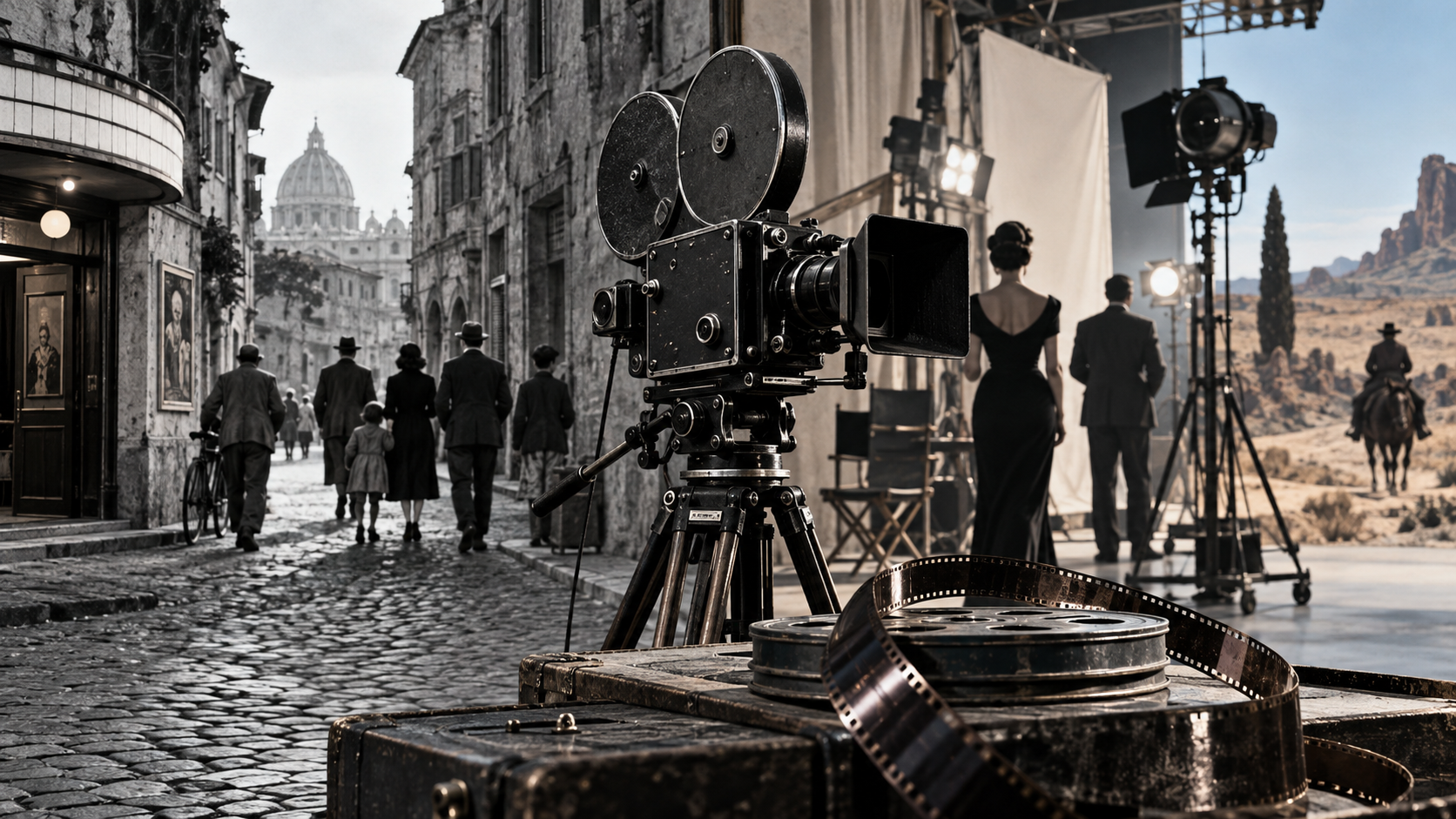
 Italian cinema has never been defined by a single style. It has produced monumental silent spectacles, emotionally direct neorealist dramas, sophisticated comedies, politically charged thrillers, visionary fantasies and some of the most influential Westerns ever made.
Choosing the “best” Italian movies is therefore inevitably subjective. Instead of presenting another constantly changing ratings chart, this guide selects 30 films for their artistry, historical importance, cultural influence and ability to engage viewers today.
The films are arranged chronologically rather than ranked. Together, they provide an accessible journey through more than a century of Italian filmmaking.
For a broader historical overview, begin with Italian Cinema: 100 Years of Masterpieces That Shaped World Film and Italia Mia’s guide to Italian movies and the cinema of Italy.
1. Cabiria (1914)
Director: Giovanni Pastrone
Genre: Silent historical epic
One of the landmarks of early cinema, Cabiria unfolds during the Second Punic War and follows a young Roman girl carried through a world of volcanic eruptions, warfare, slavery and religious ritual.
Its enormous sets, mobile camera movements and carefully staged crowd scenes helped establish Italy as a leader in early feature filmmaking. The film also introduced Maciste, the powerful servant who became one of Italian popular cinema’s first recurring screen heroes.
Although its pacing differs greatly from modern cinema, Cabiria remains essential for understanding how filmmakers learned to tell epic stories visually.
2. Rome, Open City (1945)
Original title: Roma città aperta
Director: Roberto Rossellini
Genre: Neorealist war drama
Made in the immediate aftermath of the German occupation, Rome, Open City transformed wartime Rome into the setting for a story of resistance, fear and moral courage.
Anna Magnani gives one of Italian cinema’s defining performances, while Aldo Fabrizi plays a priest assisting members of the Resistance. Rossellini combines melodrama with the urgency of streets and buildings that still bore the physical scars of war.
The film became an international symbol of Italian neorealism and changed how directors around the world approached location filming and contemporary history.
Find Rome, Open City on Amazon
3. Shoeshine (1946)
Original title: Sciuscià
Director: Vittorio De Sica
Genre: Neorealist drama
Two boys working as shoeshiners in postwar Rome dream of buying a horse. Their involvement in a black-market scheme, however, leads them into a juvenile detention system that gradually destroys their friendship.
De Sica and screenwriter Cesare Zavattini focus on children affected by poverty and institutions incapable of protecting them. The filmmaking is restrained, but the emotional consequences are devastating.
Shoeshine received an honorary Academy Award before the regular competitive category for foreign-language films was established.
4. Bicycle Thieves (1948)
Original title: Ladri di biciclette
Director: Vittorio De Sica
Genre: Neorealist drama
Antonio finally finds work posting advertisements around Rome, but the job depends upon a bicycle his family can barely afford. When it is stolen, he and his young son Bruno search the city for it.
The plot is simple, yet the film encompasses unemployment, fatherhood, dignity and the compromises imposed by poverty. De Sica filmed in real locations and cast nonprofessional performer Lamberto Maggiorani as Antonio.
Few films demonstrate the human power of neorealism as clearly. Learn more in our guide to Italian cinema’s neorealist period.
Find Bicycle Thieves on Amazon
5. Umberto D. (1952)
Director: Vittorio De Sica
Genre: Neorealist drama
Umberto is a retired civil servant whose small pension no longer covers his rent. Facing eviction and social indifference, he struggles to preserve his dignity and care for his dog, Flike.
Carlo Battisti, a university professor with little acting experience, gives the central performance extraordinary understatement. The film refuses to turn Umberto into either a sentimental symbol or a convenient social lesson.
Its treatment of aging, economic insecurity and loneliness remains strikingly relevant, making Umberto D. one of De Sica’s most humane achievements.
6. La Strada (1954)
Director: Federico Fellini
Genre: Drama
Giulietta Masina plays Gelsomina, a vulnerable young woman sold to travelling strongman Zampanò, played by Anthony Quinn. Their journey through an austere Italian landscape becomes a fable about cruelty, companionship and the human need for meaning.
La Strada retains traces of neorealism while introducing the poetic imagery, music and circus atmosphere that would define Fellini’s later films. Masina’s expressive performance and Nino Rota’s score give the story an almost timeless quality.
The film won the Academy Award for foreign-language film and established Fellini internationally.
7. Nights of Cabiria (1957)
Original title: Le notti di Cabiria
Director: Federico Fellini
Genre: Drama
Cabiria is a sex worker living on the outskirts of Rome who continues to search for affection despite betrayal and exploitation. Giulietta Masina makes her hopeful, stubborn and completely individual rather than reducing her to a stereotype.
The film moves between comedy, humiliation, religious spectacle and heartbreak, culminating in one of Fellini’s most beautiful endings. Cabiria’s final expression conveys devastation, resilience and a tentative return to life without relying on dialogue.
Explore the director’s life and creative development in Italia Mia’s biography of Federico Fellini.
Find Nights of Cabiria on Amazon
8. Big Deal on Madonna Street (1958)
Original title: I soliti ignoti
Director: Mario Monicelli
Genre: Comedy
A group of inexperienced Roman criminals attempts what should be a straightforward burglary. Poor planning, personal complications and general incompetence turn the supposedly perfect crime into a magnificent failure.
The ensemble includes Vittorio Gassman, Marcello Mastroianni, Renato Salvatori, Claudia Cardinale and Totò. Beneath the humor lies a sympathetic portrait of people trying to survive on society’s margins.
The film helped define commedia all’italiana, in which comedy exposes class divisions and social contradictions. Read more about the development of Italian comedy movies.
Find Big Deal on Madonna Street on Amazon
9. La Dolce Vita (1960)
Director: Federico Fellini
Genre: Drama and social satire
Marcello Mastroianni plays Marcello Rubini, a journalist drifting through Rome’s celebrity culture while searching for something more substantial than gossip, parties and temporary romances.
Rather than following a conventional plot, Fellini constructs a series of episodes: a religious statue flying over Rome, Anita Ekberg entering the Trevi Fountain, an intellectual gathering, an apparent miracle and a final beachside encounter.
The film won the Palme d’Or at Cannes and gave the world the term “paparazzo.” Its critique of spectacle feels even more relevant in the age of social media.
10. L’Avventura (1960)
Director: Michelangelo Antonioni
Genre: Modernist drama
A woman disappears during a yachting trip among the Aeolian Islands. Her lover Sandro and friend Claudia begin searching for her, but the investigation gradually gives way to a complicated and uncertain relationship.
Antonioni’s real subject is emotional disconnection. Landscapes, buildings, pauses and unspoken tensions become as important as dialogue or plot. Monica Vitti’s performance captures both Claudia’s attraction to Sandro and her growing unease.
Initially controversial for frustrating conventional narrative expectations, L’Avventura became a central work of modern cinema.
11. Two Women (1960)
Original title: La ciociara
Director: Vittorio De Sica
Genre: War drama
Sophia Loren plays Cesira, a widowed shopkeeper who leaves Rome with her daughter during the Second World War, hoping to find safety in the countryside.
The film examines war through civilians who have little control over the armies and political forces surrounding them. Loren rejects glamour for a physically and emotionally demanding performance built around maternal determination.
She became the first performer to win an Academy Award for a leading performance primarily in a language other than English. Read more in Italia Mia’s biography of Sophia Loren.
12. Divorce Italian Style (1961)
Original title: Divorzio all’italiana
Director: Pietro Germi
Genre: Satirical comedy
Marcello Mastroianni plays a Sicilian aristocrat who wants to leave his wife but lives in an Italy where divorce is illegal. He devises a grotesque plan to exploit the era’s legal and social tolerance of so-called crimes of honor.
The film’s comedy is deliberately uncomfortable. Germi exposes the hypocrisy of a society that publicly defends morality while tolerating misogyny and violence.
Mastroianni’s vain, calculating performance helped overturn his international image as a straightforward romantic idol. Discover more in the biography of Marcello Mastroianni.
Find Divorce Italian Style on Amazon
13. Il Sorpasso (1962)
Director: Dino Risi
Genre: Road comedy and drama
On a quiet August holiday in Rome, shy law student Roberto accepts an invitation to drive with Bruno, a loud, impulsive stranger played brilliantly by Vittorio Gassman.
Their journey through Lazio and Tuscany captures the energy of Italy’s postwar economic boom: new cars, popular music, beach resorts and rising consumerism. Beneath the carefree surface, however, lies a culture moving too quickly to examine its direction.
Il Sorpasso is funny, fast and increasingly unsettling—a perfect demonstration of how commedia all’italiana turns entertainment into social criticism.
14. 8½ (1963)
Director: Federico Fellini
Genre: Fantasy and psychological drama
Mastroianni plays Guido Anselmi, a successful filmmaker unable to begin his next production. Producers, actors, journalists, memories and fantasies crowd around him while an enormous set waits for a film he cannot explain.
Fellini turns creative paralysis into an exhilarating meditation on filmmaking. Reality, dreams and childhood memories flow into one another until separating them becomes almost impossible.
The title refers playfully to Fellini’s place within his own filmography. Personal, self-critical and endlessly inventive, 8½ became one of the most influential films ever made about artistic creation.
15. The Leopard (1963)
Original title: Il Gattopardo
Director: Luchino Visconti
Genre: Historical drama
Burt Lancaster plays Prince Fabrizio of Salina, a Sicilian aristocrat watching the world of his family decline during Italian unification. Alain Delon and Claudia Cardinale represent a younger generation adapting more successfully to the new order.
Visconti’s magnificent interiors and costumes do not simply romanticize aristocratic life. They show a society performing its own continuity while power quietly moves elsewhere.
The celebrated ballroom sequence brings historical change, mortality and social ritual together with extraordinary visual control. The Leopard won the Palme d’Or at Cannes.
16. The Gospel According to St. Matthew (1964)
Original title: Il Vangelo secondo Matteo
Director: Pier Paolo Pasolini
Genre: Biblical drama
Pasolini presents the life of Jesus using dialogue largely drawn from the Gospel of Matthew. Filmed in the landscapes and towns of southern Italy, the picture combines nonprofessional performers, austere black-and-white photography and music ranging from Bach to spirituals.
The result avoids the glossy spectacle associated with many biblical epics. Pasolini’s Christ is intense, demanding and closely connected to the poor and marginalized.
The film remains remarkable for its ability to approach a familiar story with both intellectual rigor and emotional sincerity.
Find The Gospel According to St. Matthew on Amazon
17. The Good, the Bad and the Ugly (1966)
Original title: Il buono, il brutto, il cattivo
Director: Sergio Leone
Genre: Spaghetti Western
Three gunmen pursue a fortune in buried gold against the destructive background of the American Civil War. Clint Eastwood, Lee Van Cleef and Eli Wallach embody the title roles, although Leone continually complicates those moral labels.
Extreme close-ups, immense landscapes, carefully prolonged confrontations and Ennio Morricone’s unforgettable score transform the Western into something operatic.
This Italian-led international production became the culminating chapter of the Dollars Trilogy and one of the most influential genre films ever made. Continue with Italia Mia’s history of the Spaghetti Western.
Find The Good, the Bad and the Ugly on Amazon
18. The Battle of Algiers (1966)
Original title: La battaglia di Algeri
Director: Gillo Pontecorvo
Genre: Historical and political drama
This Italian-Algerian production reconstructs the struggle between the Algerian independence movement and French authorities during the 1950s.
Pontecorvo’s grainy black-and-white photography and large cast create the immediacy of documentary footage, although the film was carefully staged. It examines bombings, torture, surveillance and political organization without turning colonial conflict into conventional adventure.
Ennio Morricone and Pontecorvo collaborated on the score. The film’s formal precision and political complexity have kept it central to debates about colonialism, resistance and state power.
Find The Battle of Algiers on Amazon
19. Investigation of a Citizen Above Suspicion (1970)
Original title: Indagine su un cittadino al di sopra di ogni sospetto
Director: Elio Petri
Genre: Political thriller and satire
Gian Maria Volonté plays a senior police official who commits murder and deliberately leaves evidence pointing toward himself. Convinced that authority makes him untouchable, he treats the investigation as an experiment in institutional obedience.
Elio Petri blends crime drama, psychological grotesque and political satire. Ennio Morricone’s eccentric score intensifies the atmosphere of instability.
The film won the Academy Award for foreign-language film and remains one of the sharpest cinematic studies of authoritarian power and the willingness of institutions to protect their own.
Find Investigation of a Citizen Above Suspicion on Amazon
20. The Conformist (1970)
Original title: Il conformista
Director: Bernardo Bertolucci
Genre: Political and psychological drama
Jean-Louis Trintignant plays Marcello Clerici, a man who embraces Fascism less from deep conviction than from a desperate desire to appear ordinary. He accepts an assignment to help assassinate his former professor in Paris.
Vittorio Storaro’s cinematography uses architecture, shadow and color to express Marcello’s emotional imprisonment. The film examines fascism not only as an ideology but also as an escape from personal responsibility.
Its visual style influenced generations of filmmakers, while its portrait of moral cowardice remains disturbing.
21. We All Loved Each Other So Much (1974)
Original title: C’eravamo tanto amati
Director: Ettore Scola
Genre: Comedy-drama
Three former Resistance fighters attempt to preserve their friendship and ideals as Italy changes over three decades. Their lives diverge through politics, work, romance, compromise and disappointment.
Scola combines intimate storytelling with a larger reflection on postwar Italian history. The film also celebrates cinema itself, referring affectionately to neorealism, Fellini and the transformative experience of watching movies.
Vittorio Gassman, Nino Manfredi, Stefano Satta Flores and Stefania Sandrelli form an exceptional ensemble. The result is funny, melancholy and deeply generous toward its imperfect characters.
Find We All Loved Each Other So Much on Amazon
22. A Special Day (1977)
Original title: Una giornata particolare
Director: Ettore Scola
Genre: Historical drama
On May 6, 1938, most residents of a Roman apartment complex leave to attend the public celebrations for Hitler’s visit to Mussolini. Two people remain behind: Antonietta, an overworked housewife, and Gabriele, a former radio announcer persecuted because he is gay.
Sophia Loren and Marcello Mastroianni give restrained performances far removed from their glamorous screen images. Their brief connection exposes the private loneliness produced by fascist expectations surrounding gender, sexuality and family.
The film turns one apartment building into a powerful portrait of life under dictatorship.
23. The Tree of Wooden Clogs (1978)
Original title: L’albero degli zoccoli
Director: Ermanno Olmi
Genre: Historical drama
Olmi follows several peasant families living on a Lombard estate near the end of the nineteenth century. The narrative emerges from work, meals, births, religious traditions and the changing seasons rather than a conventional central plot.
The performers were largely local nonprofessionals, and the dialogue uses the Bergamasque dialect. Olmi observes rural hardship without treating his characters as picturesque decorations.
Winner of the Palme d’Or, the film is patient, compassionate and visually beautiful—a detailed record of a world shaped by land, labor and rigid class divisions.
Find The Tree of Wooden Clogs on Amazon
24. Cinema Paradiso (1988)
Original title: Nuovo Cinema Paradiso
Director: Giuseppe Tornatore
Genre: Coming-of-age drama
A successful filmmaker returns to Sicily after learning that Alfredo, the projectionist who encouraged his childhood love of cinema, has died.
Through memories of the village movie theatre, Tornatore explores friendship, first love, censorship, emigration and the disappearance of communal filmgoing. Philippe Noiret brings warmth and authority to Alfredo, while Ennio Morricone and Andrea Morricone provide the celebrated score.
Both the theatrical and longer director’s cuts are available. Viewers should check the running time before buying, because the additional material significantly changes the treatment of Salvatore’s adult life.
Find Cinema Paradiso on Amazon
25. Life Is Beautiful (1997)
Original title: La vita è bella
Director: Roberto Benigni
Genre: Comedy-drama
Roberto Benigni plays Guido, a Jewish Italian father deported to a concentration camp with his young son. He attempts to protect the child psychologically by presenting their ordeal as an elaborate game.
The film deliberately moves from romantic comedy into tragedy, a tonal decision that has generated both admiration and debate. It should not be treated as a realistic depiction of the Holocaust; its focus is a father’s attempt to preserve his son’s inner world amid persecution.
The film won three Academy Awards, including foreign-language film and Best Actor for Benigni.
Find Life Is Beautiful on Amazon
26. The Best of Youth (2003)
Original title: La meglio gioventù
Director: Marco Tullio Giordana
Genre: Family and historical drama
Originally conceived for television, this six-hour epic follows two brothers and their family from the 1960s into the early twenty-first century.
Personal relationships intersect with the Florence flood, student protest, psychiatric reform, political terrorism and organized crime. Rather than turning history into a lecture, the film shows how public events redirect individual lives.
Luigi Lo Cascio and Alessio Boni create memorably contrasting brothers, one drawn toward healing and the other increasingly isolated. Despite its length, The Best of Youth is emotionally direct and remarkably absorbing.
Find The Best of Youth on Amazon
27. Gomorrah (2008)
Original title: Gomorra
Director: Matteo Garrone
Genre: Crime drama
Inspired by Roberto Saviano’s book, Gomorrah follows several interconnected lives affected by the Camorra in and around Naples.
Garrone avoids the seductive rise-and-fall structure of many gangster movies. Criminal power appears as a system embedded in housing, employment, waste disposal, fashion production and everyday survival.
The film’s fragmented narrative and observational style deny viewers a single heroic protagonist. Violence is abrupt and frequently pathetic rather than glamorous. Winner of the Grand Prix at Cannes, Gomorrah renewed international attention on contemporary Italian cinema.
28. The Great Beauty (2013)
Original title: La grande bellezza
Director: Paolo Sorrentino
Genre: Drama
Jep Gambardella, played by Toni Servillo, is a journalist and once-promising novelist who has spent decades moving through Rome’s parties, palaces and cultural circles.
Following his sixty-fifth birthday, encounters with death, memory and lost love force him to reconsider the life he has constructed. Sorrentino presents Rome as both overwhelmingly beautiful and spiritually exhausting.
The film’s relationship to La Dolce Vita is deliberate, but its tone and visual imagination are distinctively Sorrentino’s. It won the Academy Award for best foreign-language film.
Find The Great Beauty on Amazon
29. Happy as Lazzaro (2018)
Original title: Lazzaro felice
Director: Alice Rohrwacher
Genre: Magical-realist drama
Lazzaro is a gentle young farmworker living among an isolated community of sharecroppers who are being illegally exploited. A sudden break in time carries his innocence into a very different Italy.
Alice Rohrwacher moves between rural realism, fable and social criticism without clearly separating them. The film asks whether exploitation truly disappears when society modernizes or merely assumes new forms.
Adriano Tardiolo’s open, unaffected performance gives Lazzaro an almost saintly presence, while the film’s shifts in place and time continually challenge expectations.
Find Happy as Lazzaro on Amazon
30. There’s Still Tomorrow (2023)
Original title: C’è ancora domani
Director: Paola Cortellesi
Genre: Comedy-drama
Paola Cortellesi directs and stars as Delia, a wife and mother living in working-class Rome shortly after the Second World War. Her daily routine is controlled by domestic violence, economic hardship and rigid expectations surrounding women.
Filmed mainly in black and white, the movie combines social drama with elements of comedy, music and stylized movement. Cortellesi uses these tonal shifts to keep Delia’s identity from being defined solely by victimhood.
The film became a major popular success in Italy and brought renewed attention to women’s political and social position in the country’s postwar transformation.
Find There’s Still Tomorrow on Amazon
Where Should a Newcomer Begin?
If you have never explored Italian cinema, these five films make an accessible starting point:
- For neorealism: Bicycle Thieves
- For Fellini: La Dolce Vita
- For Italian comedy: Il Sorpasso
- For genre cinema: The Good, the Bad and the Ugly
- For a modern audience: Cinema Paradiso
After those, explore Antonioni for modernist cinema, Visconti for historical grandeur, Scola for comedy and political memory, and Rohrwacher for contemporary Italian filmmaking.
Italia Mia also offers guides to Italy’s influential directors from the 1950s to the 1970s and Italian cinema’s visionary directors from the 1950s to today.
Before Buying an Italian Film
Amazon listings can change, and different editions may contain different restorations or cuts. Before ordering a DVD or Blu-ray, check:
- Whether the disc is compatible with your region
- Whether English or Italian subtitles are included
- Whether the edition contains the theatrical or director’s cut
- Whether the film has been restored
- Whether the seller is Amazon, the distributor or a third-party merchant
Digital rental and streaming availability also varies by country. Searching by both the English and original Italian title often produces better results.
Frequently Asked Questions
1What is the most famous Italian movie?
La Dolce Vita, Bicycle Thieves, 8½, Cinema Paradiso and The Good, the Bad and the Ugly are among the most internationally recognizable. The answer depends partly on whether “Italian movie” includes international co-productions directed by Italian filmmakers.
2What is Italian neorealism?
Italian neorealism was a filmmaking movement associated particularly with the 1940s and early 1950s. Its directors frequently used real locations, stories about ordinary people and, in some cases, nonprofessional performers to confront war, poverty and social inequality.
3Which Italian director should I watch first?
Vittorio De Sica is an excellent introduction to neorealism, while Federico Fellini offers a transition from social realism to memory, fantasy and spectacle. Sergio Leone is ideal for viewers interested in genre filmmaking.
4Which Italian movies have won the international-film Oscar?
Italian winners include La Strada, Nights of Cabiria, 8½, Yesterday, Today and Tomorrow, Investigation of a Citizen Above Suspicion, The Garden of the Finzi-Continis, Amarcord, Cinema Paradiso, Mediterraneo, Life Is Beautiful and The Great Beauty. Earlier honorary awards went to Shoeshine and Bicycle Thieves.
5Are these films available in English?
Many have subtitled editions, while some international productions were filmed or distributed in multiple languages. Always inspect the language, subtitle and region information for the specific physical or digital edition.
Affiliate disclosure: Italia Mia may earn a commission from qualifying purchases made through Amazon links in this article, at no additional cost to you. Film availability, formats, subtitles and regional compatibility can change.